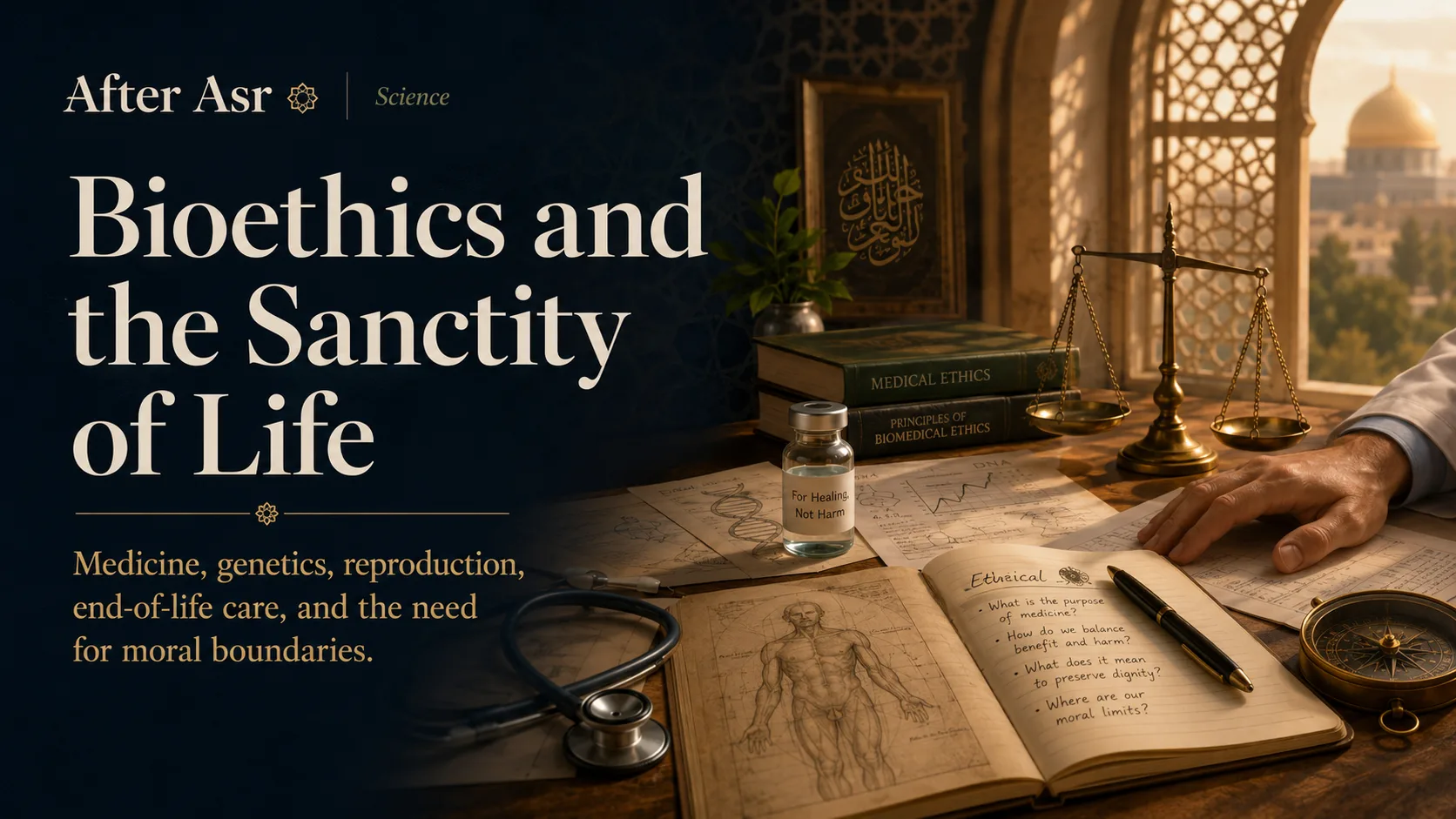
Medicine, genetics, reproduction, end-of-life care, and the need for moral boundaries
Medicine stands at the edge of human vulnerability.
It meets the newborn before language. It meets the mother in labor. It meets the injured body after accident. It meets the patient waiting for a diagnosis. It meets the person whose mind is breaking under distress. It meets the infertile couple longing for a child. It meets the elderly parent whose strength is fading. It meets the dying person between this world and the next.
Because medicine stands near life, suffering, birth, dependence, and death, it cannot be governed by technique alone.
The question is never only, “What can we do?”
It must also be, “What should we do?”
“What must we refuse to do?”
“Who is vulnerable here?”
“What dignity must be protected?”
“What belongs to healing, and what belongs to control?”
“What does mercy require?”
“What boundary should not be crossed, even when crossing it becomes possible?”
These are questions of bioethics.
Bioethics is the moral reflection required when human beings gain power over life and the body. It asks how medicine, genetics, reproduction, research, disability care, public health, mental health, and end-of-life decisions should be guided. It recognizes that scientific ability without moral boundaries can become dangerous, even when it begins with compassionate intentions.
For Muslims, bioethics begins with a profound truth: life is sacred because it belongs ultimately to God.
Human beings are entrusted with life. We do not own it absolutely. The body is not a disposable object, a consumer product, a machine to be endlessly optimized, or raw material for desire. It is an amanah. It carries dignity. It must be treated with reverence, mercy, and restraint.
This does not make Islam anti-medicine. The opposite is true. Healing is noble. Seeking treatment is honored. Reducing suffering matters. Caring for the sick is a communal and spiritual responsibility.
But mercy without boundaries can become harm.
And power without reverence can become cruelty.
Sanctity does not mean simplicity
To say that life is sacred does not mean every medical question becomes easy.
Bioethical questions are often difficult because they arise in moments of pain. A family wants to save a loved one. A patient wants relief. A couple longs for a child. A physician wants to help. A researcher wants to cure disease. A parent fears suffering for a newborn. A dying person fears becoming a burden.
These are not abstract puzzles. They are human situations filled with fear, hope, love, grief, and uncertainty.
The sanctity of life gives direction, but it does not erase complexity. It tells us that life must not be treated casually. It tells us that the vulnerable must not be discarded. It tells us that medicine must serve dignity. It tells us that death is not ours to manipulate as if we were owners of existence.
But applying these principles requires knowledge, scholarship, medical understanding, compassion, and careful judgment.
A slogan is not enough.
Bioethics requires both moral clarity and human tenderness. Without clarity, we may cross boundaries that should protect life. Without tenderness, we may speak truth in ways that crush people already suffering.
The sacredness of life should make us serious, not harsh.
Healing and control
Medicine is most beautiful when it heals.
A child receives antibiotics and survives infection. A patient receives surgery and regains function. A person in pain receives relief. A mother receives care during childbirth. A disabled person receives a device that improves mobility. A cancer patient receives treatment that extends meaningful life.
These are acts of mercy through knowledge.
But medicine can drift from healing into control.
Healing asks, “How can we care for this person’s body and dignity?”
Control asks, “How can we make life conform to our preferences?”
Healing accepts that the body is a trust. Control treats the body as a project. Healing works within moral limits. Control resents limits. Healing serves the vulnerable. Control may decide that some lives are not worth receiving, supporting, or protecting.
This distinction is especially important in genetics, reproduction, disability, aging, and end-of-life care.
When medicine seeks to heal disease, reduce pain, and restore function, it can be a form of mercy. But when medical power begins to sort lives by desirability, eliminate difference, commercialize reproduction, or treat dependence as indignity, something has shifted.
The question is no longer only medical.
It has become spiritual.
Genetics and the temptation to design
Genetic knowledge is one of the most powerful developments in modern science.
It can help diagnose disease, identify inherited risks, guide treatment, support families, and open paths toward therapies that once seemed impossible. For people carrying serious genetic conditions, this knowledge can be both frightening and merciful.
But genetics also carries temptation.
The more we learn about inherited traits, the more some may want to select, edit, rank, predict, or design human life according to preference. Disease prevention can begin to blur into enhancement. Compassion for suffering can begin to blur into rejection of people who live with disability. The child can begin to appear not as a gift to receive, but as an outcome to control.
This is ethically dangerous.
A society must ask: Are we treating genetic knowledge as a tool for healing, or as a tool for human selection? Are we supporting people with disabilities, or quietly suggesting their lives should have been prevented? Are we reducing children to traits? Are we allowing wealth to purchase biological advantage? Are we opening doors without knowing what future generations will inherit?
Genetics can reveal risk. It cannot determine human worth.
A person with a genetic condition is not a mistake. A disabled child is not a failed design. A body with vulnerability still carries dignity.
The sanctity of life means we must be very careful when our tools give us power before birth, before consent, and before the person affected can speak.
Reproduction and reverence
Reproduction is one of the most emotionally charged areas of bioethics because it touches longing, marriage, family, lineage, intimacy, loss, and the hope of children.
Infertility can be a deep grief. Couples who long for children may carry pain privately for years. Medical technologies that assist reproduction can offer real hope, and Islamic jurists have taken these questions seriously in many contexts.
But reproduction cannot be treated as mere consumer medicine.
The child is not a product. The womb is not simply a service. Lineage is not a technical detail. Marriage, parenthood, consent, embryo handling, donor material, surrogacy, commercialization, and custody of genetic material all raise serious moral questions.
A society that treats reproduction mainly through desire and market logic may lose reverence for the child.
The child becomes something ordered, selected, customized, frozen, transferred, purchased, or contractually arranged. The adults’ longing is real, and it deserves compassion. But the child’s dignity also matters. The rights of lineage matter. The dignity of women’s bodies matters. The moral structure of family matters.
Islamic bioethics does not approach reproduction only by asking what technology permits. It asks what protects nasab, dignity, marriage, the child, the mother, and the sacred trust of life.
This does not mean every reproductive technology is rejected. It means each must be examined carefully, not only medically, but morally.
Reverence asks us to slow down where desire wants speed.
Embryos, beginnings, and moral seriousness
Questions about embryos, pregnancy, and the beginning of life are among the most sensitive in bioethics.
They require care because they touch real people in painful circumstances: infertility, miscarriage, genetic disease, maternal danger, fetal anomalies, sexual violence, poverty, and fear. They also touch the moral status of developing human life.
A faithful approach must avoid both cruelty and casualness.
It should not speak about pregnancy as if women’s bodies, health, fear, and suffering do not matter. It should not speak about embryos as if they are mere material with no moral seriousness. It should not flatten complex cases into slogans. It should not allow political anger to replace scholarship, mercy, and careful judgment.
Islamic legal and ethical discussions around ensoulment, stages of development, necessity, maternal health, and exceptional circumstances are serious matters that require qualified scholarship. They are not topics for careless online certainty.
What should remain clear is this: developing life deserves reverence, and the people carrying difficult burdens deserve mercy.
Bioethics must protect both moral seriousness and human compassion.
When questions involve pregnancy, embryos, or fetal life, the tone itself becomes part of the ethics. People are often already grieving, afraid, or ashamed. They need truth, but truth carried with gentleness.
Research and the human subject
Medical progress often depends on research.
Clinical trials, observational studies, tissue samples, genetic databases, and patient records can help future patients. Research can reveal safer treatments, better diagnostics, and more effective care.
But research becomes unethical when people are treated as means rather than persons.
Consent matters. Understanding matters. Risk matters. Privacy matters. Fair selection matters. Community benefit matters. Historical abuse matters. The poor, imprisoned, disabled, institutionalized, desperate, or medically vulnerable must not become convenient subjects for the ambitions of the powerful.
A person who participates in research is not raw material for discovery.
They are a human being with dignity.
This is why ethical oversight, informed consent, transparency, and protections for vulnerable groups are essential. Science should not be allowed to excuse exploitation by invoking future benefit. A noble goal does not automatically purify an unjust method.
For Muslims, this is especially clear. The pursuit of beneficial knowledge is honorable, but benefit cannot be built on betrayal of amanah.
Human subjects are not instruments. They are souls.
Consent and its limits
Modern bioethics often places great emphasis on consent.
This is important. Patients should not be forced, deceived, or manipulated. They should understand risks, benefits, alternatives, and uncertainties. Their dignity requires that they not be treated as passive objects.
But consent alone does not settle every moral question.
A person may consent under pressure, poverty, desperation, emotional distress, misinformation, or lack of alternatives. A woman may “consent” to selling reproductive services because she has no economic security. A patient may “consent” to an experimental treatment because fear has narrowed their judgment. A worker may “consent” to health risks because refusal means unemployment.
Consent is necessary, but not always sufficient.
There are also acts a person may consent to that still raise moral concerns. Human dignity is not created entirely by individual preference. The body remains a trust even when the person wants to use it in ways that may violate that trust.
This is where Islamic ethics differs from purely individualistic frameworks. Autonomy matters, but autonomy is not absolute ownership. The human being is honored, but also accountable.
We are not free simply because we can choose. We are free in a deeper sense when our choices are rightly ordered before God.
Disability and the danger of selective compassion
Bioethics must be especially attentive to disability.
Modern societies often speak compassionately about preventing suffering, but sometimes that compassion hides fear of dependency, difference, and inconvenience. A disabled life may be spoken of as a burden before the person has even been welcomed. Families may receive more support in preventing disabled children than in caring for disabled children who are already alive.
This reveals a serious moral problem.
If a society offers testing but not support, screening but not accessibility, sympathy but not inclusion, then its compassion is selective.
Disabled people are not arguments in a bioethical debate. They are human beings with dignity, personality, worship, relationships, talents, struggles, and rights. Some suffer greatly. Some flourish with support. Many experience suffering not only from their condition, but from social neglect, inaccessible spaces, loneliness, poverty, and the assumption that their lives are less worthy.
Medicine should seek to treat disease and reduce suffering. But it must not teach society to despise the people who live with conditions medicine cannot remove.
The sanctity of life requires us to honor people whose bodies do not match our ideals of independence, productivity, beauty, or ease.
A community’s treatment of disabled people reveals whether it truly believes in dignity beyond utility.
Mental health, treatment, and dignity
Bioethics also includes mental health.
The mind can suffer in ways that are hidden, frightening, and deeply isolating. Depression, anxiety, psychosis, trauma, addiction, obsessive thoughts, and other conditions can affect worship, family, work, identity, and hope. Treatment may involve therapy, medication, social support, spiritual care, hospitalization, or crisis intervention.
Here too, medicine must be guided by dignity.
A person struggling mentally should not be reduced to symptoms, diagnosis, or risk. They should not be shamed as spiritually defective. They should not be abandoned because their suffering is difficult for others to understand. They also should not be treated only as a problem to manage.
Mental health care raises ethical questions around consent, capacity, medication, involuntary treatment, confidentiality, stigma, and the protection of life during crisis.
The sanctity of life requires seriousness when someone may harm themselves. It also requires tenderness. A person in despair needs protection, but also hope. They need safety, but also dignity. They need treatment, but also to be seen as more than their worst moment.
Muslim communities must become wiser here.
Faith, therapy, medicine, family support, and community mercy should not be treated as enemies. The person suffering needs a circle of care, not a battlefield of competing explanations.
End-of-life care and the meaning of mercy
End-of-life care is one of the most difficult areas of bioethics because it brings together pain, fear, family love, medical uncertainty, cost, hope, and grief.
Modern medicine can sometimes keep bodies alive in ways previous generations could not. Machines can breathe. Tubes can feed. Drugs can support blood pressure. Procedures can extend time. These abilities can be blessings when they support meaningful recovery.
But they also raise hard questions.
When is treatment beneficial?
When is it only prolonging suffering?
When does refusing burdensome treatment differ from causing death?
How should families decide when the patient cannot speak?
What does comfort care mean?
How do we honor life without treating death as a medical failure?
Islamic bioethics holds life sacred, but it does not require every possible intervention in every circumstance. There is a difference between seeking treatment and imagining that death can be defeated by machines. There is a difference between caring for the dying and abandoning them. There is a difference between allowing the natural process of death when treatment is futile and actively causing death.
These distinctions require qualified guidance.
But the moral center is clear: the dying person remains dignified. Pain should be relieved. Prayer and spiritual support matter. Family should be guided. Medical teams should communicate honestly. The patient should not be treated as a failed project because cure is no longer possible.
Mercy at the end of life does not mean control over death.
It means faithful care until death comes by the permission of God.
Euthanasia, despair, and the pressure to disappear
Modern debates about assisted dying often use the language of choice, dignity, and mercy.
These conversations must be approached with compassion because many people fear pain, loss of independence, dementia, loneliness, medical trauma, or becoming a burden. These fears are real. No one should mock them.
But the sanctity of life requires strong caution.
When a society accepts the idea that some lives may be ended as a solution to suffering, vulnerable people may begin to feel pressure to disappear. The elderly, disabled, chronically ill, depressed, poor, or isolated may wonder whether their continued existence is selfish. Families and healthcare systems under strain may unintentionally communicate that death is more convenient than care.
This is a grave moral danger.
The answer to suffering should be better care, not the removal of the sufferer. Better pain management. Better hospice. Better disability support. Better family support. Better mental health care. Better companionship. Better spiritual care. Better protection from abandonment.
Dignity does not require control over death.
Dignity requires that a person be honored even when dependent, weak, confused, disabled, or dying.
A society that cannot care well may begin to call death compassion.
Faith must resist that confusion.
Commercialization of the body
Bioethics must also confront the market.
Modern medicine and biotechnology exist within economic systems. Hospitals bill. Companies profit. Pharmaceuticals are priced. Fertility clinics advertise. Genetic tests are sold. Health data is collected. Wellness industries market hope. Cosmetic procedures sell insecurity. Supplements sell fear and control.
Some commerce in medicine is necessary. People must be paid. Research requires funding. Tools cost money. But when profit becomes the guiding logic, the body becomes vulnerable.
The patient becomes a customer.
The child becomes a product.
The womb becomes a service.
The gene becomes intellectual property.
The dying person becomes a revenue source.
The anxious person becomes a market.
The disabled body becomes a problem to monetize or erase.
This is dangerous.
The body should not be treated as an open field for extraction. Medical vulnerability must not be exploited. Hope must not be sold dishonestly. Fear must not be converted into profit.
Islamic ethics insists that trade must be governed by justice and lawful boundaries. Not everything people desire should be sold. Not every market should exist. Not every profitable medical service is morally sound.
The sanctity of life places limits on commerce.
Technology and the illusion of mastery
Bioethics is often difficult because technology gives the illusion of mastery.
If we can test, predict, edit, freeze, sustain, enhance, implant, automate, and monitor, we may begin to feel that life is becoming manageable on our terms. But life remains beyond us. Birth remains mysterious. Healing remains uncertain. Death remains certain. The soul remains beyond measurement.
Technology can serve life, but it cannot make us owners of life.
This distinction is essential.
A ventilator may support breathing, but it does not own breath. A fertility treatment may assist conception, but it does not make the child a possession. A genetic test may reveal risk, but it does not determine worth. A medical device may extend life, but it cannot answer what life is for.
When technology becomes powerful, humility must become stronger.
Otherwise, ability becomes arrogance.
Moral boundaries as mercy
Modern culture often treats boundaries as restrictions on compassion.
If a technology can reduce suffering, why limit it? If a person desires a procedure, why question it? If a family wants an intervention, why refuse? If a market exists, why regulate? If consent is given, why object?
But moral boundaries can be forms of mercy.
A boundary can protect the vulnerable from exploitation. It can protect children from being treated as products. It can protect women’s bodies from commercialization. It can protect the disabled from selective rejection. It can protect the dying from pressure. It can protect patients from false hope. It can protect researchers from sacrificing human dignity to ambition.
A boundary says: even here, where pain is real and desire is strong, the human being must not be violated.
Mercy without boundaries may soothe the immediate feeling while creating deeper harm.
Wisdom asks not only what relieves suffering now, but what kind of world a practice creates when normalized.
The need for scholars, physicians, and communities together
Bioethics cannot be handled responsibly by one group alone.
Physicians understand clinical realities. Scientists understand mechanisms and emerging possibilities. Islamic scholars understand sacred law, moral principles, and the tradition of ethical reasoning. Patients and families understand lived experience. Disabled people understand realities outsiders may miss. Communities understand social effects. Policy experts understand systems.
All are needed.
If scholars speak without medical understanding, they may answer questions too abstractly. If physicians speak without moral grounding, they may reduce ethics to preference or procedure. If patients are not heard, guidance may lack compassion. If communities are ignored, policies may fail in practice.
The future of Muslim bioethics requires serious collaboration.
Mosques, schools, hospitals, universities, and community organizations should create spaces where these questions can be studied before crisis arrives. Families should not first encounter bioethical complexity at the bedside, in a fertility clinic, during genetic testing, or in the ICU without guidance.
We need preparation.
Not fear, but preparation.
Adab at the bedside
Bioethics is not only about policies and rulings. It is also about adab.
How does the doctor speak to a frightened patient?
How does a family discuss a dying parent’s care?
How does a scholar answer a woman grieving a pregnancy complication?
How does a community support a disabled child?
How does a nurse preserve modesty and dignity during care?
How does a hospital make space for prayer?
How does a mosque respond to mental health crisis?
Ethics lives in tone, timing, privacy, tenderness, and respect.
A correct principle delivered harshly can wound. A compassionate tone without truth can mislead. The goal is both truth and mercy.
At the bedside, the human being is exposed. The body may be weak, undressed, dependent, medicated, confused, or in pain. Family members may be exhausted. Words spoken there carry unusual weight.
Bioethics must therefore be gentle in application.
The sanctity of life is not an abstract doctrine only. It is visible in how we touch the sick, speak to the infertile, comfort the dying, protect the disabled, and guide those facing impossible decisions.
Life as trust
At the heart of Islamic bioethics is the idea of trust.
The body is a trust.
Children are a trust.
Medical knowledge is a trust.
Genetic information is a trust.
Technology is a trust.
The dying person is a trust.
The disabled person is a trust.
The patient’s fear is a trust.
The doctor’s authority is a trust.
The scholar’s answer is a trust.
A trust is not handled however we wish.
It must be guarded, honored, and returned with care.
This understanding changes the tone of bioethics. We are not owners negotiating over property. We are trustees standing before sacred realities. We may intervene, treat, assist, and relieve suffering, but we do so within limits.
The limits are not there because life is cheap.
They are there because life is sacred.
A compassionate seriousness
Bioethics requires compassionate seriousness.
Seriousness without compassion becomes cold legalism.
Compassion without seriousness becomes boundaryless harm.
We need both.
We need to care about the couple longing for a child, and still ask what reproduction means. We need to care about the disabled person’s suffering, and still reject the idea that disability erases dignity. We need to care about the dying patient’s pain, and still refuse to treat death as a service. We need to care about scientific discovery, and still protect human subjects. We need to care about genetic disease, and still resist turning children into designs.
The sanctity of life does not make us indifferent to suffering.
It makes us more careful with how suffering is answered.
The future will ask harder questions
Bioethical questions will only become more complex.
Genetic editing, artificial wombs, reproductive technologies, organ transplantation, brain interfaces, AI-assisted diagnosis, longevity science, personalized medicine, embryo research, disability technologies, end-of-life systems, and health data surveillance will all raise questions previous generations could not have imagined in detail.
Muslim communities cannot afford to respond only after technologies become normal.
We need serious study now. We need scholars who understand science. We need scientists who respect sacred law and moral boundaries. We need Muslim physicians trained in both clinical excellence and ethical humility. We need public education that prepares families to ask better questions.
We also need courage.
The courage to embrace beneficial medicine.
The courage to reject harmful uses of technology.
The courage to comfort those in pain.
The courage to say no when no is mercy.
The courage to admit uncertainty.
The courage to protect life even when doing so is costly.
The boundary that protects the human
Bioethics exists because the human being is not merely biological material.
We are bodies, but not only bodies. We are patients, but not only cases. We are genetic beings, but not only genomes. We are mortal, but not meaningless. We are dependent, but not disposable. We are vulnerable, but not without dignity.
Medicine should serve this truth.
Genetics should serve this truth.
Reproductive care should serve this truth.
Research should serve this truth.
End-of-life care should serve this truth.
Public health should serve this truth.
Technology should serve this truth.
The sanctity of life does not answer every practical question automatically. It does something deeper. It establishes the moral atmosphere in which questions must be asked.
It tells us to slow down.
To protect the weak.
To refuse exploitation.
To honor the body.
To seek healing without worshiping control.
To comfort the dying without claiming ownership over death.
To welcome life without turning children into products.
To use knowledge with fear of God.
Human ability will continue to grow.
But if wisdom does not grow with it, medicine may become powerful without being merciful. Genetics may become precise without being reverent. Reproduction may become possible without being properly ordered. End-of-life care may become technologically advanced while spiritually impoverished.
The answer is not to fear science.
The answer is to place science beneath the sanctity of life.
To let healing remain healing.
To let mercy remain mercy.
To let boundaries protect what desire, profit, and fear might otherwise consume.
Life is sacred because it is not ours absolutely.
And because it is sacred, every hand that touches it, medical, scientific, parental, institutional, or political, must touch it with humility.