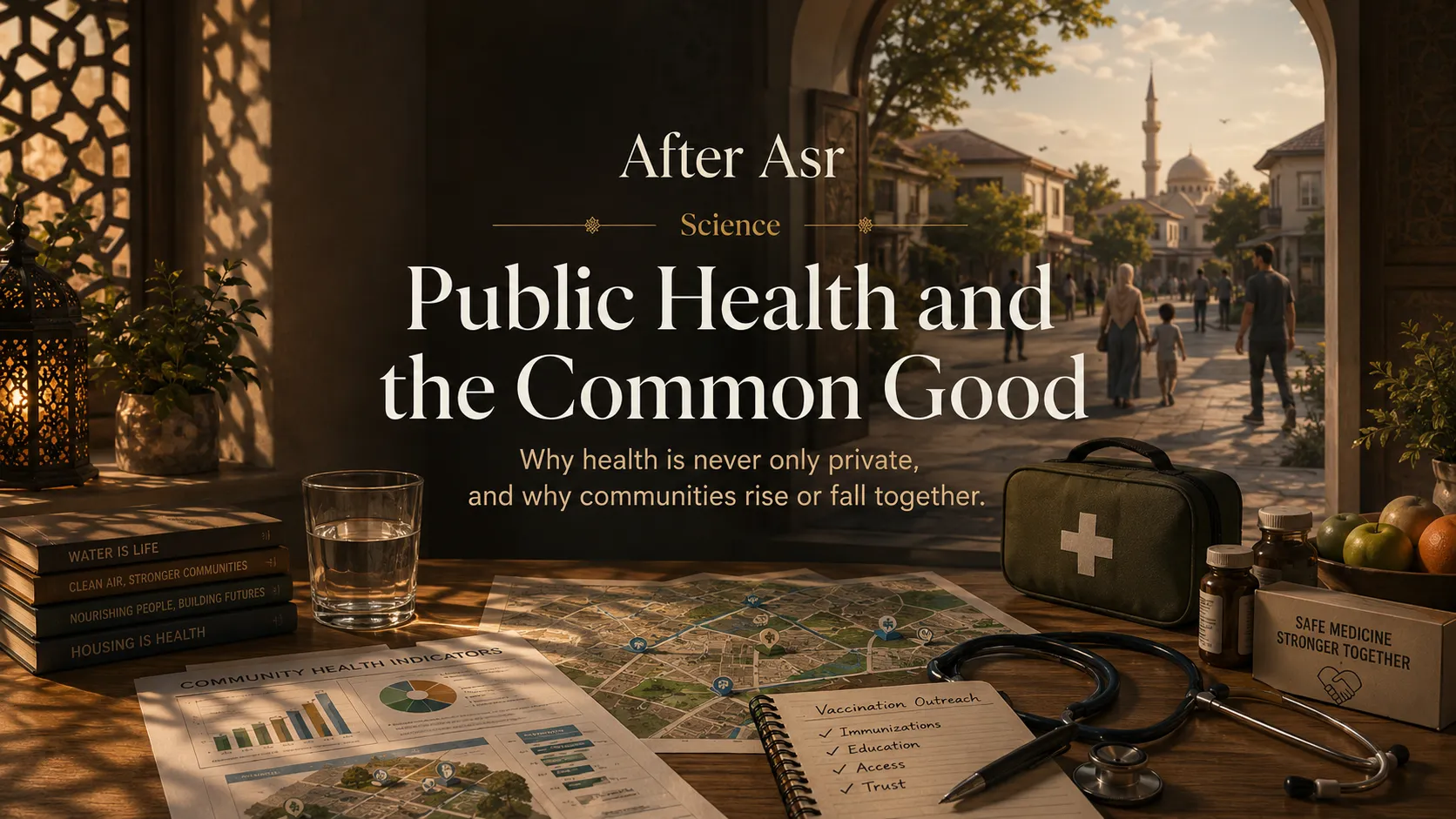
Why health is never only private, and why communities rise or fall together
Health feels personal because the body is personal.
The fever is in my child.
The diagnosis is in my chart.
The pain is in my back.
The medicine is in my cabinet.
The anxiety is in my chest.
The food is on my table.
The sleep I miss is my sleep.
The breath I struggle for is my breath.
Illness is intimate. It enters the home, the bedroom, the family schedule, the prayer routine, the bank account, the private fear of the heart. When a person is sick, it is their body that aches. Their life that slows. Their future that feels uncertain.
And yet health is never only private.
The water we drink is shared before it reaches the glass. The air we breathe moves across neighborhoods. The food we eat depends on farms, workers, transport, storage, inspection, and safety standards. Infectious disease moves through contact. Stress moves through families. Pollution settles unequally. Housing shapes asthma, sleep, injury, and mental health. Wages shape nutrition. Transportation shapes access to doctors. Public trust shapes whether people listen when danger comes.
The individual body lives inside a social body.
Public health begins with this recognition: we rise and fall together more than modern individualism wants to admit.
A society may tell people to take care of themselves, and there is truth in that. Personal responsibility matters. A person should care for the body, seek treatment, avoid reckless harm, eat with moderation, rest when possible, maintain hygiene, and act responsibly around others.
But personal responsibility is never the whole story.
A child cannot personally choose clean air if the neighborhood is polluted. A worker cannot personally choose rest if wages require exhaustion. A family cannot personally choose safe water if the system is contaminated. An elderly person cannot personally choose access to care if transportation is unavailable. A patient cannot personally choose affordable medicine if prices are impossible.
Public health asks what kind of world bodies are being asked to survive in.
The body is social before we admit it
Human beings are dependent from the beginning.
A newborn survives through care. A child grows through food, shelter, touch, language, protection, and community. Even the adult who feels independent depends on farmers, sanitation workers, nurses, road builders, pharmacists, teachers, engineers, grocery clerks, water systems, electrical grids, and countless people whose names are unknown.
The body is social before we admit it.
We breathe air affected by others. We share surfaces, roads, schools, workplaces, mosques, markets, clinics, and homes. Our habits affect those around us. Our illnesses can become someone else’s risk. Our neglect can become someone else’s burden. Our care can become someone else’s protection.
This is not a political slogan. It is biological reality.
The human body is porous. It exchanges with the world constantly. Breath, food, water, microbes, toxins, stress, touch, sleep, light, sound, and social connection all affect health. No one lives as a sealed unit.
Public health is the science and practice of taking that interconnection seriously.
It asks not only, “How do we treat this sick person?” but also, “Why are people becoming sick in this pattern? What conditions are producing harm? What can be prevented? Who is most exposed? What systems protect or endanger the body?”
Medicine often meets illness one person at a time.
Public health asks why the line outside the clinic is so long.
Clean water is public mercy
Few things show the meaning of public health more clearly than clean water.
A person may drink alone, but water is rarely a private achievement. Clean water depends on watersheds, pipes, treatment plants, testing, regulation, maintenance, engineering, funding, and honest public administration. It depends on people doing their work before crisis appears.
When clean water flows, life feels normal. When it fails, everything changes.
Cooking changes. Wudu changes. Bathing changes. Infant care changes. Laundry changes. Schools change. Hospitals change. Trust changes. The body becomes vulnerable through the most ordinary act of drinking.
Public health often succeeds so quietly that people forget it exists.
No one celebrates the absence of cholera in the sink. No one thanks the water treatment process each morning. No one thinks about microbial contamination when the tap works. But this hidden protection is one of the great achievements of applied science and civic responsibility.
Clean water is not only infrastructure. It is mercy made public.
And because water is shared, failure is never merely individual. A contaminated supply can harm thousands. Poor communities may be told to wait. Children may carry damage in their bodies long after officials move on. Families may be forced to buy bottled water while still paying for unsafe systems.
Public health teaches that the most ordinary blessings require collective trust.
If water is a trust, then neglecting it is not merely technical failure. It is moral failure.
Air belongs to everyone
Air is even more difficult to privatize than water.
We breathe what surrounds us. We cannot choose an entirely separate atmosphere. The child with asthma near a highway, the elderly person during a heat wave, the worker exposed to fumes, the family living near industry, the city breathing wildfire smoke, all reveal the same truth: air is shared.
Air pollution is a public health issue because it moves invisibly into the body.
It can affect lungs, heart, pregnancy outcomes, childhood development, and long-term disease risk. Yet because it is often unseen, it can be denied more easily. A person may not notice the harm until it accumulates. A community may be told its concerns are exaggerated until data confirms what bodies were already reporting.
Public health makes invisible harm visible.
It measures, compares, maps, and warns. It asks why some neighborhoods breathe cleaner air than others. It asks why some children carry inhalers while others do not. It asks which industries benefit from emissions and which families pay the cost.
This is where public health becomes justice.
Air belongs to everyone, but dirty air is not distributed equally. Wealth can purchase distance from some harms. Poverty often means living closer to highways, factories, waste sites, unsafe housing, or heat-trapping environments.
A society’s air reveals its ethics.
If some people are expected to breathe what others would never tolerate, the issue is not only environmental. It is spiritual.
Disease travels through relationships
Infectious disease exposes interdependence quickly.
A virus, bacteria, or parasite does not respect the boundary between “my health” and “your health.” It moves through contact, water, air, food, insects, travel, workplaces, schools, homes, hospitals, prisons, shelters, and gatherings. One person’s illness may become another person’s danger. One community’s outbreak may become a regional concern.
This does not mean people should live in constant fear of one another.
Human beings need closeness. We need prayer in congregation, meals, visits, hugs, school, work, weddings, funerals, and shared life. Public health is not a call to suspicion of the human body. It is a call to responsible care when bodies can affect one another.
Hygiene, vaccination, ventilation, sick leave, testing, treatment, quarantine when necessary, and honest communication are all ways communities protect one another.
Some of these practices require personal action. Others require systems. It is difficult for a worker to stay home when sick if staying home means losing wages. It is difficult for a parent to isolate a child in overcrowded housing. It is difficult to follow medical advice when healthcare is unaffordable. It is difficult to trust guidance when institutions have spoken arrogantly or inconsistently.
Public health must therefore understand both biology and social reality.
A disease may spread through microbes, but its impact is shaped by poverty, housing, labor, trust, healthcare access, education, and community norms.
To fight disease well, we must treat people as whole human beings, not merely transmission points.
Trust is a public health resource
Trust saves lives.
People are more likely to follow warnings, seek care, accept treatment, report symptoms, evacuate danger, and protect others when they trust the messenger. Trust is not sentimental. It is practical infrastructure.
A community with trust can respond faster in crisis. A community without trust may hesitate, argue, hide, deny, or turn to unreliable voices. This can happen even when the scientific guidance is sound.
Trust must be earned before emergency.
It is built through honesty, respect, consistency, listening, and accountability. A hospital builds trust by treating patients with dignity. A public health agency builds trust by explaining uncertainty. A mosque builds trust by caring for people before asking them to listen. A school builds trust by communicating clearly with families. A government builds trust by admitting mistakes and protecting the vulnerable.
Trust is damaged when people are dismissed, lied to, experimented on, over-policed, ignored, or treated as ignorant obstacles.
Public health cannot simply demand trust after institutions have failed to be trustworthy.
This is especially important for communities with histories of medical neglect, discrimination, poverty, or government abuse. Their skepticism may not be irrational. It may be memory.
The answer is not contempt. The answer is trustworthy conduct.
Public health communication must tell the truth, but it must also repair relationships.
The mosque as a place of public health
The mosque is not only a place of worship. It is a place where bodies gather.
People stand shoulder to shoulder. They wash for prayer. They share meals. They bring children. They visit elders. They gather during Ramadan. They attend janazah prayers. They seek advice during crisis. They bring grief, illness, loneliness, and need into the community.
Because the mosque gathers bodies and hearts, it has a public health role.
This does not mean the mosque becomes a clinic. It means Muslim communities should take health seriously as part of communal care.
A mosque can promote cleanliness without harshness. It can encourage people to stay home when contagious without shaming them. It can support elders during heat waves or storms. It can host health screenings, mental health workshops, blood drives, vaccination clinics, nutrition education, or first aid training when appropriate. It can teach moderation in eating during community meals. It can reduce food waste. It can make spaces accessible for disabled worshipers. It can check on the lonely.
The mosque can also help translate public health guidance into trusted language.
People may listen differently when guidance is explained by someone who understands their faith, family structure, concerns, and obligations. For example, fasting with illness, prayer modifications, end-of-life care, mental health stigma, and community gatherings all require both scientific and religious sensitivity.
A mosque that cares for public health is not becoming less spiritual.
It is recognizing that bodies are part of the trust.
Hygiene as dignity and responsibility
Islam gives great attention to cleanliness.
Wudu, ghusl, washing hands, care with food, cleanliness of clothing and prayer space, and the general adab of bodily purity all shape Muslim life. These practices are not identical to modern public health, but they create habits that can support it.
Cleanliness is personal dignity. It is also communal responsibility.
A person who washes, handles food safely, covers coughs, disposes of waste properly, cleans shared spaces, and avoids spreading illness protects others. The body’s hygiene becomes part of the community’s safety.
But hygiene should never become a tool for humiliating the poor or sick.
Public health must distinguish between moral negligence and lack of access. It is easy to tell people to wash hands when they have clean water, soap, safe bathrooms, and stable housing. It is harder for those living in homelessness, overcrowded housing, unsafe workplaces, or neglected institutions.
A just public health approach does not merely shame people for hygiene failures. It asks whether the conditions for cleanliness are available.
Cleanliness is an Islamic value, but making cleanliness possible for people is also a communal obligation.
Food, hunger, and shared health
Food is often treated as a private choice.
Eat better. Buy better. Cook better. Exercise more discipline. Again, personal choices matter. But food is also public health.
What food is available in a neighborhood? What can families afford? How much time do workers have to cook? What do schools serve children? How are foods marketed? What chemicals are used in production? What wages are paid to farmworkers and restaurant workers? How safe are kitchens? How much food is wasted while families go hungry?
Nutrition is not only about willpower.
A family living near fresh grocery options, with stable income, time to cook, safe housing, and nutrition education faces different choices from a family surrounded by cheap ultra-processed foods, unstable work schedules, transportation barriers, and stress.
Public health asks how food systems shape bodies.
It also asks about hunger. Hunger is not only an economic issue. It affects learning, immunity, pregnancy, mood, chronic disease, and dignity. A hungry child is not simply lacking calories. Their future is being shaped.
For Muslims, food carries spiritual significance: halal, tayyib, gratitude, moderation, hospitality, feeding the hungry, avoiding waste. Public health brings these values into social focus.
A community that hosts lavish meals while neighbors go hungry has misunderstood something.
Health rises when food is safe, nourishing, accessible, and shared with dignity.
Housing is health
A home is not just shelter. It is a health environment.
Mold can worsen asthma. Overcrowding can spread infection. Poor heating or cooling can endanger elders and infants. Unsafe wiring can cause fires. Lead exposure can affect children. Noise can disturb sleep. Violence can shape trauma. Housing instability can disrupt medicine, schooling, food, and mental health.
Public health cannot ignore housing.
A doctor may treat asthma again and again, but if the child returns to mold, the treatment is incomplete. A therapist may help with anxiety, but if a family faces eviction, the body remains under threat. A public health worker may recommend rest, but a person sleeping in unsafe conditions cannot simply choose peace.
Housing policy is health policy.
This may feel far from science, but it is not. Public health connects conditions to outcomes. It studies how the built environment affects bodies. It shows that walls, ventilation, crowding, temperature, and neighborhood safety are not separate from medicine.
A society that treats housing only as a market commodity will eventually see the consequences in hospitals, schools, and family life.
The body needs a place to be safe.
Mental health and the communal atmosphere
Mental health is often spoken of as private.
But despair, loneliness, anxiety, trauma, addiction, and burnout are also shaped by social conditions. Work demands, family instability, racism, poverty, digital overload, war, displacement, isolation, spiritual emptiness, and lack of community all affect the mind and body.
A person’s inner suffering is real, but it does not appear from nowhere.
Public health asks what conditions make emotional suffering more common. It asks why loneliness is rising. It asks how work structures affect stress. It asks how social media shapes comparison and attention. It asks how trauma spreads across families. It asks how communities can create belonging.
Muslim communities must take this seriously.
A person struggling with mental health should not be dismissed as simply weak in iman. Faith matters deeply, but human beings are embodied and socially formed. Spiritual care, therapy, medicine, friendship, rest, and practical support may all be needed.
The community atmosphere itself can heal or harm.
A mosque that shames people may worsen isolation. A family that refuses to listen may deepen pain. A community that makes room for converts, disabled people, elders, youth, single people, grieving people, and those struggling quietly may become a place of mercy.
Mental health is not only the work of professionals. It is also shaped by whether communities know how to be gentle.
Public health and the poor
Public health reveals inequality because disease often follows social fault lines.
The poor may face higher exposure to environmental harm, less access to care, more dangerous work, poorer housing, less nutritious food, more stress, and fewer opportunities for rest. When illness comes, they may delay care because of cost. When treatment is prescribed, they may struggle to afford it. When public guidance is issued, they may lack the conditions to follow it easily.
Then society may blame them for worse health outcomes.
This is unjust.
Personal responsibility does not disappear in poverty. But responsibility must be understood in context. It is cruel to demand healthy choices while building unhealthy environments around people.
Public health asks what makes health easier for some and harder for others.
This question is deeply Islamic. The poor are not an afterthought in moral life. The vulnerable are not statistical noise. The sick, hungry, indebted, displaced, elderly, orphaned, and marginalized all carry claims upon the community.
If health is shared, then inequality is not someone else’s problem. It becomes part of the moral condition of the whole society.
A community cannot call itself healthy while abandoning those whose bodies carry the cost of its comfort.
Prevention is less visible than rescue
Public health often struggles because prevention is invisible when it works.
A disease that never spreads does not make headlines. A child who never gets lead poisoning may never know who protected them. A road redesign that prevents crashes receives less attention than an emergency response after tragedy. Clean water, safe food, vaccination, sanitation, ventilation, and early screening all work partly by preventing stories from becoming dramatic.
Human beings often praise rescue more than prevention.
Rescue is visible. Prevention is quiet.
But prevention is one of the highest forms of mercy. It stops suffering before it begins. It protects people who may never know they were protected. It requires foresight, patience, investment, and care for future consequences.
This is spiritually beautiful.
Many good deeds are unseen. Public health is full of unseen service: inspectors, epidemiologists, nurses, sanitation workers, lab technicians, health educators, community organizers, and planners whose work may be noticed only when it fails.
A mature society honors prevention.
It does not wait for crisis to value health.
Individual freedom and communal responsibility
Public health often raises difficult questions about freedom.
How much should individuals be allowed to choose when their choices affect others? When should public safety limit private behavior? How should policies balance liberty, risk, religious practice, economic need, and protection of the vulnerable?
These questions are not always easy.
A society that ignores individual freedom can become coercive and abusive. A society that treats freedom as absolute individual preference can become careless and cruel. Public health lives in the tension between personal liberty and shared vulnerability.
Islamic ethics offers a useful frame: rights and responsibilities belong together.
The individual matters. The community matters. Harm matters. Intention matters. Capacity matters. The vulnerable matter. Freedom is not permission to harm others. Communal responsibility is not permission for unchecked power.
A person may have private choices, but when those choices endanger others, they become public concerns. A business may seek profit, but if it pollutes water or exploits workers, its actions are not merely private. A family may make health choices, but if misinformation spreads harm, the community is affected.
Public health asks us to grow beyond selfish freedom into responsible freedom.
A mature person does not ask only, “What do I want?”
They ask, “What do I owe?”
The common good is not the enemy of the person
Some people fear the language of the common good because they think it erases the individual.
It can, if misused. Governments and institutions have sometimes harmed individuals in the name of society. Public health must be careful to protect dignity, consent, rights, religious freedom, and accountability.
But the common good, properly understood, is not the enemy of the person.
It is the set of shared conditions that allow persons to flourish.
Clean water, safe housing, disease prevention, trustworthy medicine, public safety, accessible education, reliable information, healthy food systems, and protection from pollution are not abstractions. They serve actual people.
A society that neglects the common good does not produce freedom. It often produces private suffering.
The wealthy may buy partial protection, but the poor are left exposed. Families are told to solve systemic problems alone. Doctors treat preventable disease repeatedly. Schools struggle with the effects of hunger and trauma. Communities lose trust.
The common good matters because human beings are not isolated souls floating above material life.
We are embodied, social, and accountable to one another.
Public health as amanah
Public health is an amanah because it concerns shared trusts.
Water is a trust.
Air is a trust.
Food systems are a trust.
Medical knowledge is a trust.
Public communication is a trust.
Community spaces are a trust.
The vulnerable body is a trust.
The future generation is a trust.
Those who hold power over these trusts are accountable.
Government officials, physicians, researchers, school leaders, mosque boards, business owners, landlords, food producers, technology designers, journalists, parents, and ordinary citizens all participate in the health of the community in different ways.
The more power a person has, the heavier the trust.
A landlord who ignores mold affects health. A factory that pollutes affects health. A public official who hides risk affects health. A journalist who spreads panic affects health. A religious leader who dismisses medicine carelessly affects health. A parent who refuses basic safety affects health. A community that abandons elders affects health.
Public health is not only science. It is moral ecology.
It asks whether we are caring for the conditions through which life is sustained.
Learning from crisis without living in crisis
Public health often becomes visible during crisis: pandemics, outbreaks, natural disasters, contamination, heat waves, food recalls, hospital overload, or sudden tragedy.
Crisis can teach. It exposes weaknesses. It reveals who is vulnerable. It shows whether institutions are trusted. It reveals whether communities can organize care. It shows whether leaders communicate honestly.
But we should not need crisis to care.
A wise society learns from crisis, then builds before the next one. It strengthens public health systems, supports healthcare workers, prepares for disasters, protects water and air, addresses inequality, and builds community trust.
Living in constant crisis mode exhausts people. Ignoring lessons after crisis dishonors those who suffered.
The better path is sober preparation.
For believers, preparation is not fearfulness. It is responsibility. The Prophet ﷺ taught taking means seriously. Trust in God does not require neglecting planning, prevention, or care.
We do not prepare because we control the future.
We prepare because responsibility belongs to us, while outcomes belong to God.
What communities can do
Public health can feel large and institutional, but communities have real roles.
A mosque can organize wellness checks for elders during heat waves or storms. Families can reduce food waste and share meals. Schools can teach hygiene, nutrition, and scientific literacy. Community leaders can invite trusted health professionals to speak. Neighbors can check on the isolated. Volunteers can help people access clinics, transportation, or forms. Youth groups can clean shared spaces. Local organizations can advocate for safe housing, clean water, and accessible care.
These actions may not solve every structural problem, but they matter.
They also form people.
A community that practices care becomes more capable of care. A community that teaches children to think about others becomes less selfish. A community that builds trust before crisis becomes stronger during crisis.
Public health is not only what officials do.
It is also how neighbors live with one another.
The spiritual health of public life
Public health is not the same as spiritual health, but the two are not unrelated.
A society that is greedy may tolerate unsafe labor. A society that is arrogant may ignore the poor. A society that is addicted to convenience may damage the earth. A society that lacks mercy may abandon the elderly. A society that worships profit may price medicine beyond reach. A society that loves spectacle may spread panic faster than truth.
Physical health is shaped by moral conditions.
This does not mean illness is always caused by sin, or that sick people are morally at fault. That would be cruel and false. But communal moral failure can create public health harm.
If leaders lie, people may die.
If companies exploit, bodies may suffer.
If communities shame the sick, people may hide illness.
If families neglect elders, frailty becomes abandonment.
If societies waste food, hunger remains near abundance.
If institutions ignore pollution, children carry the damage.
Public health shows that morality enters the body through systems.
Faith must therefore care about public health, not as a replacement for worship, but as part of the trust of communal life.
Health as shared mercy
The healthiest communities are not those where no one ever gets sick.
That is impossible.
A healthy community is one where illness is not hidden by shame, where the vulnerable are protected, where public systems are trustworthy, where knowledge is communicated clearly, where prevention is valued, where the poor are not abandoned, where elders are checked on, where children breathe clean air, where food and water are safe, where medicine is treated as a trust, and where people understand that their choices affect others.
Health is shared mercy.
It is the clean water someone maintained before you drank.
The vaccine that reduced disease before your child was exposed.
The food safety rule that prevented an outbreak.
The neighbor who stayed home while contagious.
The mosque volunteer who checked on an elder.
The public warning that arrived in time.
The doctor who explained clearly.
The sanitation worker whose labor prevented disease.
The policy that reduced harm for people you may never meet.
Much of public health is love made practical through systems.
We rise and fall together
The idea that health is purely private is comforting because it limits responsibility.
It allows the healthy to imagine they are self-made. It allows the wealthy to imagine their safety is separate. It allows societies to blame the sick without examining conditions. It allows people to ignore harms that have not yet reached their own homes.
But biology tells the truth.
Breath is shared. Water is shared. Food systems are shared. Disease pathways are shared. Environmental conditions are shared. Trust is shared. Vulnerability is shared.
We rise and fall together.
This does not erase individual responsibility. It deepens it. Personal choices matter more, not less, because they are connected to others. Public systems matter more, not less, because they shape private bodies. Moral formation matters more, not less, because selfishness can become illness when scaled across society.
For the believer, this is not surprising.
The ummah is not merely a collection of isolated individuals. Neighbor has rights. The sick have rights. The poor have rights. The body has rights. The road has rights. The environment carries trust. Harm must be prevented where possible. Mercy must become action.
Public health gives scientific language to something faith has long taught: we are responsible for one another.
The question is whether we will live as if that is true.
Will we protect water before it fails?
Will we clean air before children gasp?
Will we care for the sick before crisis exposes neglect?
Will we build trust before fear spreads?
Will we feed people before hunger becomes visible?
Will we design communities where health is possible, not merely advise individuals to survive unhealthy conditions?
Health is never only private.
It is written into the spaces between us: the pipes, roads, kitchens, clinics, classrooms, mosques, policies, habits, words, wages, and acts of care that shape whether bodies flourish or suffer.
A society that understands this becomes more humble.
A community that acts on it becomes more merciful.
And a believer who sees it clearly remembers that the body is a trust, the neighbor is a trust, and the common good is not an abstraction.
It is the shared field where our care for one another becomes visible before God.