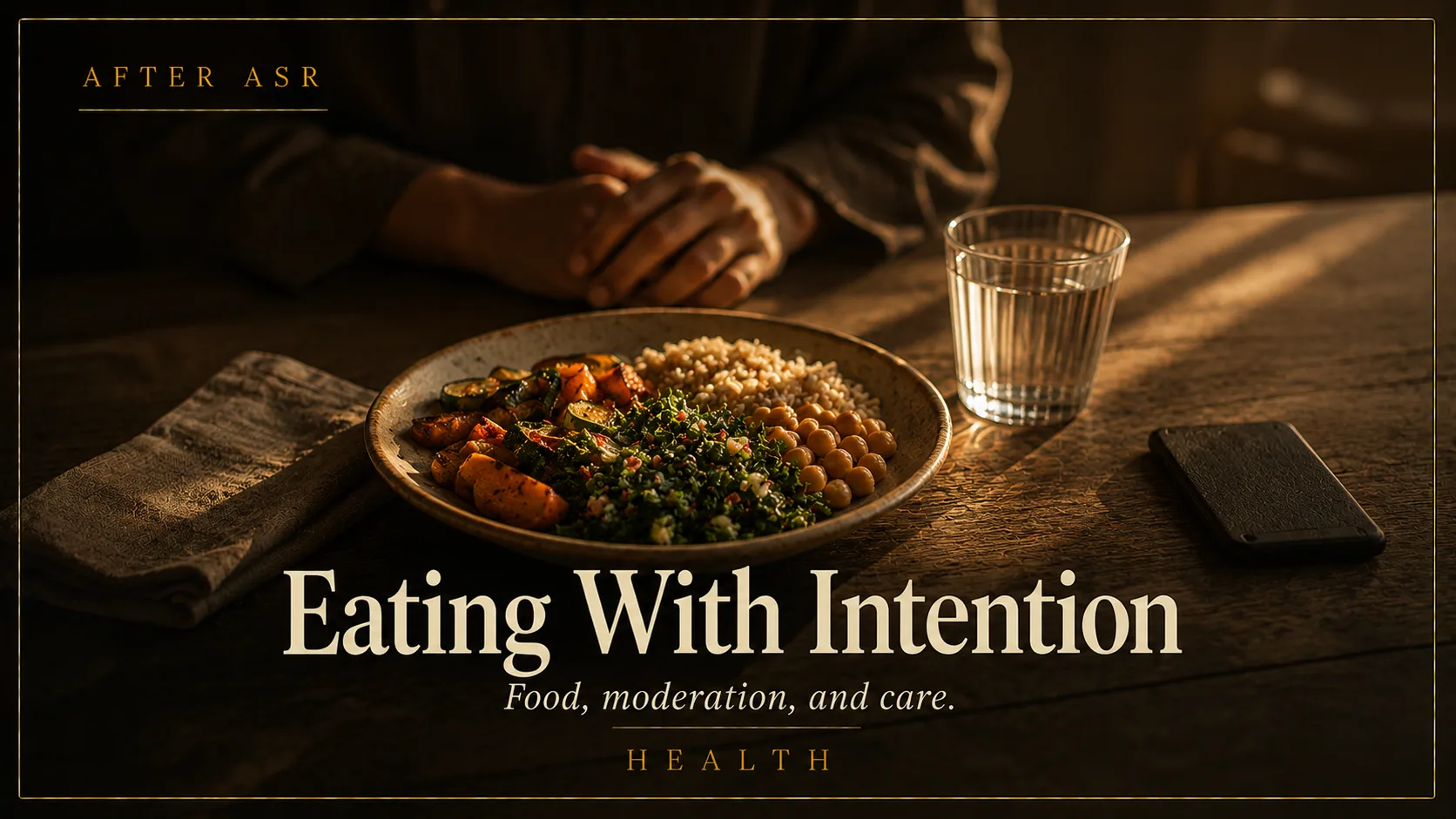
Half the meals I eat, I do not remember eating. A plate is filled, and then it is empty, and somewhere in between a phone was in my other hand and a screen held my eyes, and the food went in unnoticed, the way you might pass a whole exit on the highway without seeing it. The body was fed. But I was not there for it.
We eat, most of us, several times a day, and we are barely present for any of it.
We Eat Without Noticing
Eating has become something we do while doing something else. We eat over the sink, in the car, at the desk, in front of the screen, hands moving on their own while our attention is anywhere but the food. The meal has been demoted from an event to a background task, squeezed into the margins of busier things.
Something is lost in this, and it is not only pleasure. When we do not notice our food, we do not notice our fullness either. We eat past the point the body asked us to stop, because we were not listening when it spoke. We miss the taste, the gratitude, the small daily miracle of being fed. The unnoticed meal feeds the body and starves everything else the table was meant to hold. To eat with intention is, first, simply to be present for the eating.
Intention Turns a Meal Into an Act
In our tradition, an act becomes meaningful through the intention behind it. The same motion of the body, done thoughtlessly, is one thing, and done with awareness, is another entirely. Eating is no exception. A meal swallowed on autopilot is mere refueling. The same meal, taken with a moment of intention, becomes an act of care, of gratitude, of keeping the body that keeps you.
This is the quiet power of niyyah, of setting the heart toward something before doing it. You need not make it elaborate. A breath before the first bite. A moment of remembering where the food came from and Who provided it. That small turn of attention transforms the plate from a chore into a practice. Nothing about the food changes. Everything about the eating does.
Beginning With a Name
We are taught to begin the meal by saying the name of God. It is a small phrase, uttered so habitually that it can lose its meaning, worn smooth by repetition. But it was placed at the start of the meal for a reason. It is a doorway. It marks the moment as belonging to something larger, and it draws the wandering mind back to the table before the first bite is taken.
To say bismillah with attention is to begin eating as a person, not as a machine. It is the difference between falling upon food and receiving it. The phrase asks nothing difficult of us, only that we pause, for the length of three words, and remember that this meal is a gift and not a given. Said that way, the oldest habit becomes new again, and the ordinary plate is lifted into something worth being present for.
The Stomach in Thirds
The Prophet, peace be upon him, offered a picture of eating so simple it has never needed improving. He described the son of Adam filling no worse vessel than his stomach, and said that if one must fill it, let it be a third for food, a third for drink, and a third for breath. It is one of the most humane instructions ever given about the table.
Notice what it does not do. It does not count, or measure, or forbid. It does not turn the meal into arithmetic. It simply leaves room. A third for air, it says, room to breathe, room to rise from the table light rather than heavy. This is moderation offered not as restriction but as comfort, a way of eating that leaves the body able to move and pray and rest afterward. It is wisdom shaped like mercy.
The Cup Beside the Plate
We speak of eating and forget the drinking, though the Prophet’s picture gave the two equal weight, a third and a third. Water is the quietest of our foods, and the most neglected. We go about our days half thirsty without noticing, mistaking the body’s plea for water as hunger, or fatigue, or a headache we cannot explain. The body asks for water in a voice we have learned to ignore.
To eat with intention includes the humble cup beside the plate. There is a Prophetic manner even here, to drink in unhurried sips rather than gulping, to pause and breathe, to receive the water as the mercy it is. We are made mostly of water, and we forget it, and the body pays the small daily price of our forgetting. Attention to the cup is part of attention to the body. The simplest act of care is often just to drink, slowly, when the body asks.
Moderation Is Not Deprivation
We have confused moderation with denial, and the confusion has cost us. To eat moderately, we imagine, is to eat sadly, to push away the plate while still hungry, to live under a permanent regime of less. No wonder we resist it. Framed that way, moderation is a punishment.
But the moderation our tradition teaches is not deprivation. It is the art of stopping while the food still tastes good, rather than eating until it does not. It is leaving the table satisfied rather than stuffed. There is more pleasure in this, not less. The one who eats to heaviness spends the next hour paying for it. The one who eats to enough rises light and grateful, and looks forward, cleanly, to the next meal. Moderation is not the enemy of enjoyment. It is how enjoyment is made to last.
Hunger Is a Teacher
We are so quick to erase hunger that we have forgotten what it teaches. The moment the stomach speaks, we silence it, and so we never sit with the sensation long enough to learn from it. But a little hunger, felt on purpose, is one of the oldest schools of the soul. It is why we fast.
Hunger reminds us that we are dependent creatures, that we do not sustain ourselves, that the food which will come is a mercy and not a right. It sharpens gratitude to a fine point. The person who has felt real hunger tastes the meal differently, receives it as the gift it is. I do not romanticize going without, which for many is not a choice. But the small, deliberate hunger before a meal, unmedicated by constant snacking, returns the food to us as something wondrous. Hunger is the appetite the table was made to answer.
Fullness and Enough Are Not the Same
There is a point at which the body has had enough, and a later point at which it feels full, and the space between them is where most of our overeating lives. Fullness arrives slowly, after the signal of enough has already been sent, so that by the time we feel it, we have usually gone past what we needed. The body asks us to stop before it can prove that we should have.
Learning to eat with intention is, in large part, learning to honor enough without waiting for full. This takes a kind of trust, a willingness to set down the fork on the body’s quieter word rather than its louder one. It is not a diet and it is not a rule. It is simply attention, the same attention that hears the jaw clench or the breath shorten, turned now toward the table. Enough is a gentler master than full, and it keeps the body far better.
Eating Slowly Is Its Own Discipline
Speed is the enemy of the intentional meal. When we eat fast, we outrun every signal the body sends, finishing before the stomach has had time to report that it is satisfied. We taste less, digest worse, and eat more, all in the name of getting the meal over with so we can return to the tasks that seemed more important.
To eat slowly is a small discipline with large returns. It is not a technique to be perfected but a pace to be chosen, a decision to let the meal take the time a meal deserves. Chew. Set the fork down between bites. Speak with the people at the table. Let the food be an event rather than an interruption. The slow meal feeds the body better and the spirit besides. Hurry belongs to many parts of our lives. It does not belong at the table.
Gratitude Changes the Taste
Food tastes different when you are grateful for it. This is not sentiment; it is nearly a physical fact. The same bread, received with thanks, is richer than the bread taken for granted. Gratitude is a kind of seasoning, invisible and free, that we have mostly stopped using.
To eat with intention is to remember, even briefly, the long chain of mercy that put the food on the plate. The rain, the soil, the hands that planted and harvested and carried and cooked. The provision of a Lord who did not have to feed you and did. Held in that light, the plainest meal becomes a marvel. We end the meal, too, with thanks, praising the One who fed us and gave us drink. The gratitude at both ends of the meal is not a formality. It is what turns eating from consumption into communion.
The Table Is Meant to Be Shared
Food was never meant to be a solitary transaction. The table is a gathering place, and the meal is at its best when it is shared. The Prophet, peace be upon him, said that the food of one is enough for two, and the food of two enough for four, teaching us that a shared meal expands rather than divides. There is more than nourishment at a shared table. There is belonging.
We have let eating grow lonely. We take our plates to separate rooms, eat at different hours, treat the family meal as a luxury rather than a practice. But something happens at a table where people sit together that happens nowhere else. Bonds are fed there alongside bodies. To eat with intention includes the intention to eat with others when we can, to keep the table as a place of gathering and not only of fueling. The shared meal is one of the great, ordinary graces of a human life.
Feeding Others Is a Kind of Worship
To cook for another person is to love them with your hands. It is one of the humblest and most concrete forms of care we have, and one of the most undervalued. The one who prepares the meal, who thinks ahead about what will nourish and please, who stands over the pot while others rest, is performing a quiet service that holds families and communities together.
Our tradition honors this. Feeding the hungry, feeding the guest, feeding the neighbor, these are not small acts but central ones, praised again and again. There is worship in the food carried to the grieving, the extra plate set for the stranger, the meal made for someone too tired to make their own. To eat with intention is also to feed with intention, to see the labor of the kitchen as the sacred work it is. Whoever fills a stomach in need has done something that lasts.
The Barakah in Not Wasting
To eat with intention is also to waste less. We have grown careless with food in a way our grandparents would not recognize, filling plates beyond what we can finish and scraping the excess into the bin without a thought. Somewhere in that carelessness, something is lost that is more than money. It is a certain reverence for provision that is not ours to squander.
Our tradition treats food as a thing carrying barakah, blessing, to be honored and not thrown away. We are taught to take only what we will eat, to finish what is before us, to gather even the fallen morsel rather than leave it. This is not stinginess. It is respect for a gift, and awareness of the many who would be grateful for what we discard. To waste less is to eat as though the food mattered, because it does. The plate cleaned with gratitude is worth more than the plate abandoned half full.
We Do Not Shame the Appetite
In all of this, I want to be careful, because talk of eating quickly curdles into shame, and shame has ruined more tables than excess ever did. Around us is a whole industry built on making people feel wrong about their hunger, their bodies, their plates. It calls itself health and it is often the opposite. I want no part of it here.
The appetite is not a flaw to be conquered. It is a gift, part of how the body keeps itself alive and part of how we take pleasure in the world. To eat with intention is not to wage war on your hunger or to earn your food through guilt. It is to eat as a whole person, with gratitude and attention and reasonable measure, and then to let the meal go without a second thought. If any of this becomes another rod to beat yourself with, set it down. The table should never be a place of self-punishment.
Food Is Not the Enemy, and Not the Answer
Food carries too much weight in our imaginations, in both directions. For some it becomes the enemy, a danger to be controlled, every plate a small battle. For others it becomes the answer, the thing reached for whenever the heart is heavy, comfort taken by the forkful. Neither is the truth of it.
Food is a provision, no more and no less. It is meant to feed the body and gladden the heart in decent measure, not to bear the burden of our anxieties or to soothe every ache we cannot name. When we ask food to be our medicine for loneliness or our enemy in a war against ourselves, we misuse it, and it fails us, because it was never meant for either role. Returned to its proper place, food becomes simple again. A mercy, taken with thanks, and then set aside.
Eating Well Enough
You do not have to eat perfectly. There is no perfect way to eat, whatever the loudest voices insist. There is only eating well enough, most of the time, with attention and gratitude and reasonable measure, and leaving room for the joyful excess of a feast, a celebration, a mother’s table piled too high with love.
Well enough is a generous standard, and a livable one. It permits the birthday cake and the holiday spread and the second helping among people you love. It asks only that the ordinary meals, the daily ones, be taken with some care and some presence. A life of eating well enough is a life at peace with the table, neither at war with it nor enslaved to it. That peace is worth far more than any perfect plate.
Be There for the Meal
So put down the phone. Say the name before the first bite. Taste the food you are eating while you are eating it.
Leave a little room. Rise a little light. Say thanks at the end as you did at the beginning.
The meal will come again tomorrow, and the day after, thousands of times across a life. Be there for it. It is one of the small, faithful ways the body is kept, and one of the sweetest.