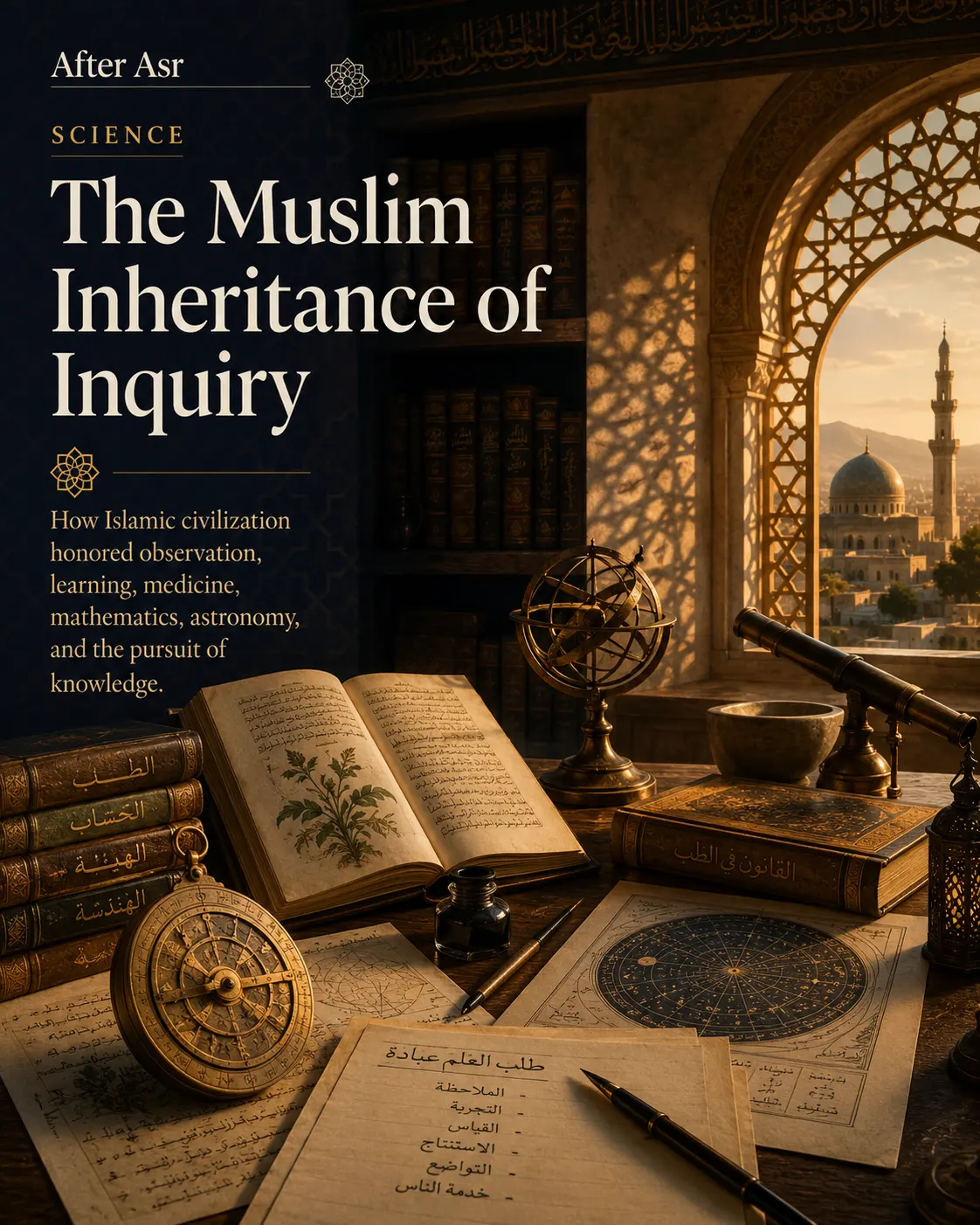
How Islamic civilization honored observation, learning, medicine, mathematics, astronomy, and the pursuit of knowledge
A civilization reveals itself by what it teaches its children to honor.
Some societies honor conquest. Some honor wealth. Some honor beauty. Some honor ancestry, law, trade, poetry, memory, or power. At its best, Islamic civilization taught Muslims to honor knowledge.
Not knowledge as decoration.
Not knowledge as arrogance.
Not knowledge as a weapon for humiliation.
Not knowledge as a luxury for the elite alone.
Knowledge as worshipful responsibility.
The first word revealed to the Prophet Muhammad ﷺ was not a command to build, fight, rule, or accumulate. It was a command to read. To recite. To receive knowledge in the name of the Lord who created. This beginning matters. It shaped the Muslim imagination in ways that would echo across centuries.
The pursuit of knowledge became more than a practical necessity. It became a religiously charged act. To learn was not merely to improve one’s worldly position. It could be a way to recognize signs, serve creation, preserve truth, heal bodies, organize society, and humble the self before the One who knows all things completely.
This inheritance did not produce perfection. No civilization does. Muslim societies had politics, rivalries, injustices, blind spots, exclusions, and failures. The history should not be romanticized into a flawless “Golden Age” story. But neither should it be forgotten or reduced to nostalgia.
There was something real in the Muslim inheritance of inquiry.
Across centuries and regions, Muslims built institutions of learning, translated and preserved earlier knowledge, expanded mathematics, developed medicine, studied optics, mapped the heavens, refined instruments, debated philosophy, wrote encyclopedias, built hospitals, and cultivated libraries. They did this in Arabic, Persian, Turkish, and other languages. They did it in cities from Baghdad to Cordoba, Cairo to Damascus, Bukhara to Fez.
The question is not only what they achieved.
The deeper question is what they understood knowledge to be.
Knowledge as an act of reverence
The Islamic view of knowledge begins with humility.
Human beings know, but their knowledge is partial. They observe, reason, test, remember, and transmit, but they do not possess reality completely. Their minds are gifts. Their senses are gifts. Their ability to name, compare, calculate, and reflect is a gift.
God’s knowledge is complete. Human knowledge is received.
This distinction protects inquiry from arrogance. To study the world is not to become sovereign over it. It is to encounter signs within creation. The world is not spiritually mute. The heavens, earth, body, seasons, animals, plants, rain, birth, death, and human history all invite reflection.
This did not mean that Muslims were asked to avoid practical study. Quite the opposite. The created world could be observed because it was ordered. It could be studied because it was meaningful. It could be used because it was a provision. It had to be used responsibly because it was a trust.
Reverence did not cancel investigation.
It gave investigation a moral horizon.
A physician studying the body could understand healing as service. An astronomer studying the sky could be moved by prayer times, navigation, calendar calculation, and awe. A mathematician could see order and elegance. A translator preserving earlier works could see knowledge as a trust across generations. A teacher could see instruction as sadaqah of the mind.
Knowledge was not meant to inflate the self. It was meant to orient the self.
Translation as humility
One of the great achievements of early Islamic civilization was translation.
Muslim scholars and patrons did not assume that truth had never appeared outside their own community. They sought knowledge from Greek, Syriac, Persian, Indian, and other intellectual traditions. Works in medicine, mathematics, astronomy, philosophy, logic, and natural science were translated, studied, criticized, expanded, and sometimes corrected.
This is an act of civilizational humility.
A proud civilization refuses to learn from others. It imagines that all wisdom begins with itself. A more confident civilization can receive, examine, and transform knowledge without losing its own identity.
The translation movement often associated with Abbasid Baghdad was not merely copying. It involved selection, interpretation, debate, and development. Earlier knowledge was brought into new conversations. It entered a world shaped by Qur’anic language, Islamic law, theology, administration, medicine, trade, and expanding urban life.
Translation also teaches a spiritual lesson.
Knowledge is not always born in the place where it is most needed. Sometimes it must be carried. Sometimes it must be preserved by people who did not originate it. Sometimes truth requires the humility to say, “Someone else saw something we should not ignore.”
This is an important lesson for Muslims today.
A faithful community should not fear learning from others. It should have the confidence to receive beneficial knowledge, examine it carefully, reject what is harmful, and place what is useful in service of truth and dignity.
Medicine as mercy
Medicine held a special place in the Muslim inheritance of inquiry because it joined knowledge to mercy.
The body is vulnerable. Illness exposes dependence. Pain makes philosophy personal. The physician stands near fear, weakness, family, hope, and death. To study medicine, then, was not only to learn anatomy, drugs, diagnosis, and treatment. It was to enter a field where knowledge touches suffering.
Muslim medical culture drew from earlier Greek, Persian, Indian, and other sources, then developed its own rich traditions. Figures such as al-Razi and Ibn Sina became associated with major medical works that influenced learning far beyond their own regions. Hospitals were built as institutions of care, training, and treatment. Physicians observed patients, compared symptoms, classified diseases, discussed ethics, and wrote extensively.
Not every practice from the past would meet modern standards. Medical knowledge develops. Some historical theories were later corrected or abandoned. But the seriousness with which medicine was pursued remains important.
Medicine was not treated as a threat to reliance upon God.
Seeking treatment did not negate tawakkul. The body could be studied because causes mattered. Illness could be treated because mercy mattered. The physician could act through means while knowing that healing ultimately belonged to God.
This balance remains crucial today.
Faith should not make us careless with medicine. Medicine should not make us forget the spiritual reality of illness. The Muslim inheritance reminds us that treatment, trust, observation, prayer, and compassion can belong together.
Mathematics and the discipline of order
Mathematics is one of the languages through which order becomes visible.
Muslim scholars contributed to algebra, arithmetic, geometry, trigonometry, astronomy, inheritance calculation, architecture, commerce, and administration. The name of al-Khwarizmi remains tied to algebra and algorithmic thinking. Mathematical knowledge helped organize practical life, but it also carried beauty.
Numbers may seem cold to some people, but mathematics can train the mind in precision, patience, and proportion.
In Islamic civilization, mathematics was not only theoretical. It helped determine inheritance shares, calculate prayer times, orient toward the qiblah, design buildings, manage trade, and study the heavens. It linked practical need with intellectual elegance.
This matters because faith is not served by intellectual laziness.
A religion that takes law, time, direction, contracts, charity, inheritance, and communal organization seriously also needs people who can think carefully. Precision can be part of justice. A miscalculated inheritance is not only a mathematical error. It can become a moral wrong. A poorly designed building is not only an engineering failure. It can endanger life.
Mathematics reminds us that truth has structure.
It also teaches humility. The mind must submit to the logic of the problem. You cannot flatter an equation into correctness. You cannot make a proof valid by wanting it to be so. In this way, mathematics can discipline the ego.
The order of numbers becomes a training ground for honesty.
Astronomy and the sky of signs
Muslim interest in astronomy was both practical and contemplative.
The sky mattered for prayer times, fasting, navigation, calendars, qiblah determination, and travel. But the sky also mattered because it humbled the human being. The heavens invited reflection on scale, order, beauty, and the limits of human control.
Muslim astronomers observed, calculated, built instruments, refined tables, critiqued earlier models, and established observatories. They studied planetary motion, stars, lunar phases, and mathematical astronomy. The astrolabe became one of the great symbols of this scientific culture, a tool of measurement, navigation, teaching, and time.
There is something spiritually powerful in this.
A believer looks at the sky and remembers God. An astronomer studies the sky and learns its patterns. These acts need not be enemies. The calculation of prayer times does not diminish prayer. The study of the moon does not erase Ramadan. The measurement of celestial movement does not make the heavens spiritually silent.
Instead, astronomy can deepen awe.
The more carefully we understand scale and motion, the more absurd human arrogance becomes. The sky teaches that our lives are real but not central. Our concerns matter, but they are not ultimate. Our power is limited. Our vision is small.
The Muslim inheritance of astronomy reminds us that looking upward can be both scientific and spiritual.
Optics and learning how to see
Among the most beautiful areas of Muslim scientific history is the study of optics.
Ibn al-Haytham is often remembered for his work on vision, light, and experimental method. His inquiries into how sight works helped shift understanding away from earlier assumptions and toward a more careful study of light entering the eye. His work stands as a reminder that even seeing must be studied.
This is profound.
We often assume that seeing is simple. The eye opens and the world appears. But vision is not passive. It involves light, structure, perception, interpretation, and limits. We see, but not completely. We can be mistaken. Appearance is not always reality.
Optics becomes more than a physical science. It becomes a lesson in humility.
The world may not be as it first appears. The eye needs correction. The mind needs discipline. Observation must be trained.
This lesson extends beyond vision. Human beings also misperceive morally. We misjudge others. We see what confirms us. We ignore what troubles us. We mistake surface for essence. We need knowledge, revelation, community, and self-examination to correct our sight.
To study how vision works is, in a deeper sense, to admit that human perception has limits.
Libraries, schools, and the social life of knowledge
Knowledge does not survive through individual brilliance alone.
It requires institutions.
Libraries, madrasas, mosques, hospitals, observatories, courts, book markets, translation circles, private study gatherings, and scholarly networks all helped sustain intellectual life in Muslim societies. Books were copied, taught, debated, commented upon, summarized, memorized, and transmitted.
This social life of knowledge matters.
A civilization that honors learning does not depend only on rare geniuses. It builds habits and institutions that allow knowledge to continue across generations. It trains teachers. It supports students. It preserves texts. It encourages debate. It develops methods of verification. It creates spaces where learning is not a private hobby, but a communal good.
This is a lesson Muslims urgently need today.
Knowledge cannot be revived by admiration alone. We cannot praise past scholars while neglecting present students. We cannot speak of Islamic civilization while underfunding schools, libraries, research, translation, publishing, teacher training, and public education. We cannot honor knowledge in slogans while treating teachers poorly or making serious study inaccessible.
An inheritance is not honored by nostalgia.
It is honored by continuation.
Inquiry within boundaries
The Muslim inheritance of inquiry was not without tension.
Questions arose about philosophy, theology, medicine, astronomy, interpretation, causality, and the boundaries of reason. Scholars disagreed. Some forms of inquiry were praised. Others were criticized. Intellectual life was never a simple story of limitless openness.
This complexity should be acknowledged.
Islamic civilization honored knowledge, but not all knowledge was treated the same way. Beneficial knowledge mattered. Knowledge that led to arrogance, confusion, harm, or spiritual corruption was debated. Scholars asked what should be studied, by whom, for what purpose, and under what moral discipline.
This is not necessarily a weakness.
Every serious civilization must ask about the ethics of knowledge. Not every curiosity is innocent. Not every inquiry benefits the soul or society. Not every powerful technique should be pursued without restraint.
The question is how boundaries are set.
If boundaries are set by fear, ignorance, or political control, they can suffocate inquiry. If boundaries are set by wisdom, ethics, and concern for human dignity, they can guide inquiry toward benefit.
The Muslim intellectual tradition at its best did not ask people to stop thinking. It asked them to think responsibly.
Avoiding nostalgia
It is easy to speak of Islamic scientific history in a way that becomes sentimental.
Muslims may point to past achievements to soothe present insecurity. We mention algebra, hospitals, astronomy, libraries, and scholars as if remembering them is the same as inheriting them. We comfort ourselves with what Muslims once did, while avoiding the harder question of what we are doing now.
Nostalgia can become a veil.
The purpose of remembering the Muslim inheritance of inquiry is not to boast. It is to be awakened.
If Muslims once valued knowledge seriously, do we?
If they built institutions, are we building them?
If they translated beneficial works, are we translating and producing knowledge today?
If they studied medicine as mercy, are we making healthcare more just?
If they studied astronomy for worship and wonder, are we teaching children to look at the sky with both discipline and awe?
If they honored scholars, do we honor teachers, researchers, physicians, and students now?
The past should not become a museum where pride sleeps.
It should become a mirror that asks whether we have become worthy descendants.
Avoiding inferiority
The opposite danger is inferiority.
Some Muslims internalize the idea that modern science belongs to someone else, that serious inquiry is foreign to faith, that Muslims are only consumers of knowledge produced elsewhere. This is historically false and spiritually damaging.
Muslims do not need to approach science as outsiders.
The pursuit of beneficial knowledge belongs naturally within an Islamic worldview. Observation, reason, medicine, mathematics, astronomy, environmental care, and technological responsibility can all be framed as parts of human stewardship. The Muslim is not forced to choose between worship and inquiry, between revelation and disciplined study, between humility before God and curiosity about creation.
But confidence is not enough.
A confident Muslim intellectual life must be excellent. It must avoid lazy apologetics, weak claims, and exaggerated “miracle science.” It must be honest with evidence. It must train students rigorously. It must welcome correction. It must respect expertise. It must produce work that can serve humanity.
The answer to inferiority is not empty pride.
It is serious contribution.
The pursuit of beneficial knowledge
Islamic tradition distinguishes between knowledge that benefits and knowledge that does not.
This distinction is crucial for science today.
Beneficial knowledge is not limited to religious law or devotional practice. Medicine can be beneficial. Engineering can be beneficial. Agriculture can be beneficial. Environmental science can be beneficial. Statistics can be beneficial. Psychology can be beneficial when practiced ethically. Technology can be beneficial when it serves dignity and does not enslave the soul.
But knowledge can also harm.
It can manipulate, exploit, surveil, deceive, intensify war, damage the earth, and deepen inequality. It can inflate the ego. It can become a tool of domination. It can become curiosity detached from mercy.
The Muslim inheritance of inquiry should therefore be understood through responsibility.
We do not seek knowledge simply because it is possible. We seek knowledge that helps us recognize truth, serve creation, heal suffering, establish justice, protect dignity, and fulfill the trust of human life.
The question is not only, “Can this be known?”
It is also, “Will this knowledge benefit, and how must it be governed?”
Observation and the ethics of attention
Observation was central to many Muslim scientific contributions.
Physicians observed patients. Astronomers observed the sky. Mathematicians observed relationships. Geographers observed lands and routes. Botanists and pharmacologists observed plants and remedies. Travelers observed customs, climates, and societies.
Observation is not morally neutral. To observe well requires attention, patience, and honesty.
A careless observer sees only what confirms expectation. A proud observer dismisses what does not fit. A sincere observer lets reality correct them.
This is a scientific virtue and a spiritual one.
The believer is repeatedly called to consider, reflect, travel, look, and take lessons. But this looking is not meant to be idle. It is meant to awaken recognition. The world is full of signs, but signs must be read.
A Muslim inheritance of inquiry should teach us to look more carefully: at the body, at nature, at data, at suffering, at technology, at our communities, and at our own assumptions.
Observation can become an act of humility when it allows reality to interrupt the ego.
Adab in knowledge
Knowledge requires adab.
Without adab, learning becomes arrogance. Debate becomes humiliation. Expertise becomes domination. Curiosity becomes invasion. Research becomes exploitation. Teaching becomes performance. Study becomes self-display.
Adab orders the seeker.
It teaches respect for teachers without blind worship. It teaches confidence without pride. It teaches questioning without insolence. It teaches disagreement without cruelty. It teaches caution before speaking. It teaches that knowledge should refine the character of the one who carries it.
This is essential for any Muslim approach to science.
A Muslim scientist should be rigorous and humble. A Muslim physician should be skilled and merciful. A Muslim engineer should be competent and conscious of public safety. A Muslim data scientist should understand bias and accountability. A Muslim environmental researcher should see stewardship. A Muslim teacher should form students, not merely deliver content.
The inheritance is not only intellectual. It is ethical.
Knowledge without adab is a danger.
Women, families, and the transmission of knowledge
The story of Muslim inquiry is often told through famous men, but knowledge in any civilization is carried more widely than its most celebrated names.
Women taught, transmitted, endowed institutions, supported scholarship, and shaped families of learning. Mothers, teachers, patrons, copyists, students, and community builders helped sustain cultures of knowledge. In many cases, the most important intellectual formation began in homes and local circles long before a student reached an advanced teacher.
This matters because knowledge is not preserved only by famous scholars.
It is preserved by communities that value learning in daily life.
A child who sees books honored learns something. A family that makes time for study teaches something. A mosque that respects teachers forms something. A community that supports girls and boys in serious learning plants something. A society that treats mothers as educators and not merely caretakers understands something essential.
The Muslim inheritance of inquiry must be renewed in households as well as institutions.
The question is not only whether we have universities. It is whether our homes and communities love knowledge enough to make it normal.
Science as service, not status
One danger in remembering scientific heritage is turning science into status.
Muslims may want to produce scientists simply so the community can feel proud. Families may push children toward medicine or engineering for prestige rather than service. Institutions may celebrate credentials more than character. Students may pursue knowledge for applause, income, or superiority.
These motives are human, but they are not enough.
Science as service is different.
A doctor serves the sick. An engineer serves safety and public need. An environmental scientist serves the vulnerable and the earth. A mathematician serves clarity and order. A teacher serves the next generation. A researcher serves truth. A technologist serves human dignity when the work is rightly guided.
Status asks, “How does this make us look?”
Service asks, “Who benefits, and is God pleased?”
The Muslim inheritance of inquiry becomes spiritually alive when knowledge is placed in service of mercy.
What we must recover
So what does it mean to recover the Muslim inheritance of inquiry today?
It does not mean pretending we live in Baghdad or Cordoba. It does not mean dressing modern work in historical aesthetics. It does not mean collecting famous names as proof of past greatness. It does not mean forcing every scientific finding into shallow apologetics.
It means recovering a posture.
The posture of seeking beneficial knowledge.
The posture of humility before truth.
The posture of reverence for creation.
The posture of disciplined observation.
The posture of ethical restraint.
The posture of service through learning.
The posture of confidence without arrogance.
The posture of taking both revelation and the created world seriously.
It also means building.
Schools that teach science with wonder and rigor.
Libraries and publications that make knowledge accessible.
Research institutions that serve real human needs.
Muslim bioethics centers that understand both medicine and sacred law.
Environmental projects rooted in stewardship.
Technology work governed by dignity and justice.
Translation projects that bring beneficial knowledge across languages.
Scholarship that is honest, excellent, and useful.
An inheritance that is not renewed becomes memory.
A living inheritance becomes work.
The future of Muslim inquiry
The future will require Muslims who can think deeply about science and faith without insecurity.
We need Muslims in medicine who understand both evidence and mercy. Muslims in technology who understand both innovation and restraint. Muslims in environmental science who understand both data and stewardship. Muslims in mathematics and physics who understand both order and humility. Muslims in public policy who understand both evidence and justice. Muslims in education who form students to think, not merely memorize.
We also need scholars of religion who are scientifically literate enough to guide communities wisely on complex issues. We need scientists humble enough to learn from ethics and revelation. We need institutions where both can speak seriously to one another.
The challenges ahead will not be simple.
Artificial intelligence, genetic technologies, environmental crises, medical ethics, public health, data surveillance, mental health, food systems, and space exploration will all raise questions that require more than technical skill. They will require spiritually grounded intelligence.
The Muslim inheritance of inquiry is not only about what Muslims once gave the world.
It is about what Muslims are now responsible to become.
The trust of inherited light
Knowledge is light, but inherited light can fade if it is not carried.
The Muslims of earlier centuries did not honor inquiry because it was fashionable. At their best, they honored it because creation was meaningful, the human body mattered, time and direction mattered, healing mattered, justice mattered, and knowledge itself was a trust before God.
We should remember them with gratitude, not vanity.
Their achievements do not make us excellent by association. Their work does not excuse our laziness. Their libraries do not replace our schools. Their hospitals do not replace our public health responsibilities. Their astronomy does not replace our need to look up. Their mathematics does not replace our need for disciplined minds.
But their inheritance can call us.
It can remind us that Islam is not afraid of truth.
It can remind us that faith and inquiry need not be enemies.
It can remind us that knowledge should serve life.
It can remind us that observation can deepen worship.
It can remind us that medicine, mathematics, astronomy, and learning can all become forms of responsibility.
The question is whether we will receive that inheritance as a museum piece or as an amanah.
If we receive it as a museum piece, we will speak proudly of the past while contributing little to the future.
If we receive it as an amanah, we will study, build, teach, translate, heal, observe, question, and serve with renewed seriousness.
The Muslim inheritance of inquiry is not only behind us.
It is a trust still waiting to be honored.