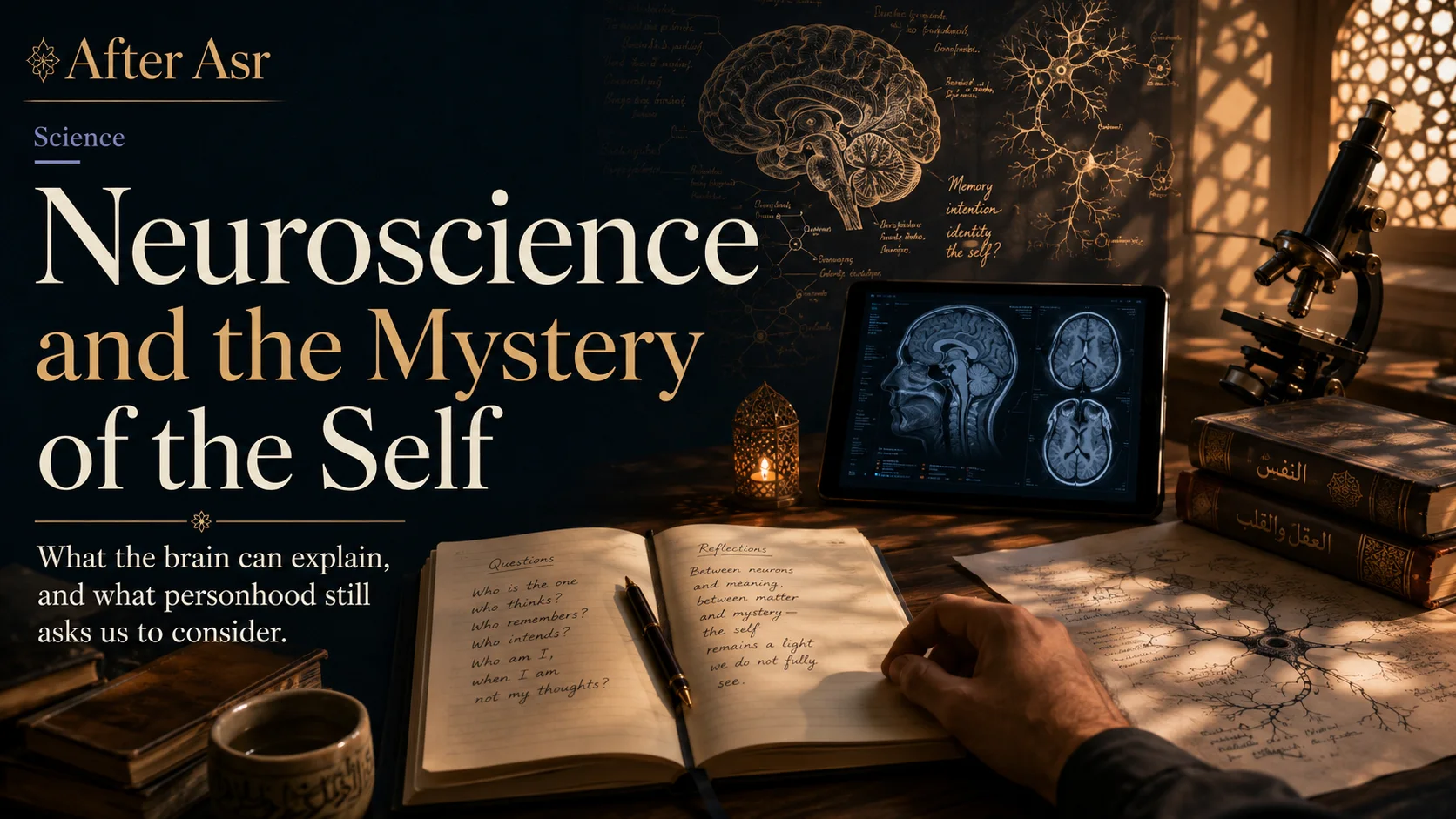
What the brain can explain, and what personhood still asks us to consider
The brain is close to us in the strangest way.
It is inside the skull, hidden from sight, silently participating in nearly everything we experience. It helps us see, remember, speak, move, recognize faces, feel fear, solve problems, form habits, grieve losses, imagine futures, and return to familiar names after years of absence. It helps regulate breath, balance, appetite, sleep, attention, and emotion. It is involved when a child learns to read, when a patient recovers after injury, when a person trembles with anxiety, when an old song brings back a forgotten room.
The brain is intimate to the self.
And yet the self is not easy to locate inside it.
A scan may show activity in a region. A lesion may change speech or memory. A chemical imbalance may affect mood. A traumatic injury may alter personality. A neurological disease may slowly change the way a person moves, remembers, or responds. Neuroscience reveals that the life of the mind is deeply embodied.
This knowledge matters. It can lead to treatment, compassion, rehabilitation, better education, more humane care, and less shame around mental and neurological suffering.
But neuroscience also raises a deeper question.
If the brain is so involved in who we are, what is the self?
Are we only neural activity? Are memories only stored patterns? Is love only chemistry? Is moral choice only firing circuits? Is prayer only a calming state? Is identity only brain function? Is consciousness only computation?
These questions must be handled carefully.
The mistake would be to deny what neuroscience reveals because it feels spiritually unsettling. The opposite mistake would be to reduce the human being to whatever neuroscience can currently measure.
The brain can explain much.
Personhood still asks us to consider more.
The brain as a living organ
The brain is not a symbol. It is an organ.
It needs oxygen, blood flow, nutrients, sleep, protection, and chemical balance. It can be injured. It can develop. It can adapt. It can be harmed by trauma, toxins, disease, stress, aging, addiction, infection, and deprivation. It can recover in astonishing ways, but it can also fail in ways that change a life forever.
This biological reality should make us more compassionate.
A person with depression is not simply being dramatic. A child with a developmental condition is not simply misbehaving. An elderly person with dementia is not simply becoming difficult. A person with traumatic brain injury may not be the same as before. A person with addiction may be caught in patterns that involve biology, habit, environment, trauma, and choice all at once.
The brain reminds us that human behavior is embodied.
This does not erase responsibility, but it complicates judgment. It asks us to be careful before calling someone lazy, weak, bad, irrational, or faithless. The body may be carrying burdens we cannot see.
A believer should welcome knowledge that increases mercy.
If neuroscience helps us understand suffering more clearly, then it can reduce cruelty. It can help families respond with patience. It can help doctors treat more wisely. It can help teachers support students. It can help communities stop shaming people for conditions they do not understand.
The brain is not the whole person, but it is part of the person’s lived reality.
To care for the self, we must care for the body through which the self lives.
What neuroscience can explain
Neuroscience can explain many things that once seemed mysterious.
It can help explain how vision works, how sound is processed, how memories form, how habits develop, how fear responses are triggered, how reward pathways shape behavior, how sleep affects learning, how trauma may alter stress responses, how attention can be trained or disrupted, and how injuries in certain areas can affect speech, movement, recognition, or emotion.
This knowledge has practical power.
It can guide therapy after stroke. It can help treat epilepsy. It can inform care for Parkinson’s disease, dementia, depression, anxiety, addiction, traumatic brain injury, autism, ADHD, and many other conditions. It can help us understand how children learn, why sleep matters, why chronic stress is harmful, and why social connection affects health.
It can also humble us.
We are not pure minds floating above biology. We think through bodies. We remember through bodies. We worship through bodies. We love through bodies. Fatigue, hunger, pain, trauma, illness, medication, hormones, and sleep all affect how we experience the world.
This does not make us less human.
It makes us embodied human beings.
Islam has never treated the body as irrelevant to the soul. Prayer has posture. Fasting has hunger. Wudu has water. Hajj has walking. Charity has the hand. Speech has the tongue. Modesty has the body. Illness has legal and spiritual significance.
The brain is part of this embodied condition.
Neuroscience can help us understand the means through which human experience unfolds. That is valuable knowledge.
But explaining the means does not exhaust the meaning.
The danger of “only the brain”
Problems begin when neuroscience is used to say the human being is “only the brain.”
This kind of reductionism often sounds confident.
Love is only chemistry.
Prayer is only neural activity.
Morality is only social conditioning in the brain.
Free will is only illusion.
The self is only a pattern of neurons.
Consciousness is only computation.
Some of these claims may contain partial insights. Love does involve the brain and body. Prayer does affect attention, breath, emotion, and neural activity. Moral judgment does involve brain processes. But the word “only” does more work than the evidence often allows.
To identify a biological process is not to capture the whole meaning of an experience.
If someone cries while making du’a, the tears have chemistry. The brain has activity. The body has a stress response. But the moment may also involve repentance, longing, fear of God, gratitude, hope, memory, shame, surrender, and love. A scan may show correlates of the experience. It does not contain the full meaning of the experience.
If a mother holds her child, neuroscience may describe attachment, hormones, memory, and reward pathways. But motherhood is not exhausted by those explanations. It includes sacrifice, responsibility, mercy, sleeplessness, fear, tenderness, and moral obligation.
The brain is involved in human meaning.
It does not own human meaning.
Consciousness and the first-person mystery
One of the deepest mysteries in neuroscience is consciousness.
We do not merely process information. We experience. There is something it is like to taste sweetness, feel grief, hear Qur’an recited beautifully, remember a childhood room, fear death, or stand in prayer before dawn.
Neuroscience can study brain states associated with conscious experience. It can examine wakefulness, attention, perception, sleep, anesthesia, coma, and disorders of consciousness. This research matters deeply, especially in medicine and end-of-life care.
But the first-person reality of experience remains difficult to reduce.
A brain scan may show activity when a person feels pain, but the scan is not the pain. It may show activity when a person remembers, but it is not the memory as lived. It may show activity during worship, but it is not the inward turning of the heart toward God.
The experience itself has a dimension that measurement approaches from the outside.
This should make us humble.
The mind is not transparent even to itself, and it is certainly not fully transparent to instruments. We can study the conditions of consciousness, the neural correlates of consciousness, and the impairments of consciousness. But the mystery of being a self who experiences the world remains profound.
For the believer, this mystery is not embarrassing. It is fitting.
Human beings are known to God more completely than they know themselves. We are not closed systems fully explained by our own tools. There remains depth in us that should be approached with reverence.
Memory, identity, and change
Memory is central to the self.
We know ourselves partly through what we remember: names, faces, stories, wounds, places, failures, joys, languages, prayers, and promises. Memory gives continuity to life. It allows a person to say, “I was there,” “I did this,” “I loved them,” “I changed,” “I regret,” “I hope.”
Neuroscience shows that memory is not a simple recording.
Memory can be fragile, reconstructed, emotional, selective, and vulnerable to injury or disease. Trauma can intensify some memories and bury others. Aging can soften recall. Dementia can slowly loosen the threads that connect a person to their past.
This raises painful questions.
If a person loses memory, are they less themselves? If dementia changes personality, where is the person we knew? If brain injury alters behavior, how do we understand identity, responsibility, and love?
These are not merely scientific questions. They are human and spiritual questions.
A person with memory loss remains a person. Dignity does not depend on perfect recall. The elderly parent who no longer remembers your name still carries rights over you. The patient with dementia is not a faded object. The self may become hidden, altered, or difficult to reach, but the human being remains sacred.
Neuroscience can help us understand what is happening biologically. Faith reminds us that dignity is not revoked by cognitive decline.
This matters greatly for caregiving.
When the brain changes, love must often become more patient, less dependent on being recognized, and more rooted in service.
Personality and the fragile self
Brain injury and neurological disease can change personality.
A person who was gentle may become impulsive. A person who was patient may become irritable. A person who was organized may become confused. A person who was emotionally expressive may become flat. Families sometimes say, with grief, “He is not the same person.”
This can be heartbreaking.
Neuroscience helps explain why such changes may happen. Damage to certain brain regions can affect inhibition, emotion, planning, speech, memory, and social behavior. Disease can alter mood and cognition. Medication can change mental state. Sleep deprivation and pain can affect personality too.
This knowledge should soften judgment.
A person’s difficult behavior may not always arise from bad character alone. Sometimes the brain is injured, inflamed, deprived, aging, or overwhelmed. Families need support, not only moral lectures. Caregivers need guidance. Communities need to learn the difference between spiritual advice and medical reality.
At the same time, we should avoid turning every moral struggle into brain function alone.
Human beings are complex. Biology matters. Habit matters. Intention matters. Environment matters. Spiritual state matters. Social conditions matter. We should neither blame everything on the self nor erase the self entirely into biology.
Wisdom holds multiple truths together.
The brain shapes behavior. The person remains morally meaningful. Compassion and responsibility must be carefully balanced.
The brain, trauma, and mercy
Trauma is one area where neuroscience has helped many people understand suffering more compassionately.
A person who has endured violence, abuse, war, neglect, humiliation, or severe fear may carry the effects not only in memory, but in the body. The nervous system may become vigilant. Sleep may be disturbed. Trust may become difficult. Certain sounds, smells, places, or tones may trigger strong reactions. The body may respond as if danger has returned.
This does not make trauma survivors broken beyond hope.
It means the body learned to survive in conditions of threat, and sometimes those survival patterns continue after danger has passed.
Understanding this can change how families, teachers, communities, and religious leaders respond.
Instead of asking, “Why are you like this?” we may ask, “What happened, and how can healing be supported?” Instead of shaming reactions we do not understand, we may become more patient. Instead of giving simplistic advice, we may encourage therapy, safety, spiritual care, healthy relationships, and time.
Faith is deeply relevant here.
Trauma can affect a person’s ability to feel safe, trust others, concentrate in prayer, or imagine mercy. A community that understands this will not rush people harshly. It will help them return gently.
Neuroscience can explain patterns of trauma. Faith can offer meaning, hope, repentance where needed, justice where possible, and the assurance that God knows the wounds no one else sees.
Addiction and the narrowing of freedom
Addiction is another place where neuroscience complicates simplistic judgment.
Addictive substances and behaviors can affect reward pathways, motivation, memory, impulse control, stress response, and decision-making. Over time, a person may feel trapped in cycles of craving, relief, shame, and return. The behavior may continue even when the person hates what it is doing.
This does not mean moral responsibility disappears.
But it does mean addiction is not solved by scolding alone.
A person struggling with addiction may need medical treatment, therapy, support groups, spiritual care, accountability, changes in environment, and protection from triggers. They may need mercy that does not enable harm, and firmness that does not crush hope.
The brain helps us understand why addiction narrows freedom.
Faith helps us understand that the person is not reducible to their addiction. They remain capable of repentance, struggle, and return, even if the path is difficult and uneven. The community’s role is not to excuse harm, but to support recovery with truth and compassion.
Neuroscience can make us less arrogant toward those trapped in destructive habits.
Most people have some experience of wanting what harms them. Addiction shows that struggle in a more severe and embodied form.
Free will, responsibility, and humility
Neuroscience has raised questions about free will.
Some experiments suggest that brain activity associated with decisions may occur before a person becomes consciously aware of choosing. Some interpret this as evidence that free will is an illusion. Others argue that such conclusions go far beyond what the studies prove.
This debate is complex.
What matters for our purposes is that neuroscience should make us more careful, not careless, in how we speak about agency.
Human beings are influenced by biology, upbringing, trauma, habit, environment, desire, social pressure, and unseen factors. We are not as independent as we imagine. Yet we also experience ourselves as responsible. We deliberate, regret, repent, choose, resist, fail, try again, and are held accountable.
Islamic thought recognizes both divine knowledge and human responsibility, both decree and moral agency, both weakness and obligation. The self is not absolute master, but neither is it meaningless machinery.
Neuroscience may reveal constraints on choice. It does not eliminate the moral reality of choosing.
A humble approach would say: human responsibility is real, but human judgment should account for capacity, impairment, compulsion, development, illness, coercion, and circumstance.
This is already reflected in law, ethics, and Islamic moral reasoning. Not every person is judged the same way under every condition. Capacity matters.
The brain can help us understand capacity more carefully.
Mental illness and spiritual misunderstanding
Mental illness is often misunderstood in religious communities.
Some people reduce it entirely to weak faith, sin, jinn, lack of gratitude, or failure to make enough du’a. Others reduce it entirely to chemistry, as if spiritual life has no role. Both extremes can harm.
The brain and the soul are not enemies.
A person with depression may need prayer and therapy. They may need medication and companionship. They may need exercise, sleep, spiritual reminders, medical assessment, and practical help. A person with severe anxiety may need grounding techniques and tawakkul. A person with intrusive thoughts may need religious reassurance and clinical support. A person in crisis may need emergency care and people who refuse to abandon them.
Good care is often layered.
Neuroscience helps us understand that mental illness can involve real biological and psychological processes. Faith helps us understand that the person remains morally and spiritually significant, not merely a diagnosis.
A mosque that dismisses mental illness may push people into shame. A clinical approach that ignores faith may miss a vital source of meaning and healing.
A wiser community allows medicine, therapy, worship, and mercy to work together where appropriate.
The self and the soul
For Muslims, any discussion of the self eventually touches the soul.
The ruh is not an object available for laboratory measurement. It is not something we can place under a microscope or scan in a machine. Revelation gives us what we need to know, while reminding us that our knowledge is limited.
This does not make neuroscience irrelevant.
The brain is part of the body through which the self lives in this world. It shapes perception, memory, attention, movement, emotion, and behavior. Studying it can help us care for people better.
But the soul reminds us that personhood is not exhausted by the measurable.
The human being is accountable before God. The human being can intend, repent, worship, love, betray, forgive, and return. The human being has dignity that does not depend on cognitive performance, productivity, intelligence, or social usefulness.
A person in coma, a newborn, a disabled child, a dementia patient, and a brilliant adult all differ in cognitive function. Their human dignity is not graded by brain capacity.
This is one of the most important moral contributions faith brings to conversations about neuroscience.
Without a sacred view of the person, societies may begin to value human beings according to function. The intelligent, productive, independent, and communicative are honored. The dependent, impaired, confused, unborn, elderly, or unconscious become vulnerable.
Faith says no.
The person is more than performance.
Prayer, the brain, and meaning
Researchers may study what happens in the brain during prayer, meditation, recitation, or spiritual experience.
This can be interesting and useful. It may show changes in attention, stress response, emotional regulation, breathing, or neural activity. Such findings can help us understand how religious practice affects the embodied human being.
But prayer is not reducible to its effects on the brain.
A person does not pray only to calm the nervous system. A believer does not make sujood merely for stress reduction. Recitation is not only sound therapy. Dhikr is not only mindfulness. These practices may affect the body, but their meaning is worship, remembrance, obedience, love, humility, and turning toward God.
It is good if prayer calms the body. It is good if recitation soothes the heart. But the purpose of worship is not exhausted by health benefits.
This distinction matters.
When religious practices are valued only because science finds measurable benefits, we risk making science the judge of worship’s worth. But worship has worth because God is worthy of worship.
Neuroscience can show some effects of prayer. Faith tells us what prayer is.
Education and the developing brain
Neuroscience has also influenced education.
We know that children’s brains develop over time, that sleep affects learning, that stress affects attention, that repetition strengthens pathways, that movement and emotion can influence memory, and that early experiences matter. This knowledge can help teachers and parents.
But here too, caution is needed.
The child is not only a developing brain. The child is a soul, a trust, a moral being in formation, a member of family and community, a future adult, and a person deserving love now.
Educational neuroscience can help us teach better, but it should not turn children into optimization projects. A child does not exist merely to maximize cognitive performance. Learning should form character, wonder, discipline, adab, compassion, and responsibility, not only brain efficiency.
A healthy educational approach uses neuroscience humbly.
It asks how sleep, stress, attention, emotion, nutrition, movement, and relationship affect learning. It also asks what kind of human being education is trying to form.
The mind is trained through the brain, but education is for the person.
Technology, attention, and the reshaped mind
Neuroscience also helps us think about technology.
Digital tools can shape attention, reward, habit, emotion, and social comparison. Notifications, infinite scroll, algorithmic feeds, and rapid novelty can train the brain toward distraction and craving. The problem is not simply that people lack willpower. Many technologies are designed to capture and hold attention.
This knowledge creates responsibility.
If we know tools are designed to exploit attention, we must be more careful with children, worship, study, sleep, family time, and our own habits. If we know the brain adapts to repeated behavior, we should ask what our devices are training us to become.
The brain is plastic. It changes with use.
That is both warning and hope.
Bad habits can shape us. Good habits can shape us too. Recitation, study, prayer, exercise, deep reading, silence, service, and healthy relationships can also train attention and character.
Neuroscience shows that formation is embodied. Faith gives formation its direction.
The moral danger of measuring the self
As neuroscience advances, there is a temptation to measure the self more and more.
Brain scans, cognitive tests, mood trackers, attention metrics, productivity tools, sleep data, wearable devices, and mental performance scores can all provide useful information. But they can also create anxiety, comparison, and reduction.
A person may begin to experience themselves as a dashboard.
How focused am I? How well did I sleep? How productive was I? What is my mood score? How optimized is my brain?
Information can help. It can also become a burden.
The self is not a set of metrics. A life is not a performance report. The soul is not visible on a chart.
We should use measurement where it serves care, diagnosis, learning, or responsibility. But we should resist becoming obsessed with self-monitoring. Not every moment needs to be quantified. Not every inner state needs to be tracked. Not every struggle needs to become data.
Sometimes the person needs rest, prayer, conversation, repentance, therapy, medicine, beauty, or a walk under the sky.
Not everything meaningful can be optimized.
Reverence for the impaired self
Neuroscience forces us to confront a painful question: how do we regard people whose brains do not function in ordinary ways?
The infant. The severely disabled person. The person with advanced dementia. The patient under anesthesia. The person in coma. The one with psychosis. The one with brain injury. The one who cannot speak. The one who cannot remember. The one whose behavior is difficult, confusing, or socially uncomfortable.
A society without reverence may measure their worth by awareness, productivity, communication, intelligence, or independence.
Faith refuses that.
Human dignity does not depend on how efficiently the brain performs. The person who cannot speak still has rights. The person who cannot remember still deserves tenderness. The person whose mind is clouded still deserves protection. The person whose behavior is shaped by illness still deserves care.
This does not make care easy. Families caring for neurological illness may suffer deeply. Caregivers need support. Medical teams need resources. Communities must not offer sentimental praise while leaving families alone.
Reverence must become practical.
Visit. Support. Fund care. Make spaces accessible. Learn how to respond. Give caregivers rest. Protect the vulnerable from abuse. Speak about neurological illness without shame.
The mystery of the self becomes most morally urgent when the self is difficult to recognize.
That is where our belief in dignity is tested.
What the brain cannot absolve
Because the brain influences behavior, some may be tempted to use neuroscience to avoid all responsibility.
“My brain made me do it.”
“My wiring is just like this.”
“My impulses are biological.”
“My habits are conditioned.”
“My choices are not really choices.”
There may be partial truths in some of these statements. Biology and history matter. But they do not automatically absolve us from effort, repair, repentance, or accountability.
Understanding a cause is not the same as removing responsibility.
If anger has biological and psychological pathways, we still must learn restraint. If desire has neural reward circuits, we still must discipline it. If habits become embodied, we still must struggle to change them. If trauma explains a reaction, healing still asks for work when possible. If addiction narrows freedom, recovery still requires support and striving.
Neuroscience should produce mercy, not moral surrender.
A person may need help. A person may have reduced capacity. A person may deserve patience. But the goal remains healing, responsibility, and return, not being trapped forever inside an explanation.
Faith insists that change is possible, even when difficult. Repentance is possible. Healing is possible. Growth is possible. The brain can be shaped. The heart can be purified. The self can be reoriented by mercy, effort, and divine help.
Personhood as a trust
The mystery of the self should make us careful.
Careful with diagnosis.
Careful with judgment.
Careful with brain data.
Careful with mental illness.
Careful with elders.
Careful with children.
Careful with trauma survivors.
Careful with people whose behavior we do not understand.
Careful with our own assumptions about agency and weakness.
Personhood is a trust.
No scan contains the whole person. No diagnosis contains the whole story. No behavior reveals the whole soul. No neurological explanation captures all meaning. No impairment cancels dignity.
This does not mean neuroscience is unimportant. It is deeply important. It can help us heal, understand, support, teach, and forgive more wisely. It can reveal hidden burdens. It can correct cruel assumptions. It can guide treatment.
But neuroscience must be held within a larger moral and spiritual vision.
The brain is part of the person.
The person is more than the brain.
The soul is known fully only to God.
The mystery remains
The more we learn about the brain, the more wonder should increase.
The brain’s complexity is astonishing. Its development, plasticity, vulnerability, and relationship to experience invite serious study. Neuroscience is one of the great fields through which human beings can reduce suffering and deepen understanding.
But the mystery of the self remains.
We are not less mysterious because neurons fire. We are not less accountable because the brain is involved in decision-making. We are not less dignified because memory can fail. We are not less spiritual because prayer has bodily effects. We are not less beloved to God because illness touches the mind.
A full account of the human being requires more than mechanism.
It requires biology, psychology, relationship, memory, moral agency, vulnerability, embodiment, faith, and the unseen reality of the soul.
Science helps us ask what is happening in the brain.
Ethics asks how the person should be treated.
Faith asks who the person is before God.
We need all three.
Neuroscience can teach us humility before the body. It can teach mercy toward suffering. It can teach patience with impairment. It can teach caution before simplistic judgment. It can teach that habits shape us, trauma wounds us, sleep restores us, and care matters.
But it should not teach us to reduce ourselves.
The self is more than a scan.
More than a diagnosis.
More than memory.
More than mood.
More than productivity.
More than cognitive performance.
More than the sum of measurable activity.
The human being is a mystery entrusted to itself, known fully by God, and called to live with responsibility inside a body that is both fragile and wondrous.
To study the brain rightly is not to shrink the self.
It is to stand with greater humility before the embodied soul, and to care more gently for the hidden worlds carried behind every face.