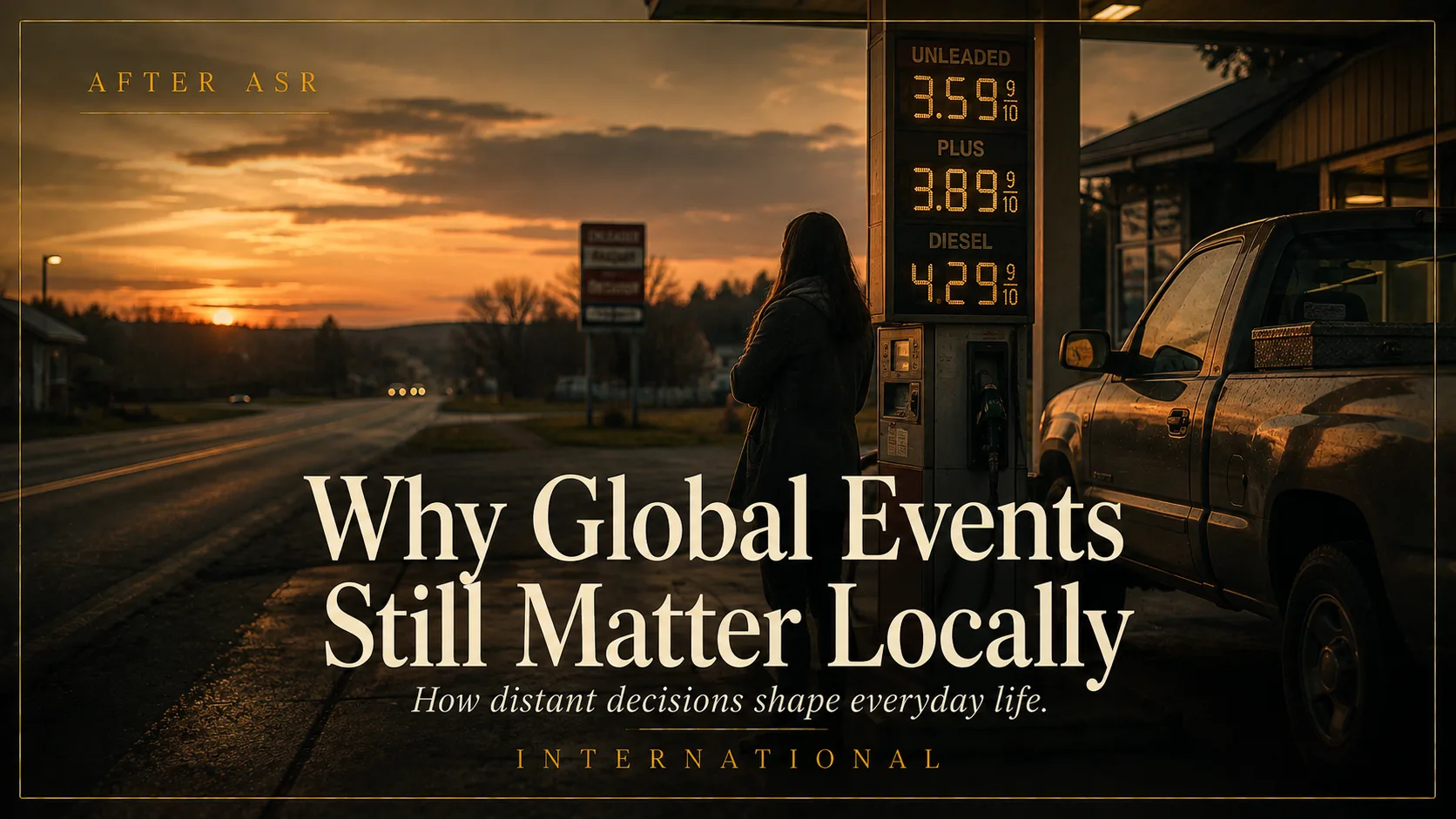
At a gas station off a two-lane road in Tennessee, a woman watches the numbers roll.
She is not thinking about the world. She is thinking about whether forty dollars will fill the tank.
It will not, this week. Somewhere she will never go, someone decided that for her.
The Number at the Pump
The price on the pump looks local. It sits on a sign at the edge of her town.
But that number was assembled far away. It carries the weight of a war she does not follow, a cartel meeting she never heard of, and a shipping lane on the far side of the earth. The digits on the sign are the last line of a very long sentence, and the sentence was written by strangers.
Then it narrows back to her. She rounds the fill to thirty-five dollars and drives to a job that will not pay more because the pump did. The whole global oil trade, all its fleets and futures markets, ends here, in one woman deciding what she can no longer afford. Distance did not protect her. It only hid the authors.
Nothing You Buy Was Made Only Here
Turn over almost any object in your house and you will find a country’s name that is not yours. Often several.
The phone was assembled from minerals mined on three continents. The shirt was sewn where labor was cheap and cotton was near. The coffee crossed an ocean before it reached the pot. The idea of a purely local life dissolves the moment you read the small print on the underside of things.
Zoom out and this is a web of ten thousand hands, most of them foreign, most of them poor. Narrow back to a kitchen shelf where those hands are invisible, folded into a price. We are stitched to the world through the ordinary objects we stop noticing. The stitching does not announce itself. It simply holds.
The strange part is how ordinary this feels. A century ago, a family in that town wore cloth spun within a day’s ride. Now the most local-seeming home is a quiet museum of the whole planet, and no one thinks it remarkable at all.
The Container That Connects the Kitchen to the Sea
There is a steel box, corrugated and rust-streaked, stacked by the thousand on ships the size of small towns.
That container is the quiet hero of your daily life. Inside one may be the toys your children open, the parts your car needs, the rice in your cupboard. It rides a vessel through a canal that a single grounded ship can block, freezing supply chains across the planet for a week.
Follow the box from the sea to the shelf. It leaves a port in Asia, crosses an ocean, rides a train through a desert, and ends on a truck at a store near your home. When that chain snags anywhere along its length, the snag arrives at your checkout as an empty shelf. You will blame the store. The store will blame the box. The box was somewhere off the coast of a country in the news.
A Decision in a Room You Will Never See
Somewhere there is a room with a long table and a dozen tired officials. They are deciding something dull.
They might be setting a tariff, or a quota, or the terms of a loan to a distant government. No camera waits outside. No alert will interrupt your evening. And yet the choice made in that room will ripple outward until it reaches the price of the shoes your daughter outgrows.
Widen the lens and such rooms sit in capitals across the earth, each one adjusting a valve in the vast plumbing of trade. Narrow back to your front door, where the water eventually arrives, warmer or colder, and you never knew a valve was turned. The distance between the table and the door is the distance we mistake for irrelevance.
Interest Rates Are Set Far Away and Felt at Home
A handful of central banks decide what money costs. Their choices sound technical and land in your mailbox.
When a bank raises its rate, mortgages climb, car loans stiffen, and a small business shelves the plan it had to hire. The words are abstract, basis points and yields. The effect is a couple in a kitchen deciding not to buy the house after all. Policy speaks in percentages. Life answers in postponed weddings.
And the rate set in one large economy travels. Poorer countries must follow or watch their currencies fall. So a decision made to cool one nation can raise the price of bread in another. The room is quiet, the language is dull, and the reach is planetary.
Debt Is a Rope Between Capitals
A poor country borrows from a rich one, or from a bank that answers to several. The rope tightens quietly for years.
When the loan comes due in a currency the borrower does not print, repayment can swallow the budget for schools and clinics. A hospital goes unbuilt in one nation so that a bond is honored in another. The transaction is called finance. On the ground it is a nurse who was never hired.
Widen the frame and this rope runs between dozens of capitals, binding the fortunes of places that share no border and no language. Narrow back to a clinic with one doctor and a waiting room that never empties. The debt was signed in a tower far away. It is being paid, in patience, by people who never saw the pen.
The Cloud Sits on Someone Else’s Ground
We speak of the cloud as if it floats. It does not. It hums in warehouses on real soil, in specific countries, under specific laws.
Your photographs, your messages, your bank records rest on machines that sit inside another nation’s borders and answer, in the end, to that nation’s rules. When two governments quarrel over data, the quarrel can reach the app in your pocket. The most personal corner of your life has an address abroad.
Zoom out and the wires of the internet run along the seabed in a few thick cables, guarded, tapped, and occasionally cut. Narrow back to a teenager sending a message she believes is private and weightless. It is neither. It crossed a border and a jurisdiction before her friend across town read it.
The Factory and the Faraway Wage
A plant closes in a town that had one plant. The reason is a wage in a country most locals could not find on a map.
The work did not vanish. It moved, to where hands were cheaper and rules were looser. For the family whose income walked out with it, the cause is not abstract. It is a padlock on a gate they drove past for thirty years.
Zoom out and this is the whole logic of global production, chasing the lowest cost from country to country. Narrow back to one laid-off father filling out forms at a folding table, competing, without knowing it, against a worker he will never meet. The competition is real. It is also invisible, which is what makes it feel like fate instead of choice.
Your Plate Is Assembled From Six Countries
Look at an ordinary dinner and count its passports. The count will surprise you.
The shrimp was farmed in one nation, the rice grown in another, the spices dried under a third sun, the oil pressed from a fourth country’s seed. A modest weeknight meal is a summit of continents, quietly convened on a single plate. You did not invite them. The market did.
When drought strikes one of those distant fields, the price of your dinner nudges upward, and you feel a far-off sky in your grocery bill. The plate is local. The harvest was not. Every ordinary meal is a small treaty among places that will never sign anything.
There is a kind of grace in this, if you look for it. To eat is to be fed by strangers, most of whom you would never recognize and could never thank. The table is set, three times a day, by a world that does not know your name.
Weather in One Hemisphere, Prices in Another
A frost in one growing region can raise the cost of breakfast half a world away. The frost never touches you. Its price does.
When coffee-growing hills freeze, or a wheat belt bakes, the loss enters the market and radiates outward. The farmer who lost the crop and the shopper who pays more never speak. They are joined only by a commodity and a number that moves them both.
Widen the frame and the whole planet’s harvests pour into shared pools, so scarcity anywhere raises the tide everywhere. Narrow back to a father at a checkout, quietly returning one item to the shelf because the total climbed again. He blames the store, or the season, or himself. The true cause was a sky he never saw.
Migration Is Local on Both Ends
A person leaves one town and arrives in another. Both towns feel it, in opposite ways.
The place he left loses a worker, a son, and the money he might have sent home. The place he reaches gains a laborer, a neighbor, and an argument at the next council meeting. Migration is often discussed as a border problem. It is really two local stories, joined by a road.
Zoom out and the movement of people is one of the great forces shaping this century, driven by war, wage, and weather. Narrow back to a single family at a bus station, and to another family, elsewhere, setting an extra plate. The global map of migration is drawn, in the end, in kitchens. It always was.
The Medicine Cabinet Has a Foreign Policy
Open the small mirror-fronted cabinet in your bathroom. Much of what is inside was made abroad.
The active ingredients in common medicines are manufactured in a few countries, then shipped to the rest. When one of those plants halts, or a trade dispute stiffens, a routine prescription can suddenly go scarce. Your health is quietly hostage to factories you cannot name.
Follow one pill backward from the cabinet to a chemical plant on another continent, through a supply chain thinner than anyone likes to admit. Then narrow to a mother counting her child’s remaining doses. She is not thinking about trade policy. Trade policy, it turns out, has been thinking about her.
A War You Do Not Watch Still Reaches Your Fuel
You can decide not to follow a distant war. You cannot decide to be untouched by it.
Conflict in a region that produces oil or grain sends its tremor through the markets, and the tremor arrives as your heating bill. You did not choose to be involved. Involvement was arranged by pipelines and shipping lanes long before the fighting began.
Widen the lens and a single blocked strait can lift energy prices across every continent at once. Narrow back to an old man in a cold apartment, turning the thermostat down one more degree. He has never heard of the strait. The strait, indifferent, has heard of no one, and reaches him anyway.
This is the hard mercy of a connected world. You may look away from the suffering of others, but the economics of that suffering will not look away from you. The two are joined whether or not you consent to the joining.
The Illusion of the Self-Sufficient Town
Every town likes to believe it stands on its own. Few towns have for a hundred years.
The fuel arrives from elsewhere. The seed is patented elsewhere. The bank that holds the mortgages answers to a market elsewhere. Self-sufficiency is a comforting story a place tells at its own festivals, while its actual life depends on a hundred distant threads.
This is not a loss to mourn. It is a fact to understand. The town that knows it is woven into the world can at least see the threads and ask who is pulling them. The town that believes it is alone will keep being surprised, again and again, by weather it did not make.
The Myth of the Faraway
We keep a word for events that will not touch us. The word is faraway. It is usually wrong.
Faraway is a feeling, not a fact. On a wired planet, a decision on the far side of the globe can reach your table faster than a letter reaches the next county. The map of distance and the map of consequence stopped matching some time ago, and most of us are still reading the old one.
This does not mean everything abroad is your emergency. It means the reflex to file a story under not my concern deserves a second look. The faraway is often the near, delayed by a few weeks of shipping and a single number on a sign.
Think of the last thing that made your household budget tighten. Trace it honestly and the trail rarely stops at the county line. It runs out to a field, a bank, a border, or a war, and only the last few inches of it were ever local at all.
What Interdependence Asks of Us
If the world reaches into our kitchens, it also asks something of us in return. Mostly it asks for attention.
Not the anxious attention that follows every alarm, but the steady kind that remembers the hands behind the objects. To know that your shirt had a sewer, your fuel a source, your dinner a distant field, is to live a little less like a sleepwalker in a wired age.
Interdependence is not a slogan to celebrate or a threat to fear. It is simply the shape of the house we all now live in. The question is only whether we notice the walls, or keep bumping into them in the dark.
Attention of this kind can even soften us. It is harder to despise a distant people once you know they sewed your shirt and grew your rice. The web that binds our prices also binds our fates, and a person who sees the web sees a neighbor where he once saw a stranger.
The Pump Clicks Off
The woman in Tennessee finishes at thirty-five dollars. The pump clicks off before the tank is full.
She does not know the name of the strait, or the room, or the container ship idling off a coast she cannot picture. She only knows the tank is short and the week is long.
But the world was here, at this pump, in the plain arithmetic of her afternoon.
It arrived without a passport and left no note.
It is always here, in the price, in the shelf, in the pill, in the bread.
Far is a story we tell to feel safe.
The truth is nearer.
It is already at the table.