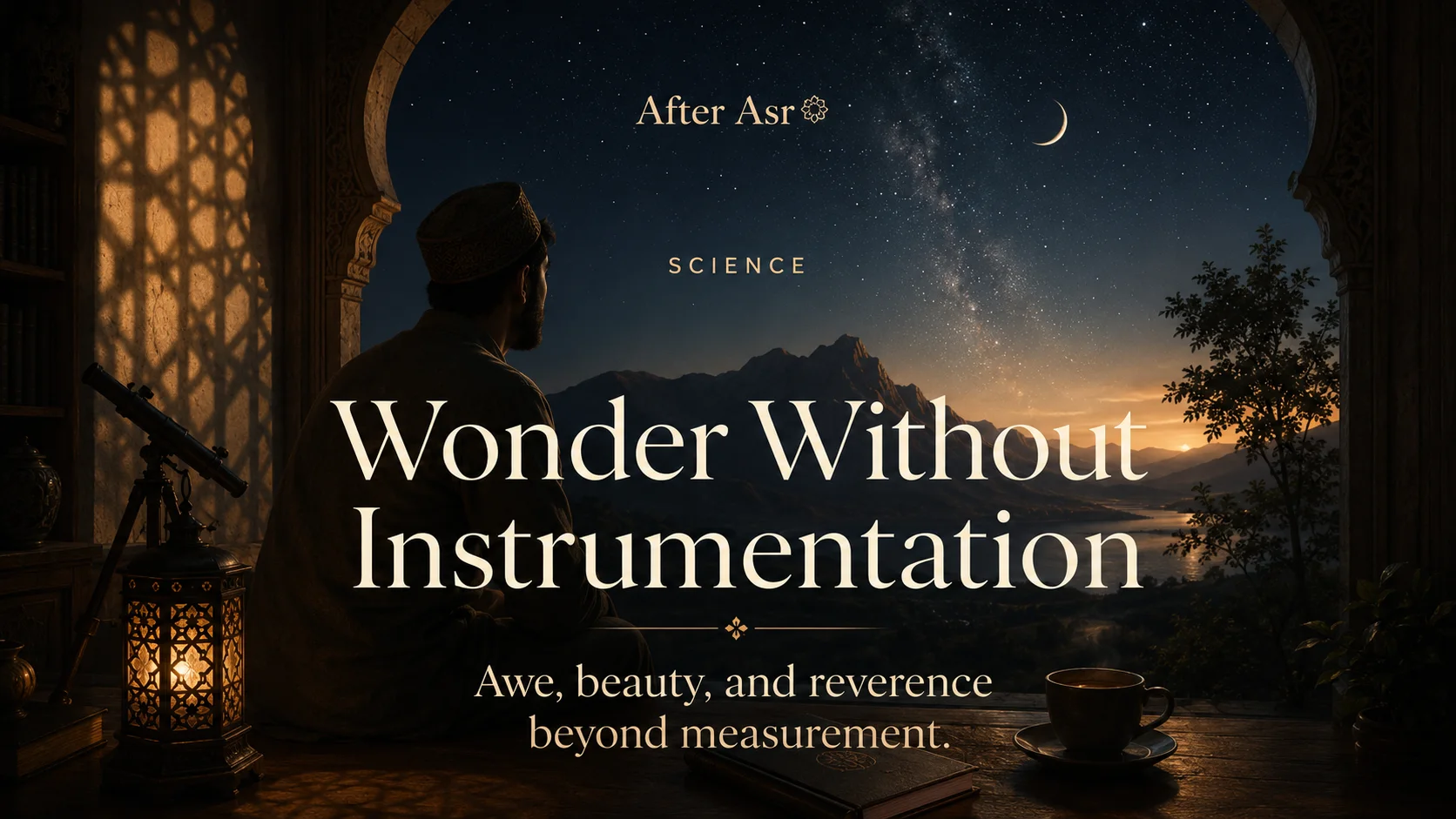
Awe, beauty, and reverence beyond measurement
Not every encounter with truth begins by measuring.
Sometimes it begins by looking.
A person stands beneath the night sky and falls silent. A child watches sunlight move through leaves. An old man listens to rain on the roof. A mother studies the face of her sleeping child. A traveler sees mountains rising in the distance. Someone sits by the ocean and feels, without needing to say it, that the world is larger than the self.
No instrument is being used.
No data is being collected.
No hypothesis is being tested.
No chart is being prepared.
No conclusion is being published.
And yet something real is happening.
The human being is being addressed by beauty.
This kind of wonder is not anti-scientific. It does not reject measurement, evidence, or careful inquiry. It simply reminds us that measurement is not the only way human beings encounter meaning. There are moments when the proper response to reality is not to analyze first, but to receive. To pause. To notice. To become small in a way that restores proportion.
Science can deepen wonder by revealing hidden structures, vast scales, delicate systems, and astonishing mechanisms. But wonder does not begin only when instruments appear. Before the telescope, human beings looked up. Before the microscope, they marveled at life. Before weather satellites, they felt the mercy and danger of rain. Before anatomy textbooks, they knew the body was a sign of dependence and mystery.
Instrumentation can extend sight.
But reverence begins in the heart.
The gift of ordinary seeing
There is a kind of seeing that modern life often weakens.
We see quickly. We photograph quickly. We scroll quickly. We pass over things as if the world exists mainly to provide background for our tasks. A sunset becomes content. A meal becomes an image. A landscape becomes a location. A child’s question becomes an interruption. A bird’s song becomes noise behind the notification.
The eye is open, but attention is thin.
Wonder requires a different kind of seeing.
It requires allowing something to be present without immediately using it, naming it, posting it, explaining it, or moving past it. It asks us to stand before reality with enough stillness for the world to recover its weight.
A tree is not merely shade, timber, oxygen production, carbon storage, or landscaping. It may be all of these things, but it is also a living form of beauty. Its branches hold time. Its roots know darkness. Its leaves receive light. Birds enter it as shelter. Children sit beneath it before they understand ecology. The old rest under it and remember seasons.
A person can study the tree scientifically and gain knowledge. But a person can also sit beneath the tree and gain humility.
Both forms of encounter matter.
Science teaches us how the tree lives. Wonder teaches us not to treat life casually.
What measurement can and cannot do
Measurement is one of the great achievements of human thought.
To measure is to bring discipline to perception. It helps us compare, test, predict, and correct ourselves. Measurement allows medicine to dose carefully, engineering to build safely, weather science to warn communities, and environmental science to reveal hidden damage. Without measurement, many harms would remain invisible.
We should not belittle measurement.
But measurement has a scope.
A device can measure the wavelength of light, but not the full meaning of a sunrise to a grieving person who has survived another night. A scale can measure the weight of a newborn, but not the love that fills the room. A microphone can record a recitation, but not fully capture what trembles in the heart when revelation is heard. A sensor can measure rainfall, but not the gratitude of a farmer after drought.
The measured reality is real. It is simply not the whole reality.
This distinction protects us from two mistakes.
The first mistake is to reject measurement because it does not capture everything. That is foolish. The fact that a thermometer cannot measure love does not make it useless for measuring fever.
The second mistake is to assume that what cannot be measured is less real. That is also foolish. Human life is filled with realities that are deeply meaningful even when they resist quantification: sincerity, dignity, beauty, mercy, longing, repentance, awe, trust, and worship.
A wise person lets measurement do its proper work without making it the judge of all meaning.
Awe before explanation
Some people fear that explanation destroys awe.
They worry that once we understand how something works, it becomes less beautiful. The rainbow becomes optics. The flower becomes reproduction. The body becomes physiology. The stars become plasma, gravity, and distance. The ocean becomes chemistry, currents, and ecology.
But explanation does not have to destroy awe.
Often, it can enlarge it.
A rainbow is no less beautiful because light bends through water. A flower is no less delicate because it has reproductive structures. The body is no less astonishing because cells, nerves, blood, hormones, and organs participate in its life. The stars are no less humbling because astronomy gives language to their distance.
The problem is not explanation. The problem is a heart that receives explanation as possession.
If learning how something works makes us arrogant, then knowledge has been mishandled. If learning how something works makes us more grateful, then knowledge has become a path toward reverence.
Awe can survive explanation.
In fact, mature awe often grows through it. The more carefully we understand a thing, the more we may realize how little our first glance contained. The world becomes not flatter, but deeper.
Yet there remains a kind of wonder that does not wait for explanation. It is immediate. It is the gasp before analysis, the silence before speech, the tear before language.
That wonder matters too.
Beauty as a form of invitation
Beauty does not force itself upon us.
It invites.
A sky at dusk does not command attention, yet it offers itself. The pattern on a leaf, the curve of a shell, the quiet dignity of a mountain, the rhythm of waves, the flight of birds, the face of a loved one after years of hardship, all of these invite the human being to wake up.
Beauty is not always useful in the narrow sense.
A flower may have ecological function, but the experience of beauty exceeds function. A bird’s song may serve biological purposes, but the human heart receives more than information from it. The desert may be studied geologically, but its vastness can cleanse the ego in a way no diagram can explain.
Beauty reminds us that the world is not merely a problem to solve.
It is also a gift to behold.
This is important because modern people often approach the world through use. What can this do? What can I gain? How can it be optimized? How can it be consumed, managed, monetized, photographed, explained, or improved?
Wonder interrupts the logic of use.
It says: this is not only for you. This does not need to justify itself by serving your desire. You may stand before it, receive it, and be changed by it.
For the believer, beauty can become a sign. Not proof in the simplistic sense, but invitation. It can soften the heart toward remembrance. It can make gratitude feel natural. It can expose the poverty of a life reduced to consumption.
Reverence and the limits of possession
To wonder rightly is to recognize that not everything beautiful belongs to us.
A mountain is not diminished because we cannot own it. The sky does not become less meaningful because no one can purchase it. The ocean does not become ours because we cross it. The body is not ours absolutely because we inhabit it. Creation is not ours absolutely because we use it.
Wonder teaches reverence, and reverence teaches restraint.
A person who reveres the natural world is less likely to treat it as disposable. A person who reveres the body is less likely to reduce it to appearance, pleasure, or productivity. A person who reveres knowledge is less likely to use it carelessly. A person who reveres human dignity is less likely to turn people into data points, markets, or obstacles.
Reverence is not passivity. It does not mean we never touch, build, harvest, treat, study, or intervene. Human beings must live. We use the earth, medicine, technology, and knowledge. But reverence changes how we use them.
It asks us to act with humility.
The farmer may cultivate the land without despising it. The doctor may treat the body without reducing the patient to a case. The scientist may study creation without imagining that study equals ownership. The community may build without forgetting that land, water, air, and future generations have claims upon us.
Wonder without reverence can become aesthetic consumption. Reverence turns wonder into responsibility.
The danger of a disenchanted life
A disenchanted life is not necessarily an atheist life.
A religious person can also become disenchanted if they stop seeing.
A person may believe in God but move through creation as if it were spiritually silent. They may recite about signs in the heavens and earth, yet never look carefully at either. They may speak of gratitude while rushing past blessings. They may know religious vocabulary but lose the tenderness of amazement.
Disenchantment is a condition of the heart.
It is the inability to be addressed by beauty. It is the habit of treating the world as ordinary because it is familiar. It is the dullness that comes from too much consumption and too little contemplation.
Science does not cause disenchantment. Often, scientists are among those most capable of wonder because they have learned to look closely. The cause is not knowledge. It is heedlessness.
A person can know little science and be heedless. A person can know much science and be reverent.
The question is not only what we know. It is how awake we are before what we know.
Instruments and humility
Scientific instruments are among the most humbling tools human beings have made.
A telescope shows that the sky is vaster than our unaided sight suggested. A microscope shows that the small is more complex than our eye could imagine. A scanner reveals hidden structures inside the body. A sensor detects patterns too subtle for ordinary perception. Instruments do not merely give us control. They reveal our limitations.
They say: your senses are not enough.
This should produce humility.
But instruments can also tempt us into thinking that only instrument-mediated reality matters. If we cannot measure it, record it, image it, model it, or quantify it, we may treat it as secondary.
This temptation must be resisted.
Instruments extend perception, but they do not replace the whole human encounter with reality. The scientist observing a cell and the worshiper standing beneath the night sky are not doing the same thing, but both may be encountering something real. The child marveling at a butterfly has not failed because he cannot explain metamorphosis. The grandmother who feels awe at rain after drought is not less truthful because she does not speak in meteorological terms.
There is knowledge through instruments. There is also knowledge through presence, memory, love, worship, and moral perception.
Human beings are not machines for measuring. We are souls who receive, interpret, and answer.
The night sky before the telescope
Long before modern astronomy, human beings looked at the stars.
They navigated by them. They marked seasons by them. They told stories beneath them. They felt small beneath them. They prayed beneath them. The sky was not only an object of study. It was a vast reminder that human life is not the center of all things.
Modern astronomy has made the sky more astonishing, not less.
We now know that the points of light are not merely decorative. We know distances so large they trouble the imagination. We know galaxies beyond galaxies. We know that light itself carries history across time. We know that what appears still is full of motion.
But even without these details, the night sky already had power.
A shepherd, traveler, child, poet, or worshiper could look upward and feel awe without calculating distance. Their awe was not invalid because it lacked instrumentation. It was a truthful response to scale, beauty, and human smallness.
Science can refine that awe. It does not create it from nothing.
The sky calls to the human being before the telescope and after it.
The body before anatomy
Long before modern biology, people knew the body was wondrous.
They saw birth. They saw healing. They saw hunger, strength, illness, aging, death, and the mystery of consciousness. They felt the pulse before they understood circulation fully. They experienced breath before respiratory physiology. They knew pain before neuroscience. They loved faces before developmental psychology.
Modern anatomy and medicine have deepened our understanding of the body in extraordinary ways. We should be grateful. But the body did not become meaningful only when science explained it.
A mother did not need an anatomy textbook to know that the child in her arms was precious. A dying person did not need cellular biology to feel the gravity of mortality. A fasting person does not need metabolic charts to know that hunger teaches dependence. A worshiper in sujood does not need biomechanics to know that the body can express humility.
The body is both studied and lived.
Science helps us care for it. Wonder helps us revere it. Faith helps us remember that it is a trust.
Silence as a way of knowing
Some realities require silence before speech.
This does not mean silence replaces study, or that feelings replace evidence. It means the human being sometimes needs to receive before explaining. There are moments when immediate analysis becomes a way of avoiding vulnerability.
Standing before a newborn.
Standing beside a grave.
Watching the ocean at night.
Hearing Qur’an recited beautifully.
Seeing a loved one recover after illness.
Looking at the first light after a long and difficult night.
In such moments, speech may come later. Measurement may come later. Reflection may come later. But the first response may be silence.
Silence can be a form of adab.
It admits that reality is larger than our immediate commentary. It protects awe from being consumed too quickly. It gives the heart time to understand what the mind has not yet formed into words.
Modern life often rushes to caption everything. Wonder asks us to sometimes leave the caption unwritten.
The role of poetry, prayer, and praise
Science is not the only language by which human beings respond to the world.
There is poetry. There is prayer. There is praise. There is lament. There is gratitude. There is dhikr. There is the quiet sentence spoken alone, “SubhanAllah.”
These languages do not compete with science because they do different work.
Science may describe the structure of a mountain. Poetry may speak of its majesty. Policy may ask how to protect it. Prayer may turn the heart from the mountain to the One who created it.
A full human life needs more than one language.
If we only speak scientifically, we may become precise but emotionally and spiritually thin. If we refuse scientific language, we may become vague and careless with the physical world. Wisdom allows each language its place.
The believer should not be embarrassed by praise.
To say SubhanAllah before beauty is not anti-intellectual. It is an act of recognition. It admits that the beautiful thing is not self-existing, not random in its significance, not spiritually mute.
Praise is what wonder becomes when it knows where to turn.
Wonder and moral repair
Wonder can help repair the moral imagination.
A person who never wonders may become careless. The world becomes raw material. The body becomes a tool. Other people become functions. Time becomes productivity. Nature becomes resource. Knowledge becomes power. Worship becomes habit.
Wonder interrupts that flattening.
When we wonder, we begin to see again. The old person is not merely slow. The child is not merely noisy. The tree is not merely shade. The river is not merely water. The body is not merely machinery. The earth is not merely property. The sky is not merely atmosphere.
Wonder restores thickness to reality.
This moral repair matters because many forms of harm begin by reducing things. People are harmed when they are reduced to numbers, labels, labor, risk, or inconvenience. Nature is harmed when it is reduced to commodity. The body is harmed when reduced to appearance or output. Religion is harmed when reduced to identity without reverence.
Wonder is not enough by itself. It must become responsibility. But without wonder, responsibility can become dry and mechanical.
A community that cannot marvel may struggle to protect what is sacred.
Awe without escape
Wonder should not become escape from suffering.
It would be wrong to speak of beauty as if it erases injustice, illness, poverty, war, grief, or environmental harm. The world is beautiful, but also wounded. Creation contains signs of mercy, and human beings also spread corruption. A sunset does not cancel hunger. A mountain does not erase oppression. A flower does not excuse neglect.
True wonder does not require denial.
In fact, wonder can deepen responsibility precisely because it helps us love what is at stake. The person who has truly noticed clean water may care more when water is polluted. The person who has watched birds disappear may grieve ecological loss more honestly. The person who has held a fragile body may care more about medicine and dignity. The person who has tasted beauty may better understand why ugliness of character is so tragic.
Wonder is not a retreat from the world.
It is a way of returning to the world with a cleaner gaze.
The poor also deserve beauty
Beauty should not belong only to those with leisure.
This is a moral point.
The poor are often spoken about only in terms of need: food, shelter, safety, wages, healthcare. These are urgent and necessary. But human beings also need beauty. Children in poor neighborhoods deserve trees, clean parks, safe skies, art, color, quiet, and places where the soul can breathe. Elderly people in neglected facilities deserve more than survival. Workers deserve rest. Families deserve environments not stripped of all grace.
Beauty is not a luxury in the shallow sense. It is part of human dignity.
Environmental injustice often includes the theft of beauty. Polluted air, unsafe water, treeless streets, industrial noise, and decayed public spaces do not only harm bodies. They also harm the human capacity for peace and wonder.
A faithful society should care about this.
If wonder matters, then access to beauty matters. If creation is a sign, then communities should not be forced to live where the signs are buried under neglect and pollution. If the soul needs spaces of reverence, then public life should not be designed only for profit and movement.
Awe belongs to everyone.
Wonder as worshipful attention
For the believer, wonder can become worshipful attention.
This does not mean every beautiful moment automatically becomes worship. The heart can enjoy beauty selfishly. It can consume beauty for status, pleasure, or escape. But when beauty leads to gratitude, humility, remembrance, and reverence, it becomes spiritually meaningful.
To look at the sky and remember God is not a small thing.
To see provision in food is not a small thing.
To feel humbled by the body is not a small thing.
To notice rain as mercy is not a small thing.
To recognize beauty without trying to possess it is not a small thing.
Worshipful attention turns the world into a field of reminders.
It does not require us to abandon science. It requires us to remain awake while doing science, receiving science, and living among the realities science helps us understand.
A scientist can practice worshipful attention. So can a farmer, doctor, child, teacher, artist, parent, traveler, or patient. The instrument is not the requirement. The awakened heart is.
Recovering the ability to behold
One of the tasks of our age is to recover the ability to behold.
To behold is more than to see. It is to see with patience, reverence, and openness. It is to allow a thing to be itself before turning it into use, content, data, or argument.
Behold the sky without immediately photographing it.
Behold the child without immediately correcting.
Behold the meal before consuming.
Behold the body before criticizing it.
Behold the elderly before rushing past.
Behold the earth before extracting from it.
Behold the signs before explaining them away.
This kind of beholding may sound simple, but it resists many pressures of modern life.
It resists speed.
It resists consumption.
It resists arrogance.
It resists distraction.
It resists the belief that knowing means controlling.
Wonder without instrumentation is not ignorance. It is a form of attention that remains available even before analysis begins, and still remains after analysis ends.
The world is more than what we can measure
The world is measurable in many ways.
This is a mercy. Measurement helps us heal, protect, build, and understand. We should use instruments well. We should support careful science. We should be grateful for knowledge that reveals what the unaided eye cannot see.
But the world is also more than what we can measure.
Awe is real. Beauty is real. Reverence is real. Sincerity is real. Mercy is real. The trembling of the heart before creation is real. The silence after seeing something beautiful is real. The gratitude that rises without being commanded is real.
No instrument needs to validate these realities before they matter.
The human being was not made only to calculate. We were made to know, to love, to worship, to care, to receive, to remember, and to answer.
Science can show us astonishing things. But sometimes, the first lesson is simply to look.
To look at the sky until pride weakens.
To look at water until gratitude returns.
To look at the body until arrogance softens.
To look at a flower until usefulness is no longer the only category.
To look at another human being until dignity becomes visible again.
Wonder is not a substitute for knowledge.
It is one of the ways knowledge remains humane.
Awe after knowing
The highest goal is not to choose between science and wonder.
It is to let knowledge and wonder deepen one another.
Let the microscope reveal hidden life, then let the heart marvel.
Let the telescope reveal vast distance, then let the soul become humble.
Let medicine reveal the body’s complexity, then let gratitude increase.
Let environmental science reveal interconnection, then let stewardship become serious.
Let physics describe light, then let sunrise still silence you.
The instrument can extend the eye.
The method can discipline the mind.
The data can correct assumption.
The explanation can clarify the mechanism.
But awe keeps the soul awake.
Without awe, knowledge can become cold. Without knowledge, awe can become vague. Together, they can form a person who studies carefully and receives reverently.
This is the posture After Asr seeks to honor: not superstition, not arrogance, not anti-science romanticism, not sterile technical pride, but a full human encounter with creation.
A world measured carefully.
A world beheld gratefully.
A world studied with discipline.
A world received as sign.
Not every wonder needs an instrument.
Sometimes the eye is enough to begin.
Sometimes silence is enough to receive.
Sometimes beauty is enough to humble.
Sometimes the heart knows that what stands before it cannot be exhausted by description.
And in that moment, the proper response may not be analysis.
It may be reverence.