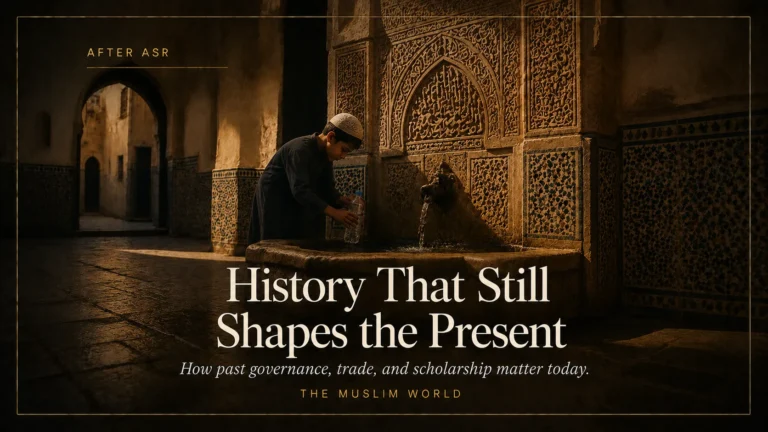
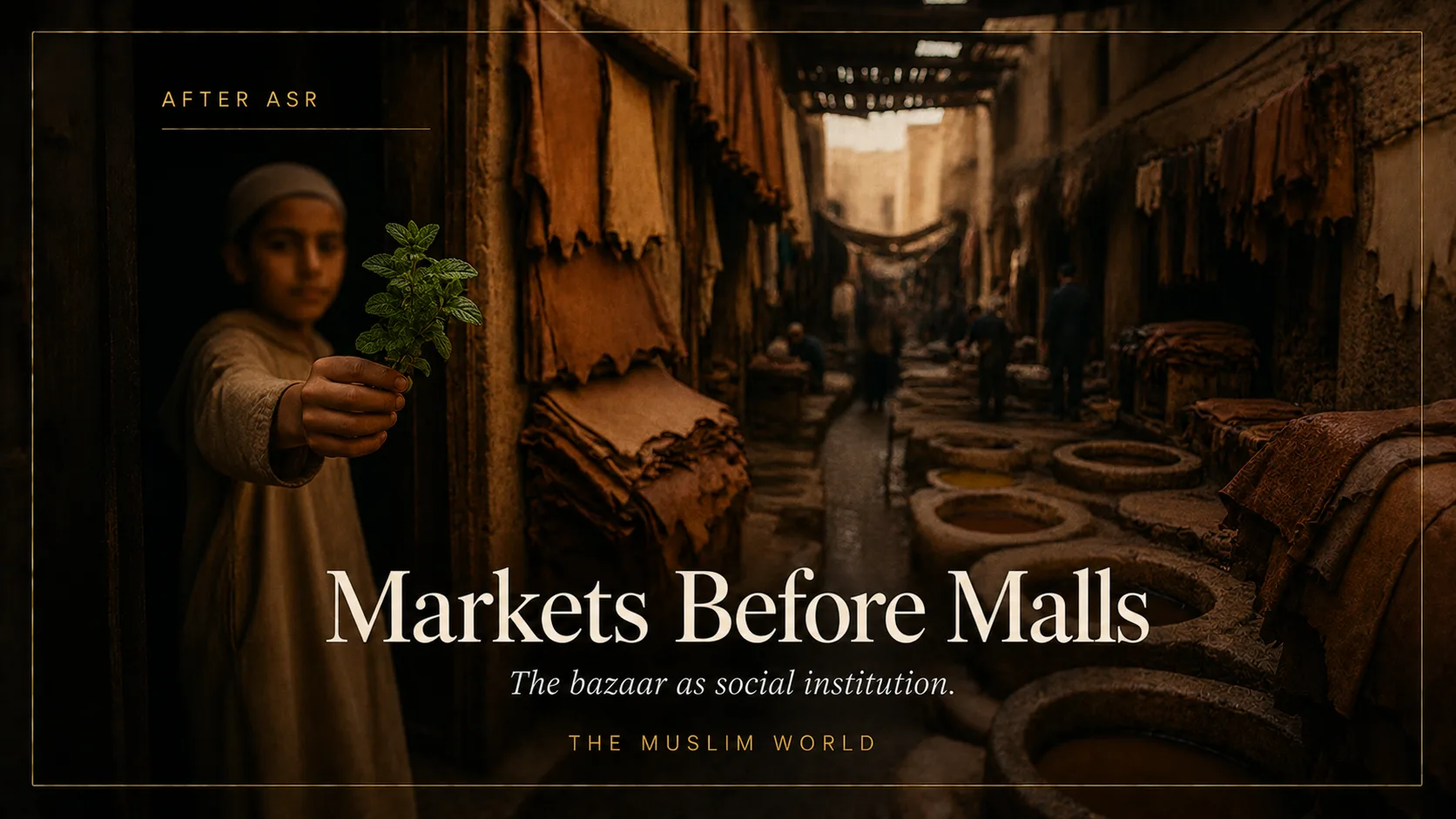
In the old city of Fez, you can smell your way to the tanneries.
Before you see the dye pits, the leather reaches you: sharp, ancient, unmistakable. A boy presses a sprig of mint to your nose and grins. He has done this for a hundred tourists and a thousand neighbors.
You have not entered a shopping district. You have entered an organism.
A Mall Sells You Things; A Bazaar Holds a City
A shopping mall is a machine for selling. It is climate controlled, anonymous, and interchangeable. You could be in Dubai or Dallas and not know the difference. It wants your money and not your name.
The bazaar wants both. It is where a city keeps its accounts, arranges its marriages, spreads its news, and settles its scores. Commerce is only the surface of it. Underneath runs everything else a community needs to do to remain a community.
Zoom out from that single mint-scented lane in Fez and you see a structure older than most nations, repeated across a continent: the suq, the souk, the bazaar, the pasar. Then narrow back to the lane, where a man is not selling leather so much as continuing a conversation his grandfather started. That is the difference. The mall has customers. The bazaar has neighbors.
The Map of the Souk Is a Map of Trades
The first thing to understand about a bazaar is that it is not random. It is organized by craft, and the organization is centuries deep.
There is the coppersmiths’ lane, where the hammering never stops. There is the spice row, where the air changes color. There is the gold souk, the cloth hall, the street of the dyers, the alley of the bookbinders. To know where a thing is made is to know where to buy it, and the whole city carries the map in its head.
Widen the lens and this is a guild geography, each trade a self-governing body with its own elder, its own standards, its own apprentices. Narrow back to one apprentice sweeping copper filings from the floor at dawn. He is not merely working a job. He is being admitted, slowly, into a lineage with an address.
Before Dawn, the Wholesale City
The retail bazaar you walk through by day was fed, before dawn, by another market you never see. Wholesale happens in the dark.
At the produce grounds and the fish quays, the day’s real prices are set while the city sleeps. Trucks and handcarts arrive by lamplight. Crates of tomatoes, mounds of mint, silver heaps of sardines change hands in a fast, shouted language of their own. By the time the shopper reaches the stall, the drama is over and the goods are simply there.
Zoom in on one porter carrying a crate twice his width through the gray light. Zoom out and this hidden market underlies every visible one, a second city that works while the first rests. The bazaar the visitor photographs is only the afternoon of a day that began in the middle of the night.
Price Is a Conversation, Not a Number
To a Western eye, haggling looks like conflict. Inside the bazaar it is closer to courtship.
The first price is not a demand. It is an opening line. What follows is an exchange in which both parties learn about each other: where you are from, whether you are in a hurry, whether you know the trade, whether you can be trusted to return. The tea that appears midway is not a trick. It is the point.
Zoom in on one negotiation over a carpet, an hour long, ending in a price neither could have named at the start. Zoom out and this is how an entire economy priced itself before the barcode, through relationship rather than sticker. The number you finally agree on is almost incidental. What you have really established is that the two of you now know each other.
The Caravanserai Was the First Hotel
Trade needed shelter, and so the Muslim world built the caravanserai, the khan, the funduq. On the edges of the bazaar and along the roads between cities, these great courtyards housed travelers, their animals, and their goods.
Downstairs the camels rested and the bales were stored. Upstairs the merchants slept. In the courtyard, over the evening meal, news moved: prices in the next city, a war on a distant road, a new fashion in a faraway court. The caravanserai was hotel, warehouse, and wire service in one.
Widen the lens and a chain of these buildings stitched the trade routes together from the Atlantic to China. Narrow back to one traveler unrolling his mat in a strange city, listening to a stranger describe a market he has never seen. Tomorrow he will carry that description a hundred miles further. The goods moved on camels. The information moved on tongues.
The Merchant Carried More Than Cargo
The bazaar merchant was never only a seller of things. He was a carrier of worlds.
He moved between cities and cultures, learned languages, married into distant families, and kept the trust that made long-distance trade possible at all. Faith itself traveled in his saddlebags. Whole regions became Muslim because merchants, not armies, arrived first and stayed. Commerce was the introduction; belief followed the friendship.
Zoom in on one trader from Gujarat setting up in a Malay port, taking a local wife, opening a shop. Zoom out and this quiet pattern, repeated ten thousand times over centuries, redrew the religious map of half the world. The bazaar was not only where goods changed hands. It was where civilizations were introduced to one another.
Credit Written in a Worn Notebook
Long before banks reached these streets, the bazaar ran on credit, and the credit ran on reputation.
A merchant’s word was his collateral. Debts were kept in a notebook or in memory, settled at the harvest or the festival. Money could be sent across a continent through the hawala system, a note honored by a trusted man in a distant city, with nothing crossing the desert but confidence. The whole apparatus rested on the certainty that a man who cheated would be finished.
Widen the lens and this was a financial network of real sophistication, moving value across borders without a single coin traveling the road. Narrow back to one shopkeeper letting a widow buy on account until her son is paid. The ledger in his drawer is not just arithmetic. It is a record of who, in this quarter, can be believed.
The Muhtasib Kept the Market Honest
A market that runs on trust still needs a guardian, and the Muslim world invented one. His title was the muhtasib, the inspector of the market.
He checked the scales for false weights. He tested the bread for short measure. He judged whether a trade was fair and a claim was true. His office sat at the meeting point of commerce and conscience, for cheating a buyer was not merely bad business but a sin. The market was understood to be a moral space, not a lawless one.
Widen the lens and this was regulation rooted in religion, the belief that God watches the balance in a merchant’s hand. Narrow back to one inspector, centuries ago, tipping a grain seller’s scale to test it before a watching crowd. The modern agencies that weigh our bread have an ancestor, and he answered to more than a ministry.
The Great Bazaars Were the Great Cities
To name the famous bazaars is to name the crossroads of the old world. Each was the beating chamber of its city.
The Grand Bazaar of Istanbul, thousands of shops under one vaulted roof. The covered markets of Isfahan, ringing a royal square of blue tile. The souks of Marrakech spilling from the great mosque. The old market of Sana’a, packed into a city of gingerbread towers. Each was not a feature of its city. It was the reason the city existed.
Zoom in on one gold merchant in the Istanbul bazaar, third generation behind the same counter. Zoom out and behind him stretch five hundred years of the same trade, the same vaults, the same slow choreography of buyers and sellers. Empires rose and fell over his head. The bazaar simply changed its currency and carried on.
The Spice Road Ran Through Here
Pick up a pinch of saffron in a Persian bazaar and you are holding one end of a very long rope. The other end reaches back through centuries of trade.
Pepper from India, frankincense from Arabia, silk from China, coffee from Yemen: these moved through the bazaars of the Muslim world before Europe found a sea route around them. Fortunes turned on a sack of cloves. Wars were fought over who controlled the road. The spice in a grandmother’s pot is the faint residue of a global economy she never studied.
Widen the lens and the bazaar sat astride the richest trade on earth, the hinge between East and West. Narrow back to one vendor weighing cardamom on a brass scale, calling the price in a singsong his father used. He is the last visible link in a chain that once decided the wealth of nations.
The Mosque and the Market Share a Wall
In the classic Muslim city, the great mosque and the main bazaar stand side by side, often sharing a wall. This is not an accident of planning. It is a statement.
Faith and commerce were never meant to live in separate quarters. The merchant prays between customers. The rent from the shops often endowed the mosque, the school, the fountain. When the call to prayer sounds, the bazaar half empties, then fills again, the two rhythms folded into one day.
Zoom in on one draper rolling down his shutter for the noon prayer, trusting his neighbor to watch the goods. Zoom out and the whole city is built on the assumption that a man can be devout and a dealer at once, that the sacred and the practical are roommates. The wall between mosque and market is shared because, in the older imagination, there was never really a wall at all.
Women Were Always in the Market
The stereotype keeps the Muslim woman at home. The bazaar has never agreed.
In the markets of West Africa, women dominate the trade, controlling whole sectors of the economy from behind their stalls. In Yemen and Morocco and Indonesia, women sell, buy, lend, and bargain with formidable skill. The great markets of some cities would collapse without the women who run them, and everyone in the trade knows it.
Zoom in on one trader in a Kano market, a woman who has sold cloth for forty years and sits at the center of a web of debts owed to her. Zoom out and the image of the silent, sheltered Muslim woman dissolves in the noise of the marketplace. The camera that keeps her indoors has simply never followed her to work.
The Bazaar Is Also a Newsroom
Before there were newspapers, there was the market, and the market missed nothing.
Rumor, politics, scandal, and price all traveled the same lanes. To learn the true mood of a city, a ruler would send men to listen in the bazaar, because the bazaar knew before the palace did. When the merchants shuttered their shops in protest, governments trembled. More than one regime has been shaken by a market that decided to close.
Widen the lens and the bazaar has been a political force across the region’s history, its shutters a kind of vote. Narrow back to two shopkeepers over tea, deciding what they think of a new decree, their verdict rippling outward stall by stall. Power feared these streets for a reason. A place that trades in everything trades in opinion too.
What the Mall Cannot Replicate
The mall arrived in the Muslim world with air conditioning and imported brands, and it is genuinely popular. It is cool, clean, and predictable. It should not be dismissed.
But it cannot do what the bazaar does. It cannot remember your father. It cannot extend you credit on a handshake. It cannot be the place where the neighborhood decides what it thinks. The mall optimizes the transaction and quietly deletes everything around it: the relationship, the reputation, the belonging.
Zoom in on a teenager in a Cairo mall, buying the same sneakers sold in forty countries. Zoom out and something is being standardized that used to be particular, a local economy folding into a global catalogue. The bargain the mall offers is real. So is the thing it asks you, without saying so, to give up.
The Bazaar Bends but Does Not Break
It would be easy to write the bazaar’s obituary. It has survived a great deal, and it is surviving this too.
It has outlasted empires, colonization, and the first arrival of the department store. Now it faces the mall and the phone screen. Yet the old markets adapt: the coppersmith takes orders by messaging app, the spice seller ships worldwide, the carpet dealer posts his rugs online and still serves tea to the buyer who comes in person. The form is ancient. It is not fragile.
Widen the lens and you see an institution that has always changed its wares while keeping its soul. Narrow back to one young shopkeeper photographing his goods for a customer three countries away, standing in a shop his family has held for two hundred years. He is not betraying the bazaar. He is doing exactly what it always did: reaching the next market over.
The Coppersmith’s Son
Return to the lane of the coppersmiths, because the essay owes it a return. The hammering is a family sound.
The old man at the anvil learned from his father, who learned from his. His son is at university now, studying engineering, and may not take up the hammer. The father says he understands, and mostly he does. But he keeps a small tray polished, in case the boy changes his mind, and he tells no one that he does.
This is the quiet drama beneath every stall: a trade deciding whether it will survive one more generation. The bazaar is not a monument. It is a relay, and the baton is always, just now, being offered to someone who has other plans.
What You Buy Is Not the Point
In the end, the thing you carry home from the bazaar is the least of it. The transaction was never really about the object.
It was about being known, being placed, being folded for an hour into the life of a street. You came for a lamp and left having been asked about your family. That is the good the mall cannot stock. It is not for sale, and it is the most valuable thing the market holds.
Zoom out one last time over the whole covered city of stalls, and it looks like commerce. Look closer and it is something older. It is a machine for keeping people in each other’s lives.
The Lane Closes at Dusk
At day’s end the shutters come down, one after another, along the lane.
The copper goes quiet. The spices are covered. The tea glasses are washed and stacked.
The boy with the mint has gone home. Tomorrow he will be back at the mouth of the tannery street.
Nothing here was only bought or sold. Everything here was also witnessed.
A market is a place. A bazaar is a way of belonging.