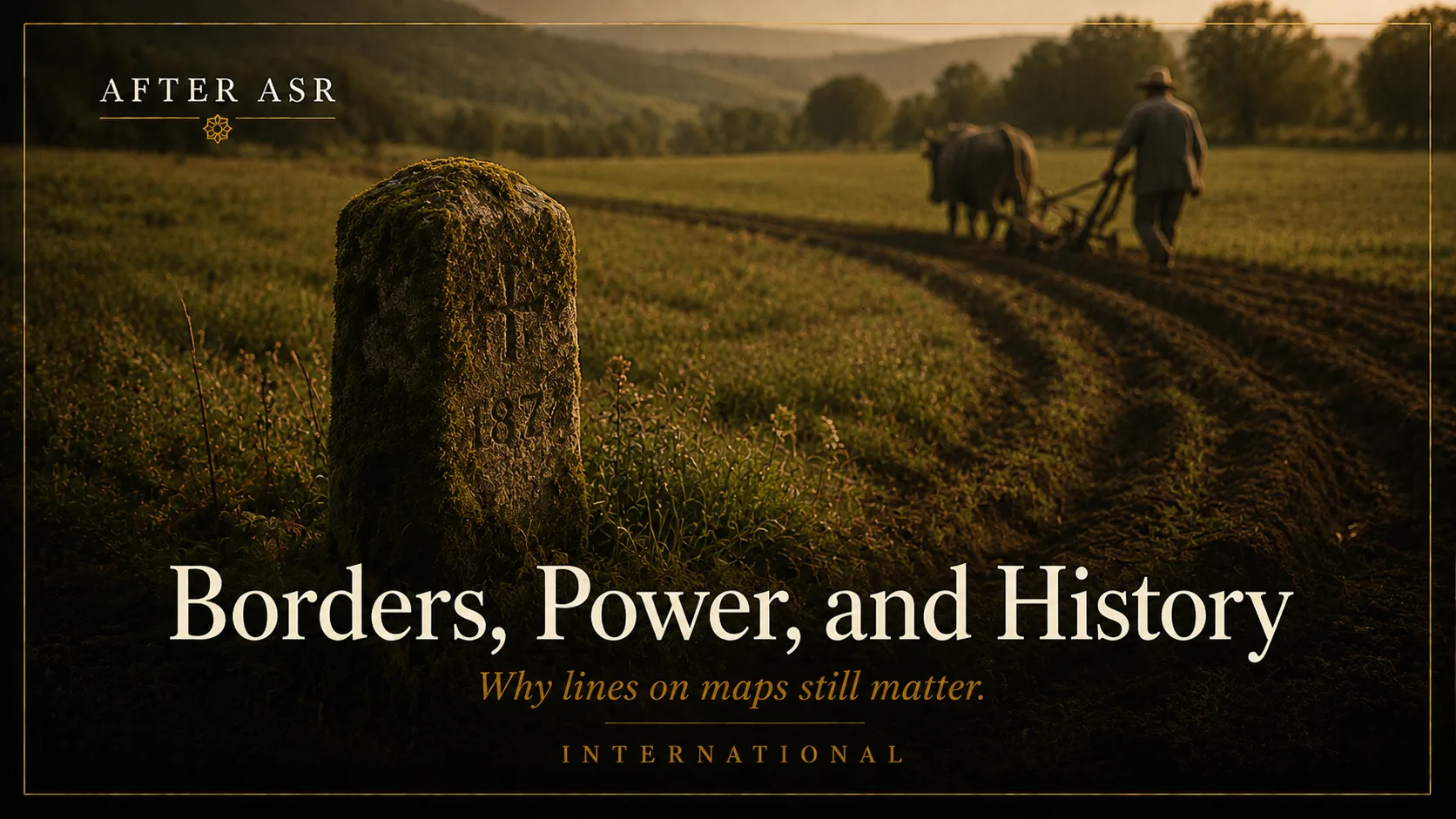
In a green meadow somewhere in Europe stands a short stone pillar, half swallowed by moss.
A farmer plows around it every spring without a second thought. His grandfather did the same.
That stone decides which country the wheat belongs to, which army, which tax, which war.
The Stone in the Meadow
The pillar is unremarkable. A boot could kick it over. Yet it carries an astonishing weight.
Someone, long ago, agreed that the world would be sorted at exactly this spot. On one side of the stone, the children go to one kind of school and salute one kind of flag. On the other side, a few paces away, everything is different, though the soil and the sky are the same.
Zoom out and this stone is one knot in a net of such markers that circles the entire planet. Every state on earth is defined by a chain of these agreements, stone to river to fence to sea. Narrow back to the farmer, who does not think about the net at all. He thinks about rain. The border is the largest fact in his life and the one he notices least.
A Border Is a Decision, Not a Discovery
We speak of borders as if explorers found them lying in the grass. No one ever did.
A border is a choice, made by people with power, at a particular moment, for particular reasons. It is written down, defended, and then, after a few generations, mistaken for something eternal. The oldest-looking line on the map was once a fresh decision that surprised the people it divided.
Widen the lens and there is nothing in nature that says a border must run here rather than there. Narrow back to the treaty table where tired men traded valleys like cards, one river for one mountain, a people handed across in a single afternoon. The grass did not consent. The grass was never asked. The line is an act of will pretending to be a fact of geography.
Rivers and Mountains Are Not as Honest as They Look
The most natural-seeming borders follow rivers and ridgelines. They seem obvious, God-given, beyond dispute.
But a river is a poor fence. It shifts its bed over the years, and the border shifts with it, or does not, and then two states argue over a strip of mud that changed sides while everyone slept. A mountain range has passes and valleys where peoples mingle regardless of the peak above them. Nature does not draw clean lines. We only pretend it does.
Zoom out and whole legal disputes have hinged on which channel of a wandering river counts as the true one. Narrow back to a farmer whose field crossed into another country because a flood moved the water fifty meters east. He did nothing. He committed no act. The river emigrated, and took his back acres with it.
The Straight Lines Tell on Themselves
Look at a map and find the borders that run dead straight for hundreds of miles. Those lines are confessions.
No people, left alone, ever settled themselves along a perfect ruler’s edge. A straight border means someone far away drew it with an instrument, ignoring the rivers, the tongues, and the families on the ground. The straighter the line, the more distant the hand that made it, and the more indifferent that hand was to who lived beneath.
Widen the frame and the arrow-straight borders of certain continents are the signatures of empires that measured from capitals across the sea. Narrow back to a village that a ruler’s line cut in two, its well on one side and its graveyard on the other. The people never chose the ruler. The ruler never saw the well. The line is still there.
A Wall Is an Argument in Concrete
Some borders are content to be a stone in a meadow. Others rise into walls you can see from a hill.
A wall is a border that has stopped trusting agreement and turned to concrete instead. It says, in the plainest material, that the line will be held by force and not by consent. Walls are built not where states are confident but where they are afraid. The height of the wall measures the depth of the fear.
Zoom out and walls have ringed cities, split nations, and snaked across deserts for as long as there have been states with something to keep out. Narrow back to a child who grows up with a gray slab at the end of her street, learning early that the world is a place with an other side she may not see. The wall teaches before any school does. It teaches that some lines are meant to wound.
The Checkpoint Is Where the State Touches the Body
A border on a map is abstract. At the checkpoint it becomes a hand on your shoulder.
Here the vast machinery of the state narrows to a single booth, a single officer, a single question about who you are and why you wish to pass. Your documents are weighed. Your face is compared to a photograph. For a moment the entire power of a nation is concentrated on the small matter of whether you, specifically, may cross.
Widen the lens and millions pass through such booths each day, sorted and stamped and turned back across the earth. Narrow back to one traveler whose papers are not quite right, standing to the side, watching others go through. The line on the map did not feel real to him until this moment. Now it is the most real thing in the world.
Who Draws the Line Holds the Power
Mapmaking looks like a gentle craft of ink and paper. It is one of the oldest instruments of power.
To draw the map is to decide what is inside and what is outside, what is central and what is edge, what has a name and what is left blank. Empires always sent their surveyors close behind their soldiers. The map did not describe the conquest. It completed it, turning seized ground into settled fact.
Zoom out and the power to name a place, to fix its border and print it in an atlas, is the power to make a claim look like a truth. Narrow back to a schoolroom where children trace their country’s outline in colored pencil, absorbing as nature what was once a fierce and bloody argument. The map hides its own violence. That hiding is its purpose.
The Map Came After the Army
We imagine borders as the cause of wars. More often they are the residue of them.
A border is usually where two armies finally stopped, exhausted, and agreed to call the mud between them a line. Later the line is dressed in law and treaty and made to look reasonable. But under most calm borders lies an old battlefield, and the calm is only the memory of who won.
Widen the frame and the whole map of the world is a snapshot of the last time force paused to catch its breath. Narrow back to a quiet border crossing where families now picnic on either side, unaware that the tidy fence marks where a generation once bled into the grass. The picnic is a mercy. It is also an amnesia. The line remembers what the picnickers have forgotten.
The Line Manufactures the Smuggler and the Refugee
Draw a border, and you create in the same stroke two figures who did not exist before it.
On one side, the smuggler, who moves goods the line has made illegal by the mere act of dividing them. On the other, the refugee, who becomes a foreigner by crossing a line his ancestors walked freely for a thousand years. Neither did anything but continue an old habit. The border reclassified them as criminal and stranger.
Zoom out and vast economies of contraband and vast tragedies of displacement are conjured into being by lines on maps. Narrow back to a woman carrying flour across a border that split her market town, now a criminal for feeding her family the way her mother did. She did not move. The line moved through her livelihood. The law found her on the wrong side of a stone.
A Line Can Split a People or Invent a Nation
Borders do not only divide. Over time, they also create the very peoples they claim merely to contain.
Draw a line and keep it for a century, and the people on each side begin to drift apart, in dialect, in schooling, in the songs their children learn. The border becomes a mold. What began as one people slowly hardens into two, each convinced it was always distinct. The line did not find a difference. It manufactured one, patiently, over generations.
Widen the lens and some of the proudest nations on earth are the children of borders their ancestors once cursed as artificial. Narrow back to two cousins on opposite sides of such a line, who now feel foreign to each other though their grandparents were one household. Time did that. The border gave time its instructions, and time obeyed.
The Frozen Conflict
Some borders are neither settled nor at war. They sit in a cold, permanent argument.
A frozen conflict is a line that both sides reject and neither will move, held in place by soldiers who grow old at their posts. No treaty ends it. No battle decides it. Generations are born, raised, and buried alongside a dispute that never resolves and never quite explodes. The stone in the meadow becomes a wound that will not close and will not kill.
Zoom out and several such frozen lines cross the modern map, quiet on the news for years, then suddenly deadly. Narrow back to a shepherd who has grazed his flock in sight of an enemy trench his whole life, on speaking terms with the soldiers, hostage to a quarrel above his head. He did not start it. He cannot end it. He simply lives on its edge, as his father did.
Enclaves and the Strange Geometry of Power
Now and then the map produces shapes that seem to mock all reason. A piece of one country marooned inside another.
An enclave is a scrap of territory surrounded entirely by a foreign state, reachable only by crossing another country to get home. These oddities are the fossils of old marriages, wars, and bargains, frozen into the map long after anyone remembers why. They look absurd because they are the leftovers of forgotten power.
Widen the frame and there are villages where a person crosses an international border to fetch bread and crosses back to sleep. Narrow back to one family whose kitchen and bedroom lie technically in two different states, a border running through the house because of a treaty older than the plumbing. They laugh about it. They also carry two sets of papers. The absurd geometry is their daily life.
Borders in the Sea and the Sky
Not every border is a stone you can touch. Some run through open water and empty air.
Nations draw lines across the sea to claim the fish and the oil beneath, and across the sky to control who may fly above. These borders are invisible, yet fleets patrol them and aircraft are turned back at them. The ocean looks free and lawless. It is in fact one of the most carefully divided surfaces on earth.
Zoom out and the richest disputes of the coming century may be over undersea lines no eye can see. Narrow back to a fisherman who has cast his nets in the same bay for forty years and is now told the water past a certain unmarked point belongs to another flag. The fish do not know the line. The fisherman is punished for their ignorance and his own.
The Border That Runs Through a Person
The strangest borders are not on any map at all. They run down the middle of a single human being.
A person born of two peoples, or raised across a line, carries the border inside. He belongs fully to neither side and is questioned by both. The checkpoint he passes most often is the one in his own name, his own accent, his own divided loyalty. No stone marks it. He feels it every day.
Widen the lens and millions live along this inner frontier, the human proof that borders never divide as cleanly as maps promise. Narrow back to one man at a family gathering, translating between his mother’s people and his father’s, at home in both languages and fully trusted by neither. He is not confused. He is the living evidence that the line was always too simple for the life it tried to cut.
A Border Can Also Be a Shield
It would be dishonest to speak of borders only as wounds. A line can also protect the ones inside it.
For a small people surrounded by larger neighbors, a recognized border is the difference between self-rule and absorption. It marks the space where their language is safe, their laws are their own, their children answer to no distant capital. Not every fence is cruelty. Some fences are the only reason a small nation still exists at all.
Zoom out and much of the world’s decolonization was a struggle precisely to win a border, to turn a ruled territory into a country of its own. Narrow back to a citizen of a tiny state, voting in his own tongue, governed by neighbors rather than strangers. The line that hems him in also holds his freedom. A border, like a wall of a house, can imprison or it can shelter. Often it does both at once.
The No-Man’s-Land Between the Lines
Between two hostile borders there is often a thin ribbon of ground that belongs to neither. It has its own strange life.
In this buffer, mines may rust and grass may grow tall, and wildlife may thrive precisely because no human dares to enter. The no-man’s-land is what power leaves empty when two states cannot agree who owns the middle. It is the negative space of the map, defined entirely by fear on both sides.
Widen the frame and some of these strips have stood untouched for generations, accidental wildernesses guarded by watchtowers. Narrow back to a deer crossing freely where no person may walk, indifferent to the flags on either fence. The animal has solved the border by ignoring it. Only the humans remain trapped by the line they drew.
Why the Line Still Matters
In an age of instant messages and global trade, we are told borders are fading. On the ground, they are not.
The line still decides which passport opens which door, which child gets which vaccine, which family may flee and which must stay. For the powerful, borders soften into a formality. For the poor, they remain a wall that can end a life. The privilege of finding borders quaint belongs only to those the borders have chosen to favor.
Zoom out and the same globalized world that carries a video around the earth in a second will still turn a hungry family back at a fence. Narrow back to the stone in the meadow, small and mossy, deciding everything. It has not faded. It has only learned to look harmless.
The Stone Remains
The farmer finishes his row and turns the plow at the pillar, as he always has.
He does not read history in it. To him it is a nuisance in the middle of good soil, a thing to steer around.
But empires rose and fell to place that stone. Armies bled to keep it there.
The wheat grows on both sides, indifferent, green.
The line is invisible and the line is everything.
Someone drew it. Someone can redraw it.
Until then, the farmer plows around the stone.