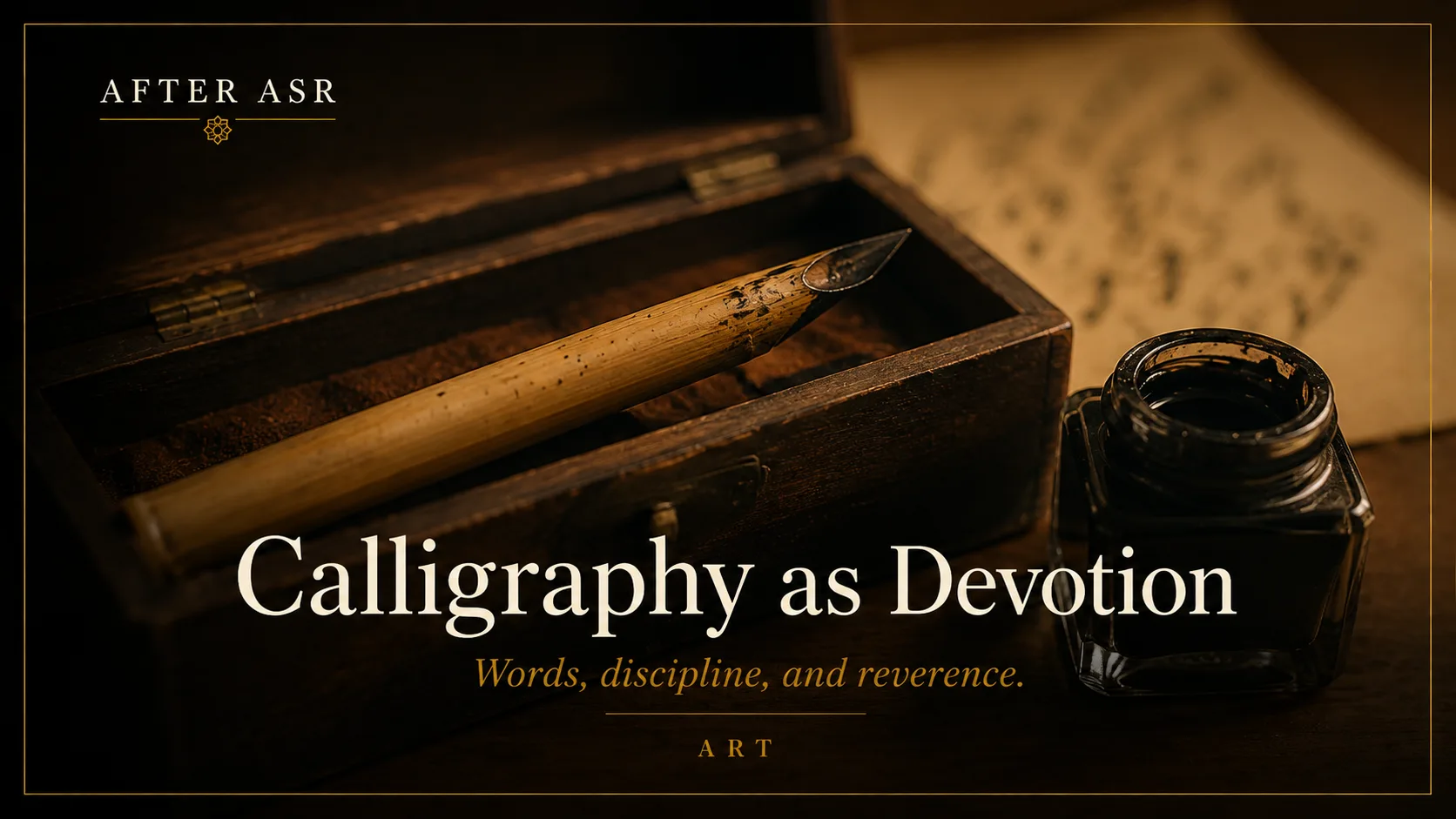
A reed pen lies in a wooden box on the calligrapher’s table, cut at a slant, its tip darkened where the ink has soaked in.
It is a plain thing, hardly longer than a finger, the color of dried honey. You would step over it in a field and never look twice. Yet a whole life of discipline runs through it, from the marsh where it grew to the page where it will lay down the name of God.
The reed was a marsh plant before it was ever a pen
The qalam begins its life standing in shallow water, one stalk among thousands, bending in the wind with no idea of the word it will one day carry. It is cut, dried, sometimes buried for months so the fibers harden and the color deepens to amber. Only then does it come to the table.
I find something instructive in that origin. The instrument of the highest sacred art in our tradition is a common weed from a wet field, given years and patience until it is fit for the work. Nothing about the reed was precious to begin with. It was made precious by preparation. The pen is the first lesson before a single letter is written, and the lesson is that readiness is slow.
The knife, and the cut that decides everything
Before the reed can write, it must be cut, and this cut is the most guarded skill the calligrapher owns. A small sharp knife pares the reed to a point, hollows it, and then, on a hard surface of bone or shell, slices the tip at a precise angle. A hair too wide, a degree too steep, and every letter that follows will be subtly wrong.
Masters have said that half of writing is in the cutting of the pen. The student may spend a long apprenticeship simply learning to shape the nib before he is trusted to make a single fair line with it. The cut is invisible in the finished page, and it governs the finished page completely. So much of devotion is like this. The part that decides everything is the part no one will ever see.
Ink made of soot and gum and patience
The black ink was not bought in a bottle. It was made, often by the calligrapher himself, from soot gathered off the inside of a lamp, ground with gum and water for hours until it flowed without settling. Some recipes took days. Some were perfumed. Some were kept as family secrets.
To make your own ink is to be joined to the whole of the work, from the smoke to the sentence. The calligrapher who grinds his ink at dusk is already praying, in a sense, before he has written a word. There is no shortcut in it. A poor ink betrays a fine hand, and so the maker learns to give patience to the invisible foundation and not only to the visible flourish. The reverence starts in the inkwell. The soot was a residue, the leaving of a burnt lamp, the sort of thing anyone else would wipe away and discard. In the calligrapher’s hands that residue became the very body of the sacred word. Nothing in this craft is too lowly to be lifted, if it is lifted with care.
Paper that had to be earned before it could be written on
The page, too, was prepared. Raw paper was sized with a wash of starch and egg white, then burnished, rubbed for a long time with a smooth stone of agate until the surface gained a faint sheen and the pen could glide without catching. A well-prepared sheet might be set aside to cure for a year before anyone wrote on it.
Think of what that means about the value placed on the word to come. The surface that would hold sacred text was polished like a mirror before a single letter touched it. Nothing was casual. The paper was made worthy of what it would carry, exactly as the reed was, exactly as the maker hoped to make himself. Preparation everywhere, before the work anywhere.
Years pass before the first fair copy
A student of this art does not write a beautiful page in his first year, or his third. He copies the forms his master sets before him, over and over, and brings them to be corrected, and copies them again. The road to a license can run many years, and much of it is spent on a handful of letters.
We are not used to this kind of slowness. We want the skill in a season. But the calligrapher submits to a long obedience, trusting that the hand is being trained below the level he can feel. Discipline here is not punishment. It is the shape love takes when it means to last. The years are not an obstacle before the art. The years are the art, becoming a person.
The single letter, practiced a thousand times
Much of the training begins with the alif, the simple upright stroke, the first letter, a single vertical line. It looks like the easiest thing in the world. It is among the hardest. The alif must be exact in its length, its lean, its weight, its beginning and its ending, because every other letter is measured against it.
To draw one line, correctly, ten thousand times is a strange and humbling labor. The student who masters the alif has not merely learned a stroke. He has learned to give total attention to something small, to accept correction without wounded pride, to find in one plain line an entire discipline. The upright letter teaches uprightness. You cannot rush the alif, and it will not let you pretend you have.
The blackened sheets of repeated practice
There is a kind of practice sheet, treasured now, where the calligrapher wrote the same phrase again and again across the same page, and then across it once more at a new angle, and again, until the paper is almost solid black with overlapping words. Nothing on it can be read. It was never meant to be read.
These blackened pages are among the most moving objects in the whole tradition, to me. They are pure devotion, made visible. A person sat and wrote and wrote, not to produce a text but to wear a groove into the hand and the soul, filling the sheet until the words became a dark field of effort. The unreadable page is the truest record of a hidden discipline. It is prayer you can hold.
The body learns to sit before the hand learns to write
Calligraphy is not only in the fingers. The calligrapher learns how to sit, how to hold the paper on the knee rather than flat on a table, how to move the whole arm and not merely the wrist, how to breathe so the line does not tremble. The body is trained into stillness so the hand can be free.
There is a quiet kinship here with the postures of prayer. In both, the outer body is composed and disciplined so that something inward can happen without obstruction. The steadiness of the hand rests on the steadiness of the breath, which rests on the steadiness of the heart. You cannot write a calm line with an agitated soul. The page is honest that way, and the discipline reaches all the way down.
The scripts each have a temperament of their own
There is not one hand but many, and each carries its own character. There is the clear, upright script made for the reading of the Quran, plain and legible and steady. There is the grand, sweeping script that rises across the walls of mosques, majestic and architectural. There is the hanging, flowing script beloved of the Persian poets, where the line seems to lean and pour.
A calligrapher learns these as a musician learns modes, and each demands its own discipline of the hand. To move from one to another is to change one’s whole bearing at the table. The scripts are a vocabulary of reverence, ranging from the humblest legibility to the most soaring praise. The tradition kept them all, and asked the master to be at home in more than one, so that the word could be dressed in a manner fitting its place.
To write the revealed word is to approach it clean
Many calligraphers would not write the name of God, or a verse of the Quran, without first performing the ablution, the same washing they made before prayer. The hand that formed the sacred word came to it purified, as the body comes to prayer purified. I hold this practice with great respect and will not reduce it to a rule.
What it shows is how completely the writing was understood as an act of reverence and not merely of skill. The scribe was not illustrating a text. He was serving one. The word he copied was, to him, the most precious thing that could pass through a human hand, and he prepared himself for it as he would prepare to stand before its Author. Devotion is the right word for this. It is not a metaphor.
Even the corrected mistake was treated with reverence
If a scribe copying the Quran made an error, he could not simply cross it out and hurry on as he might with any other page. The word he had set down was too weighty for that. In some traditions the mistaken text was washed from the page with water, and the water itself, having carried letters of the sacred word, was not poured down a drain but buried in clean ground or given to the roots of a tree.
Imagine the care folded into that. Even the washing water of an error was treated as holy, because letters of revelation had passed through it. Nothing the sacred word had touched could be thrown away without thought. This is reverence carried to its furthest and gentlest edge, reaching even into the correction of a slip of the hand. The mistake was not despised. It was honored, gently cleaned away, and returned to the quiet earth.
The master’s correction, and the license passed hand to hand
The student’s work went back to the master, who marked it, praised a stroke, condemned another, and sent it home to be done again. This went on for years, until at last the master judged the student ready and granted him a license, an ijaza, written in the master’s own hand, permitting him now to sign his work and to teach.
That license linked the student to a chain of teachers running back through the centuries, hand to hand to hand. He did not invent his art. He received it, guarded it, and would one day pass it on. There is a deep humility built into this. The calligrapher is a link, not a source. He holds something older than himself and hands it forward, slightly more alive for having passed through his years of care.
Discipline turns out to be a form of love
We tend to hear the word discipline as a cold word, a matter of rules and denial. The calligrapher’s life quietly corrects us. All that repetition, all that correction, all those blackened sheets, are not the opposite of love. They are what love looks like when it refuses to be careless with the beloved.
You do not spend ten years learning to lay down one line for a thing you hold cheap. The discipline is the measure of the devotion, and the devotion is the reason for the discipline. Each proves the other. The student endures the long obedience because the word at the end of it is worth an endurance. Reverence without discipline is only a feeling. Discipline is reverence that has agreed to do the work.
The letter has a body, and the body has a law
The great masters measured their letters. The height of the upright was counted in a stack of small rhombic dots, each dot the mark of the pen pressed once to the page. A curve had its proper depth, a loop its proper roundness, all reckoned against that unit. The beauty was not loose inspiration. It rested on a hidden geometry of proportion.
This is the paradox at the heart of the art. The freest, most flowing line is built on the strictest measure. The letter is a body, and the body obeys a law, and only through obedience to the law does it become graceful rather than merely correct. The dot is the atom of the whole tradition. From that single pressed mark, an entire architecture of the written word is raised.
The calligrapher signs himself the poor one
When at last a master signed a finished work, the old habit was not to boast. Many signed with a formula of humility, calling themselves the poor one, the needy one, the servant, adding that the piece was written by one who is poor before his Lord. The finest hand in a city might sign as a beggar.
I find this the tenderest detail of all. A lifetime of discipline, a skill few could equal, and the signature it earns is a confession of poverty before God. The art did not swell the maker. It emptied him. The more he could do, the smaller he understood himself to be against the word he was permitted to write. That is the fruit of true devotion. It ends not in pride but in a grateful smallness.
In the end the hand disappears and the word remains
The aim of all this labor is strange to say plainly. It is that the reader, meeting the finished page, should not think of the calligrapher at all. The hand that spent forty years learning to vanish has vanished, and only the word is left, standing clear and radiant, as though it wrote itself.
The highest craft erases the craftsman. The line is so sure, so inevitable, that it seems never to have been made by struggling human fingers at a cluttered table at dusk. This is the last discipline and the hardest. To work a lifetime so that your work will point past you. The reed, the ink, the years, the corrections, all of it spent so that a stranger might read a sacred word and forget there was ever a hand.
The reed, again, in its wooden box
So devotion, in this art, is not a mood that visits the maker. It is a discipline he builds, letter by letter, over a lifetime, until reverence has been written into his hand.
The reed lies in its box, cut and waiting, the color of dried honey.
It was a weed in a marsh once. Now it carries the word of God.
Between those two things lies a whole life of patience.
The calligrapher lifts it and dips it and steadies his breath.
He signs himself the poor one.
And the word, at last, is all that anyone will see.