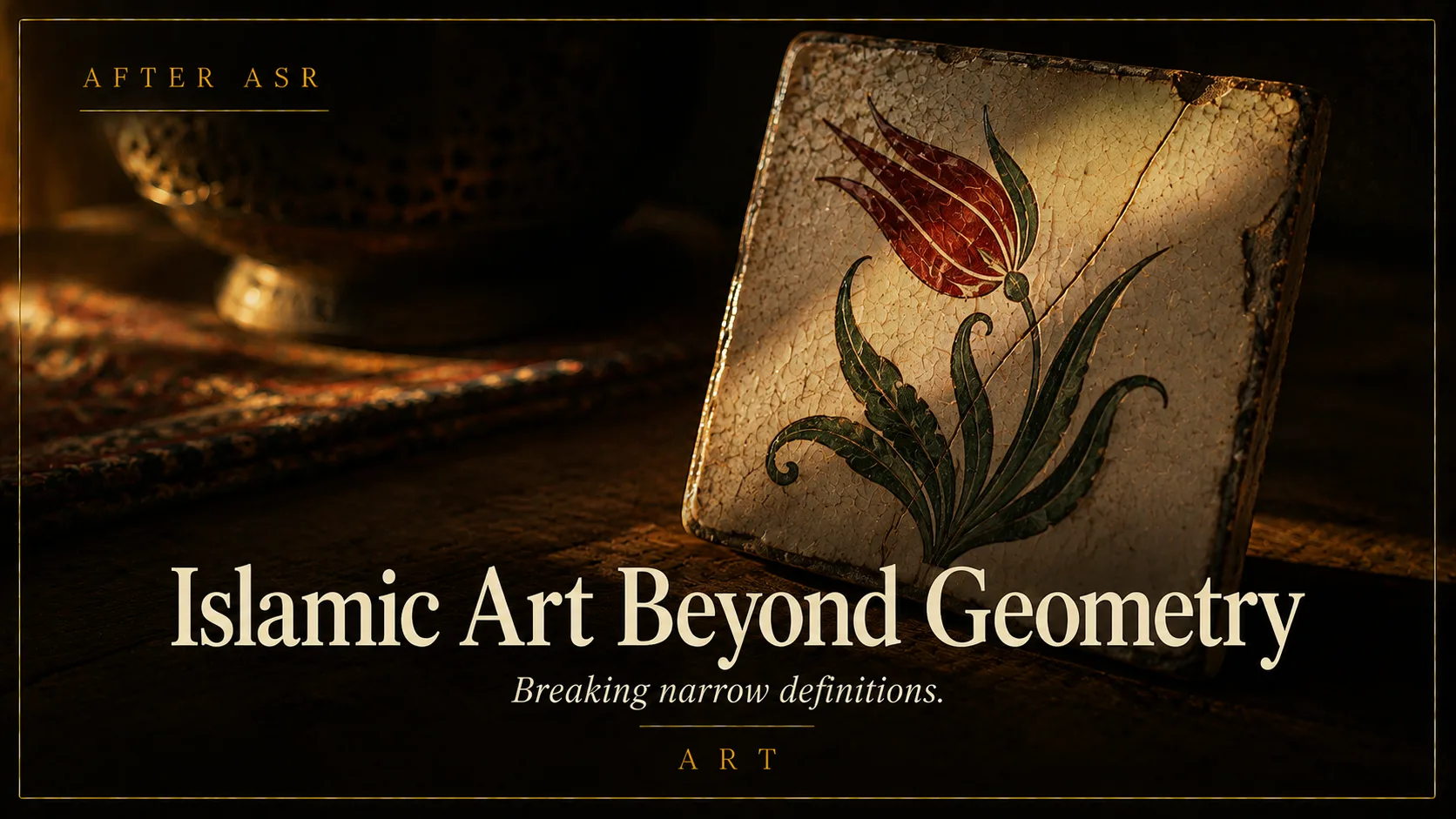
There is a single glazed tile behind glass in a museum I visit, and painted on it is a red tulip leaning on a green stem, with one curling leaf.
The white ground has gone faintly ivory with age. A hairline crack runs through the flower and has been mended so carefully you must look twice to find it. It is five hundred years old. It is a tulip. It is not a triangle, or a star, or a grid.
We have been handed a very narrow picture of what this art is
Ask most people what Islamic art looks like and they will describe geometry. Interlocking stars, endless tessellation, the abstract lattice that covers a dome. They are not wrong that these exist, and that they are glorious. They are wrong only in thinking that this is the whole of it, or even the center of it.
The tile with the tulip should trouble that picture at once. So should the carpet woven as a garden, the bowl painted with a leaping fish, the manuscript page where a small bird sits in a border of gold. A tradition that spanned a thousand years and three continents could never have fit inside a single motif. The narrow picture is a convenience, and like most conveniences it quietly leaves out most of the truth.
The arabesque was always a garden, never merely a grid
Even the pattern that people do call Islamic art is misread when it is called geometric. Look closely at the scrolling ornament we name the arabesque and you find leaves, buds, tendrils, vines that split and rejoin and split again. It is a plant. It is growth, stylized and made rhythmic, but growth all the same.
The maker was not drawing abstraction for its own cold sake. He was drawing a vine that never withers, a garden that does not need a season, a green thing given an order that living gardens can only dream of. To call this geometry is to see the scaffolding and miss the flower climbing it. The pattern is botanical at its root. It remembers the garden even when it grows too perfect to be one. Stand before a wall of it and you feel not the chill of mathematics but the hush of a grove, endlessly branching, going on past the edge of the wall and, you sense, past the edge of the world.
Why the definition narrowed in the first place
Part of the flattening happened on the museum label. It is easier to hang a placard that says geometry and abstraction than to explain a civilization. The tidy story travels well. It fits in a sentence and a classroom, and once it fits there it hardens.
Part of it came from a genuine and important truth, handled too roughly. Our tradition did turn away from images in its most sacred spaces, and I will come to that with the care it deserves. But a caution about certain images inside the mosque was taken, by outsiders, to mean that Muslims made nothing but pattern anywhere at all. From a rule about the sanctuary, a myth about the whole culture was built. The truth was richer and messier and far more alive.
A carpet is a paradise garden you are allowed to walk on
Unroll an old Persian carpet and look at what is actually there. A central pool. Channels of water crossing it. Beds of flowers laid out in quarters. Cypress trees at the borders, birds among the blossoms, sometimes a deer stepping through the field.
This is not decoration in any thin sense. It is a picture of the garden of paradise, brought indoors, laid on the floor of a house that may have no garden at all. A family in a dry city could spread a green meadow under their feet in winter. The weaver was making a landscape you could kneel in, an image of promised mercy that doubled as the place you sat to drink your tea. To reduce that carpet to pattern is to walk across paradise and notice only the weave.
Birds and beasts have always lived in the margins
Turn the pages of an illuminated manuscript and you will meet a small menagerie. A hoopoe perched in a border of gold. A hare in the undergrowth of an initial. Fish circling the inside of a glazed bowl, painted so the water you poured seemed to set them swimming.
These living creatures were made with delight and without apology across enormous stretches of the Muslim world. They fill ceramics, textiles, metalwork, and the painted book. The idea that Muslims never depicted a living thing dissolves the moment you actually handle the objects. The animals are everywhere, drawn by makers who plainly loved them. What was reserved and what was free is a real and careful subject. But the blanket claim that nothing living was ever drawn is simply not what the objects say.
The glazed bowl and the secret of its shine
Take up a bowl of old lusterware and tilt it slowly to the light. The surface flushes gold, then copper, then a strange metallic rose, a shimmer the potters coaxed from the kiln by a process so difficult that whole cities guarded the knowing of it as a secret. Painted in the well of the bowl there might be a bird, a horseman, a spray of leaves.
These bowls were made to be used, and they were used until they chipped. Their makers were chemists and artists in the same breath, chasing a color that changed as you moved. To hold one is to hold a small argument against the idea that this art was austere. There is nothing austere about a bowl that catches fire quietly whenever the light shifts across it. It was made to delight the eye of an ordinary person eating an ordinary meal at the end of a long day.
The book was the great canvas of this civilization
If you want to find where the highest artistic ambition of the Muslim world was poured, look at the book. Not only its words, but the whole made object. The illuminated opening pages worked in gold and lapis. The bindings stamped and tooled in leather. The marbled endpapers where color floated on water and was lifted onto the sheet, so that no two copies were ever the same.
A single fine manuscript could hold the labor of a papermaker, a calligrapher, an illuminator, a painter, a binder, and a gilder, each a master. The book was where they gathered. To think of this tradition as pattern on a wall is to overlook the room where it kept its treasure, which was the page, held in the hand, opened slowly, guarded like an heirloom.
The painters of Persia, India, and the Ottoman court
There were whole workshops of painters who filled books with human figures. Kings on horseback, lovers in a garden, a poet reciting under a tree, whole crowded battles rendered in a hundred small faces. The courts of Persia, of Mughal India, of the Ottomans kept these painters and prized them.
This history has to be held with knowledge and with care. Figuration flourished in the secular and courtly book, in the private and the princely, even as the mosque and the copied Quran were kept free of images by long conviction. There were debates among the learned, and different times and places drew the line in different places. What is false is the flat claim that the drawing of living forms simply did not happen. It happened, abundantly, in its proper rooms, made by Muslim hands.
The word was honored far beyond the shape of the letter
We will speak elsewhere of the letter itself, of the discipline of the reed pen. Here I mean something broader. The arts of the word in Muslim life reached past calligraphy into the poem, the story, the ode recited from memory, the couplet inlaid over a doorway so that the building itself spoke.
A tile over an arch might carry a line of verse. A ring might be cut with a single name. A garden pavilion might have a whole poem set into its walls, so that to walk through it was to read it. The word was not confined to the page. It was set into stone and metal and glaze and made part of the built world, so that beauty and meaning arrived together and could not be pried apart.
Silk, embroidery, and the art you were meant to wear
Some of the most sophisticated art of the Muslim world was never hung on any wall. It was woven to be worn. Silks patterned with lions and lattices, sashes shot with metal thread, robes so fine they were sent between kings as the gift that outranked all others.
Closer to the ground there was embroidery, the domestic art of women in a thousand towns, working flowers and vines onto cloth for a dowry, a cradle, a festival, a wrapping for the holy book. This art was portable and personal and profoundly skilled, and it has too often been left off the list because it lived in the home and not the palace. To leave it off is to leave off the hands of half the makers.
The inlaid tray and the art hidden in metal
Consider a brass tray inlaid with silver and copper, its surface alive with a slow procession of ornament, its rim carrying a band of blessing. It was made to serve food, and it was made to stop the eye, and its maker saw no conflict between the two.
Metalwork carried some of the most patient craft of all: ewers shaped like birds, lamps pierced so light escaped in patterns, candlesticks worked until the brass looked soft. This is art you could pick up, warm from a hand, worn where thumbs had rested for generations. It was not set apart to be revered from a distance. It was passed around a room, and its beauty was the beauty of a thing well used.
Colored glass, and light made into a material
In the wall of an old room there is a window of carved plaster, its openings filled with small panes of colored glass, red and blue and amber and green. Nothing at all is painted on it. The whole art of it is only the shape of the openings and the colors chosen for the panes.
Then the sun moves behind it, and the thing comes alive. Pools of red and blue slide across the floor and climb the far wall and lie across the laps of the people sitting quietly there. The maker was not decorating a window. He was composing with light itself, arranging how the sun would enter the room and where its colors would fall through the changing hours. The true material of that art is not the glass or the plaster. It is the daylight, borrowed and tinted and gently let in.
The garden itself was a made and studied thing
Do not forget that the garden was not only painted onto carpets and pages. It was built. The Muslim world raised the making of gardens to a high and deliberate art, laid out in four quarters around channels of water, planted with cypress and rose, cooled by fountains engineered to sing.
These gardens were compositions as careful as any painting, arranged so that shade and water and scent and the sound of falling water arrived in a planned order as you walked. They were images of paradise built at full scale, meant to be entered rather than looked at. A tradition that composed whole gardens as works of art cannot honestly be reduced to the pattern on a single tile.
A thousand years across three continents is not one motif
Set the objects side by side and the narrowness of the old picture becomes almost funny. A carved screen from Cairo, a blue tile from Isfahan, a painted book from Delhi, an embroidered cloth from a village in Anatolia, a silver box from Andalusia. These were made centuries and oceans apart by people who did not share a language.
What they shared was a faith and a set of loves, not a single style. To gather all of them under one word and call it geometry is like gathering every cathedral, every hymn, and every icon and calling it, flatly, stone. The word is not wrong. It is only so small that it hides everything worth seeing.
The village pot belongs on the list beside the palace tile
When we widen the definition, we must widen it in both directions at once. Not only outward from geometry to gardens and books and glass, but downward from the palace to the kitchen. The rough water jar of a village, the painted wooden spoon, the clay whistle shaped for a child, the coarse rug a family wove for its own cold floor.
These are art too, and often the truest art, because no patron commissioned them and no signature was ever expected. They were made beautiful for no reason at all except that their makers could not quite bear to leave them plain. A tradition is not only its masterpieces resting in glass cases. It is also the humble, anonymous, daily beauty made by people who never once thought of themselves as artists. Leave them off the list, and the list has begun to lie.
Why the non-figurative traditions still deserve our reverence
None of this is meant to belittle the pattern, the star, the great abstract fields that cover a dome. They are among the highest achievements of human art, and I would not trade a single lattice of them for anything. The turning away from images in the sacred spaces was not a poverty. It was a choice, made out of reverence, to leave the making of living forms in their fullness to the One who alone gives life.
I hold that choice with care and will not reduce it to a rule or a fashion. Out of it came an art that points past itself, that fills the eye without filling it with faces, that gives the mind a green infinity to rest in. To honor the breadth of this tradition is not to demote its abstraction. It is to stop pretending the abstraction was the only room in a very large house.
The tile, again, behind its glass
So the trouble with the narrow definition is not that it is false. It is that it is small, and smallness told often enough begins to feel like truth.
The red tulip leans on its green stem, mended, five centuries old, and it is not a triangle.
Somewhere a carpet is a garden, a bowl is a pond, a book is a treasury.
The house is larger than the label on its door.
Walk in.
There is a tulip on the wall, and it has been waiting a long time to be seen for what it is.