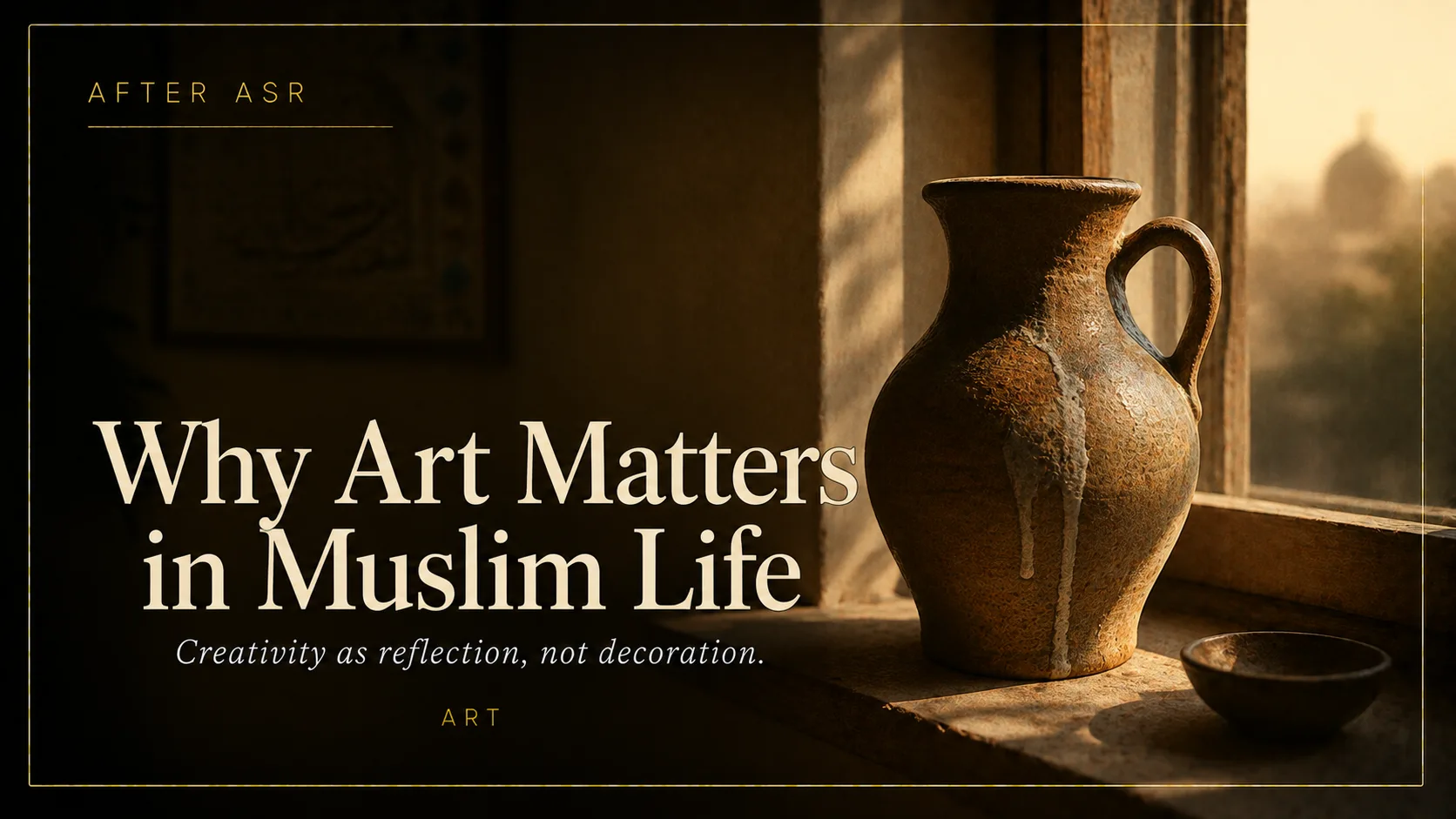
There is a clay water jug on my grandmother’s windowsill, and it does not quite match anything else she owns.
One shoulder of it ran thin in the kiln, so a pale streak crosses the belly like a scar that healed cleanly. She keeps finer vessels in the cupboard, matched sets with gold at the rim. This is the one her hand goes to.
The jug was made by someone who was paying attention
Someone sat at a wheel and lifted this shape out of wet earth. You can feel, if you close your fingers around it, where a thumb pressed a shallow groove below the rim. It is a place for the lip to rest. The potter did not have to leave that groove. A plain edge would have poured just as well.
It is a small kindness set into the clay for a mouth the maker would never meet. That is the first thing art is, before it is anything grand. It is attention made into a shape. Someone cared, and the caring stayed in the thing after the hands were gone. We reach for it a lifetime later and feel, without a word, that we were thought of.
We were taught to call this decoration, and to mean something small
The word decoration arrives with a shrug. It suggests frosting on a cake, a ribbon on a box, the line item you cut first when the money runs short. It names the part you could strip away and lose nothing you needed.
But look again at the jug. The beauty of it is not laid over the usefulness like a coat of paint. The curve that pleases the eye is the same curve that pours without spilling. There is no plain jug hiding underneath, waiting to be dressed. In much of Muslim life the beautiful thing and the useful thing are one object, and you cannot pry them apart without breaking both. The title of this essay asks why art matters. The honest first answer is that we have rarely known how to separate it from living.
A machine can copy the shape but not the attention
On the shelf below the jug sits a stack of factory cups, six of them, identical to a hair. They are useful and they are clean and I have nothing against them. But no thumb ever paused over any one of them. They were poured into a mold by the thousand and each is a perfect copy of a decision made once, far away, by no one in particular.
The handmade jug carries a different weight. Its small flaws are not failures. They are the fingerprints of a single afternoon that happened only once. When we say art matters, part of what we mean is that the trace of a real person in a real hour matters, and that a world of flawless copies is quietly a lonelier place.
A made thing carries a record of the one who made it
Run a finger along any handmade seam and you can read the mood of the hand that closed it. Patience leaves an even line. Haste leaves a hurried one. The object keeps this record long after the maker has forgotten the afternoon that made it.
This is why I trust the word reflection more than the word decoration. To reflect is to turn a thought slowly inward, and also to throw a light back out. The potter reflected before he worked and while he worked. The finished vessel hands that reflection to whoever lifts it. It is a mirror that shows you, faintly, someone else’s care, and asks you to add your own.
The prayer rug remembers the body that once used it
My grandmother has a sajjada folded on the arm of a chair. The wool has worn pale in three places, and you do not have to be told what made them. There is a soft oval where the forehead comes down, and two fainter ovals below it where the knees settle five times a day.
The rug was woven with a niche in its design, an arch that leans toward the direction of prayer. Years of use have thinned the pile until the pattern glows rather than shouts. The rug is not damaged. It is softened, the way a word grows gentle from being said often and with love. Beauty here was never sealed behind glass. It was spent, daily, until the spending became its own slow kind of beauty.
Beauty and use were never meant to live in separate rooms
Consider the copper pot that boils the water and also leans the lamplight into a warm blade across the counter. Consider the wooden spoon rubbed dark and smooth by twenty years of stirring, the grain of it now like the lines in a palm. Neither was made only to be looked at, and neither is only a tool.
A tradition that puts a pattern on the tile, the door, the bowl, and the page is a tradition that refuses to leave the ordinary undressed. It treats the objects of daily life as worthy of care. That refusal is not vanity. It is a way of insisting that no honest task is too humble to be done beautifully, and that the hand which pours your water deserves a vessel made with love. When the useful thing is also the lovely thing, the whole day is quietly raised. You do not wait for a special occasion to be surrounded by care. You are surrounded by it while you wash a cup.
The lamp and the light it was asked to hold
There are old mosque lamps of glass and enamel, shaped like a bud about to open, hung on chains above the place of prayer. The Quran speaks of light in the Surah of Light, and the believers who made these lamps knew those verses by heart. I will not pretend to weigh what the verses mean. That is not my trade, and reverence keeps me careful with what is not mine to explain.
What I can say is plainer. The makers gave their finest craft to the vessel that would carry the flame. The beauty of the lamp was a response to what the lamp was for. When a thing is asked to hold light, the hands rise to the asking. We make most beautifully the objects we ask to serve the most.
Most of these makers never signed their names
Walk through the great works of this tradition and you will notice how few of them are signed. The tile-setter, the weaver, the woman who embroidered the cloth, the man who carved the door, most of them are gone into an honorable silence, their names kept only by God.
I find something clarifying in that. The work was not a monument to the maker. It was an offering, and an offering does not need a signature to be sincere. Creativity here is a reflection of something larger than the person reflecting, so the person can afford to step out of the frame. The jug does not tell me the potter’s name. It tells me he was there, and that he was faithful to the clay.
To make something well is a quiet form of thanks
There is a word in our tradition for doing a thing beautifully, for the excellence that reaches past the minimum a task requires. It lives close to the idea of worship without pretending to be the same as it. To sand a joint smooth that no one will ever touch is a small instance of that excellence.
I have come to think of it as gratitude turned into work. We are set down in a world already full of form and color, of grain and shadow and the exact weight of an apple in the hand. To add a little order of our own, carefully, is one way the grateful answer what they have been given. You cannot easily say thank you to the sky. You can make a bowl that is worthy of the fruit it holds.
The child with the crayon is already a maker
No one has to teach a small child to cover a page. Give her a broken crayon and a bare wall and she will improve the wall, by her own lights, at once. The impulse arrives long before the instruction. We come into the world wanting to leave marks on it.
This is why I distrust the idea that art is a luxury imported into serious life from somewhere refined. It is not an accessory bolted onto a grown and finished person. It is native to us, present in the first fist that closes around a stub of color and drags it across a surface with unmistakable joy. To ask why art matters is a little like asking why children sing.
A swept floor is the beginning of an aesthetic
Beauty is not the private property of the wealthy. I have sat in a home with almost nothing in it and felt the care in every corner. The floor was swept in clean, deliberate arcs. A bright cloth lay square on the table. Three oranges sat in a shallow bowl, arranged, though no guest was expected.
The woman who set those oranges down was making art, though she would laugh to hear it named that. She was answering a bare room with order and a little color. The empty-handed are not shut out of beauty. Often they guard it most fiercely, because they have learned by heart that it costs almost nothing and gives almost everything.
Ornament is not a lie told over a plain surface
There is a suspicion, old and stubborn, that ornament conceals. That the pattern is a mask, the flourish a distraction from some poverty underneath. I understand the fear, because falseness does love to dress itself up.
But the vine that climbs across a tiled wall is not hiding the wall. It is honoring it, drawing the eye along the surface, praising the flatness rather than pretending it away. Good ornament is praise, not disguise. It says: this wall, this door, this cup, was worth the labor of making it lovely. That is not a deception. It is a kind of thanks paid to the plain thing itself, for being here, for being ours to touch.
Art teaches the eye to slow down, and slowness sits close to gratitude
You cannot take in a good pattern at a glance. A carpet with a thousand knots asks you to stop, to follow one line until it turns, to notice how a border quietly answers a field. The reward comes only to the eye that is willing to linger.
Slowness is the gift folded inside the design. We are grateful, in the end, only for the things we have looked at long enough to love. A world seen quickly is a world half thanked. The pattern slows us down, almost against our will, until we can finally see what has been in front of us the whole time.
The museum is not the only house where art can live
We are trained to picture art as the thing behind glass, guarded, lit, untouchable, visited once and photographed. That is one house it can live in. It is not the only one, and in Muslim life it has rarely been the usual one.
Here the masterpiece is often the tray you set the tea on, the ewer that pours water over your hands before a meal, the carved box that holds a copy of the Quran. The finest craft was always let loose among the ordinary hours. You were meant to use it, to wear it thin, to hand it down with the fingerprints still on it. Beauty was not sealed away from life. It was invited to dinner and given the best seat.
A thing made well is worth the trouble of mending
When one of the matched cups chips, it goes into the bin without ceremony. There are five more, and a sixth is cheap enough. But when the old jug once cracked along its foot, my grandmother did not throw it out. She had it bound with a fine loop of wire and went on filling it, the mend showing plainly, the way a stitch is sometimes left visible on the elbow of a coat.
There is a whole ethic hiding inside that small choice. A thing made with love asks to be kept, and keeping it sometimes means letting the repair show its face. The mend is not a shame to be hidden away. It is a record of having been valued enough to save. The most beautiful objects I know are almost never the flawless ones. They are the ones that were loved hard enough to be worth fixing when the world would have let them go.
What the maker owes the one who will use the thing
Return once more to the thumb-groove below the rim. The potter left it for a stranger. He would never see the mouth it welcomed, never know the morning it served, never once be thanked. He made it well anyway.
That is the moral trust folded inside all honest craft. The maker owes care to a person he will never meet. He can cut the corner, and no one will catch him for years, if ever, if at all. To make it well regardless is to keep faith with a stranger across time. Every well-made object is a small covenant between two people who will never share a room, signed in the language of care.
What we quietly lose when we say it is just decoration
The heavy word in that phrase is not decoration. It is just. When we say a thing is just decoration, we hand ourselves permission to stop looking at it. We stop making it with care, because care has been reclassified as waste. We let the beautiful ordinary thin out and vanish, and we congratulate ourselves on the efficiency.
What departs with it is not only some pretty surfaces. What departs is a whole way of paying attention to the world and to one another. A people that stops making its small things beautifully has begun, very quietly, to stop noticing them at all. And a people that stops noticing is not far from a people that stops giving thanks.
The jug, again, on the windowsill
So the question in the title was never really about art. It is about attention, and about thanks, and about the marks we leave for people we will never meet.
My grandmother reaches past the finer vessels and lifts down the flawed one. The pale streak catches the last of the afternoon light.
She fills it. The water goes in cleanly, the way the maker meant it to.
She does not think of any of this. She only knows which jug feels right in the hand.
That knowing is where the art lives.
It was never decoration.
It was care, kept in a shape, waiting to be reached for.