
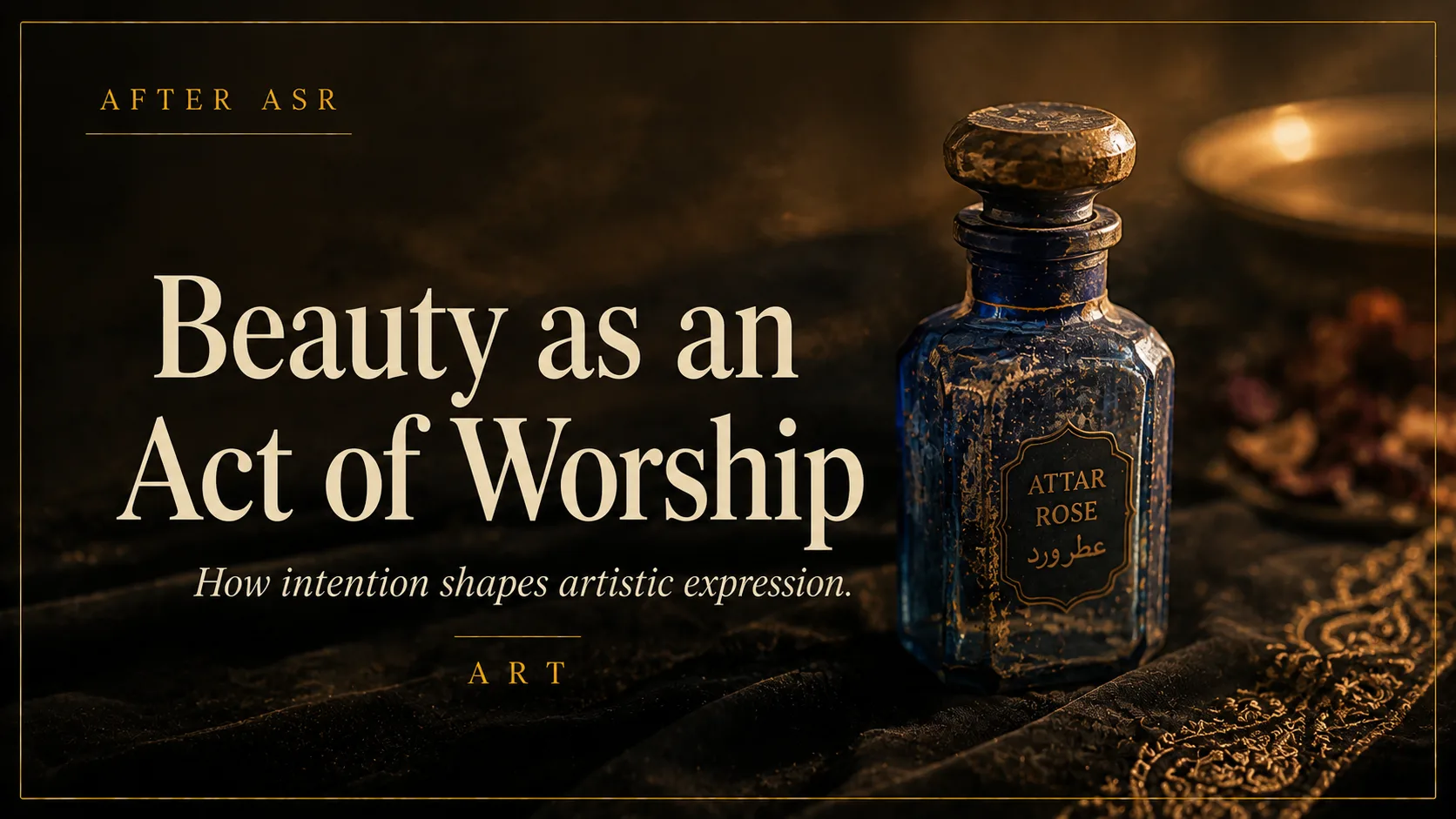
My grandfather carried a small blue bottle of attar in the breast pocket of his coat, and it was worn smooth as a river stone.
It was no bigger than a thumb. The glass had gone cloudy at the shoulders from decades of being opened and closed. Before he left for the mosque he would tip it once against his wrist, touch the wrist to his collar, and step out into the evening smelling faintly of rose.
The drop of scent was not meant for anyone in the room
No one at home commented on it. He did not wear it for us, and he was not going anywhere he would be admired. He was going to stand in a row of men and bow toward a wall.
The rose was an offering aimed somewhere the eye could not follow. He was making himself a little more lovely for an audience he could not see. That small habit taught me the whole subject of this essay before I had the words for it. Beauty, done a certain way, is not display. It is a gift sent quietly upward, and the sender does not wait around for thanks. I have thought since that the surest sign of an offering is that no one nearby is meant to notice it. He was not perfumed for the world. He was perfumed for the meeting, and the world only happened to be in the room.
An act takes its meaning from where it is aimed
Our tradition holds that deeds are weighed by their intentions, that the direction of the heart is what gives an action its true name. The same motion of the hand can be one thing or another depending entirely on where it is pointed.
This is why beauty and worship are not far apart in Muslim life. A beautiful thing made to be admired and a beautiful thing made as an offering can look identical from across the room. What separates them is invisible. It is the aim. The reed pen and the ink are the same in either hand. Only the intention behind the letters decides what the page becomes.
The wooden comb and two ways of using it
There is a wooden comb I remember, plain, worn pale along its teeth. A person can lift that comb to a mirror out of pure vanity, hungry to be seen and envied. The same person can lift the same comb to tidy himself before he stands before his Lord, to come clean and ordered into prayer.
The comb does not know the difference. The hair falls the same way. But heaven, our teachers say, knows the difference completely. This is the strange grace of the subject. The smallest ordinary object becomes a hinge, and worship or its opposite turns quietly upon it, and no witness in the room can tell which way it swung.
To do a thing beautifully because He sees
There is a station in our faith often translated as excellence, the idea of worshipping as though you could see God, and knowing that even when you do not see Him, He sees you. I hold this lightly, aware it is far larger than an essay on art can carry.
But I notice what it does to a maker’s hands. If the work is done as though it is seen by the One who misses nothing, then no corner can be cut in the dark. The finish becomes honest all the way through. Excellence stops being about impressing a customer and becomes about answering a gaze that reaches everywhere. Beauty made under that gaze has a particular quiet to it. You can sometimes feel, holding such a thing, that it was not made to win anything. It was made to be worthy of being seen by One who already saw everything, which is a different and gentler ambition than the wish to be admired.
The brass bowl and the washing that comes before
Before he prayed, my grandfather washed. There was a brass bowl kept for it, dented and bright from handling. He rinsed his hands, his mouth, his face, his arms, and drew wet fingers back over his hair, and washed his feet, unhurried, the water catching the last light.
I understood, watching, that he was making himself beautiful before an act. Not perfumed and combed for the crowd, but cleaned and ordered for the meeting. The washing was practical and it was also aesthetic and it was also devotion, and these were not three separate things happening at once. They were a single gesture. Beauty here is what a person does to become fit to stand somewhere holy.
The wooden stand that holds the open book
There is a folding stand of carved wood, an X of two panels hinged at the center, made to hold the Quran open without a hand pressing down the page. The good ones are worked with patterns along the arms, careful even in the places where a knee will hide them from view.
The maker of such a stand knew exactly what it would carry. He was not building a shelf for any book. He was building a small throne for the Word, and he carved it as though the object it held could feel the difference in his attention. The reciter sets the book upon it and shapes each verse slowly with the breath, unhurried, and the beautiful stand and the beautiful voice are doing the very same work. Both are care aimed at the sacred. Both are ordinary craft, quietly turned toward heaven.
The maker’s intention travels into the object
When a woman sits to embroider a cloth that will cover the Quran, her intention does not stay in her chest. It goes down her arm, into the needle, into the thread, into the small tight stitches she will never be praised for by name.
You can feel this in old sacred objects, though I cannot prove it and will not try. There is a devotion held in the material, as scent is held in wool. The thing was made as worship, and it goes on quietly worshipping in the corner of a room a century later. Intention is not only a private weather in the maker. It is the most important ingredient, and it stays in what the hands leave behind.
Beauty offered is not the same weather as beauty displayed
I want to be careful here, because the line is fine and easy to preach across without earning it. A person can adorn a home, cook a splendid meal, wear fine cloth, and mean any of a hundred things by it.
What I trust is the direction of the beauty. Offered beauty leans outward and upward, toward the guest, toward the gathering, toward God, and it does not keep score. Displayed beauty leans back toward the self and waits to be counted. The objects can be identical. The perfume is the same rose. Only the tilt of the heart behind it tells you whether a table was set as a boast or as a prayer.
The unseen finish is where the intention shows
Turn over a piece of fine embroidery and look at the back. In the best work the underside is nearly as careful as the front, though almost no one will ever lift it to look. Turn a good carpet over and find the knots tied honestly where they will never be seen.
This is where I go to read a maker’s intention, if I want to know it. The visible face can be flattered into looking good. The hidden side tells the truth. When the unseen surface is finished with the same care as the seen one, you are looking at work made for a witness beyond the human eye. The back of the cloth is a kind of confession.
The best cloth was always saved for the sacred thing
Watch which cloth a household chooses to wrap its Quran in and you will learn something true about that household. It is rarely the worn towel or the faded scrap. It is the good cloth, the embroidered one, the piece kept from a wedding or a grandmother, the fabric held to be too fine for ordinary days.
This instinct runs very deep in us. The best is set aside for the sacred, not the leftover. The finest tile went to the wall of the mosque, the finest binding to the holy book, the finest hour of the maker’s whole day to the work that would serve worship. To give beauty its proper aim is partly to give it your best material and never your scraps. What a family saves its finest things for is a quiet confession of what it holds most dear.
Bakhoor, and the perfuming of an ordinary room
There is a small burner for bakhoor, a clay dish that has held a hundred coals. Before guests arrive, or before a Friday, someone lets a curl of fragrant smoke wander the rooms, catching in the curtains, settling into the corners.
No painting is hung, no music played. The beauty here is invisible, made of scent and welcome. It is hospitality raised to an art, and hospitality in our tradition sits very close to worship. To make a room lovely for a guest, or lovely for the approach of a sacred day, is to treat the guest and the day as worthy of trouble. The smoke says, without words, that someone here was expected and honored.
When the intention curdles, the beauty sours with it
I will not pretend the danger is not real. Beauty can be turned into a mirror for the self. The same skill that offers can also perform. When a maker begins to work chiefly to be seen working, something goes quietly wrong in the grain of it.
Our teachers named this danger plainly and feared it in themselves. Show corrodes worship from the inside, and it can corrode art the same way. This is not a reason to distrust beauty. It is a reason to keep watching the aim of it, gently, in oneself first. The rose is innocent. The question is always where the wearer is pointing it, and whether he can bear to let it go unremarked.
A plate of dates, arranged, before the fast is broken
At sunset in Ramadan, a hand arranges the dates on a plate. It would be simpler to leave them in the box. Instead they are set out in a small deliberate order, glistening, ready, though the family is hungry and no one would complain about the box.
That arranging is a tiny act of beauty, and I have come to think it is also a tiny act of worship. It says the breaking of the fast is worth a moment of care, that the mercy of the meal deserves to be met with a set table and not a torn wrapper. The hand that arranges is not performing for the family, who are too hungry to grade the plate. It is answering the gift of the sunset with a small gift of order in return. The dates taste the same either way. Arranged, they taste a little like gratitude.
Henna drawn on the hands before a holy day
Before Eid the women sit together with a cone of henna and draw slow vines across each other’s palms, curling around the wrist, dotting the fingertips. It takes hours of patient work. It fades within a few weeks. No one keeps it, and no one expects to.
I used to think of it as pure adornment, and part of it surely is. But the timing gives its deeper aim away. The hands are made beautiful for the day the fast is completed, for the prayer at first light, for the gathering of the community in its finest clothes. The henna is pointed at an occasion held to be sacred. That it fades does not lessen it at all. Much of the most devoted beauty in our life is made to be temporary, offered for a single moment and then let go, like the arranged dates and the curl of bakhoor smoke. Beauty aimed at worship does not need to last. It needs only to be sincere while it is here.
The threshold, and the self we carry across it
There is a doorway into the room where we pray, and something happens as we cross it. We slow. We have washed, perhaps combed, perhaps touched a drop of scent to the wrist. We have made the outer self quiet and clean, and we carry it across the threshold like a cup we do not want to spill.
The tending of the outer self is not vanity here. It is preparation, the way you would tidy a room before someone beloved arrives. Beauty at the threshold is a form of respect. It confesses that where we are going matters, and that we did not want to arrive careless.
A clean corner of the house, kept only for this
In many homes there is a corner given over to prayer and to nothing else. A rug rolled and stood on end in it, a shelf with the Quran wrapped in cloth, perhaps a string of beads hanging on a nail. It is often the plainest corner in the whole house, and somehow the most carefully kept.
No guest is entertained there. No screen faces it. The care spent on that corner is spent on an act and not on an impression, because its only regular visitors are the family at prayer and the One they turn toward. I have noticed that people keep such corners cleaner than the rooms they show to strangers. The beauty of that swept, ordered, undecorated corner is worship made visible in the plain work of housekeeping. It is a small room built entirely around an aim.
Beauty is gratitude returned to the One who gave it
Everything the maker works with was given first. The clay, the rose, the wool, the light that shows the color, even the hand and its skill. None of it was manufactured out of nothing by the maker himself.
So the most honest thing to do with beauty may be to send some of it back. To take the given color and the given form and shape them, carefully, into an offering. Worship through beauty is not the invention of something new so much as the grateful return of something borrowed. The maker holds up the finished thing and means, in the deepest part of the work, thank You. That returning is where art and worship finally become one gesture.
The bottle, again, in the breast pocket
So intention is not a small footnote to beauty. It is the whole of what makes beauty worship and not merely display.
My grandfather is gone now. The little blue bottle sits in a drawer, still faintly holding its rose.
I open it sometimes, and the smell is the smell of a man getting ready to go and stand before God.
He never explained any of it. He only tipped the bottle to his wrist and stepped out into the evening.
The scent was never for us.
It was aimed higher, and sent quietly, and he did not stay to be thanked.
That is the whole lesson, kept in a thumb of blue glass.