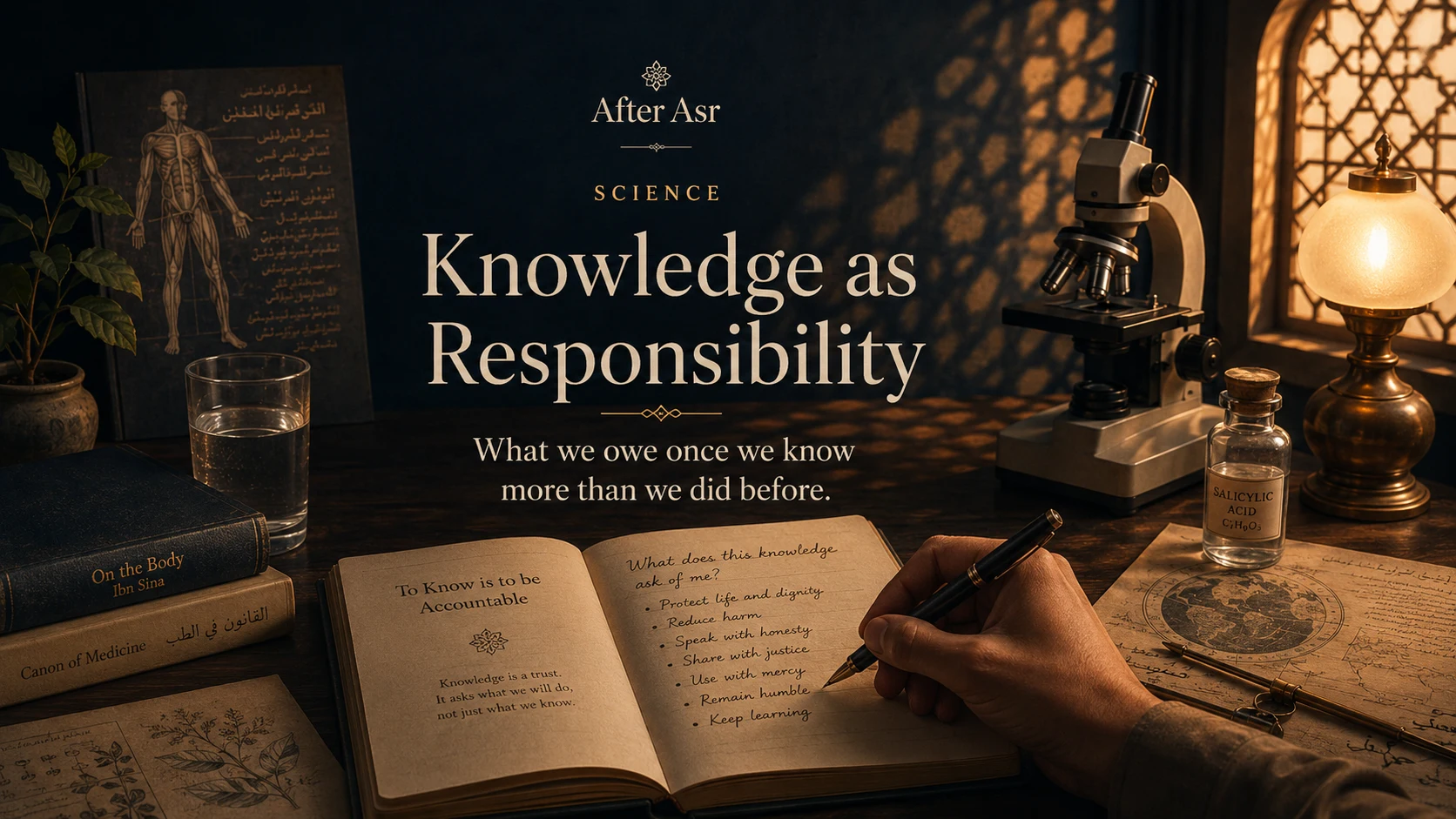
What we owe once we know more than we did before
Knowledge changes the person who receives it.
Not always immediately. Not always visibly. A person may read a study, hear a warning, learn a fact, receive a diagnosis, notice a pattern, or understand a harm for the first time, then continue with the day as if nothing has shifted. But something has shifted.
Before, perhaps, there was ignorance.
Afterward, there is responsibility.
This is one of the most serious truths about knowledge. To know is not only to possess information. It is to become answerable for what that information now requires. A fact may enter the mind quietly, but once it is understood, it begins to make claims upon the conscience.
If we learn that water is contaminated, we owe more than curiosity.
If we learn that a medicine can heal, we owe more than admiration.
If we learn that a technology harms attention, privacy, or dignity, we owe more than fascination.
If we learn that a community is suffering, we owe more than sympathy.
If we learn that our habits damage the earth, our bodies, or other people, we owe more than surprise.
Knowledge creates obligation.
This does not mean every person becomes responsible for solving every problem. Human beings are limited. We cannot carry the whole world in our hands. But once we know something true, we can no longer live as if we do not know it.
That is the moral weight of knowledge.
Science makes this especially clear because science often reveals hidden relationships. It shows how diseases spread, how pollution travels, how bodies respond, how systems fail, how technologies shape behavior, how risk accumulates, and how causes produce consequences over time.
Science helps us see.
Faith asks what we will do with sight.
Knowledge is not decoration
In many modern settings, knowledge is treated like decoration.
People collect books, articles, podcasts, courses, statistics, documentaries, studies, and opinions. They become informed, or at least informed-looking. They learn enough to speak well, argue confidently, post intelligently, or signal awareness. Knowledge becomes part of identity, status, or personal branding.
But knowledge was never meant to be mere decoration for the self.
The purpose of knowing is not only to appear intelligent. It is not only to win arguments. It is not only to feel superior to those who know less. It is not only to accumulate facts like ornaments on the mind.
Knowledge should change how we live.
A person who learns about nutrition should become more careful with the body, not merely more judgmental of others. A person who learns about climate and pollution should become more responsible, not merely more anxious or politically loud. A person who learns about medical bias should become more attentive to the vulnerable, not merely more cynical. A person who learns about technology’s effects on attention should examine their own habits, not only criticize society.
Knowledge that never becomes responsibility may become arrogance.
The more a person knows, the more they may be tempted to treat knowledge as possession. But truth is not owned in that way. Truth is entrusted.
The question is not only, “What do I know?”
The deeper question is, “What does this knowledge now require of me?”
Seeing creates accountability
There is a difference between walking past a need because you did not know and walking past it after you have seen it clearly.
The first may be ignorance.
The second may be avoidance.
This distinction matters because much of modern life is built on not seeing. We are protected from the conditions behind our comfort. We often do not see the workers who made what we bought, the pollution created by what we used, the data collected by the platforms we enjoy, the suffering hidden inside systems that function smoothly for us.
Science often breaks this comfortable invisibility.
Public health data shows that some neighborhoods are sicker than others. Environmental testing reveals contamination. Medical research reveals disparities in treatment. Labor studies reveal harm beneath convenience. Psychological research reveals how digital systems exploit attention. Climate science reveals consequences beyond the present moment.
Once harm becomes visible, innocence becomes harder to claim.
This does not mean responsibility is simple. Seeing a problem does not automatically tell us exactly what to do. The path forward may require expertise, collective action, policy, money, patience, and difficult tradeoffs.
But seeing does create a moral interruption.
It prevents us from honestly saying, “I did not know.”
A faithful person should treat that interruption seriously.
The burden of useful knowledge
Some knowledge is immediately useful.
A doctor learns which treatment works best. A parent learns which safety habit protects a child. A city learns which bridge is failing. A farmer learns which soil practice preserves the land. A teacher learns which students are being left behind. A family learns that a relative’s symptoms may indicate something serious.
Useful knowledge carries direct responsibility.
If a physician knows a safer treatment and withholds it without good reason, that is betrayal. If a city knows a structure is unsafe and ignores it, that is negligence. If a company knows a product harms people and hides the evidence, that is corruption. If a parent knows a danger and refuses reasonable protection, that is carelessness.
The more direct the knowledge, the heavier the responsibility.
This is why scientific and technical expertise carries special moral weight. Experts often know risks the public cannot see. Engineers know structural weaknesses. Physicians know medical warning signs. Environmental scientists know contamination patterns. Data scientists know system biases. Researchers know the limits of their findings.
To know professionally is to carry an amanah professionally.
A person with specialized knowledge must not use complexity to hide from accountability. They should not exploit the public’s lack of expertise. They should not bury inconvenient findings, overstate results for funding, or speak beyond evidence for attention.
Useful knowledge should become service.
The danger of knowing and doing nothing
There are many reasons people do nothing after knowing.
Sometimes the problem feels too large. Sometimes action is costly. Sometimes responsibility threatens comfort. Sometimes the solution is unclear. Sometimes people are tired. Sometimes they assume someone else will act. Sometimes they tell themselves the knowledge is not certain enough, not urgent enough, or not their concern.
These reasons may be understandable. They are not always acceptable.
A society that knows and does nothing becomes morally numb.
It may know that children are harmed by pollution and still delay. It may know that workers are exploited and still celebrate cheap prices. It may know that misinformation spreads quickly and still reward dramatic content. It may know that loneliness harms health and still design communities around isolation. It may know that some patients are dismissed and still protect medical arrogance.
Knowing without acting can become a habit.
At first, it feels uncomfortable. Then it becomes normal. Eventually, people learn to live beside knowledge without letting it disturb them. They become informed and inactive, aware and unchanged.
This is spiritually dangerous.
The heart can harden not only through ignorance, but through repeated refusal to respond to what has become clear.
Responsibility is not the same as guilt
When we say knowledge creates responsibility, some people hear only guilt.
They feel accused. They imagine that every new fact is another burden, another reason to feel ashamed, another impossible demand. This reaction is understandable, especially in an age where people are constantly exposed to suffering across the world.
But responsibility is not the same as guilt.
Guilt may be appropriate when we have done wrong. But responsibility is broader. It is the recognition that knowledge places us in relationship to reality. It asks us to respond according to our capacity, role, and access.
A doctor’s responsibility differs from a patient’s.
A parent’s responsibility differs from a child’s.
A government’s responsibility differs from an individual’s.
A wealthy person’s responsibility differs from someone struggling to survive.
An expert’s responsibility differs from an ordinary reader’s.
A community’s responsibility differs from a single household’s.
Islamic ethics recognizes capacity. We are not accountable for what is beyond our ability. But we are accountable for what is within it.
Responsibility should not crush the soul. It should wake it up.
The question is not, “Can I fix everything?”
The question is, “What has become clear to me, and what am I able to do faithfully?”
The first responsibility is truthfulness
Once we know more, the first responsibility is truthfulness.
We must tell the truth about what we know and what we do not know. We must not exaggerate, hide, distort, or manipulate. We must not use knowledge selectively to defend what we already wanted. We must not pretend certainty where there is uncertainty, and we must not pretend uncertainty where evidence is strong.
This matters in science communication, medicine, policy, religious teaching, family life, and ordinary speech.
If a study is limited, say it is limited.
If evidence is strong, do not weaken it because it is inconvenient.
If a risk is real but small, explain its scale.
If harm is happening, do not hide behind vague language.
If you do not know, say you do not know.
Truthful speech is a form of responsibility because other people act based on what they hear.
A misleading statistic can shape policy. A false medical claim can harm a patient. A distorted environmental claim can delay protection. A sensational headline can create panic. A confident but wrong religious answer can burden a conscience.
Knowledge should make the tongue more careful.
The second responsibility is humility
Knowledge should make us humble because every new thing we learn reveals how much we did not know before.
A person who learns deeply in any field eventually discovers complexity. The body is more intricate than first imagined. The earth is more interconnected. Human behavior is more layered. Technology has more consequences. Medicine has more uncertainty. Data requires more interpretation. Public policy has more tradeoffs.
Shallow knowledge often produces confidence. Deeper knowledge often produces humility.
This humility is not weakness. It is proper proportion.
It allows a person to say, “This is what the evidence suggests, but there are limits.” It allows the expert to remain teachable. It allows the student to ask better questions. It allows the believer to say “Allah knows best” with sincerity, not as a formula.
Humility also protects us from using knowledge as a weapon.
A knowledgeable person should not humiliate those who know less. A scientifically literate person should not mock the confused. A doctor should not speak down to patients. A teacher should not use intelligence to shame students. A religiously informed person should not use sacred knowledge to dominate others.
Knowledge without humility can become cruelty.
The third responsibility is care
Knowledge should increase care.
If we learn how the body works, we should care for bodies more gently. If we learn how trauma affects people, we should become slower to judge. If we learn how ecosystems depend on balance, we should become less wasteful. If we learn how disease spreads, we should become more mindful of the vulnerable. If we learn how misinformation harms, we should become more careful with what we share.
Care is the proof that knowledge has entered the heart.
A person can know much about nutrition and still be harsh toward people struggling with food, poverty, body image, or illness. A person can know much about mental health and still be impatient with sadness. A person can know much about environmental harm and still treat ordinary families with contempt rather than helping them change. A person can know much about religion and still lack mercy.
Knowledge must be joined to rahmah.
Care does not mean sentimentality. It does not mean avoiding truth. Sometimes care requires warning, correction, boundaries, or difficult decisions. But even hard truth should be carried with concern for the person affected.
Knowledge should not make us colder.
If it does, something has gone wrong.
The fourth responsibility is action
Eventually, knowledge asks for action.
Not always dramatic action. Sometimes the action is small, quiet, repeated, and local.
Take the medicine correctly.
Stop sharing claims you have not verified.
Reduce waste at home.
Check on the sick neighbor.
Change the way you teach a child.
Ask better questions at the doctor’s office.
Support policies that protect clean water.
Make your workplace safer.
Build technology with safeguards.
Design research ethically.
Speak up when data shows harm.
Repent when knowledge exposes your own negligence.
Action is how knowledge becomes embodied.
A person may not be able to solve the whole problem of environmental damage, but they can reduce waste, support wiser systems, teach children reverence, and avoid denial. A person may not be able to fix healthcare inequality, but they can advocate, listen, support access, and challenge dismissive attitudes. A person may not be able to reform all technology, but they can set boundaries, protect children, and refuse dishonest use.
Responsibility begins where capacity begins.
The size of the action should match the person’s role and ability. But some action should follow genuine knowledge.
Otherwise, knowledge remains suspended above life.
Knowing harm creates a duty to prevent harm
Some knowledge is especially urgent because it concerns harm.
If we know an action will likely hurt people, we must ask whether we can prevent or reduce that harm. This is basic moral reasoning, but it is easy to avoid when the harm is distant, delayed, or distributed across many people.
Environmental harm often works this way. The person causing the damage may not see the child who suffers from polluted air. Digital harm works this way too. The platform designer may not see the teenager made anxious by algorithmic comparison. Industrial harm may be hidden in supply chains. Medical harm may appear in statistics before it appears in personal stories.
Science helps connect actions to consequences.
Once the connection is visible, responsibility becomes harder to avoid.
A company that knows its product harms people cannot claim ignorance. A government that knows a community is exposed to unsafe conditions cannot claim surprise. A researcher who knows a system is biased cannot say the outcome is merely technical. A user who knows a platform is designed to exploit attention cannot pretend their habits are neutral.
Knowing harm does not always tell us the full solution. But it does create a duty to seek one.
Knowing benefit creates a duty to share benefit
Knowledge of benefit also creates responsibility.
If we know clean water prevents disease, we should care about who has clean water. If we know certain treatments save lives, we should care about access. If we know education protects communities from misinformation, we should teach. If we know early intervention helps children, we should not let help be available only to the wealthy.
Beneficial knowledge should not be hoarded.
This is especially important in medicine and public health. A treatment that exists but remains inaccessible raises moral questions. A technology that could assist disabled people but is priced beyond reach raises moral questions. Research that is publicly funded but privately locked away raises moral questions. Scientific literacy available only to privileged students raises moral questions.
Knowledge becomes more noble when it serves.
Faith intensifies this. Beneficial knowledge is not only personally useful. It is a form of ongoing good when shared sincerely and responsibly. Teaching someone what protects life, improves health, strengthens judgment, or deepens awe can become an act of service.
But sharing benefit must be done with accuracy. Good intentions do not excuse spreading weak claims or false hope. To share beneficial knowledge, we must first honor truth.
Knowledge and the vulnerable
The vulnerable have special claims upon knowledge.
Children depend on adults to understand risks they cannot evaluate. Patients depend on medical professionals. Workers depend on safety standards. Poor communities depend on honest environmental testing and fair policy. Disabled people depend on design choices made by others. The elderly depend on caregivers, medicine, infrastructure, and social mercy.
When knowledge concerns the vulnerable, responsibility deepens.
A society should not wait until the vulnerable can force recognition. It should seek out harms that are easy to ignore because the affected people lack power.
Who is not being studied?
Who is not being protected?
Who is not being believed?
Who is not receiving the benefit of what is already known?
Who carries risks chosen by others?
These questions belong at the center of scientific responsibility.
Knowledge that serves only the comfortable is morally incomplete.
The responsibility to correct ourselves
Knowledge sometimes requires self-correction.
We may learn that a belief we repeated was false. A habit we defended was harmful. A product we used had hidden costs. A judgment we made about others was unfair. A policy we supported had consequences we did not understand. A technology we embraced shaped us badly.
When this happens, responsibility begins with honesty.
We should not defend old positions simply because we once held them. We should not cling to ignorance after knowledge arrives. We should not treat correction as humiliation.
To learn better and refuse to change is a deeper problem than not having known at all.
This is true in science and in the soul. Revision is part of honest knowledge. Repentance is part of honest faith. Both require the courage to say, “I was wrong,” “I did not know enough,” or “I must change.”
A community that cannot correct itself cannot mature.
The temptation to outsource responsibility
Modern systems often allow responsibility to be outsourced.
A person says the algorithm recommended it. A company says the market demanded it. A government says the experts advised it. An institution says the policy required it. A user says everyone else is doing it. A consumer says they are just one person.
But knowledge asks each actor to identify their part.
The engineer has a part.
The funder has a part.
The policymaker has a part.
The teacher has a part.
The parent has a part.
The consumer has a part.
The scholar has a part.
The community has a part.
Not all parts are equal. Some people have more power and therefore more responsibility. But less power does not mean no responsibility.
Faith does not allow us to disappear into systems. We remain moral agents inside them. We may not control everything, but we are still accountable for what we choose, support, spread, ignore, and normalize.
The question is not only, “Who is to blame?”
It is also, “What is my trust here?”
Knowledge and worship
For the believer, knowledge should lead to worshipful responsibility.
To know the body should deepen gratitude for health and mercy toward illness. To know the earth should deepen stewardship. To know the stars should deepen humility. To know medicine should deepen care for the sick. To know the effects of speech should deepen caution with the tongue. To know the fragility of life should deepen repentance.
Knowledge should not terminate in the mind. It should travel toward the heart, the hand, and the habit.
This is why knowledge is dangerous when separated from tazkiyah. A person may become more informed and more arrogant. More educated and less merciful. More skilled and less accountable. More powerful and less humble.
The problem is not knowledge itself. The problem is knowledge entering an unpurified self.
Faith asks knowledge to bow.
Not by becoming anti-intellectual, but by remembering its proper place before God. The knowledgeable person does not become sovereign. They become more responsible.
The mercy of not knowing everything
If knowledge creates responsibility, then one might wonder whether ignorance is easier.
In some ways, yes. But ignorance is not a virtue when knowledge is available and needed. Still, it is a mercy that human beings do not know everything.
We are not built to carry total knowledge. We do not see all consequences, all hearts, all futures, all hidden causes, all possible outcomes. Only God knows completely.
This should comfort us.
Our responsibility is real, but limited. We act according to what has been made clear to us, within our capacity, after sincere effort. We seek knowledge where needed. We consult. We verify. We avoid speaking beyond what we know. We correct when corrected. Then we entrust what remains to God.
This balance prevents both arrogance and despair.
Arrogance says, “I know enough to control everything.”
Despair says, “I cannot know everything, so I can do nothing.”
Responsibility says, “I know enough to be faithful with the next step.”
Teaching knowledge as responsibility
Children and students should be taught that knowledge carries moral weight.
Science education should not only ask students to memorize systems and facts. It should ask what those facts require. What does knowledge of the body require in how we eat, rest, exercise, and care for the sick? What does knowledge of ecosystems require in how we waste, build, and consume? What does knowledge of statistics require in how we read headlines? What does knowledge of technology require in how we protect attention, privacy, and dignity?
Religious education should also teach this.
A student who learns that cleanliness matters should care about public spaces. A student who learns that backbiting is harmful should become careful with digital speech. A student who learns that creation is filled with signs should become attentive to the natural world. A student who learns that knowledge is sacred should become humble before what they do not know.
Formation means knowledge becomes character.
If students learn facts without responsibility, they may become clever but careless. If they learn responsibility without facts, they may become sincere but ineffective. We need both.
The quiet responsibilities of ordinary people
Not everyone is a scientist, doctor, engineer, policymaker, or teacher.
But ordinary people still encounter knowledge daily. We learn about a family member’s illness. A neighbor’s hardship. A workplace danger. A harmful rumor. A child’s need. A local environmental concern. A community pattern. A personal habit that is damaging us.
These smaller knowings matter.
Responsibility often begins close to home.
If you know someone is lonely, check on them.
If you know a child is struggling, help them.
If you know a claim may be false, do not share it.
If you know you are exhausted, rest before your body forces you.
If you know your words wound people, discipline your tongue.
If you know your consumption is wasteful, begin reducing it.
If you know your community lacks access to knowledge, teach what you can.
The ordinary scale is not insignificant.
Most moral life happens in ordinary settings: kitchens, clinics, classrooms, roads, mosques, workplaces, family rooms, group chats, and quiet moments of choice.
Knowledge becomes responsibility there too.
What we owe after knowing
So what do we owe once we know more than we did before?
We owe truthfulness.
We owe humility.
We owe care.
We owe action according to our capacity.
We owe protection of the vulnerable.
We owe correction when we were wrong.
We owe restraint when knowledge gives us power.
We owe sharing beneficial knowledge responsibly.
We owe gratitude for what knowledge reveals.
We owe accountability before God for what we do with it.
This is not a burden meant to crush us. It is a calling meant to mature us.
Knowledge should make us more awake.
Awake to the body as a trust.
Awake to the earth as a trust.
Awake to technology as a trust.
Awake to speech as a trust.
Awake to expertise as a trust.
Awake to public life as a trust.
Awake to the fact that seeing more clearly means walking more carefully.
The trust of knowing
Knowledge is a gift, but it is not a toy.
It is not merely content to consume, status to display, or ammunition for argument. It is a trust that asks to be honored.
Science helps us see hidden causes and consequences. Faith teaches us that hidden causes and consequences matter before God. Together, they remind us that information should become responsibility, and responsibility should become service.
We may not know everything.
But we know enough to be more careful than we are.
We know enough to be more truthful than we are.
We know enough to be more grateful than we are.
We know enough to protect some harms, repair some wounds, teach some truths, and refuse some forms of heedlessness.
The question is whether knowledge will soften us or harden us.
Will it make us arrogant, or humble?
Will it make us cynical, or responsible?
Will it make us cold, or merciful?
Will it make us louder, or more truthful?
Will it make us more powerful, or more accountable?
To know more than we did before is to stand at a moral threshold.
We can cross it with care, or we can turn away and pretend nothing has changed.
But something has changed.
We have seen.
And once we have seen, the next question is not only what we know.
It is what kind of people we will become now that we know it.