Writing from displacement and longing.
Exile is often imagined as distance.
A person leaves a country, crosses a border, arrives somewhere else. Maps record the movement. Governments assign a status. Families learn new routes to airports. The practical facts of displacement are immense: housing, papers, language, work, safety, legal uncertainty, money, loneliness.
But literature knows that exile is not exhausted by geography.
A person may leave home and discover that home has followed them as ache, memory, argument, and unfinished sentence. Another may return after years away and find that the place remembered no longer exists, or that they themselves have become foreign to it. Someone may remain physically in the land of their birth while political repression, war, occupation, or cultural estrangement makes ordinary belonging impossible. Exile can be forced by armies. It can be prolonged by bureaucracy. It can be inherited by children who grow up inside a nostalgia for a place they have never seen.
Edward Said, himself one of the twentieth century’s most influential writers on displacement, described exile as “the unhealable rift forced between a human being and a native place, between the self and its true home.” He rejected the romantic tendency to turn exile into pure artistic glamour, insisting that beneath its literary fascination lies rupture, grief, and “crippling sorrow.” (granta.com)
That caution matters. Exile has produced extraordinary literature, but exile should not be praised as though loss were artistically desirable. No one should need dispossession in order to write beautifully. No homeland should have to be destroyed so that later generations can admire the poems of longing it leaves behind.
And yet the literature of exile persists because displaced people write. They write to remember. To resist erasure. To make a provisional room in language. To recover the names of streets, foods, songs, villages, seasons, and dead relatives from the flattening vocabulary of politics. They write because exile does not only remove a person from place. It threatens to disorder time itself. The past becomes overbright. The future remains uncertain. The present feels temporary even when it lasts decades.
Literature cannot restore what exile takes. But it can refuse the lie that what was lost never mattered.
Exile Is Not Travel
The language of movement can obscure the severity of displacement.
Travel implies choice, even when it is difficult. Migration may involve hope, strategy, and ambition alongside loss. Diaspora can describe a scattered people sustaining connections across distance over generations. Exile is narrower and harsher. It names estrangement under pressure, often accompanied by political exclusion, danger, or the impossibility of return.
The distinctions are not always clean. A migrant may feel exiled. A refugee may later build a flourishing diasporic life. A writer may move voluntarily and only later realize that return has become impossible. But literature often senses the tonal difference. Exile carries a special relationship to coercion and broken belonging.
Said wrote that exiles are “cut off from their roots, their land, their past,” and that this discontinuity can produce an urgent effort to reconstitute life through memory, ideology, nationalism, or art. (granta.com)
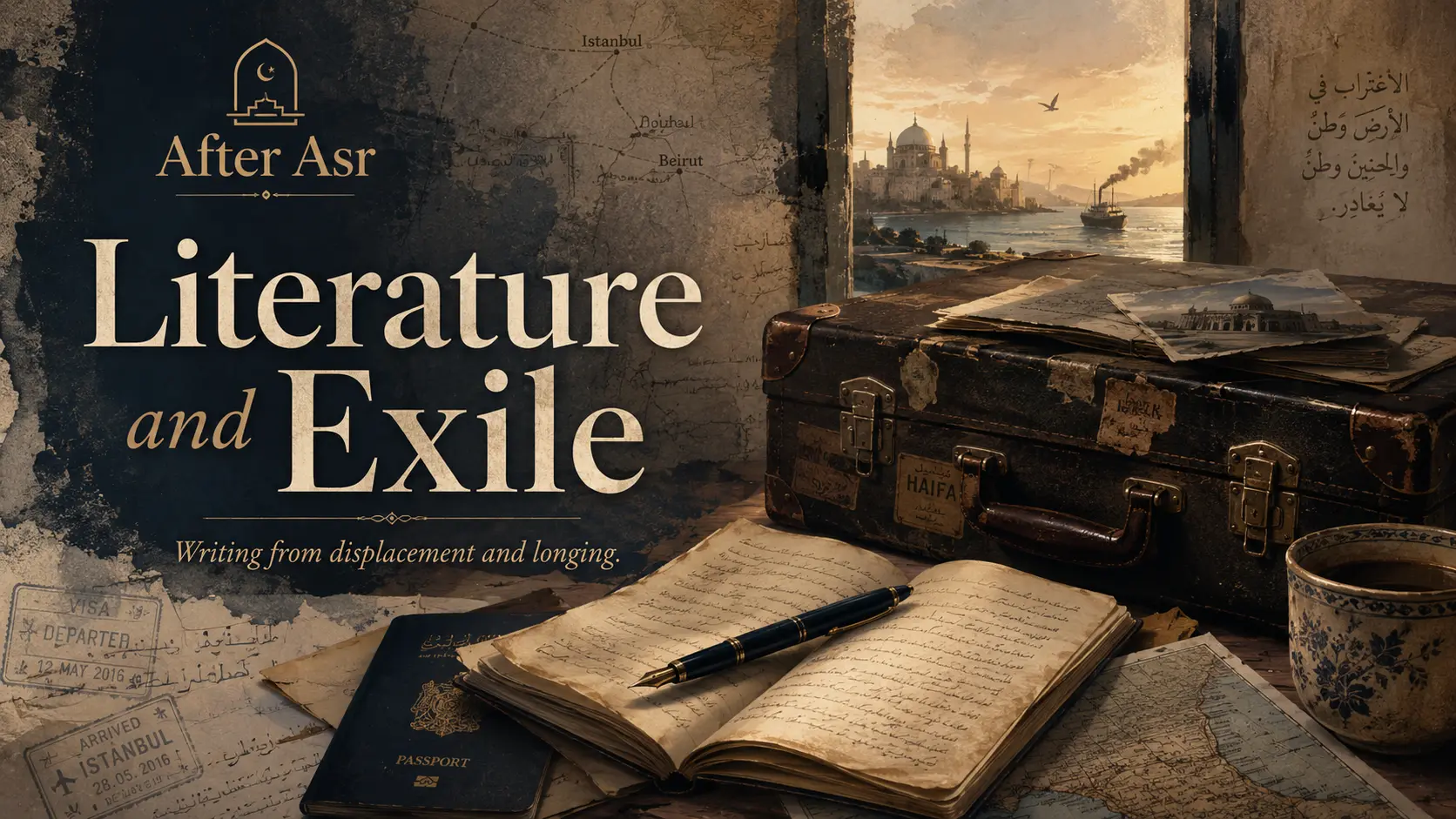
This helps explain why exile writing so often circles the same objects: keys, suitcases, passports, maps, recipes, letters, family names, untranslatable words. Such objects are not merely nostalgic props. They are anchors. They hold together a world whose physical continuity has been broken.
A traveler may describe a city to share discovery. An exile may describe the same city to prevent disappearance.
Home Becomes a Question
In ordinary life, home is often assumed rather than defined. It is the place one returns to, complains about, escapes, longs for during travel, or fails to appreciate until leaving. Exile turns home into a philosophical problem.
Is home a territory?
A language?
A childhood memory?
A graveyard?
A legal right?
A smell after rain?
A mother’s pronunciation of one’s name?
A place that still exists but no longer recognizes the person returning?
Literature of exile rarely answers once and for all. It keeps asking.
Mahmoud Darwish, whose poetry became inseparable from Palestinian displacement and memory, resisted a simplistic idea of return. In a landmark 1996 interview, conducted while he was waiting for permission to reside in Ramallah, he reflected on exile as something so deeply internalized that even return could not simply undo it. “Exile is so strong within me,” he said, “I may bring it to the land.” (palestine-studies.org)
That insight is devastating because it complicates the fantasy that displacement ends the moment one re-enters a homeland. A person can cross a border back into place and still remain estranged from the time that was lost there. Streets change. Families scatter. The dead do not return. The self formed in absence cannot be laid aside like luggage at customs.
Exile literature understands that home may become both destination and wound. The writer longs for it, interrogates it, reconstructs it, and sometimes fears discovering that memory has preserved a version no longer available to reality.
Language Becomes a Second Homeland, and a Second Loss
Displacement often unsettles language.
An exile may write in the mother tongue while living in a country where that tongue is rarely heard. Another may shift into the language of the host country and feel both expansion and betrayal. A third may move between languages, never fully at ease in one, carrying certain memories only in the words that first held them.
This is one reason exile literature is so preoccupied with translation, accent, silence, and linguistic estrangement. Language is not merely a tool for describing home. It is one of the places home resides.
Current scholarship on exile and memory continues to emphasize this intertwining of lost space and lost language. A 2025 comparative study of Russian exile novels by Nabokov and Gaito Gazdanov argues that narratives of exile often use retrospective memory to register not only geographical displacement but the collapse of a former world and the effort to reconstruct it through narrative form. (academic.oup.com)
For writers, the stakes become especially sharp. To write in the language of exile may grant broader readership while also exposing distance from one’s first linguistic home. To write in the first language may preserve intimacy while risking practical isolation. Some writers alternate. Some translate themselves. Some invent a hybrid literary voice that reflects neither total belonging nor total loss.
Ngũgĩ wa Thiong’o, though his relation to exile emerged from a different historical context, remains central to this conversation because he treated language as inseparable from cultural memory and political domination. After imprisonment in Kenya, he famously turned from English toward Gĩkũyũ, arguing that language was not only a medium of communication but a carrier of memory and worldview. His later years in exile continued this lifelong defense of linguistic dignity. (theguardian.com)
The exile writer therefore confronts a painful question: what survives when the place is lost but the language remains? And what changes when even the language begins to live elsewhere?
Longing Can Preserve, and It Can Distort
Exile writing is often powered by longing. This longing can be morally beautiful. It refuses indifference to place. It honors landscapes, customs, and ordinary relations that political discourse may reduce to abstractions. It insists that removal from home is not merely logistical inconvenience, but a fracture in the continuity of self and community.
Yet longing has dangers.
The home remembered in exile may become purified by distance. Its injustices recede. Its conflicts soften. Its ordinary boredom disappears. What remains is an idealized homeland assembled from childhood fragments, family stories, loss, and need. Such idealization is understandable. Pain seeks coherence. But literature becomes richer when it can distinguish love from falsification.
Said warned that exile can tempt people toward compensatory myths of restored purity or triumphant ideology. The ache of discontinuity can produce rigid narratives of belonging, precisely because the lived experience of belonging has been disrupted. (granta.com)
The strongest exile literature often resists this temptation. It loves home without lying about it. It mourns displacement without sanctifying every feature of what was left behind. It understands that one can long for a place and still remember its hierarchies, silences, or failures. That tension makes the work more truthful, not less devoted.
A writer who says only “home was perfect” risks writing nostalgia. A writer who says only “home was false” risks writing severance. Exile literature at its best inhabits the more difficult sentence: home was real, beloved, imperfect, and still irreplaceable.
The Exile Writes Against Official Forgetting
Displacement is often accompanied by narrative struggle.
States rename events. Borders are redrawn. Villages disappear from maps. Refugees become numbers. Political violence becomes “security.” Expulsion becomes “transfer.” Occupation becomes “administration.” The exiled writer confronts not only loss, but the possibility that loss will be redescribed until it no longer appears as loss at all.
This is why so much exile literature feels archival. It catalogs names, places, family relations, songs, dishes, textures of daily life. It remembers not as indulgence, but as resistance.
Darwish’s work repeatedly transformed Palestinian displacement from geopolitical abstraction into lived language. His poems preserved the relationship between land, memory, and identity without reducing poetry to propaganda. Even when writing politically, he maintained that poetry must remain poetry, not merely serve as a slogan. His influence endures because he made exile intimate without making it small. (palestine-studies.org)
The same impulse appears across exilic traditions. Writers fleeing authoritarianism document the feel of a censored society, the strange temporality of waiting for visas, the guilt of safety, the fear for those still inside, and the humiliation of becoming legible to bureaucracies through paperwork rather than personhood. PEN International’s 2026 case list documented continuing persecution of writers worldwide, including imprisonment, harassment, enforced disappearance, and forced exile. The existence of modern writers-in-exile programs in Canada, Germany, and elsewhere underscores that literary exile is not a relic of the past, but an ongoing condition produced by political repression. (pen-international.org)
Literature becomes witness here. It records what power has an interest in smoothing over.
Exile Changes Time
For the exile, time often splits.
There is the time before departure. The time of leaving. The suspended time of waiting. The new country’s time, which moves forward with apparent normality while the exile’s mind remains interrupted. There is also inherited time, in which children grow up inside stories of a place they know through memory borrowed from parents and grandparents.
Exile literature frequently moves nonlinearly because exile itself resists clean chronology. Memory returns in flashes. A smell in a foreign kitchen collapses decades. A train station in one country recalls a bus terminal in another. A word overheard on the street opens a village lane long gone. The past is not past in exile. It remains active.
A 2025 article on exile and memory in early Russian émigré fiction argues that lost space and lost time become inseparable, with narrative form itself attempting to recover a world that cannot be restored materially. (academic.oup.com)
This helps explain why exilic works often feel haunted. They are not merely backward-looking. They are trying to understand how the past continues occupying the present. A displaced writer may write about childhood not because they cannot move on, but because history has denied them a stable relation to what came before.
To remember in exile is sometimes to refuse the demand that one become entirely new.
The Body in Exile
Displacement is not only intellectual or emotional. It is bodily.
The body learns new climates. New foods. New postures in unfamiliar bureaucratic offices. It learns how to stand in airport lines, how to speak under surveillance, how to hear one’s accent returned by strangers. It may become hypervisible as foreign, or invisible as labor. It may age far from the graves of ancestors. It may experience safety and still not feel settled.
Exile literature often turns to the body because abstractions fail. Homesickness appears as nausea. Fear as insomnia. Language loss as a tightening in the throat. Shame as hesitation before speaking. Longing as the inability to enjoy arrival because someone else was left behind.
This bodily dimension prevents exile from becoming a merely symbolic condition. A person is not exiled in theory. They miss funerals. They lose touch with neighbors. They learn that time zones can make grief administratively difficult. They cannot visit a parent without visas, money, or risk. They become fluent in sending condolences by phone.
Literature restores those intimate costs to the idea of displacement.
The Child of Exile Inherits a Question
Not all exile literature is written by those who left. Much is written by those born after departure.
Children of exile inherit fragments. A homeland described at dinner. A language heard but not fully mastered. Anger they understand before they know its source. Maps on walls. A surname teachers mispronounce. Family grief activated by news from a place the child cannot remember leaving because they never did.
For such writers, exile may become secondhand memory and first-hand identity. They are not displaced in the same way as their parents, yet they may feel suspended between a country that claims them incompletely and a homeland that knows them through lineage more than lived experience.
This condition produces a distinct literature of diaspora and inherited longing. It asks whether memory can be transmitted without becoming myth, whether return is possible to a place known through stories, whether loyalty requires sameness, and whether children must carry grief at the same intensity as those who experienced the original rupture.
The literature is often tender and uneasy. It recognizes that inherited exile can become both identity and burden. The child may feel responsible for remembering what the parent fears will disappear, while also longing for the freedom to form a less wounded relation to belonging.
Exile Can Sharpen Vision, But at a Cost
Said acknowledged that exile may produce unusual forms of awareness. Because the exile lives between worlds, they may see both home and host country with estranged clarity. They may notice assumptions locals overlook. They may become wary of nationalist absolutes. They may compare social orders rather than treating any one as inevitable. (granta.com)
This perspective has enriched literature tremendously. Exile writers often expose the provincialism of nations that imagine themselves universal. They reveal how belonging is regulated by accent, paperwork, race, religion, and class. They understand that identity can be layered without being false.
But the sharpened vision should not be detached from the price paid for it. The exile’s comparative insight is born of rupture. The writer may gain a vantage point no settled person possesses, but not necessarily one they would have chosen.
There is a difference between learning from exile and aestheticizing it.
Literature should honor the intelligence exile can produce without pretending exile is desirable because it yields good books.
The Writer in Exile Today
Exile is not only a great twentieth-century theme. It remains painfully current.
Writers, journalists, poets, and intellectuals continue to flee authoritarian states, war zones, persecution, and threats linked to their work. PEN International reported in April 2026 that in 2025 it documented 140 cases of persecution worldwide, including writers facing imprisonment, harassment, judicial persecution, enforced disappearance, and forced exile. Programs such as PEN Canada’s Writers in Exile and PEN Germany’s Writers-in-Exile initiative exist because literary displacement remains an urgent reality, not a historical category sealed in the past. (pen-international.org)
This contemporary context matters for how we read exile literature. It is not merely a genre of melancholy. It is connected to free expression, censorship, war, and the right of people to narrate their own societies without being driven out of them.
When an exiled writer publishes, the book may carry more than artistic ambition. It may carry risk. It may be written in safety shadowed by guilt. It may speak for no one but the author, and still reveal the cost of a world in which truth-telling can make one homeless.
A Muslim Literary Sensibility and Exile
Muslim readers encounter exile not as an alien concept.
Islamic history includes migration, dispossession, persecution, and the pain of leaving beloved places. The Hijrah from Makkah to Madinah is not reducible to exile as modern literary theory defines it, and it should not be flattened into metaphor. It is a sacred historical event with theological, communal, and civilizational significance. Yet Muslim consciousness is deeply familiar with the emotional gravity of departure under pressure and the ache of separation from home.
The Prophet Muhammad ﷺ loved Makkah. Reports preserved in the tradition recount his sorrow at leaving the city, affirming its belovedness even as migration became necessary. Muslim readers therefore know that faith does not trivialize attachment to place. Leaving can be commanded by circumstance and still hurt.
This matters when reading modern exile literature. A Muslim lens need not romanticize national belonging, nor treat homeland as an idol. Islam teaches that the earth belongs to God and that moral responsibility exceeds tribe and territory. Yet it also recognizes memory, place, burial, neighborhood, language, and kinship as meaningful. Love of home is not automatically narrow. It becomes dangerous when it hardens into arrogance or exclusion.
Exile literature often inhabits this delicate terrain. It mourns lost place without making place absolute. It reveals how deeply human beings need rootedness, while also showing that dignity must survive when roots are torn.
Longing Is Not Weakness
Modern culture sometimes treats longing as a problem to solve. Move on. Adapt. Reinvent yourself. Build a new life. These instructions may be practically necessary and even wise. Exiles do rebuild. They work, marry, raise children, create businesses, learn languages, cultivate friendships, and contribute to new homes.
But longing should not be pathologized merely because it persists.
A person can be grateful for safety and still miss a homeland. They can love a new country and grieve an old one. They can succeed professionally and remain unsettled by the fact that their mother is buried far away. They can laugh freely in one language and dream in another. Literature allows such doubleness without demanding resolution.
This is one of its mercies. It does not force the exile into gratitude or bitterness as exclusive identities. It permits mixed feeling. It gives shape to the life between.
What Exile Literature Gives the Reader
For readers who have known displacement, exile literature may offer recognition. It says: the divided self is not invented. The shame of forgetting words is real. The guilt of adaptation is real. The confusion of return is real. The exhaustion of explaining oneself is real.
For readers who have not known exile, such literature offers moral enlargement. It asks them to understand that borders are not abstractions to those separated by them. That home is not a decorative theme. That the right to return, remember, name, and narrate is bound up with dignity.
It may also challenge settled readers to see their own comfort differently. The fact that one can visit ancestral graves, complain about a hometown, keep childhood friends nearby, or assume one’s language will remain publicly available is not universal. It is privilege, often invisible until contrasted with its loss.
Exile literature does not ask for pity. At its best, it asks for seriousness.
Writing as a Temporary Home
A displaced writer cannot rebuild a country in a poem. They cannot reopen a closed border with a novel. They cannot restore every lost object through memory. Literature has limits, and honesty requires acknowledging them.
Still, writing can become a form of temporary shelter.
A sentence can preserve a house no longer standing. A poem can hold a mother tongue against forgetting. A memoir can give children what parents were too wounded to explain. A novel can transform scattered fragments into a shape sturdy enough to revisit. A writer can say: I was moved, but I was not erased. My world was broken, but not rendered meaningless. What was lost will not be handed over silently to those who call loss inevitable.
Exile does not become beautiful because literature arises from it.
But literature born of exile can become beautiful because human beings, even in dispossession, continue making forms that resist disappearance.
The exile writes from absence.
The page becomes address.
Longing becomes structure.
Memory becomes argument.
Language becomes a place one can still enter.
And sometimes, for a little while, the book gives both writer and reader a home that history could not fully take away.