
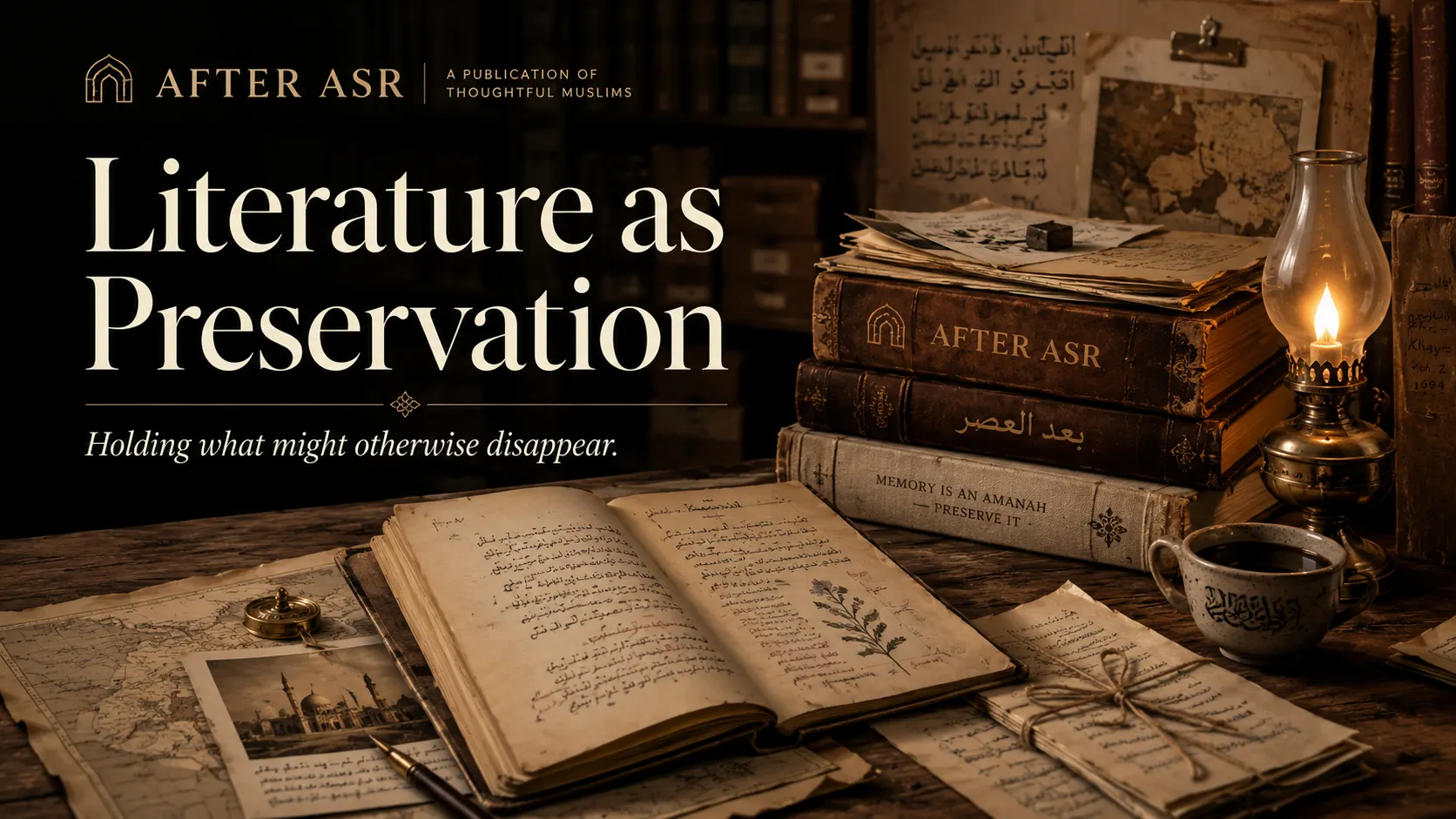
Holding what might otherwise disappear.
A society does not lose itself all at once.
It loses a phrase first. A lullaby no one sings anymore. A local name for wind, soil, grief, or kinship. A grandmother’s story interrupted once too often until it stops being told. A dialect considered too provincial to write down. A neighborhood erased from maps before anyone records how it smelled after rain. A library neglected because its papers look old rather than urgent. A manuscript eaten by dampness, insects, war, or indifference. A community’s memory translated into official language so efficiently that the original experience vanishes beneath the summary.
Disappearance often begins quietly.
Literature matters because it resists that quietness. It holds. It gathers what time scatters. It preserves not only events, but texture: how people spoke, what they feared, what they found funny, what they loved enough to describe precisely, what they assumed would always remain and therefore almost forgot to record.
A history may tell us that a city changed. A novel may remember the café where men argued after noon prayer, the seamstress whose window was lit before dawn, the schoolyard insult that revealed a larger social hierarchy. An archive may list the names of migrants. A poem may preserve the sound of departure. An oral tale may carry a moral world that never entered a formal book. A family memoir may save from oblivion a woman whose labor built several lives but produced no official record.
Literature is not the only guardian of memory. Archives, museums, oral history projects, libraries, historians, language activists, religious institutions, and communities themselves all preserve what would otherwise fade. But literature has a distinctive role because it preserves through form. It does not merely store information. It makes memory inhabitable.
UNESCO describes oral traditions and expressions as crucial vehicles for passing on knowledge, social values, and collective memory across generations. Its Memory of the World programme, meanwhile, exists to safeguard documentary heritage against loss and “collective amnesia.” These efforts recognize a truth literature has always known: memory is not guaranteed by importance alone. What matters can still disappear unless someone cares enough to carry it forward.
Literature as preservation is therefore not nostalgia. It is cultural responsibility.
What Preservation Means in Literature
To preserve is not simply to freeze.
A preserved thing remains available to later life. A manuscript conserved in a library is not preserved so that no one will ever touch it. It is preserved so that thought may return to it. A folk song is not protected by sealing it away from singers. It survives by being sung, taught, adapted, remembered. A language is not preserved merely through dictionaries. It remains alive when people use it to joke, grieve, flirt, argue, pray, and tell stories.
Literature preserves in this living sense. It keeps something available for renewed encounter.
A novel can preserve the moral atmosphere of a vanished town. A poem can keep alive the emotional charge of a historical wound long after the headlines disappear. A memoir can record how public events entered private bodies. A body of oral stories can carry a community’s codes of hospitality, ridicule, courage, patience, and warning. Even a fictional work set in an imagined village may preserve real patterns of speech and social life that modernization might otherwise flatten.
Scholarship on cultural memory has long noted that literature functions as one of the most pervasive media through which societies remember, whether in canonical works, popular genres, films, war stories, romances, or digital narratives. Literature does not simply reflect memory. It helps shape what communities retain, reinterpret, and pass on.
This means preservation is not neutral. Literature does not conserve everything equally. It selects, emphasizes, orders, and gives emotional weight. A writer deciding to linger on a grandmother’s proverb rather than a politician’s speech is making a judgment about what deserves endurance. A poet naming destroyed villages is contesting an official map. A novelist restoring ordinary humor to people typically portrayed only through suffering is preserving a fuller humanity.
To preserve through literature is to say: this must not be reduced beyond recognition.
Official Records Are Necessary. They Are Not Enough.
Civilizations need archives.
Court documents, tax records, censuses, newspapers, legal judgments, letters, ledgers, photographs, and manuscripts are indispensable. Without them, history becomes more vulnerable to invention and denial. Preservation programmes around the world exist because paper decays, digitized files can be corrupted, and conflict places records at risk. The British Library’s Endangered Archives Programme, for example, funds digitization of archives threatened by destruction, neglect, or physical deterioration. UNESCO’s Memory of the World Register added 74 documentary heritage collections in 2025, bringing the total to 570, reflecting the ongoing global effort to protect the recorded traces of human civilization.
Yet official records often preserve power better than life.
They document births, deaths, transactions, decrees, arrests, property lines, troop movements, and policy changes. But they may not preserve the smell of a schoolbook, the sound of a market call, the particular embarrassment of speaking one’s home language badly after years away, or the way a community understood itself before outsiders named it differently.
Literature often enters where records thin out.
A government file may note a forced relocation. A novel may reveal the grief of packing objects chosen not for monetary worth but for memory. A census may identify a language in decline. A poem may preserve the cadence of that language before it disappears from public life. A newspaper may report that a factory closed. A short story may capture how the closure altered marriages, ambitions, and teenage shame in the neighborhood around it.
This is why literary preservation is not redundant. It protects the dimensions of life that official documentation tends to omit because they are too subjective, too ordinary, too intimate, or too inconvenient.
Human beings do not live as entries in databases. Literature preserves what the database cannot hold.
Oral Traditions: Memory Before the Page
Long before many stories were written, they were voiced.
They traveled through recitation, repetition, gesture, rhythm, and performance. Oral traditions carried genealogies, moral lessons, religious memory, local histories, songs, proverbs, epics, jokes, and communal explanations of the world. UNESCO emphasizes that oral traditions help sustain knowledge, social values, and collective memory, while also noting that languages themselves are central vehicles of intangible cultural heritage.
Oral literature is sometimes treated as fragile because it is not fixed in print. But its flexibility is also part of its strength. A tale can adapt as it passes from elder to child. A proverb can fit a new situation while retaining an old wisdom. A praise poem can change emphasis depending on who recites it and why. Oral traditions are not failed books. They are living forms of memory.
Still, they are vulnerable.
When a language declines, oral literature loses its natural home. When younger generations are discouraged from speaking a heritage language, stories may survive only in partial translation. When urbanization, displacement, schooling, or media homogenization interrupts intergenerational transmission, entire archives of unwritten literature can thin rapidly. Preservation then becomes urgent, not because oral traditions should be embalmed, but because communities deserve the chance to carry them forward on their own terms.
Literature in written form can assist this work. Transcription, bilingual editions, children’s books based on oral tales, community storytelling projects, and literary adaptations can help preserve what might otherwise vanish. But they should do so humbly. A written version is not the whole oral event. It cannot fully capture voice, pause, audience response, gesture, or the social setting of the telling.
The page may save the story. It cannot entirely save the evening in which the story once lived.
Manuscripts and the Labor of Rescue
Preservation sometimes becomes visibly dramatic.
The manuscripts of Timbuktu have become one of the most powerful modern examples. The Library of Congress describes these manuscripts, many dating from the sixteenth to eighteenth centuries and some from even earlier, as evidence of the high level of intellectual civilization attained in West Africa. UNESCO has likewise emphasized their cultural and scholarly significance.
When armed militants seized Timbuktu in 2012, librarians, custodians, and local families risked their lives to smuggle tens of thousands of manuscripts out of the city in crates, rice sacks, donkey carts, boats, and vehicles. AP reported in 2025 that more than 27,000 manuscripts were saved from possible destruction, and that the first major batch returned to Timbuktu in August 2025 after years of safekeeping in Bamako. The manuscripts preserve centuries of African scholarship in fields including Islamic jurisprudence, science, medicine, and history.
This is preservation in its most literal form: books being carried away from fire.
But the rescue of Timbuktu’s manuscripts also clarifies a broader point. Literature and documentary culture are not abstract luxuries. They are repositories of civilizational dignity. Destroying them is not merely vandalism against paper. It is an attempt to sever communities from evidence of what they knew, debated, authored, and valued.
Their survival matters because future generations can still encounter a West African Islamic intellectual heritage that colonial stereotypes and modern neglect have too often obscured. The manuscripts do not merely sit in preservation boxes. They rebut false histories.
A society may be told it had no scholars, no libraries, no sophisticated textual culture. A preserved manuscript says otherwise.
Literature Protects Languages From Becoming Ghosts
A language does not disappear only when its last fluent speaker dies. It begins disappearing when it stops being trusted with serious life.
When children are taught that a home language is embarrassing, when public institutions refuse it, when literature is published only in dominant languages, when poetry is no longer composed in it, when stories migrate away from it, the language begins to narrow. It may remain spoken casually while losing its capacity to carry philosophy, humor, scholarship, romance, and grief across generations.
Literature resists that narrowing.
A novel written in a threatened language insists that the language is sufficient for complexity. A book of poems proves it can still bear compression and beauty. A children’s story gives young readers a world in which their ancestral vocabulary is not merely domestic residue but literary material. Translation can extend a work’s reach, but creation in the original language protects a more intimate inheritance.
This matters because language preserves distinctions another language may not replicate. Kinship terms, forms of respect, local metaphors, agricultural knowledge, modes of blessing, and verbal textures often encode histories of relation. Once the language is lost, some of those distinctions may survive in explanation, but explanation is not the same as living use.
UNESCO’s work on oral traditions foregrounds the inseparability of language and intangible heritage. When languages weaken, the stories, songs, and social knowledge carried by them face greater risk of disappearance.
Literature cannot single-handedly save a language. Policy, education, family practice, and community will all matter more. But literature can demonstrate that a language is still a house large enough for thought.
The Everyday Is Most at Risk
Grand events are more likely to be recorded than ordinary life.
Wars receive chronicles. Kings receive biographies. Elections receive archives. Catastrophes receive photographs. But much of what later generations most ache to know is modest. What did people eat on ordinary nights? How did wedding preparations sound? What insults were considered funny? How did neighbors borrow from one another? What did children fear? What did elders repeat? How did faith inhabit the day beyond formal ritual?
Literature preserves these smaller things because writers notice them.
A realist novel may become, decades later, an unintended ethnography of everyday life. A village story may preserve rituals no longer practiced. A domestic memoir may reveal how technology changed the rhythm of a home. A comic essay may record the rise and fall of habits once thought permanent. A poem about a local fruit, a seasonal smell, or a river’s color may later become evidence of a landscape altered by climate and development.
This is why “minor” literature can become culturally major over time. A local magazine, an immigrant newsletter, a serialized neighborhood column, a children’s rhyme, or a self-published family history may preserve something no state archive considered important enough to collect.
Preservation requires a widened idea of significance.
What seems too ordinary to save in the present may become irreplaceable in the future.
Literature Preserves Interior Life
Facts can establish that an event occurred. Literature can preserve how it entered consciousness.
This is not the same as saying fiction is superior to history. It is not. The forms answer different questions. But literature has unusual power to retain interiority: confusion, hesitation, self-deception, mixed motive, shame, and the strange mental negotiations by which people survive change.
A report may note that a school was integrated, a border closed, a neighborhood gentrified, a mosque founded, a family emigrated, a book banned. Literature may preserve what those events felt like from within. Who felt hope? Who felt threatened? Who kept silent? Who adapted too quickly? Who pretended not to care? Who misunderstood the meaning of the change until much later?
Interior life is fragile because it leaves fewer durable traces. People often do not confess their full feelings in official documents. They do not record every embarrassment, envy, or longing. Literature gives shape to such matters. Through fiction, lyric, essay, or memoir, it keeps alive not only what happened, but what kinds of souls were formed in response.
A civilization that preserves events but not inwardness preserves a skeleton.
Literature helps keep the pulse.
Preservation Can Be an Act of Resistance
What disappears is often political.
Colonial regimes have dismissed local literatures as primitive. Authoritarian states have banned books and imprisoned writers. War destroys libraries. Extremist movements burn archives. Economic neglect leaves records to rot. Dominant languages crowd out smaller ones. Migrants are pressured to abandon old stories in order to become legible within new societies.
To preserve literature under such conditions is not neutral. It is resistance.
The Timbuktu manuscripts are one example. So are oral history projects among communities whose pasts were never centered in official archives. So are digitization efforts by institutions trying to rescue endangered archives before climate, conflict, or decay erase them. So is Nigeria’s 2026 deposit of cultural records, manuscripts, and creative works into the Arctic World Archive in Svalbard, described by The Guardian as an effort to safeguard African historical memory for generations to come amid archival vulnerability and underfunded preservation infrastructure.
Preservation asserts that these records deserve a future.
It says that history will not be written only by the powerful, the wealthy, the victorious, or those whose institutions happen to endure. It claims that community memory has value even when no empire has catalogued it. It insists that a poem in a marginalized language, a women’s oral narrative, or a regional manuscript tradition deserves more than sentimental praise before neglect.
Resistance through preservation is rarely dramatic in the moment. It often looks like scanning pages, cataloguing boxes, recording elders, training conservators, funding libraries, teaching children songs, or publishing a book that a commercial market considers too local.
Yet over time, these acts determine what survives.
What Literature Preserves Beyond Facts
Literature preserves several things official memory struggles to keep:
Voice.
Not merely what was said, but how people spoke. Formality, sarcasm, tenderness, prayerfulness, irritation, regional rhythm.
Atmosphere.
The emotional weather of a place or era. Suspicion under surveillance. Optimism during reconstruction. Fatigue in a declining town.
Moral imagination.
What a community admired, feared, forgave, condemned, or found shameful.
Local knowledge.
Plants, seasons, routes, recipes, labor practices, ceremonial details, speech forms, kinship patterns.
Contradiction.
The fact that people can love a tradition and suffer under one of its distortions, feel pride and grief toward the same homeland, or participate in systems they also resent.
Minor lives.
People too ordinary for monuments: shopkeepers, nurses, grandmothers, students, laborers, widows, migrants, village teachers, quiet eccentrics.
Silences.
What could not safely be said, what was evaded, what the form itself circles rather than states.
This is why literature is so often indispensable to later generations trying to understand a world they did not inhabit. It preserves not a complete record, but a human one.
A Muslim Literary Heritage Worth Holding
Muslim civilizations possess immense traditions of preservation.
The Qur’an itself has been memorized, recited, taught, and transmitted with extraordinary care across centuries. Hadith sciences developed intricate methods of transmission and verification. Scholars copied manuscripts. Libraries flourished in cities across the Muslim world. Poetry circulated orally and in writing. Adab literature preserved stories, wit, ethics, and social knowledge. Travel narratives recorded roads, cities, scholarly networks, and the variety of Muslim life across regions.
These traditions belong to different categories and should not be flattened together. The preservation of revelation is not the same as the preservation of literature. Hadith authentication is not the same as oral folklore. Yet all point toward a civilizational seriousness about transmission.
Muslim literary preservation today should draw strength from that inheritance. It should care about manuscripts, but also about living languages. About classical texts, but also about community memoirs. About scholarly editions, but also about children hearing family stories before they disappear. About digitization, but also about readers. A scanned manuscript unread by anyone is safer than a burned one, but preservation reaches fuller purpose when access, study, and cultural ownership follow.
The return of Timbuktu’s manuscripts in 2025 dramatized this point. Preservation was not merely about physical survival. It was about restoring a city’s connection to its own intellectual history and asserting the significance of African Islamic scholarship against centuries of distortion.
Literature as preservation, in Muslim contexts, is therefore not backward-looking. It equips the future with fuller memory.
The Risk of Preserving Only What Institutions Already Value
Preservation can reproduce hierarchy if left unexamined.
Large institutions often prioritize materials already recognized as prestigious: famous authors, official documents, elite correspondence, canonical manuscripts. These are worth protecting. But preservation becomes narrower than memory if it ignores working-class writing, women’s letters, community newspapers, oral histories, children’s rhymes, activist pamphlets, local theater scripts, immigrant newsletters, and digital-born cultural material.
The British Library’s Endangered Archives Programme is significant in part because it supports preservation work around the world in contexts where archives are at risk precisely because they have lacked resources or institutional priority. Such efforts help broaden what enters the protected record.
Literature teaches us to value the less obviously monumental. A single unpublished notebook may reveal a community’s interior history more vividly than a government statement. A stack of local magazines may preserve the aspirations of a generation. A collection of oral tales recorded before language loss accelerates may contain an entire ethical universe.
Preservation should not only honor what has already been declared important. It should protect what future generations may discover they needed.
Digital Preservation Is Not Automatic
The digital age creates a strange illusion: because something exists online, it will remain.
It may not.
Websites vanish. Platforms close. Files corrupt. Passwords are lost. Formats become obsolete. Digital abundance can conceal extreme fragility. The Council on Library and Information Resources has warned that cultural memory is threatened not only by physical deterioration and climate change, but also by the vulnerability of digital information and unequal access to preservation infrastructure.
This matters for contemporary literature and community memory. Blogs, newsletters, online magazines, digital zines, diaspora forums, spoken-word videos, and social media archives may eventually become vital records of how communities thought and spoke in an era of rapid change. Yet much of this material is precarious.
A society serious about literary preservation must think beyond shelves. It must ask how digital works will be stored, migrated, catalogued, and made accessible. It must also avoid assuming that corporate platforms are neutral stewards of culture. They are not designed primarily as archives. They are businesses.
The future may know less about our age than we imagine if we mistake posting for preserving.
Preservation Without Idolization
To preserve literature is not to treat every inherited text as sacred or beyond critique.
Some old works contain cruelty, hierarchy, prejudice, or exclusion. Some traditions deserve correction. Some stories survive because they served power, not because they served truth. Preservation does not require admiration. It requires availability.
A text can be preserved so that later generations may challenge it. A racist novel may matter historically because it reveals the imagination of an era. A colonial travel account may be valuable not as trustworthy description, but as evidence of the gaze that helped justify domination. A patriarchal conduct manual may need preservation so readers can understand the social world women navigated and resisted.
Destroying a troubling text does not undo the history that produced it. Preserving it with context may teach more.
Literature as preservation should not become antiquarian worship. The past is not valuable simply because it is past. It matters because it shaped the present, because it contains beauty and warning, because it records what human beings made of their conditions, and because forgetting rarely produces wisdom.
The Writer as Keeper
Not every writer sees themselves as a preservationist. Many write toward invention, argument, pleasure, or artistic experiment. Yet writers often become keepers almost accidentally.
They preserve the neighborhood where they grew up because they set a story there.
They preserve a dialect because they refuse to standardize every line of dialogue.
They preserve a grandmother’s phrase because it becomes the title of an essay.
They preserve a vanished workplace through a memoir of boredom and camaraderie.
They preserve the emotional texture of a protest, a pandemic, a mosque community, a wedding custom, a language mixture, a particular kind of silence.
Sometimes writers realize only later that they recorded a world already fading.
This gives ordinary literary work unexpected gravity. A poem about a now-demolished café becomes a historical artifact. A novel written before smartphones becomes a record of another pace of social life. A letter between siblings becomes evidence of migration’s emotional economy. A school magazine becomes one of the few surviving documents of a community’s self-image in a given decade.
Writers cannot preserve everything. They should not write under the constant burden of archival anxiety. But they can understand that attention itself is preservative. What they choose to notice may be what remains.
Holding What Might Otherwise Disappear
At its deepest, literature as preservation is an act of care toward time.
It recognizes that people are mortal, places change, languages weaken, institutions fail, libraries burn, files decay, and ordinary worlds vanish without ceremony. It refuses both panic and indifference. It writes. It records. It gathers. It transmits.
A preserved book cannot restore a destroyed city.
A poem cannot recover every word of a lost language.
A digitized manuscript cannot replace the scholars whose hands once turned its pages.
A family memoir cannot revive those it remembers.
But preservation is not resurrection. It is refusal of total loss.
It says: something remained.
A voice.
A rhythm.
A record.
A scene.
A sentence.
A name.
Literature holds these things not in perfect safety, but in offered continuity. It allows one generation to place a fragment of its world into the hands of another. The later generation may reinterpret it, argue with it, cherish it, or find in it something the earlier one did not know it had preserved.
That is the quiet majesty of literature.
It does not stop time.
It leaves something time must work harder to erase.