
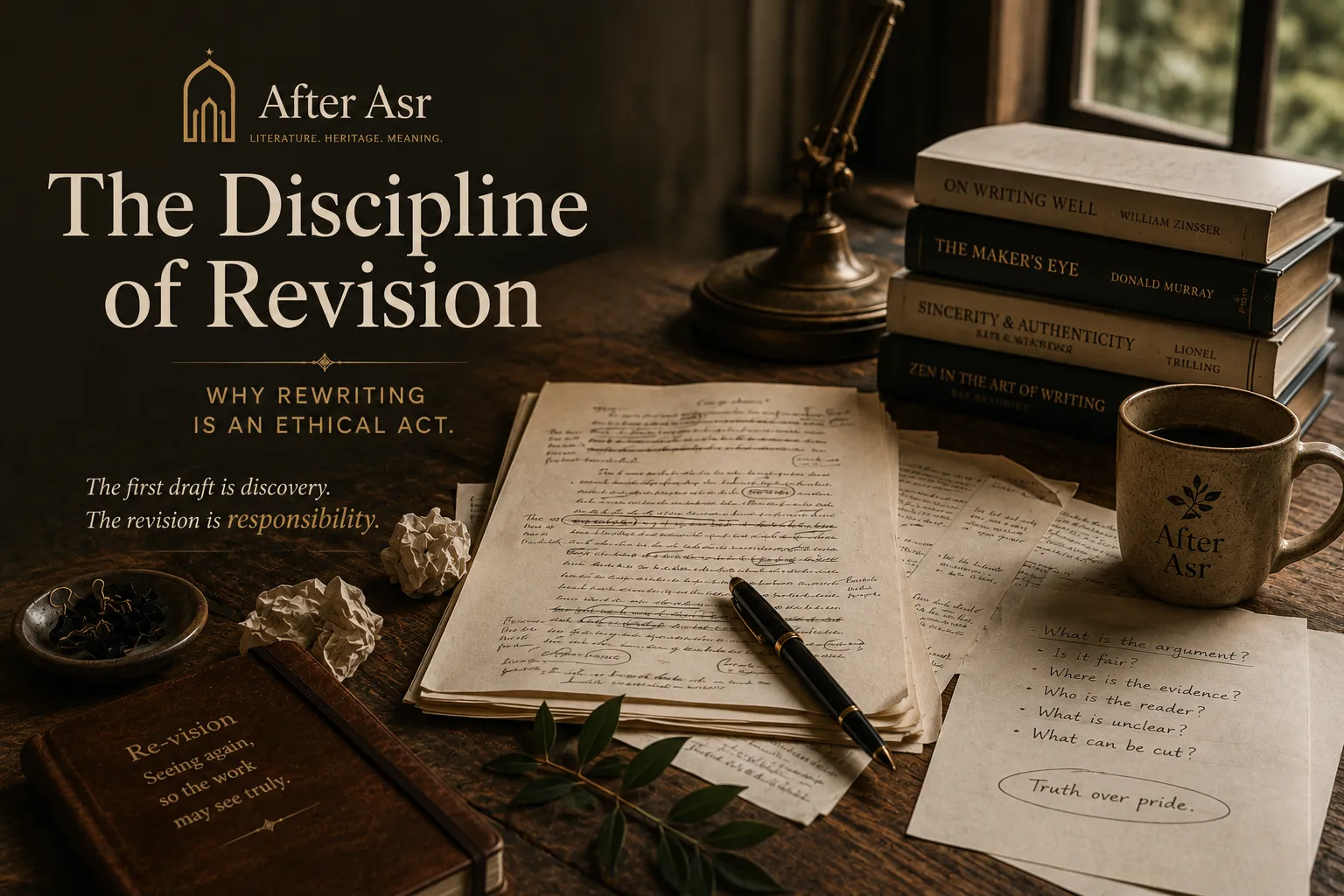
Why rewriting is an ethical act.
The first draft is often where a writer discovers what they wish they had already known.
A paragraph begins confidently, then wanders into a claim the writer cannot quite defend. A scene carries emotion but not clarity. An argument sounds forceful until its exaggeration becomes visible on rereading. A sentence dazzles, perhaps, but distracts from the truth it was supposed to serve. A character in a novel behaves conveniently rather than convincingly. A personal essay accuses someone too broadly. A reported piece includes a detail that sharpens the prose but may unfairly sharpen the reader’s judgment.
Revision begins at this point of discomfort.
Not polishing. Not tidying commas. Not replacing one adjective with another so the writer can feel industrious while leaving the deeper problem intact. Revision in its fullest sense means seeing again. It means returning to what one has written with enough humility to ask whether the work is true to its purpose, fair to its subject, coherent for its reader, and worthy of the attention it requests.
This is why rewriting is not merely technical. It is ethical.
The writer revises because readers should not be forced to carry preventable confusion. Because people represented on the page should not be distorted by lazy phrasing or theatrical emphasis. Because a claim should not be stronger than the evidence allows. Because beauty should not excuse inaccuracy. Because the first version of a thought is often entangled with ego, haste, or incomplete seeing.
Donald Murray, one of the major voices in process-based writing pedagogy, argued that revision is the means by which writers first make meaning and then make that meaning clear. In his account, everything on the page, from content to structure to documentation to pace, should be evaluated according to whether it develops the meaning of the work. (wacclearinghouse.org)
That formulation deserves to be read morally as well as rhetorically. Revision asks the writer to stop treating the draft as self-expression alone and begin treating it as responsibility.
A draft says, “This is what came out of me.”
Revision asks, “Is this what should remain?”
The Myth of the Inspired First Attempt
Literary culture still indulges the fantasy of effortless creation.
The inspired writer sees clearly, writes fluently, and produces pages charged with immediate brilliance. Revision, in this fantasy, belongs to lesser minds, to timid writers who failed to get it right the first time. A passage that arrives quickly is regarded as authentic. A passage heavily reworked risks seeming less alive.
Professional writers know better.
Peter Elbow, reflecting on his own practice, observed that revision is often the hardest part of writing and that he spends more time revising than generating first drafts. Murray made a similar point in “The Maker’s Eye,” arguing that writers learn to see their manuscripts anew only after draft production, when they can shift from maker to critical reader. (mediaed.org) (robertnazar.wordpress.com)
The first draft may contain urgency. It may contain the spark no revision should extinguish. But it also contains accident. Repetition. Overstatement. Sentences that feel honest only because they have not yet been challenged. Writers who worship the first draft often mistake immediacy for truth.
A thought that arrives forcefully is not necessarily a thought that has been examined. Anger can be immediate. So can vanity. So can borrowed language. So can a prejudice the writer did not realize they were reproducing.
Revision does not betray inspiration. It tests it.
If the first draft contains something living, revision helps it survive beneath the clutter. If the first draft contains something false, revision provides the opportunity to remove it before it becomes a public burden.
Revision Means Looking Again
The word revision contains its own philosophy: re-vision, seeing again.
Nancy Sommers’s influential study of student and experienced writers found that less experienced writers often define revision as cleaning up words and correcting surface errors, while experienced writers treat revision as a process of discovering and reshaping meaning. They rethink structure, audience, emphasis, and what the piece is actually trying to do. (psychology.yale.edu)
This difference is not merely pedagogical. It reveals why revision matters ethically.
A superficial reviser asks:
- Is this sentence smoother?
- Did I remove redundancy?
- Is the grammar correct?
A deeper reviser also asks:
- Is the central claim actually true?
- Have I represented the other side fairly?
- Does this scene earn its emotional force?
- Am I withholding necessary context because it weakens my preferred conclusion?
- Is the reader being manipulated by structure rather than persuaded by substance?
- Have I mistaken confidence of tone for integrity of thought?
The act of seeing again allows a writer to become less captive to the draft’s original momentum. What seemed inevitable while composing may appear careless after distance. A striking metaphor may now seem cruel. A clever line may now feel glib. A paragraph that once seemed passionate may reveal itself as imprecise.
Revision creates the moral interval between impulse and publication.
Without that interval, writers risk offering others their unprocessed reflexes and calling it honesty.
The Reader Should Not Be Punished for the Writer’s Laziness
One ethical argument for revision is simple: readers deserve clarity.
A public piece of writing asks for another person’s time. It asks them to follow a path of thought, enter a narrative, consider evidence, hold details in memory, and trust the writer’s guidance. That trust is not unlimited. The writer has obligations in return.
Revision honors the reader by doing the labor of organization before demanding the labor of attention.
This does not mean every text must be easy. Difficulty can be necessary. Some ideas are complex. Some literary forms intentionally resist quick consumption. Poetry may be compressed. Philosophy may require slow progress. Sacred texts demand contemplation rather than simplification. The obligation is not to make everything effortless. It is to ensure difficulty arises from the subject or form, not from preventable carelessness.
Writers sometimes defend obscure prose by implying that confused readers are insufficiently serious. Sometimes the reader is indeed impatient. But sometimes the writer has not finished thinking. Murky structure may be mistaken for depth. Excessive abstraction may conceal a weak claim. Redundant paragraphs may signal that the writer is circling rather than advancing.
Audience-centered revision practices in composition pedagogy routinely ask writers to consider whether their writing addresses the intended readers consistently, whether it draws them in, and whether its purpose remains clear. These questions are often taught as rhetorical strategy, but they also carry an ethic of consideration. (courses.lumenlearning.com)
The writer should not make the reader excavate a path the writer refused to build.
Revision is hospitality.
Rewriting Protects Against Overclaiming
Many bad sentences are not grammatically bad. They are morally careless.
They say “always” where the evidence supports “often.”
They say “proves” where the evidence suggests.
They accuse motive where only action is known.
They turn one example into a universal pattern.
They strengthen a conclusion because strength feels satisfying, not because the claim can bear it.
Such overclaiming is common in public writing because it produces force. Strong declarations move quickly. Nuance slows the line. A writer may fear that qualification will weaken impact. But ethical writing should be willing to lose a little thunder in order to keep its integrity.
Revision is where such sentences can be corrected.
A writer rereads and asks:
- Do I know this?
- Can I support this?
- Is this a fact, interpretation, or inference?
- Would I accept this standard of evidence from someone whose conclusion I opposed?
This matters especially in essays dealing with injustice, religion, identity, politics, and public harm. Moral urgency does not exempt a writer from accuracy. In fact, the more serious the subject, the more necessary proportion becomes. A just cause can be weakened by careless argument. A true concern can become easier to dismiss when framed by claims that exceed the evidence.
Revision protects the truth from the writer’s desire to make it louder than it needs to be.
Rewriting Makes Room for Fairness
A writer rarely arrives at fairness automatically.
The first draft often reflects the writer’s own center of gravity. This is natural. Writing begins somewhere. It may begin in conviction, offense, grief, or loyalty. But when a piece addresses other people, other communities, or contested ideas, fairness must often be built through revision.
This does not require false balance. Some positions are better supported than others. Some actions deserve unequivocal criticism. To be fair is not to pretend all sides are equally right. It is to represent what one critiques accurately enough that the critique becomes trustworthy.
A first draft may caricature an opponent because caricature is rhetorically convenient. Revision can restore the strongest version of the argument being answered. A first draft may depict a family member through one painful memory. Revision can ask whether the person has been flattened into a function. A first draft may describe a community through its most visible failures. Revision can ask whether context and proportion have been lost.
The ethics of writing about other people becomes especially urgent in creative nonfiction. Writers have long wrestled with whether, when, and how to reveal the lives of relatives, partners, neighbors, and strangers whose experiences intersect with their own. Essays on nonfiction ethics emphasize that a writer’s moral burden cannot simply be transferred to subjects by asking them to approve a draft; the writer must still decide what is fair, necessary, and responsible. (creativenonfiction.org)
Revision is where that burden becomes visible. It asks whether the page is truthful without being needlessly cruel, candid without being exploitative, specific without becoming voyeuristic.
A Sentence Can Become Truer by Becoming Less Impressive
Writers are often seduced by their best-sounding lines.
A sentence arrives with rhythm. It glitters. It has authority. It may even feel quotable. The problem is that it does not quite belong. It exaggerates. It dramatizes. It speaks more elegantly than honestly. Yet because it is beautiful, the writer hesitates to cut it.
Revision requires a special kind of courage here: the willingness to remove what is impressive in order to preserve what is true.
The phrase “kill your darlings,” often attributed in various forms across literary history, remains popular because it identifies a genuine problem. Writers become attached to local brilliance even when it harms the larger work. The ethical dimension is frequently overlooked. A darling sentence may not merely slow the pace. It may distort emphasis, manipulate emotion, or make the writer appear more profound than the thought deserves.
Donald Murray’s emphasis on meaning provides a better standard than vanity. If every word should remain only because it develops the meaning of the work, then no sentence is entitled to survival merely because the writer admires it. (wacclearinghouse.org)
This is humbling. It is also liberating. The writer stops serving the sentence and returns to serving the work.
A smaller, plainer line may be more ethical than a dazzling one if it tells the truth more exactly.
Revision Corrects the Ego’s First Draft
Writing exposes ego not only through boastfulness, but through control.
The writer may want the reader to feel a specific admiration, outrage, tenderness, or pity. They may arrange events to secure that response too neatly. They may omit their own uncertainty. They may narrate a conflict in a way that preserves their dignity at everyone else’s expense. They may include self-criticism only in forms that make them appear admirably self-aware.
Revision can challenge these maneuvers.
A writer returning to a personal essay may ask:
- Have I allowed myself to be too innocent?
- Have I made everyone else simpler than I was?
- Am I confessing in a way that still seeks praise?
- Does the structure guarantee my vindication before the reader has weighed the matter?
Such questions are uncomfortable. They should be.
A draft often wants to justify its author. Revision asks whether justification has displaced truth.
Sarah Einstein, writing on ethics and first-person creative nonfiction, argues that the essay can become an ethical act precisely because it is an attempt to account for the self before another, not a performance of finished innocence. The essay’s value lies in the difficulty of that attempt, not in arriving at self-exoneration. (assayjournal.com)
Rewriting helps preserve that difficulty. It keeps the writer from converting self-examination into self-display.
The Ethical Difference Between Complexity and Evasion
Revision often adds nuance. But nuance can become cowardice if it is used to avoid saying what must be said.
A writer may soften a conclusion because they fear displeasing readers. They may qualify a moral judgment until it loses force. They may introduce so many caveats that the argument never risks clarity. Sometimes this is responsible. Sometimes it is avoidance masquerading as sophistication.
The discipline of revision therefore requires a second test: not only “Have I overstated?” but also “Have I retreated from truth?”
Ethical rewriting sharpens where sharpening is warranted and softens where softening is honest. It does not confuse fairness with timidity. A piece about abuse should not become vague in order to appear balanced. A report on censorship should not obscure the direction of power. An essay on prejudice should not bury its moral claim beneath an excess of procedural caution.
The reviser’s task is proportion. To say no more than the truth permits, and no less than the truth requires.
This balance is difficult. It cannot be achieved through formula. It is developed through practice, rereading, and the humility to ask whether a sentence is being moderated by wisdom or by fear.
Revision Is an Act of Listening
Writers often revise after hearing from others: editors, peers, teachers, fact-checkers, translators, sensitivity readers, friends, or those with lived knowledge of a subject. Feedback can reveal confusion the writer cannot see because the writer already knows what they meant. It can expose assumptions hidden in language. It can identify where a passage rings false, where a person is underdeveloped, where a claim requires sourcing, or where a tone unintentionally wounds.
Revision in response to good feedback is a form of listening.
This does not mean surrendering every decision. Donald Murray cautioned that revising for meaning cannot depend wholly on others because readers do not necessarily know what the writer is trying to say. The writer must remain the work’s responsible interpreter. (patthomson.net)
But refusing all feedback in the name of artistic purity is often just ego in ceremonial dress. The writer who asks to be read, then rejects every sign that reading became difficult or ethically troubling, has not defended the work. They have insulated themselves.
To revise after listening is to admit that the page enters a world larger than the writer’s intention.
A phrase that seemed neutral to the author may carry a history they did not know. A fictional depiction may repeat a stereotype the author thought they had avoided. A paragraph that felt clear may force readers to infer too much. Revision does not guarantee perfection, but it signals willingness to become more accurate through encounter.
Rewriting Fiction Is Also Ethical
The ethical stakes of revision are not confined to nonfiction.
Fictional worlds also represent people, histories, and moral possibilities. A novelist revises not only for plot efficiency but for truthfulness of character. Does this person act from a believable motive, or merely to serve the author’s thematic plan? Has a secondary character been reduced to a device? Does the villain exist only to make the protagonist luminous? Is suffering distributed with seriousness, or deployed whenever the story needs depth?
These are ethical questions because fiction shapes perception. A lazy stereotype in a novel may reach readers more powerfully than a blunt opinion essay because it is embedded in a memorable story. A beautifully written but false portrayal can linger.
Revision allows the novelist to interrogate convenience. It asks whether a character has been given dignity as a person within the imaginative world, even if they are morally flawed. It asks whether pain has been instrumentalized. It asks whether the narrative allows complexity where complexity is warranted.
A first draft often uses characters to move. A later draft should allow them to live.
Rewriting Honors Time
Good revision takes time, and time alters judgment.
A sentence that feels urgent on Monday may feel inflated on Friday. A scene that seemed necessary in the drafting heat may appear redundant after a week away. An argument that once felt clear may reveal gaps when reread after research. Distance allows the writer to return less entangled with the initial act of production.
Murray describes the writer revising by moving in and out: stepping back to examine the whole, then moving close again to mark, fit, adjust, and refine. That rhythm captures revision’s respect for temporal perspective. (wacclearinghouse.org)
The ethical value of time is significant in a culture that rewards immediate reaction. Publishing too quickly can mean transmitting error, unfairness, or emotional excess before the writer has had a chance to test it. Not all writing can wait. Journalism often faces deadlines. Public statements may be necessary during crises. But wherever time exists, it should not be surrendered casually.
A delayed piece is not always a weaker piece. Sometimes it is the first version that has finally become responsible.
The Revision of One’s Own Position
Some of the most important revisions happen not in the sentence, but in the writer.
Research complicates the argument. A source contradicts an assumption. A conversation reveals that the writer has misunderstood a practice they intended to critique. A fact-checker discovers that a striking anecdote does not hold. A character based on personal memory appears less cruel after the writer considers what they could not have known at the time.
Ethical writers revise their conclusions when needed.
This sounds obvious. It is not. Writers can become invested in the piece they planned to write. They may subtly ignore evidence that would require rethinking the structure. They may revise language around a weakened claim instead of revising the claim itself. They may protect the essay’s dramatic arc at the expense of intellectual honesty.
Revision becomes ethical when the writer allows reality to alter the work.
Sometimes that means cutting a beloved section. Sometimes it means changing the thesis. Sometimes it means admitting the topic cannot be responsibly handled yet. Sometimes it means not publishing.
The willingness to abandon a false version is part of writing well.
A Muslim Ethic of Returning and Correcting
For Muslim readers and writers, the discipline of revision resonates with a broader moral habit: returning to one’s actions, examining intention, correcting error, and refusing prideful attachment to what ought to be improved.
Writing is not worship simply because it is careful, and revision should not be spiritualized cheaply. Yet a Muslim ethic of accountability can illuminate the writer’s task. The Qur’an repeatedly warns against following what one does not know and commands believers to speak with uprightness. These principles bear upon writing, where claims can travel far beyond the moment of composition. (quran.com) (quran.com)
To revise is, in one sense, to ask whether one’s words are closer to right speech than they were before. Are they more truthful? More just? Less vain? Less reckless? More careful with what they assert and whom they affect?
Muslim tradition also values muhasabah, self-accounting. While that concept belongs primarily to the moral and spiritual life, writers can recognize its literary analogue. The draft is not sacred because it came from us. It should be examined. Its weaknesses should not be defended merely because they expose our effort. Correction is not humiliation. It is a form of care.
A writer who refuses revision because change feels like defeat has confused ego with integrity.
Revision Is Care for the Work
There is also an aesthetic reason to revise: the work deserves its fullest form.
A poem may contain a line of real force buried beneath weaker lines that diffuse it. An essay may possess a valuable idea trapped inside an unfocused structure. A novel may know its ending before it has earned it. Revision is how the writer clears space for what the work is trying to become.
The Modern Language Association has described revision not as an accessory applied after writing, but as writing itself, the defining process through which articles, essays, and manuscripts acquire purpose and clarity. (mla.org)
This claim matters because it frees revision from the status of punishment. Rewriting is not what happens because the writer failed. It is how the writer completes the act.
A sculptor removes stone. A musician rehearses phrasing. An architect redraws lines. A writer revises. The first version opens the work. The later versions answer it.
Care for the work means not abandoning it at the stage where it merely resembles itself.
Revision Is Care for the Reader
The work matters. The reader matters too.
A writer revises transitions so the reader can follow. Clarifies examples so the reader is not misled. Cuts repetition so the reader’s attention is not exploited. Sources claims so the reader can trust. Reconsiders tone so the reader is challenged rather than needlessly antagonized. Removes cheap emotional manipulation so the reader’s response remains their own.
Revision is the point at which writing becomes less possessive. The writer stops asking only, “Did I say what I wanted?” and begins asking, “Can another person meet this honestly?”
That question changes everything.
It does not mean pandering. A reader may be unsettled. They may disagree. They may need to work. But the difficulty should arise from the encounter with truth, beauty, or complexity, not from the writer’s negligence.
The ethical reviser respects the reader enough not to confuse burden with depth.
Revision Is Care for Those Represented
When writing about real people, communities, or histories, revision becomes a matter of justice.
A phrase can mischaracterize. A sequence can imply causation the evidence does not support. A detail can make a person appear ridiculous when the scene actually calls for compassion. A compressed summary can erase what is morally essential. A pronoun choice, a descriptor, an omitted context can alter how a reader judges someone who may never see the page.
Rewriting gives the writer a chance to ask whether they have used another person’s life responsibly.
This is especially urgent in journalism, memoir, criticism, and literary nonfiction, but fiction writers also face it when drawing on recognizable communities or historical wounds. The ethics of representation do not end at the first draft. They intensify there. A writer may begin with good intentions and still produce harmful simplification. Revision is where intention meets accountability.
No final text will be perfectly just. But the writer should be able to say they returned to the work and tried to reduce preventable harm without betraying necessary truth.
The Discipline of Cutting
Revision often means addition: more context, more evidence, fuller scenes, sharper explanation. But some of its most ethical acts are acts of removal.
Cut the flourish that glamorizes suffering.
Cut the paragraph that repeats what the reader already knows.
Cut the accusation that cannot be proved.
Cut the joke that diminishes the wrong person.
Cut the autobiographical detail that exposes someone else needlessly.
Cut the sentence that exists mainly to display intelligence.
Cut the conclusion that offers false closure because uncertainty felt aesthetically inconvenient.
Cutting is difficult because it can feel like loss. It is loss. The writer spent time producing what now must go. But not all labor deserves preservation. Some sentences are stepping stones, not structures.
Revision teaches non-attachment to one’s own output. That is an ethical discipline in itself.
The Writer Is Revised by Revision
At its deepest, revision does not only improve writing. It changes the writer.
A person who regularly revises learns to distrust first certainty. They become more sensitive to exaggeration. They recognize how often a draft protects the ego. They learn that clarity requires more patience than cleverness. They discover that tone is a moral instrument. They become accustomed to asking whether a sentence is fair, whether a claim is proportionate, whether a subject deserves better.
Such habits can migrate beyond the page.
The revising writer may become a more careful speaker. A more measured critic. A less impulsive public participant. Not always. Writing practice does not automatically produce virtue. But revision repeatedly rehearses a moral motion worth honoring: I made this. I am responsible for it. It can be better. I will return.
That is not only craft.
It is character practiced through language.
Why Rewriting Is Ethical
Rewriting is ethical because writing enters other lives.
It enters the mind of a reader.
It enters public argument.
It enters the reputation of people described.
It enters a community’s memory.
It enters the archive.
It may outlast the mood in which it was composed.
The draft is private consequence. Publication is shared consequence.
Revision stands between them.
It asks the writer to bear more of the burden before asking others to receive the work. It asks the writer to trade impulsive force for earned force, flattering simplicity for honest complexity, self-protection for self-scrutiny, imprecision for care.
The first draft may reveal what we think.
Revision asks whether what we think deserves to be said this way.
That question is inconvenient. It slows production. It wounds pride. It sometimes dismantles pages we wanted to keep.
But it is also where writing becomes worthy of trust.
A writer who revises is not merely improving sentences. They are choosing responsibility over haste, justice over convenience, and truth over attachment to the first version of themselves.