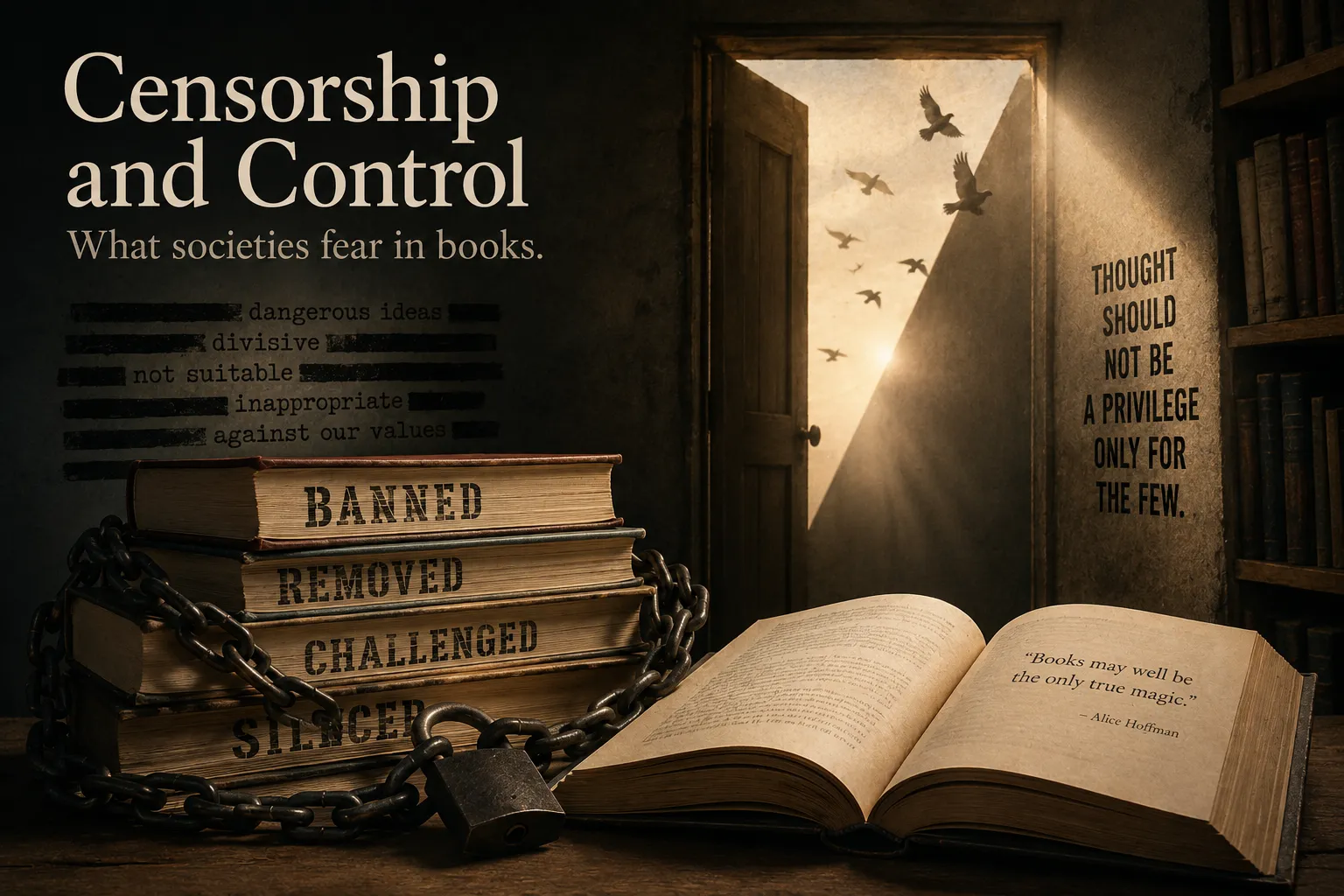
What societies fear in books.
A society does not fear every book it removes.
Some books are quietly neglected. Some are outgrown. Some are poorly written, badly argued, or simply unused. Libraries make collection decisions. Schools make age-based judgments. Parents guide their children’s reading. Communities debate what is suitable for which setting. None of this, by itself, is censorship.
Censorship begins when the question changes.
Not, “Is this the right book for this specific reader, class, or shelf?”
But, “Who must be prevented from encountering this book at all?”
Not, “How should difficult material be taught responsibly?”
But, “How can we remove the difficulty from public view?”
Not, “Can readers think through this?”
But, “What if they do?”
Books become threatening when they interrupt the official arrangement of memory. When they restore interior life to people a culture prefers to discuss abstractly. When they suggest that children may ask questions adults do not control. When they expose the distance between public virtue and private injustice. When they preserve histories that institutions would rather soften. When they make obedience less automatic.
This is why censorship so often presents itself as protection. It rarely announces, “We are afraid of thought.” It speaks instead of decency, safety, moral order, age appropriateness, national unity, community standards, or parental rights. Some of these concerns can be sincere and legitimate. Young readers do require guidance. Schools do make curricular choices. Public institutions cannot carry everything.
But censorship thrives in the blur between stewardship and control.
The current wave of book challenges in the United States makes the distinction urgent. The American Library Association reported that 4,235 unique titles were challenged in 2025, the second-highest total it has ever documented. Of those titles, 1,671, or 39 percent, represented the lived experiences of LGBTQIA+ people and people of color. PEN America separately recorded 6,870 instances of school book bans during the 2024–2025 academic year across 23 states and 87 public school districts. These are not isolated quarrels over a handful of controversial works. They reflect a sustained conflict over what young people may encounter, whose stories receive public legitimacy, and how much complexity institutions are willing to tolerate.
Books are censored not only because they contain ideas. They are censored because ideas, once given a human face, can become difficult to dismiss.
The Book as a Site of Control
A book is unusually vulnerable to censorship because it is unusually portable.
It can be carried home. Read alone. Underlined. Shared with a friend. Returned to years later. A speech passes through the air. A television segment moves on. A book waits. It does not demand immediate agreement. It simply remains available.
That availability unsettles controlling institutions.
A book can outlast the moment of its approval. It can fall into hands for whom it was not intended by those who regulate culture. It can be rediscovered after a regime changes, after a parent’s worldview is questioned, after a young person acquires enough language to understand what once felt unnamed. Books do not only communicate ideas at the moment of publication. They preserve alternate possibilities for later use.
That is why censors often focus not only on what people currently believe, but on what they might someday be equipped to imagine.
A society committed to control cannot be fully comfortable with shelves. Shelves imply options. Libraries imply trust. Bookstores imply that no single authority has completed the task of deciding what minds may meet. Even a school library, modest and supervised, carries this unsettling democratic principle: a young person may browse.
The fear is rarely that every reader will be persuaded by every book. The fear is that readers may encounter a question before an authority has prepared the answer.
Censorship Often Begins With a Claim of Protection
The language of protection deserves careful handling.
There are books children are not ready for. There are materials that belong in one educational setting and not another. Parents do have moral responsibilities. Teachers and librarians make judgments constantly. To reject censorship does not require pretending that every objection to every book is irrational.
The danger lies in turning selective, contextual judgment into broad suppression.
A parent deciding that their own child is not ready for a particular novel is exercising care. A school district removing that novel from every student because a pressure campaign has declared it intolerable is exercising power. A teacher choosing not to assign a book in a specific course is making a curricular decision. A state law designed so broadly that districts preemptively purge books to avoid controversy creates a chilling infrastructure around reading.
In 2025, the American Library Association documented 713 attempts to censor library materials and services, with books targeted in the majority of those efforts. Reporting on ALA’s data, several outlets noted that a striking share of contemporary challenges are not spontaneous, one-family objections, but coordinated actions initiated by organized groups, officials, or politically driven campaigns. The precise percentages vary by reporting year and dataset, but the pattern is consistent: modern censorship efforts increasingly operate through networks of pressure, not only individual parental concern.
Protection becomes censorship when it claims the authority to narrow other people’s access without sufficiently narrow justification. It becomes control when the proposed remedy is not guidance, classification, conversation, or alternatives, but disappearance.
A healthy society can say, “This book may be difficult.”
A fearful society says, “Therefore no one should find it.”
What Is Really Being Protected?
Censorship often claims to protect readers. Sometimes it is protecting power.
A book about racism may be removed in the name of avoiding discomfort, when what is actually being preserved is a cleaner national self-image. A book about queer adolescence may be challenged as inappropriate, when what is actually threatened is the idea that only one kind of childhood deserves recognition. A novel about sexual violence may be described as obscene, when what unsettles censors is its refusal to let violence remain unspeakable. A history of colonialism may be deemed divisive, when its true offense is that it complicates inherited heroism.
This does not mean every censor consciously understands their motive in such terms. People can sincerely believe they are defending innocence while also defending a world in which certain truths remain unavailable. Motives are often mixed. But censorship should be judged not only by stated intention. It must be judged by its effect.
The books most frequently targeted in the United States today are not random. ALA reports that works representing LGBTQIA+ people and communities of color account for a substantial share of challenged titles. PEN America has also documented heavy targeting of books about race, racism, gender, sexuality, and social justice, alongside a sharp rise in challenges to nonfiction works on activism, history, and health.
This pattern suggests that censorship is not merely reacting to isolated content. It is contesting which lives are allowed to appear in public institutions without apology.
A society reveals much by what it labels dangerous. Sometimes the danger is genuinely harmful material. Sometimes the danger is a reader discovering that the official story was incomplete.
Censorship Fears Memory
Books are repositories of memory, and memory is politically inconvenient.
A nation may celebrate its founding myths while neglecting those who were excluded from them. A community may prefer stories of unity to stories of internal abuse. An institution may honor progress while burying the records of whom progress cost. Books disturb these arrangements because they preserve memory in forms capable of intimate transmission.
A historical monograph can challenge public myth through evidence. A memoir can make that challenge personal. A novel can reveal what the archive cannot easily show: how policy enters a kitchen, how humiliation settles into a child, how history becomes inheritance rather than background.
This is why censorship often gathers around books that revisit the past from angles authority would prefer to marginalize. In 2024, a Texas citizens review panel moved Linda Coombs’s nonfiction children’s book Colonization and the Wampanoag Story from nonfiction to fiction, a decision widely criticized by anti-censorship advocates as a distortion of Indigenous history rather than a neutral cataloging choice. In May 2026, Knox County Schools in Tennessee removed Alex Haley’s Roots from school library shelves under a state materials law, even while allowing it to remain available for classroom teaching. The decision drew criticism because a work central to the literary memory of slavery was rendered less accessible to students through a narrow content review.
Censorship does not always burn history. Sometimes it reclassifies it. Sometimes it shelves it elsewhere. Sometimes it creates enough administrative pressure that institutions remove difficult books before anyone formally demands it.
Control over memory rarely announces itself as forgetting. It presents itself as management.
The Long History of Dangerous Books
The fear of books is not new.
The Catholic Church’s Index Librorum Prohibitorum, formally maintained from the sixteenth century until its publication ceased in 1966, listed books regarded as dangerous to faith or morals. The index included religious and philosophical works as well as texts deemed theologically or culturally disruptive. Its existence illustrates a recurring pattern in censorship: authorities claim the right to protect a community by supervising what forms of thought may circulate within it.
In Nazi Germany, censorship became theatrical. In May 1933, pro-Nazi university students burned tens of thousands of books in more than 20 German towns and cities. The targeted works were labeled “un-German” and included books by Jewish authors, pacifist writers, and leftist thinkers. The United States Holocaust Memorial Museum describes the burnings as symbolic of the Nazi desire to remake German culture according to Nazi ideology.
Book burning remains such a powerful image because it reveals censorship without euphemism. Fire does publicly what bureaucratic removal does quietly: it declares that certain words should not remain available in the common world.
Yet modern censorship need not look like a bonfire to be serious. It may appear through procedural review boards, vague laws, selective enforcement, hostile funding environments, or organized complaint systems designed to overwhelm librarians and educators. The absence of smoke does not mean the absence of control.
Why Books Frighten Authoritarian Instincts
Books are not always revolutionary. Many are ordinary, flawed, or forgotten. Yet authoritarian instincts consistently distrust independent reading because books complicate obedience.
They offer comparison. A person living inside one official narrative can encounter another. They offer historical memory. A present authority can be measured against past abuses. They offer interiority. Groups described only through slogans can suddenly appear as persons. They offer moral vocabulary. Readers may learn to name manipulation, propaganda, humiliation, and fear. They offer companionship. Someone made isolated by dominant culture may discover that they are not singular in their experience.
A controlling society wants interpretation to remain centralized. Books distribute it.
This is why censorship frequently intensifies around childhood and education. Adults who control what young people read do more than manage school materials. They influence the boundaries of future imagination. A child who never encounters a history of racial injustice may grow into an adult less equipped to recognize its afterlives. A teenager who never reads about another person’s loneliness, difference, or moral conflict may remain more dependent on inherited caricatures. A student who sees only sanitized narratives of nation, family, or faith may confuse simplicity with truth.
Censors often say they are protecting children from confusion. But confusion is sometimes the beginning of thought. The aim of education cannot be to preserve innocence through ignorance indefinitely. It must be to cultivate discernment with care.
Discomfort Is Not the Same as Harm
One of censorship’s most effective strategies is to collapse discomfort and harm into the same category.
A book may be uncomfortable because it is genuinely gratuitous or poorly suited to its audience. That possibility should not be denied. But a book may also be uncomfortable because it speaks honestly about racism, abuse, war, poverty, sexual exploitation, religious hypocrisy, or historical violence. To treat all discomfort as injury is to make truth dependent on ease.
The distinction matters.
A student may feel distressed reading about slavery. That distress does not prove the material should be removed. It may indicate that the text is communicating a grave reality accurately. A reader may feel challenged by a character who does not confirm their moral assumptions. That is not necessarily harm. It may be literature doing its work. A parent may dislike a book’s worldview. That does not establish that the book is unfit for every reader.
Societies mature by learning how to encounter difficult material responsibly, not by pretending difficulty itself is disqualifying.
This does not mean schools should assign every difficult book to every age. Pedagogy matters. Context matters. Warnings and preparation can matter. But censorship bypasses pedagogy. It treats difficulty as contamination rather than as something to be taught through.
Books are often feared precisely because they produce unease without providing a quick route back to complacency.
The Chilling Effect Is Part of the Point
Censorship does not need to remove every book to reshape a culture. It only needs to make enough people uncertain about what is safe to keep, teach, write, stock, or defend.
The concept of a chilling effect refers to situations in which restrictions or threats deter expression beyond the exact limits of the rule itself. Contemporary scholarship continues to examine how speech restrictions can discourage lawful or valuable expression when the risks of crossing uncertain boundaries appear too high.
In book culture, chilling effects can appear in many ways. A librarian may avoid purchasing a title likely to provoke attack. A teacher may remove a novel from a syllabus before a formal challenge is filed. A publisher may anticipate controversy and ask for changes that make a work less vulnerable. An author may avoid school visits or public discussion after threats. A district may broadly purge materials rather than carefully reviewing them title by title.
By the time a society counts removed books, another layer of loss may already be invisible: the books never purchased, never assigned, never written with full freedom.
Censorship is not only about absence from shelves. It is about the atmosphere of caution that precedes absence.
Not Every Restriction Is Censorship, and That Matters
Opposing censorship requires intellectual honesty. Otherwise the defense of reading becomes sloppy and easier to dismiss.
Libraries make selection decisions because budgets and space are finite. Schools choose age-appropriate materials because education is structured. Parents guide children because parenting includes discernment. Religious communities may recommend or discourage books according to their values. None of these acts automatically constitutes censorship.
The key questions are:
- Who is making the decision?
- For whom?
- Through what process?
- Based on what criteria?
- With what opportunity for review or appeal?
- Does the decision guide a reader, or silence other readers?
- Does it preserve choice, or abolish it?
A parent declining a book for their own child preserves pluralism. A parent demanding that no child in the district may encounter it does not. A school assigning a different novel in one class is curricular discretion. A political campaign forcing the removal of large swaths of literature because they touch disfavored identities or histories moves toward censorship.
Clarity here matters because defenders of censorship often rely on false equivalence. They frame public removal as though it were merely personal choice. It is not. Choosing not to read a book is freedom. Preventing others from reading it is power.
Literature Is Dangerous to Simplified Worlds
What societies fear in books is not only explicit dissent. They fear complication.
A book may not argue against authority directly. It may simply show that authority’s categories are inadequate. It may portray a person the public has learned to despise and make that contempt harder to sustain. It may show a family unlike the reader’s own without presenting difference as pathology. It may reveal that a national triumph contained someone else’s grief. It may expose how easily moral language becomes a cover for domination.
Literature is especially threatening to narrow control because it often changes readers without announcing that it intends to. An argumentative tract can be rebutted. A novel is harder to debate in the same way. Its influence may arrive through sympathy, recognition, discomfort, and memory. A censor may fear not that a reader will memorize a thesis, but that they will become less available to a prescribed simplification.
This helps explain why so many challenged books center people whose presence unsettles conventional hierarchies. The fear is not always that the book will “convert” readers to a particular ideology. Sometimes the fear is that it will grant too much humanity to those whom a social order depends on keeping abstract.
A book that humanizes the wrong person is dangerous to any worldview built on distance.
The Moral Temptation of Control
Censorship is often practiced by people who sincerely believe they are defending the good.
That is precisely why it should be treated as a temptation, not merely a vice belonging to obvious villains. Every community has values. Every parent wants to protect something. Every society negotiates the relationship between freedom and responsibility. The desire to shield people from corrupting influence is not inherently evil.
But the desire can become authoritarian when it loses trust in the moral development of readers.
A community committed to truth should prefer better reading over less reading. It should teach context, critique, discernment, and argument. It should answer books it finds flawed rather than making them disappear. It should distinguish between guiding the young and infantilizing the public. It should know that exposure is not endorsement, and that serious readers are not automatically captives of whatever they encounter.
Control promises cleanliness. Literature insists that mature moral life is messier than that.
A Muslim Publication Should Care About This
A Muslim sensibility has reasons to take censorship seriously without collapsing into a careless libertarianism that treats all expression as equally wise.
Islam honors knowledge, transmission, interpretation, and the seriousness of words. Muslim civilizations have preserved, commented on, debated, translated, classified, and transmitted vast bodies of writing across centuries. They have also had their own histories of suppression, polemical control, and contested boundaries around permissible thought. A serious Muslim literary ethic should not romanticize either unrestricted expression or imposed silence.
It should ask what protects souls without shrinking minds.
What guards modesty without confusing moral formation with ignorance.
What preserves reverence without shielding weak arguments from scrutiny.
What prepares readers for difficulty rather than pretending difficulty can be removed from the world.
The defense of books is not the claim that every book is good. It is the claim that the power to decide what may be encountered must be handled with immense care, because human beings become smaller when authorities casually narrow the field of thought.
Muslim readers, especially, should recognize that truth does not require the suppression of every challenge. A faith confident in its depth should not be frightened by the existence of books. It should form readers strong enough to meet them.
The Shelf as a Measure of Trust
A society’s shelves reveal what it believes about its people.
A broad shelf says: readers can be guided without being caged. Difficult histories can be faced. Young people can grow into complexity. Communities do not need to fear every story that interrupts comfort. Moral formation is not achieved by making the world unreadable.
A narrowed shelf says something else: certain memories are too destabilizing, certain identities too disruptive, certain questions too dangerous, certain readers too fragile to be trusted.
No society can place everything on every shelf. But a culture that steadily removes books representing difficult histories and marginalized lives is not merely curating. It is shaping the public imagination by subtraction.
The question is not whether books influence us. They do. That is why censorship exists. The question is whether we respond to influence by cultivating discernment or by expanding control.
Books deserve neither worship nor fear. They deserve reading.
And when societies fear them too much, it is often because the books are doing what literature has always done: preserving memory, enlarging sympathy, questioning power, and making simplified worlds harder to maintain.