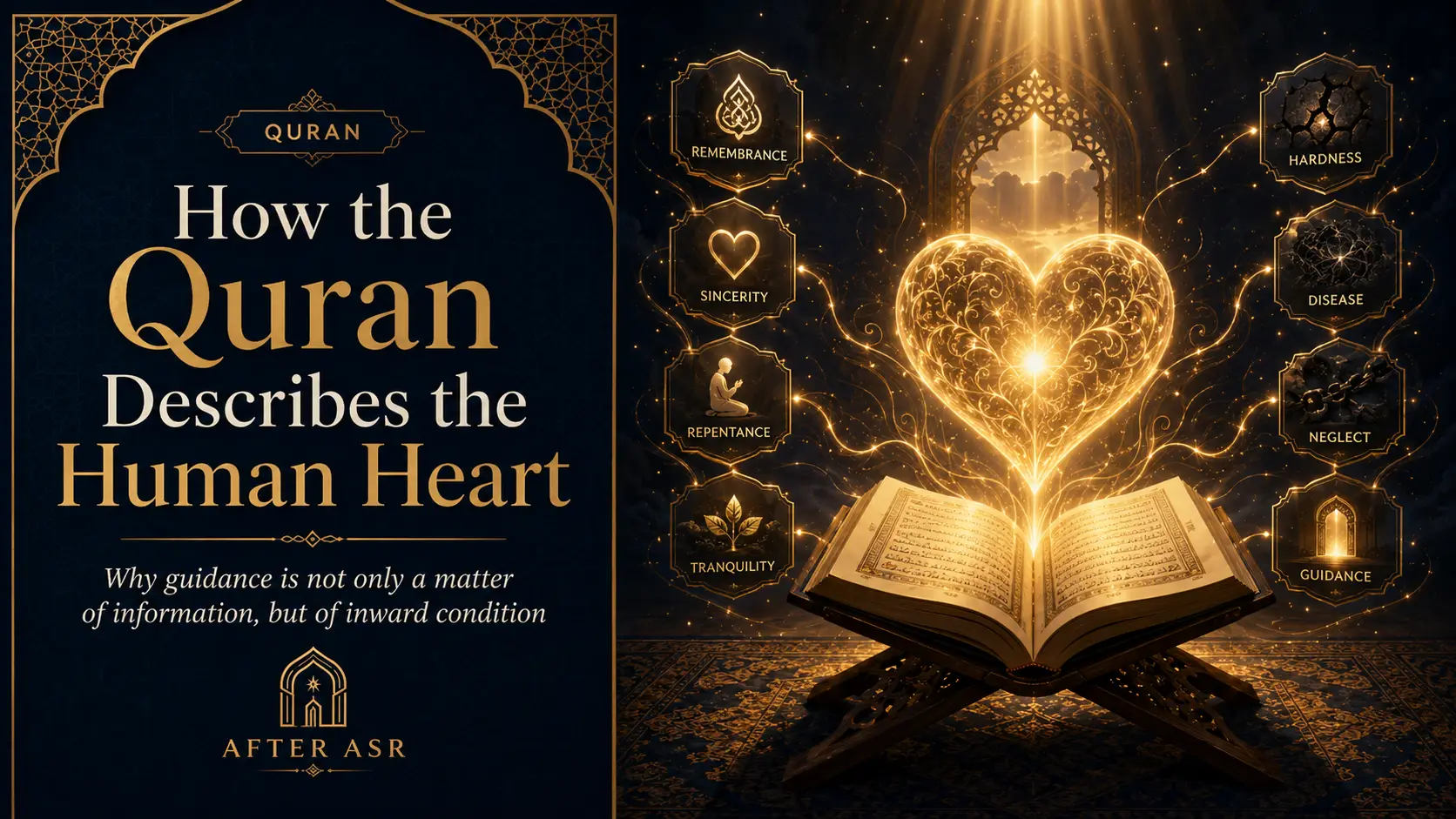
Why guidance is not only a matter of information, but of inward condition.
The Quran speaks to the mind, but it repeatedly returns to the heart. This is one of the most important features of Quranic psychology. The human being is not treated as a machine that simply receives correct information and then behaves correctly. People can know and still deny, hear and still resist, see signs and still turn away, speak religious language and still remain inwardly distant from Allah. The Quran understands that the crisis of the human being is not only intellectual. It is spiritual, moral, emotional, and inward.
The heart, in the Quranic view, is not merely the place of feeling. It is the center of recognition, sincerity, intention, moral perception, love, fear, arrogance, humility, remembrance, and denial. A heart can be alive, diseased, hard, sealed, tranquil, blind, repentant, arrogant, fearful, softened, or guided. This language is not decorative. It tells us that our relationship with Allah is shaped not only by what we claim to believe, but by what has happened inside us.
This is why the Quran does not simply ask whether a person has heard the message. It asks what kind of heart received it. The same verse may soften one person and irritate another. The same warning may awaken one soul and make another defensive. The same blessing may produce gratitude in one person and entitlement in another. The difference is not always in the information. Sometimes the difference is in the heart.
The Heart as the Place of Recognition
The Quran often presents guidance as something that must be recognized, not merely processed. A person may hear the truth outwardly, but recognition happens inwardly. The heart is where the human being either receives truth with humility or blocks it through pride, desire, fear, or attachment.
This is why a sound heart matters so deeply. A person with a receptive heart does not need every reminder to flatter them before they accept it. They do not treat correction as humiliation. They do not demand that revelation bend around their ego. When truth comes, they may struggle with it, but they do not despise it simply because it challenges them.
A corrupted heart behaves differently. It may ask questions not in order to learn, but to avoid surrender. It may look for contradictions because obedience feels threatening. It may pretend that its problem is lack of evidence when the deeper problem is love of control. The Quran repeatedly exposes this inward resistance. Human beings do not always reject guidance because they cannot understand it. Sometimes they understand enough to know that accepting it would require change.
The Heart Can Become Diseased
The Quran describes disease in the heart, and this is one of its most sobering images. A diseased heart is not necessarily a heart that has stopped functioning outwardly. The person may still speak, plan, argue, succeed, and even appear religious. But inwardly, something has become distorted.
Diseases of the heart include hypocrisy, envy, arrogance, greed, resentment, lust, love of status, attachment to the world, and the desire to be praised for what one has not truly done. These diseases change how a person sees. Envy makes another person’s blessing feel like an injury. Arrogance makes advice feel like insult. Greed makes enough feel like deprivation. Hypocrisy makes religion into performance. Love of status makes sincerity difficult. Resentment makes forgiveness feel like defeat.
This is why spiritual disease is so dangerous. It does not remain private. It leaks into speech, family life, leadership, worship, business, community, and judgment of others. A diseased heart interprets reality through its illness. It may call cruelty honesty, vanity excellence, cowardice wisdom, and revenge justice. The Quran’s language forces the believer to ask not only, “What am I doing?” but “What inward condition is producing what I do?”
Hardness of Heart
Among the most frightening descriptions in the Quran is the hard heart. A hard heart is not simply a person with a strong personality. It is a heart that no longer responds properly to reminders. It hears of death and remains unmoved. It sees suffering and feels little. It receives blessings and does not become grateful. It sins and does not feel alarm. It is corrected and becomes defensive. It witnesses signs of Allah and moves on as if nothing has been shown.
Hardness often develops gradually. Few people wake up one morning and decide to become spiritually unresponsive. The heart hardens through repeated neglect. A sin committed once with shame may later become a habit without feeling. A prayer delayed occasionally may become a life organized around everything except prayer. A small arrogance may grow into a personality. A person may ignore reminders so often that reminders begin to feel annoying rather than merciful.
This is one reason the Quran repeats itself. Repetition is part of Allah’s mercy toward hearts that forget. But repetition also exposes hardness. If reminder after reminder comes and the heart grows only more dismissive, the problem is not that the message lacked clarity. The problem is that the heart has lost softness.
Blindness of the Heart
The Quran teaches that blindness is not only a condition of the eyes. A person may have physical sight and still be blind inwardly. This kind of blindness is moral and spiritual. It is the inability or refusal to see reality as it is.
A blind heart sees the world but misses its signs. It sees wealth but not dependence upon Allah. It sees death but not its own return. It sees beauty but not the Creator. It sees power but not accountability. It sees religious practice but not sincerity. It sees people but not their rights. It sees sin but not consequence.
This blindness often hides behind confidence. A person may think they see clearly because they are intelligent, educated, successful, or socially admired. But the Quran does not measure sight by worldly competence alone. True sight is the ability to recognize Allah’s signs, understand one’s dependence, distinguish truth from falsehood, and prepare for the Hereafter. A person can understand the workings of the world and still misunderstand the meaning of life.
The Sealed Heart
The Quran also speaks of hearts being sealed. This is among the most serious warnings in revelation, and it should be approached with fear and humility. A sealed heart is one that has become closed to guidance after persistent rejection, arrogance, or corruption. It is not a condition a believer should speak about lightly regarding specific individuals. The proper response is not to diagnose others, but to seek protection for oneself.
The idea of sealing teaches that refusal has consequences. Turning away from guidance is not spiritually neutral. Each act of rejection affects the heart. Each time a person knowingly dismisses truth, mocks a reminder, defends a sin, or prefers desire over Allah, something inward may change. The heart can lose sensitivity. What once felt dangerous may feel normal. What once felt shameful may feel justified. What once felt like mercy may feel intrusive.
This should make the believer urgent about repentance. The danger is not only punishment after death. The danger is becoming the kind of person who no longer wants to return before death. A sealed heart is terrifying because it may not feel terrified. That is why a living heart asks Allah for protection before it reaches such a state.
The Tranquil Heart
The Quran does not describe only diseased or hardened hearts. It also describes hearts that find tranquility through the remembrance of Allah. This tranquility is not the same as having an easy life. A believer may be grieving, poor, ill, pressured, or uncertain while still possessing a heart anchored in Allah. Quranic tranquility is not the absence of difficulty. It is the presence of a deeper security beneath difficulty.
This kind of heart knows that Allah sees, provides, forgives, judges, and sustains. It does not understand every event, but it is not spiritually homeless. It has a place to return. In fear, it remembers Allah. In sin, it returns to Allah. In blessing, it thanks Allah. In confusion, it asks Allah for guidance. In loss, it does not imagine that Allah has disappeared.
The modern world often seeks tranquility through control: more money, more planning, more comfort, more distraction, more affirmation. Some of these may have ordinary benefit, but none can give the heart what only Allah gives. A person may have every external comfort and still feel inwardly unstable. Another may have little by worldly standards and still possess a heart that knows its Lord.
The Repentant Heart
The Quran honors the heart that returns. This is crucial because the believing heart is not necessarily a heart that never falls. It is a heart that does not make peace with distance from Allah. It may slip, but it does not settle. It may become wounded by sin, but it seeks healing. It may feel shame, but it does not allow shame to become despair.
A repentant heart is honest. It stops pretending. It does not dress sin in beautiful language forever. It does not blame everyone else for its choices. It does not say, “This is just who I am,” when the Quran is calling it to become better. It turns back because it believes Allah’s mercy is real and because it knows that remaining far from Allah is more dangerous than admitting failure.
This is one of the great signs of life in the heart: the ability to return. A deadened heart may sin and feel nothing. An arrogant heart may sin and defend itself. A despairing heart may sin and give up. But a repentant heart sins and comes back wounded, humbled, and hopeful. The Quran repeatedly opens the door for such a heart because Allah knows the servant’s weakness and loves those who return to Him sincerely.
The Heart and Intention
The Quranic view of the heart gives great weight to intention. Human beings see actions, but Allah knows what those actions carry inwardly. This means that the same outward deed may have different realities before Allah. A person may give charity for Allah, while another gives for recognition. A person may speak truth from sincerity, while another speaks truth to humiliate. A person may seek knowledge to serve, while another seeks knowledge to dominate. A person may appear humble while inwardly admiring their own humility.
This inward dimension should make the believer careful. Good deeds are not only about external completion. They require inward purification. The question is not only, “Did I do the act?” but “For whom was it done?” A person who understands the heart becomes less impressed with performance and more concerned with sincerity.
At the same time, this should comfort the believer whose good deeds are unseen. Allah knows the intention hidden behind quiet service, private tears, restrained anger, secret charity, and unrecognized patience. The world may misread or ignore such acts, but Allah does not. The heart’s sincerity is not lost simply because people never applaud it.
The Heart and Hypocrisy
Hypocrisy is one of the most dangerous conditions of the heart because it allows religious appearance to coexist with inward corruption. The hypocritical heart is not merely weak. It is divided. It presents one reality outwardly while serving another inwardly. It may stand among believers, use religious language, and appear committed, while its inner loyalties are elsewhere.
The Quran’s warnings about hypocrisy are severe because hypocrisy damages both the self and the community. It turns religion into a mask. It makes worship performative. It allows a person to seek the benefits of belonging without the sincerity of surrender. It also creates mistrust, because words and appearances no longer reveal the truth of the person.
A believer should not read these warnings primarily as a tool for accusing others. The safer and more beneficial approach is self-examination. Where am I performing what I do not live? Where do I seek people’s approval more than Allah’s? Where does my public religion exceed my private obedience? Where do I use Islamic language while resisting Islamic discipline? These questions are not comfortable, but they may protect the heart from becoming false.
The Heart and Gratitude
The Quran connects the heart to gratitude. Gratitude is not merely saying “alhamdulillah” with the tongue, though saying it is beautiful and necessary. Gratitude is an inward recognition that every blessing comes from Allah and must be used in a way pleasing to Him. A grateful heart does not treat blessings as proof of personal superiority. It treats them as trusts.
Ingratitude begins when blessings become invisible. The person still enjoys them, but no longer recognizes their Source. Health becomes expected. Food becomes expected. Shelter becomes expected. Family becomes expected. Faith itself becomes expected. The heart stops seeing gifts and begins seeing entitlements. This is spiritually dangerous because entitlement turns mercy into complaint.
A grateful heart is not one that has everything. It is one that sees Allah’s generosity in what it has been given. Such a heart may still feel pain, ask for relief, and struggle with hardship. Gratitude does not require pretending life is easy. It requires refusing to let hardship erase all recognition of mercy.
The Heart and Fear
Fear in the Quran is not meant to be panic or despair. It is a moral awareness of Allah’s greatness, judgment, and knowledge. A healthy heart fears Allah in a way that protects it from arrogance and sin. This fear is not the fear of a cruel power. It is the fear of standing before the Lord who knows the truth of the servant completely.
Such fear is necessary because the ego is skilled at self-excuse. Without fear, a person may treat sin casually, delay repentance, and assume forgiveness without return. Fear awakens seriousness. It reminds the believer that choices matter, that rights matter, that intentions matter, and that private life is not hidden from Allah.
But fear must remain joined with hope. If fear separates from hope, it may become despair. If hope separates from fear, it may become carelessness. The Quran cultivates both because the heart needs both. The believer fears Allah enough to leave what destroys them and hopes in Allah enough to return after failure.
The Heart and Love
The Quranic heart is also a heart of love. Love is not absent from Quranic spirituality. The believer loves Allah, loves what Allah loves, loves guidance, loves righteousness, loves the Prophet, peace and blessings be upon him, and loves the people of faith in a way ordered by obedience to Allah. But the Quran also warns that love can become disordered.
A person may love wealth too much, status too much, family in a way that leads to disobedience, desire in a way that becomes enslavement, or the self in a way that rejects correction. The issue is not that the heart loves. The heart was made to love. The issue is what occupies the highest place.
Tawheed purifies love by placing Allah above all. This does not erase human love. It protects it. When Allah is first, love for people becomes more just, less possessive, less desperate, and less idolatrous. A person can love family without obeying them against Allah. They can love a spouse without making that person the center of existence. They can love work without making career their god. The heart becomes healthier when its loves are ordered by the One who created it.
The Heart and Remembrance
The Quran repeatedly connects life of the heart with remembrance of Allah. Dhikr is not merely repetition with the tongue, though spoken remembrance is central and blessed. It is also the heart’s refusal to live as if Allah is absent. A remembering heart brings Allah into its awareness during ease, hardship, temptation, decision, gratitude, and fear.
Forgetfulness is one of the heart’s great dangers. A person may believe in Allah but forget Him functionally. They plan without relying on Him, enjoy without thanking Him, sin without fearing Him, suffer without turning to Him, and succeed without humbling themselves before Him. Such forgetfulness may not feel like disbelief, but it weakens the heart and makes disobedience easier.
Remembrance restores orientation. It brings the scattered self back to its Lord. It reminds the heart that it is not alone, not self-created, not self-sufficient, and not directionless. The heart that remembers Allah becomes more capable of patience, repentance, gratitude, and restraint.
The Heart Can Be Softened
One of the hopeful teachings of the Quran is that the heart can change. A hard heart can soften. A diseased heart can be healed. A heedless heart can awaken. A fearful heart can find tranquility. A sinful heart can repent. A distracted heart can remember. This is why the believer should never treat their current inward condition as permanent.
The path of softening is not mysterious. The Quran itself softens the heart when approached sincerely. Prayer softens. Repentance softens. Remembering death softens. Serving others softens. Leaving sin softens. Seeking forgiveness softens. Keeping good company softens. Secret worship softens. Asking Allah for a sound heart softens.
But the believer must participate in this healing. A person cannot feed the heart with constant sin, distraction, arrogance, and heedlessness, then wonder why it feels spiritually numb. The heart is affected by what it consumes. What we watch, hear, say, desire, repeat, and normalize all leave marks. Guarding the heart is not paranoia. It is spiritual realism.
The Sound Heart
The Quran points toward the sound heart as the heart that will matter most when worldly measures collapse. A sound heart is not a flawless heart in the sense of never having struggled. It is a heart purified from shirk, arrogance, hypocrisy, and ultimate attachment to anything besides Allah. It is a heart that returns to Allah sincerely and does not knowingly prefer falsehood over truth.
This concept should reorder our priorities. People spend enormous effort beautifying the body, improving reputation, building wealth, strengthening career, and managing how they are perceived. Some of that may be permissible or even beneficial in its place. But the heart is the inward reality that will accompany the servant to Allah. A beautiful image cannot replace a corrupt heart. Public admiration cannot purify a diseased heart. Religious performance cannot substitute for a heart that refuses sincerity.
The sound heart is not produced by appearance. It is produced by Tawheed, repentance, remembrance, humility, obedience, and Allah’s mercy. The believer’s greatest project is therefore not merely to look successful, informed, attractive, moral, or religious. It is to meet Allah with a heart that was truthful in its return.
Conclusion
The Quran describes the human heart because the heart is where guidance is either received or resisted. It is where sincerity forms, where arrogance hides, where disease spreads, where repentance begins, where remembrance settles, where fear and hope live, and where love is either purified or corrupted. To understand the Quran’s language of the heart is to understand that Islam is not only about outward action, nor only about intellectual agreement. It is about the transformation of the inward self before Allah.
This should make the believer humble. No one sees their own heart perfectly. No one is beyond the need for purification. A person may appear strong while inwardly diseased, or appear broken while inwardly beloved to Allah. The Quran turns us away from shallow measurement and toward a more serious concern: what is the condition of the heart that will return to its Lord?
The answer is not found in self-flattery or despair. It is found in turning back to Allah again and again. The heart can harden, but it can also soften. It can become diseased, but it can also heal. It can forget, but it can also remember. It can fall, but it can also return.
The Quran does not speak about the heart merely to describe us.
It speaks about the heart to save us.