
Cooperation without compromising belief.
Interfaith work often begins with something ordinary.
A mosque receives a call from a church asking if volunteers can help distribute food before Thanksgiving. A synagogue invites local Muslim leaders to attend a community safety meeting after a hate incident. A school district gathers clergy to discuss student grief. A city council wants faith communities to help with homelessness, refugee resettlement, disaster relief, or neighborhood conflict. A Muslim family is invited to speak at a local church about Ramadan. A pastor attends an iftar. An imam attends a vigil. A group of young Muslims join Christians, Jews, and others to clean a park or pack meals for families who will never know who prepared them.
At its best, interfaith work can be a form of neighborliness. It can remind people that disagreement does not require hostility. It can soften ignorance, open doors, protect vulnerable communities, and make public life more humane. It can allow Muslims to serve society without hiding who they are. It can help neighbors see Islam not as an abstraction from the news, but as a living faith carried by people who pray, raise children, visit the sick, feed the hungry, bury their dead, and worry about the same streets, schools, and storms.
But interfaith work also carries a real tension.
For Muslims, cooperation is not the same as theological blending. Courtesy is not the same as compromise. Friendship is not the same as surrender. Public harmony is not worth the price of private confusion. A Muslim can stand beside a neighbor in service without pretending that the deepest differences between faiths do not matter. A Muslim can speak gently without speaking vaguely. A Muslim can honor the dignity of others without diluting the truth of Islam.
The challenge is not whether Muslims should be good neighbors. They should. The challenge is whether they can enter shared spaces with enough confidence to be both gracious and clear.
The need for a better imagination
Many conversations about interfaith work fall into two unhelpful extremes.
On one side, interfaith cooperation is treated as a threat by default, as though any meeting with people of other faiths must lead to dilution, confusion, or betrayal. This fear is not always baseless. Some interfaith spaces do pressure participants to flatten their beliefs into a comfortable sameness. Some prefer religion only when it becomes soft, symbolic, and politically convenient. Some welcome Muslims only if they speak about Islam as culture, not revelation, or as identity, not truth.
On the other side, interfaith work is sometimes treated as an obvious moral good that only intolerant people would question. In this view, the goal is often “unity,” but unity is left undefined. Difference becomes embarrassing. Doctrine becomes a problem to manage. Sincere belief is softened into shared sentiment. The language becomes warm but thin: love, peace, community, hope, respect. These words matter, but if they are detached from truth, they can become a kind of fog.
Muslims need a better imagination than either fear or fog.
The Islamic tradition does not require Muslims to be socially isolated from people of other faiths. Nor does it allow Muslims to dissolve Islam into a vague spiritual friendliness. The Prophet ﷺ dealt with people across religious, tribal, and social lines. The Qur’an speaks with moral seriousness about other communities, disagreement, justice, covenant, invitation, argument, and neighborly conduct. Islamic history includes coexistence, debate, protection, tension, trade, scholarship, law, and ordinary human relationships across religious boundaries.
This history is not simple, and it should not be romanticized. But it gives Muslims a wider frame than the narrow options often offered in American public life. We do not have to choose between hostility and dilution. We can choose principled engagement.
Cooperation is not confusion
A Muslim who helps a church feed the hungry has not affirmed Christian theology. A Muslim who attends a synagogue security meeting has not blurred the meaning of tawheed. A Muslim who joins a city-wide effort to shelter families during a hurricane has not entered a religious compromise. Shared action does not automatically mean shared creed.
This distinction matters.
Much of American civic life depends on cooperation among people who disagree deeply. People work together in hospitals, schools, neighborhoods, nonprofits, businesses, and public agencies without sharing the same worldview. A Muslim doctor can treat patients of every faith. A Muslim teacher can care for students from many homes. A Muslim business owner can serve customers without asking about their beliefs. A Muslim volunteer can stand beside a Christian, a Jew, an atheist, a Hindu, or someone unsure what they believe, and still remain fully Muslim.
The danger comes when cooperation is framed as theological agreement, or when Muslims feel pressured to speak as though differences are minor, outdated, or unimportant. Islam does not ask us to pretend. It asks us to be truthful and just.
There is a dignity in saying, with warmth, “We do not believe the same things, but we can work together here.” There is maturity in saying, “Our faith teaches us to serve the needy, protect the vulnerable, and honor our neighbors. We come to this work as Muslims.” There is clarity in saying, “We respect your right to believe as you do, and we ask for the same respect. Our cooperation does not require us to erase our differences.”
This kind of language is neither harsh nor evasive. It is honest.
The pressure to become acceptable
American Muslims often enter interfaith spaces carrying an unspoken pressure: be acceptable.
Be calm enough not to frighten people. Be familiar enough not to seem foreign. Be spiritual enough to be inspiring, but not so religious that anyone feels challenged. Speak about fasting as empathy, but not too much about obedience. Speak about hijab as empowerment, but not too much about modesty before Allah. Speak about charity as service, but not too much about zakat as worship. Speak about Islam as peace, but not too much about submission.
This pressure can be subtle. No one may say it directly. It may appear in the questions asked, the topics avoided, the panels organized, the compliments given. Muslims may be praised most when they sound least disruptive to secular comfort. They may be invited back when they present Islam as a cultural enrichment rather than a claim about reality, worship, morality, and the purpose of life.
This is where dilution often begins, not through dramatic betrayal, but through small edits of the self.
A Muslim speaker starts avoiding words like Allah, revelation, sin, obedience, judgment, or truth because they feel too heavy for the room. An imam frames everything in universal language because Islamic language may seem too particular. A Muslim organization begins to measure success by applause from outsiders rather than benefit to believers and service to Allah. Young Muslims learn that public respect comes when Islam is translated into something softer than itself.
This does not mean Muslims should speak without wisdom. Every setting has its adab. Not every audience needs a lecture. Not every gathering is a place for theological debate. But wisdom is not the same as self-erasure. Good communication clarifies. Dilution conceals.
To represent Islam well is not to make Islam smaller. It is to make our speech more faithful, more precise, and more beautiful.
Respect without pretending
Respect is one of the most abused words in interfaith spaces because it is often left undefined.
For Muslims, respect does not mean affirming every belief as true. It does not mean saying all paths are the same. It does not mean participating in worship that contradicts Islam. It does not mean hiding disagreement because disagreement feels uncomfortable. Respect means recognizing the dignity of human beings, speaking truthfully, avoiding mockery, honoring commitments, protecting rights, and dealing with people justly.
A Muslim can respect a person without accepting their theology. This is not hypocrisy. It is moral clarity.
In fact, pretending to agree when we do not is not true respect. It treats others as too fragile for honesty. It turns relationship into performance. It replaces sincerity with politeness. Real respect allows people to be known as they are.
This kind of respect is especially important in friendships across faith lines. Many Muslims have Christian relatives, Jewish coworkers, atheist friends, Hindu neighbors, Buddhist classmates, or family members who left religion entirely. American Muslim life is not lived in sealed rooms. It unfolds in workplaces, schools, military units, hospitals, airports, neighborhoods, and extended families where difference is ordinary.
The question is not whether we encounter difference. The question is whether we encounter it with a sound heart.
A Muslim should not be cruel. A Muslim should not mock what others hold sacred. A Muslim should not lie about Islam to avoid tension. A Muslim should not confuse kindness with agreement. A Muslim should not confuse disagreement with hatred.
This balance is not always easy, but it is necessary for mature faith.
The role of tawheed
The center of Muslim interfaith engagement must be tawheed.
Not public relations. Not social acceptance. Not institutional prestige. Not access to powerful rooms. Not the desire to be liked. Tawheed, the worship of Allah alone, is not one belief among many in Islam. It is the foundation that gives every other action its meaning.
This matters because interfaith work often becomes unstable when Muslims enter it from insecurity. If we are unsure of our own theological center, we may seek validation from others. If we are embarrassed by Islamic particularity, we may overcorrect by making Islam sound like whatever the room already values. If we see ourselves mainly as a misunderstood minority, we may shape every encounter around being accepted rather than being faithful.
Tawheed frees the believer from that need.
A Muslim does not serve neighbors because Islam needs approval. A Muslim serves because Allah loves mercy, justice, generosity, and care for creation. A Muslim does not speak kindly because Islam is on trial. A Muslim speaks kindly because the tongue is accountable. A Muslim does not cooperate because all beliefs are the same. A Muslim cooperates where cooperation is righteous and permissible, while remaining clear about what Islam teaches.
This gives interfaith work a different posture. The Muslim is not entering the room as a nervous guest seeking permission to belong. The Muslim enters as a servant of Allah, responsible for truth and conduct. That responsibility includes humility, not arrogance. It includes listening, not only speaking. It includes keeping promises. It includes refusing injustice even when committed by one’s own community. It includes mercy toward people who misunderstand us. It also includes boundaries.
Without tawheed, interfaith work can become a mirror in which Muslims look for approval. With tawheed, it can become a field of service.
Where boundaries matter
Not every invitation should be accepted. Not every partnership is wise. Not every public prayer, statement, vigil, panel, or ceremony is appropriate for Muslim participation in the same way.
Boundaries are not signs of hostility. They are signs of seriousness.
A Muslim leader may attend a civic gathering to express condolences, but decline participation in a worship ritual that conflicts with Islamic belief. A Muslim organization may partner on food distribution, but avoid signing a theological statement that implies all religions are equally true. A Muslim speaker may join a panel on religious literacy, but refuse framing that treats hijab, prayer, or Islamic morality as mere cultural preferences. A mosque may welcome neighbors to an open house, but maintain the adab of the prayer space. A Muslim student group may collaborate with other faith groups on service projects, but preserve its own prayer, study, and gender guidelines.
These distinctions require courage because boundaries can disappoint people. Some may misunderstand. Some may accuse Muslims of being divisive. Some may say, “Why can’t you just join us?” Others may interpret any limit as rejection.
But faithful boundaries should be explained with gentleness and consistency. “We are grateful to be included. Because of our religious commitments, we cannot participate in that part of the ceremony, but we would be honored to attend respectfully.” Or, “We can support this shared service effort, but we cannot sign language that conflicts with our beliefs.” Or, “We are happy to host visitors and answer questions, while also preserving the mosque as a place of Muslim worship.”
Such language is not aggressive. It is clear.
Muslims should not apologize for having beliefs that shape their participation. Every serious faith community has boundaries. A public square that welcomes religion only when religion has no boundaries is not truly pluralistic. It is only comfortable with belief after belief has been weakened.
The difference between dialogue and display
Some interfaith events are meaningful. Others are mostly display.
Dialogue requires honesty, patience, and the willingness to be changed at least in understanding, even if not in belief. Display requires a stage, a photograph, and the appearance of harmony. Dialogue allows hard questions. Display avoids them. Dialogue can deepen trust. Display can create a temporary warmth that disappears when conflict arrives.
Muslim communities should learn to tell the difference.
A useful interfaith relationship may not be glamorous. It may involve regular meetings with local clergy, school officials, hospital chaplains, nonprofit directors, or neighborhood leaders. It may involve showing up for each other during floods, fires, vandalism, funerals, refugee arrivals, or food drives. It may involve explaining Ramadan every year to the same school district until they finally understand why Eid absences matter. It may involve discussing zoning conflicts, prison chaplaincy, student prayer spaces, cemetery needs, or halal food access.
This work is slow. It does not always produce viral photos. But it builds trust.
By contrast, some interfaith spaces are designed to make everyone feel enlightened for an evening. People read prepared remarks, share symbolic gestures, affirm peace, and leave without any deeper relationship. These events are not necessarily harmful, but Muslims should not mistake them for the substance of community building.
The real question is: does this work help us become better neighbors while remaining better Muslims? Does it protect the vulnerable? Does it increase understanding without requiring dilution? Does it create channels of trust before crisis comes? Does it allow honest difference? Does it produce service, not only sentiment?
If the answer is yes, the work may be worthwhile.
Converts and interfaith family life
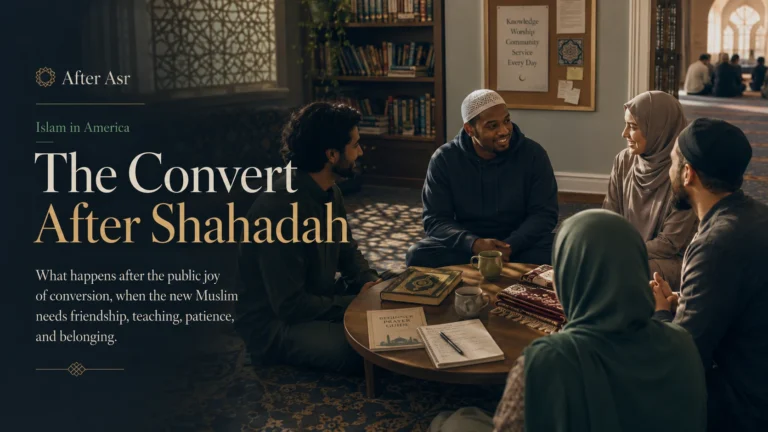
For converts, interfaith work is not always a public program. It may be Thanksgiving dinner.
Many converts live in families where they are the only Muslim. They navigate Christmas invitations, church weddings, funeral services, family prayers, holiday meals, questions about raising children, and relatives who interpret Islam through fear, confusion, or grief. They must learn boundaries not as theory, but as daily life. They may love people whose beliefs they do not share. They may be asked to participate in rituals they cannot join. They may feel pressure to prove that becoming Muslim did not make them cold, foreign, or distant.
This is one of the most intimate forms of interfaith engagement in America.
The convert needs more than slogans. “Just be kind” is not enough. “Avoid everything” is often not enough. The convert needs fiqh, wisdom, emotional steadiness, and community support. They need to know how to honor parents without obeying them in what displeases Allah. They need to know how to attend a family gathering without participating in worship. They need to know how to explain Ramadan, Eid, prayer, halal food, and Islamic marriage with patience. They need to know that sadness does not mean weakness, and boundaries do not mean cruelty.
Born Muslims can learn from this. Many immigrant and second-generation Muslims speak about interfaith work as something outside the home, but converts know that religious difference can sit at the same table, share childhood memories, and say “I love you” while still not understanding your prayer.
A mature American Muslim community should be gentle with converts in these tensions. It should not shame them for loving their families. It should not push them into unnecessary harshness. It should not leave them alone to figure out every boundary through trial and pain. It should help them live Islam with clarity and mercy, especially where the heart is tender.
Interfaith work and Muslim confidence
One of the most beautiful things interfaith work can reveal is Muslim confidence.
Not loudness. Not defensiveness. Not the need to dominate every conversation. Confidence.
A confident Muslim community can invite neighbors to an iftar without turning Ramadan into a cultural performance. It can explain fasting as worship, discipline, gratitude, and obedience to Allah, not only as empathy for the poor. It can open the mosque without transforming it into a museum. It can answer questions honestly. It can say “we believe” without flinching. It can say “we disagree” without contempt. It can serve food, offer chairs, smile warmly, and still preserve prayer when the adhan is called.
Confidence also allows Muslims to listen. Insecure communities often hear every question as an attack. Confident communities can distinguish between hostility and ignorance, between sincere curiosity and bad faith, between a clumsy question and a malicious one. They can respond proportionately. They can correct without humiliating. They can let some comments pass without making every moment a battlefield.
This confidence must be cultivated from within. It cannot be borrowed from public approval. If Muslims only feel secure when praised by outsiders, then interfaith work will always tempt them toward performance. But if Muslims are rooted in worship, knowledge, and communal dignity, they can meet others without fear of disappearing.
The goal is not to become impressive to others. The goal is to be faithful before Allah and beneficial to creation.
The danger of using Islam as decoration
There is a version of interfaith work that likes Islam when it is decorative.
It likes calligraphy, lanterns, food, music, modest fashion, personal stories, and poetic language. It likes Muslims who can add texture to civic events. It likes Ramadan as a lesson in empathy, Eid as a multicultural celebration, hijab as a symbol of resilience, and the mosque as an exotic but friendly place to visit.
There is nothing wrong with beauty, food, stories, or hospitality. These can open hearts. The danger comes when Islam is welcomed only as decoration, but not as guidance.
Islam is not merely an aesthetic contribution to American pluralism. It is not only a culture to be sampled, a cuisine to be praised, or a minority voice to be included. Islam is submission to Allah. It makes claims about truth, worship, human purpose, moral limits, family life, economics, sexuality, death, accountability, and the unseen. It comforts, but it also commands. It beautifies, but it also disciplines. It creates community, but it begins with revelation.
Muslims should be careful not to offer the public only the parts of Islam that are easily admired. Not every setting requires every teaching, but our own understanding must remain whole. When Islam is reduced to decoration, Muslims may gain invitations while losing depth.
After Asr’s readers will recognize this temptation beyond interfaith spaces. It appears anywhere Islam is made publicly acceptable by being made spiritually thin. The task is not to make Islam unnecessarily strange. The task is to refuse making Islam less than itself.
Shared service as moral meeting ground
Some of the strongest interfaith relationships are built through service rather than statements.
When people feed the hungry together, they learn something about each other that panels may not reveal. When they sit with grieving families, rebuild after storms, visit prisons, support refugees, or advocate for basic dignity in local systems, they encounter one another through responsibility. Service has a way of exposing sincerity. It is harder to reduce someone to a stereotype when you have watched them carry boxes in the rain.
For Muslims, shared service can be a powerful form of public witness, but only if intention is guarded. We do not serve merely to improve Islam’s image. We serve because service is part of faith. If a better image comes, alhamdulillah. If no one notices, the work is still seen by Allah.
This matters because American Muslims are sometimes tempted to frame every act of goodness as reputation repair. “Let’s show them who Muslims really are.” There is some value in correcting misinformation through action. But if the primary audience becomes “them,” something has shifted. The poor person becomes a means of public messaging. The volunteer project becomes a branding tool. The heart starts looking sideways.
A healthier framing is simpler: Allah loves mercy. People are in need. We have been commanded to do good. Our neighbors have rights upon us. We will work with others where the work is good, and we will keep our intention with Allah.
This does not make the work less public. It makes it cleaner.
When interfaith work becomes avoidance
There is another quiet danger: using interfaith work to avoid harder work within the Muslim community.
It can be easier to attend a polished interfaith dinner than to address dysfunction in the mosque. Easier to speak about peace at a public panel than to resolve conflict between board members. Easier to be praised by civic leaders than to listen to Muslim women who feel unheard, converts who feel abandoned, youth who feel judged, or families struggling with real needs. Easier to represent Islam outwardly than to repair trust inwardly.
A community should not neglect external relationships. But outward respectability cannot replace inward health.
If Muslims are known by local leaders but unknown to their own struggling members, something is wrong. If a mosque has excellent interfaith relations but poor convert care, poor youth mentorship, poor transparency, and little spiritual teaching, then its public image may be stronger than its foundation. If leaders are more comfortable explaining Islam to outsiders than serving difficult people inside the community, interfaith work has become an escape.
The order matters. A Muslim community should be rooted inwardly and generous outwardly. Worship, knowledge, family care, youth development, elder care, women’s participation, convert support, financial trust, and spiritual formation are not secondary to public engagement. They are what make public engagement truthful.
A tree with shallow roots may still look beautiful in a photograph. It cannot withstand weather.
Speaking clearly about difference
Eventually, serious interfaith relationships will encounter real difference.
Not just food, holidays, or clothing. Difference about God. Difference about Jesus, peace be upon him. Difference about scripture. Difference about salvation. Difference about gender, sexuality, marriage, law, morality, worship, prophethood, and the meaning of freedom. Difference about whether religion should guide public life. Difference about what love requires and what truth permits.
If a relationship cannot survive honest difference, it was not as strong as it appeared.
Muslims should not seek conflict for its own sake. There is no virtue in being abrasive. But we should also not train ourselves to panic whenever difference becomes visible. A pluralistic society does not require everyone to agree. It requires people to live together with justice despite disagreement. For Muslims, this means holding Islamic belief without cruelty, and extending civic fairness without theological surrender.
There are ways to speak that are both clear and gentle:
“We honor Jesus, peace be upon him, as one of the greatest messengers of Allah, but we do not believe he is divine.”
“We believe the Qur’an is revelation from Allah, and this shapes how we understand worship and moral life.”
“We can work together to protect families from hunger and homelessness, even though our religious teachings are not identical.”
“We respect your freedom to practice your faith, and we ask that our community’s commitments also be respected.”
“We cannot participate in that ritual, but we are grateful for the invitation and wish to remain good neighbors.”
Such clarity may feel uncomfortable in a culture that often confuses disagreement with harm. But discomfort is not always harm. Sometimes discomfort is simply the feeling of honesty entering the room.
Teaching young Muslims to engage without dissolving
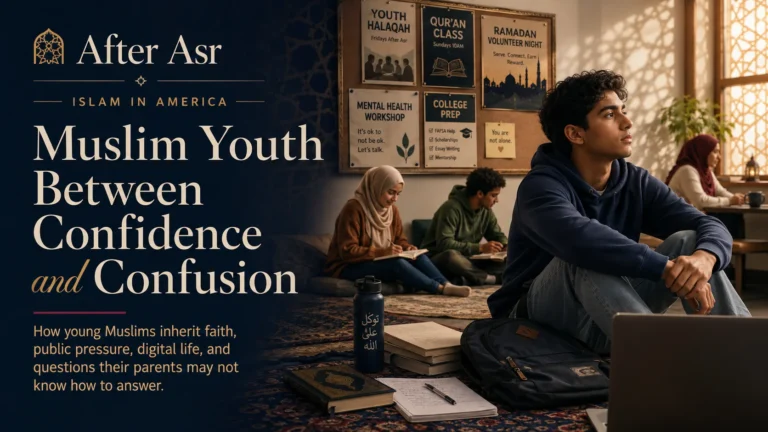
Young Muslims in America often grow up in environments where interfaith and secular pluralism are not occasional events, but daily realities. Their classmates may come from every religion and no religion. Their teachers may treat all beliefs as personal identities. Their universities may celebrate inclusion while quietly assuming that strong religious conviction is suspect. Their workplaces may welcome diversity but struggle with real religious boundaries.
If young Muslims are not taught how to engage without dissolving, they may improvise under pressure.
Some may become rigid and fearful, seeing every friendship outside the community as a threat. Some may become embarrassed by Islam, keeping only the parts that are socially rewarded. Some may divide themselves into private and public selves, religious at home or the mosque, vague everywhere else. Some may become fluent in social justice language but unable to explain tawheed, salah, halal, modesty, or revelation with confidence.
This is not a failure of youth alone. It is a failure of formation.
Young Muslims need models of adults who can move through American life with rootedness. They need to see Muslims who are kind to neighbors, excellent at work, respectful in disagreement, loyal to prayer, clear about boundaries, and unashamed of Islam. They need to learn that being principled does not mean being harsh, and being friendly does not mean being formless.
They need more than warnings. They need language, examples, and practice.
A youth group can discuss how to respond to invitations to religious services. A weekend school can teach the difference between respect and agreement. Parents can role-play how to explain Eid absences or halal needs. Imams can address public engagement without only speaking in fear. Muslim college mentors can help students navigate chapels, interfaith councils, activism spaces, and campus events without losing themselves.
The next generation will not be protected by silence. They will be strengthened by clarity.
A pluralism with room for conviction
America often speaks about pluralism, but not all pluralism is equal.
A thin pluralism welcomes religious people as long as religion remains private, symbolic, and harmless to dominant assumptions. It celebrates diversity in clothing, food, holidays, and stories, but becomes uneasy when believers make truth claims or maintain moral boundaries. It likes faith communities that provide volunteers, social services, and colorful festivals, but not faith communities that refuse to be remade in the image of the age.
A deeper pluralism can handle conviction.
It understands that Muslims are not being disrespectful by believing Islam is true. Christians are not being disrespectful by believing Christianity is true. Jews are not being disrespectful by preserving Jewish covenantal identity. People of other faiths and philosophies also carry serious commitments. The public square does not become more honest by pretending these differences are imaginary.
Muslims should help build the deeper kind of pluralism, not by weakening Islam, but by modeling principled coexistence. We can defend our own freedom while defending the rights of others. We can oppose bigotry without accepting relativism. We can serve the common good without surrendering divine guidance. We can be American neighbors without making America the measure of truth.
This is difficult work because it does not satisfy those who want Muslims either invisible or assimilated, either angry or decorative, either silent or endlessly apologetic. But difficulty is not a sign that the path is wrong. Often, it is a sign that the path is real.
The adab of invitation
Interfaith work is not only about cooperating with others. It is also about how Muslims invite others to understand Islam.
Da’wah in America is sometimes imagined as a formal conversation, a table at an event, a brochure, a lecture, or a debate. These have their place. But much invitation happens before anyone names it. It happens when a neighbor sees Muslims keeping their promises. It happens when a coworker notices someone praying on time. It happens when a family attends an open house at the mosque and is received with warmth. It happens when Muslims respond to ignorance without humiliation. It happens when Islamic belief is explained without embarrassment.
Good interfaith work can create conditions where da’wah becomes more human. Not manipulative. Not hidden. Not a bait-and-switch. Simply human.
A Christian neighbor who has eaten iftar at a mosque may later ask a real question about the Qur’an. A Jewish colleague who has worked beside Muslims on a refugee project may understand Muslim concerns about safety more deeply. A secular city official who has seen a mosque serve the poor may become more willing to accommodate Eid or prayer needs. A non-Muslim relative who sees a convert become more patient, disciplined, and generous may begin to reconsider what Islam has done in their life.
Muslims should not enter every relationship with a strategy. People can feel when they are being treated as projects. But Muslims should also not hide the hope that others may come to know Allah. The best invitation is sincere, patient, and unforced. It trusts that guidance belongs to Allah.
Keeping the soul intact
Interfaith work without dilution requires more than policy. It requires spiritual grounding.
Before the meeting, pray. Before the panel, renew intention. Before the public statement, verify facts. Before accepting the invitation, ask whether the terms are clear. Before declining, ask whether the refusal can be communicated with grace. Before speaking about Islam, remember that you are accountable to Allah for what you make easy, what you make hard, what you hide, and what you exaggerate.
And after the event, return to the mosque. Return to the Qur’an. Return to the people who need care when no one is watching. Return to the children learning to pray. Return to the convert who is lonely. Return to the family struggling with rent. Return to the elder who needs a ride. Return to the quiet obligations that do not come with applause.
This is how the soul stays intact.
Interfaith work can be good. It can be necessary. It can protect communities, build trust, reduce ignorance, and serve people in need. But it is not the center of Islam in America. Worship is. Revelation is. Obedience to Allah is. The formation of sincere believers is. The building of communities that remember Allah, serve creation, and tell the truth is.
When Muslims remember this, they can cooperate without dissolving.
They can sit at shared tables without forgetting the qiblah. They can sign up for service projects without signing away belief. They can honor neighbors without confusing all paths. They can speak gently without speaking weakly. They can be fully present in American life without allowing American approval to become their compass.
Interfaith work, at its best, does not ask Muslims to become less Muslim.
It gives Muslims another place to practice being Muslim well.