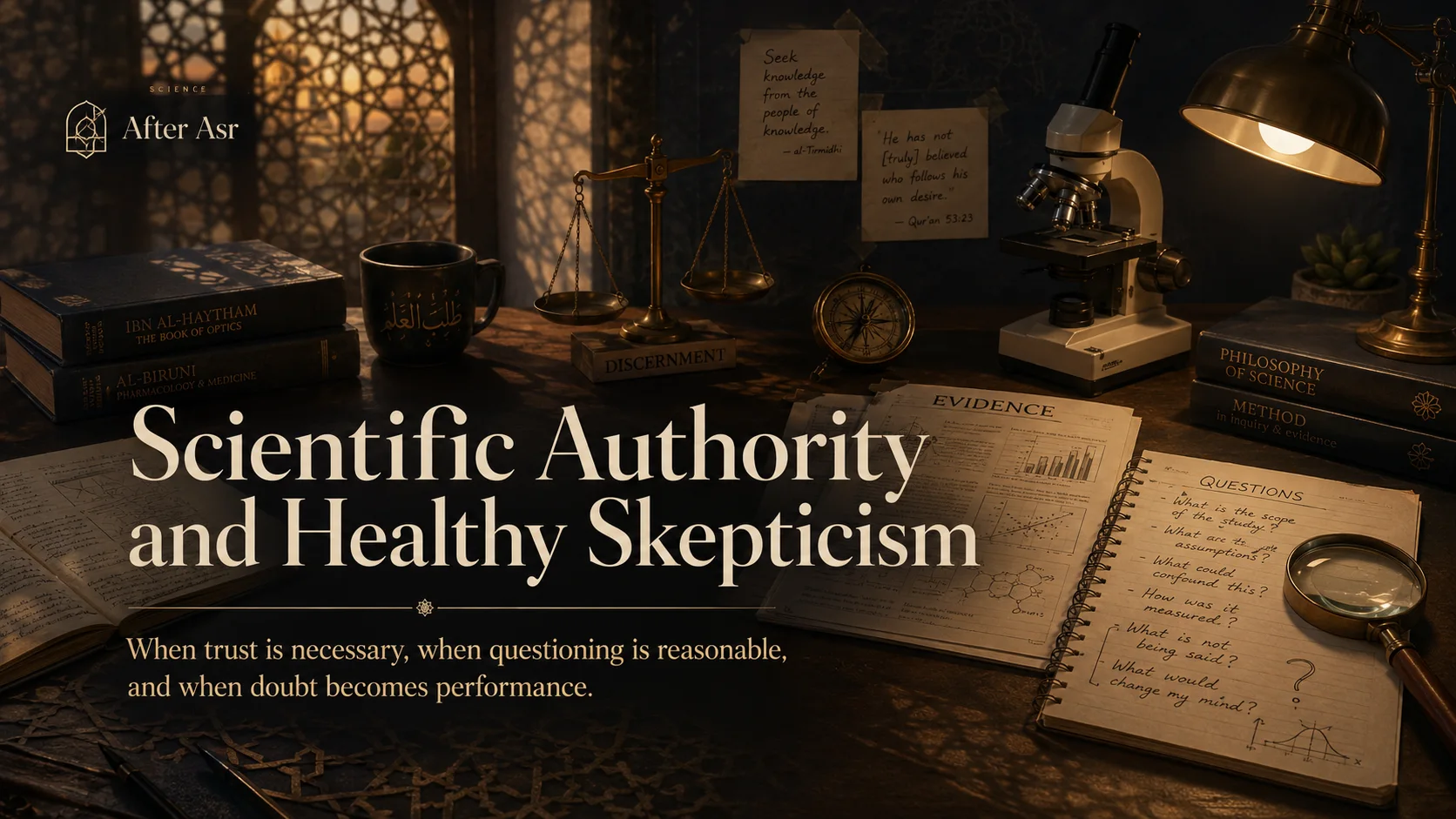
When trust is necessary, when questioning is reasonable, and when doubt becomes performance
No one lives without trust.
We trust the pilot when we board a plane. We trust the pharmacist when a prescription is filled. We trust the engineer when we cross a bridge. We trust the electrician whose work we never inspect, the mechanic whose repair we cannot personally verify, the meteorologist who warns of a storm, the doctor who reads a scan, the researcher whose paper we may never understand in full.
Modern life is built upon networks of knowledge too large for any one person to master.
This is not a weakness. It is part of being human. We are limited creatures. We learn from one another. We depend on skill, training, testimony, institutions, memory, and inherited knowledge. A society where no one trusts anyone quickly becomes impossible to live in.
Yet trust can be abused.
Experts can be wrong. Institutions can become arrogant. Funding can shape priorities. Research can be distorted. Public communication can overstate certainty. Authorities can hide mistakes to preserve reputation. Technical language can be used to silence ordinary people. People with credentials can speak outside their actual expertise.
So the question is not whether we should trust authority or question authority.
We must do both.
Scientific authority matters because expertise is real. Healthy skepticism matters because human beings, including experts, are fallible. The challenge is learning the difference between thoughtful questioning and performative doubt, between humility and cynicism, between refusing blind trust and refusing to be taught.
A mature society needs experts who are humble enough to be questioned, and citizens who are humble enough to learn.
Why scientific authority matters
Scientific authority exists because knowledge requires discipline.
A physician does not become a physician by having opinions about the body. An engineer does not become an engineer by feeling confident about structures. A climate scientist does not become one by watching the weather. A statistician does not become one by liking numbers. Expertise requires years of study, practice, correction, examination, failure, and refinement.
This does not make experts perfect. It does make their knowledge different from casual opinion.
A person who has spent decades studying infectious disease is not automatically right about everything, but their judgment on infectious disease carries weight. A person trained in toxicology may see risks an ordinary person misses. A researcher who understands study design may notice weaknesses in a claim that sounds persuasive to the public.
Authority, in this sense, is not merely status. It is earned competence within a field.
A society that rejects all expertise becomes vulnerable to confusion. It begins treating every voice as equal simply because every voice is loud. The careful researcher and the charismatic influencer stand side by side as if fluency were the same as knowledge. The doctor and the rumor compete in the same public square. The person who has studied a matter for years is dismissed by someone who watched a few videos and learned the vocabulary of suspicion.
This is not freedom of thought. It is the collapse of discernment.
Respecting scientific authority means recognizing that some people really do know more than others about particular subjects. It means allowing training, method, evidence, and peer scrutiny to matter. It means not confusing personal confidence with understanding.
Authority is not infallibility
Respect for authority should never become worship of authority.
Scientific authority is human authority. It is limited, situated, and accountable. It can be influenced by funding, institutional culture, politics, ideology, ambition, pride, and fear. It can overlook evidence. It can move too slowly. It can dismiss patients, communities, or researchers who challenge dominant assumptions.
History contains enough examples to make blind trust foolish.
Medical authorities have dismissed real suffering. Industries have funded research to protect profit. Governments have misused scientific language to justify harmful policies. Research communities have neglected diseases affecting the poor. Public institutions have sometimes communicated uncertainty badly, then expected trust afterward.
To acknowledge this is not anti-science. It is honesty.
The scientific method itself assumes human fallibility. That is why claims must be tested, methods shown, results replicated, conflicts disclosed, and conclusions revised. Science is not strong because scientists are immune from error. It is strong when it builds systems that help correct error.
Authority should be respected, but it should also remain answerable.
The expert should be able to explain. The institution should be able to disclose. The guideline should be open to revision. The claim should be proportional to evidence. The public should be allowed to ask sincere questions without being treated as an enemy.
Trust becomes healthier when authority accepts accountability.
Skepticism as a virtue
Skepticism, properly understood, is not hostility to truth. It is a discipline of carefulness.
Healthy skepticism asks: How do we know? What evidence supports this? What is the method? What uncertainty remains? Who funded the research? Has the result been repeated? Does the conclusion go beyond the data? Are there conflicts of interest? Are there reasonable alternative explanations?
These are good questions.
They protect us from manipulation. They help us avoid spreading weak claims. They prevent fear from becoming knowledge. They remind experts that authority must serve truth, not reputation. They help the public become more responsible participants in scientific life.
Healthy skepticism is humble because it admits that first impressions may be wrong.
It is also patient. It does not rush to believe every dramatic claim. It does not rush to reject every difficult one. It waits, examines, compares, and asks what level of confidence is justified.
This kind of skepticism is compatible with trust. In fact, it strengthens trust because it distinguishes trustworthy authority from mere assertion.
A skeptical person can still say, “I do not know enough to judge this alone, so I will listen to qualified people.” That is not weakness. It is wisdom.
When questioning is reasonable
Questioning scientific authority is reasonable in many situations.
It is reasonable when claims are new, uncertain, or based on limited evidence. It is reasonable when guidance changes and the reasons are unclear. It is reasonable when a study is funded by an interested party. It is reasonable when experts disagree. It is reasonable when a recommendation affects people differently based on age, health, occupation, community, religion, income, or access.
It is reasonable when a patient feels unheard.
A person living inside a body may notice symptoms that a rushed doctor misses. A community exposed to pollution may notice patterns before officials investigate. Workers may understand risks hidden from management. Parents may observe changes in children that a system treats as isolated. Questioning can be a way of insisting that lived reality not be dismissed.
It is also reasonable to ask about values.
Science may provide evidence about risk, benefit, and likely outcomes. But public decisions often involve values too: justice, privacy, religious freedom, protection of the vulnerable, cost, consent, dignity, and distribution of burden. Asking about those values is not anti-scientific. It is part of public moral reasoning.
The problem begins when questioning becomes immune to answers.
A sincere question seeks understanding. A performative question seeks to keep doubt alive forever.
When doubt becomes performance
Doubt becomes performance when it stops being a path toward truth and becomes an identity.
The performative skeptic does not ask questions in order to learn. He asks in order to signal that he is not fooled. He treats distrust as intelligence and trust as weakness. He moves from one objection to another, not because the objections are strong, but because the goal is to avoid being persuaded.
If one claim is answered, another appears. If one source is provided, the source is dismissed. If evidence becomes strong, the institutions behind the evidence are called corrupt. If experts agree, the agreement itself becomes suspicious. If experts disagree, disagreement becomes proof that nothing is knowable.
This kind of doubt feels powerful because it never has to build anything.
It only has to reject.
But rejection is not the same as wisdom. Suspicion is not the same as understanding. A person can distrust everything official and still believe nonsense. A person can reject experts and become dependent on influencers, rumors, or charismatic outsiders with far less accountability.
Performative doubt often pretends to be independence while quietly belonging to another tribe.
It asks, “Who benefits?” only of the people it already dislikes. It demands impossible certainty from mainstream evidence while accepting weak claims from favored voices. It calls itself critical thinking, but it rarely criticizes its own assumptions.
Healthy skepticism is willing to be convinced by good evidence. Performative skepticism is not.
Cynicism is not courage
Cynicism often disguises itself as maturity.
The cynic says, “Everyone lies.” “All institutions are corrupt.” “Experts just say what they are paid to say.” “Research can prove anything.” “You cannot trust anyone.” This posture may sound worldly and sophisticated, especially to people who have been disappointed by authority.
But cynicism is often a form of despair.
It refuses the hard work of discernment by flattening everything. If everyone lies, then no careful judgment is needed. If all institutions are equally corrupt, then no distinction must be made between stronger and weaker evidence. If research can prove anything, then a person is free to believe what feels right.
This is not wisdom. It is surrender.
Cynicism protects the self from being disappointed, but it also protects the self from being responsible. If nothing can be trusted, then no one can be obligated to learn, change, submit to evidence, or act.
A believer should be cautious of cynicism because it corrodes amanah. Trustworthiness still matters. Truth still matters. Testimony still matters. Expertise still matters. The fact that human beings can lie does not mean truth has vanished from the world.
The proper response to corruption is not to abandon discernment. It is to become more disciplined in seeking what is trustworthy.
The difference between expertise and elitism
Some public distrust comes from confusing expertise with elitism.
Expertise is real knowledge earned through discipline. Elitism is the attitude that ordinary people are beneath explanation, consultation, or respect. The two are not the same, but they can become tangled.
An expert can become elitist when they mock the public, dismiss sincere concerns, hide uncertainty, or speak as if credentials remove the need for accountability. Institutions can become elitist when they expect compliance without transparency. This damages trust.
But public anger at elitism should not become rejection of expertise itself.
The fact that some experts are arrogant does not mean expertise is fake. The fact that some institutions communicate badly does not mean every claim from trained specialists is suspicious. The fact that ordinary people deserve respect does not mean every opinion carries equal weight on technical matters.
A healthy society must resist both elitism and anti-intellectualism.
Experts should serve the public with humility. The public should recognize the value of expertise without surrendering moral agency. There must be translation, accountability, and mutual respect.
Knowledge should not become a weapon of class pride. But neither should resentment become a substitute for knowledge.
Trust as a relationship
Trust is not only intellectual. It is relational.
People ask not only, “Is this claim true?” They also ask, “Who is telling me this? Do they respect me? Have they been honest before? Do they understand my life? Are they hiding anything? Are they willing to admit error? Do they care about people like me?”
This is why scientific authority cannot rely only on correct information. Correct information matters, but trust also depends on the character of the messenger and the conduct of institutions.
A doctor who listens earns trust differently from one who rushes. A public health official who explains uncertainty earns trust differently from one who overstates. A scientist who discloses conflicts earns trust differently from one who hides them. A journalist who avoids sensationalism earns trust differently from one who turns every study into panic.
Trust grows through repeated truthfulness.
It weakens when people feel manipulated, ignored, or shamed. It weakens when authorities communicate only after crisis. It weakens when institutions admit mistakes only after being exposed. It weakens when ordinary questions are treated as disobedience.
Scientific authority becomes stronger when it remembers that trust is not a possession. It is a responsibility.
The role of humility in experts
Humility is not optional for scientific authority.
An expert should know the boundaries of their expertise. A brilliant physicist is not automatically an authority on nutrition, public policy, Islamic law, or family life. A physician may know medicine deeply but still need to listen to the patient’s experience. A researcher may understand data but not the local community affected by the research.
Humility says: I know something real, but not everything.
This humility protects both the expert and the public. It prevents overreach. It encourages collaboration. It makes room for correction. It helps experts speak proportionally, distinguishing between established evidence, emerging evidence, interpretation, and personal opinion.
The humble expert can still be firm. Humility does not mean refusing to warn the public when evidence is strong. It does not mean treating all claims as equal. It does not mean allowing falsehood to spread unanswered.
Humility means confidence remains tied to evidence and accountability.
A public that sees humility in experts is more likely to trust them. Not because humility makes experts perfect, but because it makes them safer.
The role of humility in the public
The public also needs humility.
It is easy to say, “I did my own research,” when what we mean is that we searched until we found a voice that felt convincing. It is easy to believe we understand a field because we have learned a few terms. It is easy to mistake suspicion for intelligence.
Real humility admits that complex fields require training.
A person may have valid concerns without being qualified to judge every technical detail. A patient may know their body without knowing pharmacology. A citizen may ask important policy questions without knowing epidemiology. A parent may notice a child’s struggle without knowing the full science of development.
Humility allows us to say, “I have questions, but I also need guidance.”
This is not humiliation. It is part of intellectual maturity.
The public has the right to ask for explanations, transparency, and accountability. But that right should not become the belief that every person is equally equipped to evaluate every scientific matter independently.
We depend on one another. That dependence requires trust, but also careful selection of whom to trust.
How to evaluate authority wisely
A thoughtful person can ask practical questions when evaluating scientific authority.
Is this person trained in the relevant field?
Are they speaking within their expertise?
Do they show their evidence?
Do they acknowledge uncertainty?
Do other qualified experts broadly agree?
Are there conflicts of interest?
Do they correct themselves when wrong?
Do they make extreme claims without proportional evidence?
Are they selling something?
Do they rely on fear, contempt, or conspiracy to persuade?
These questions help us avoid both blind trust and reckless distrust.
Authority is not all or nothing. Some experts are highly reliable in one field and unreliable outside it. Some institutions are trustworthy in some ways and flawed in others. Some claims are well established, while others remain uncertain. Some dissenters are serious and important. Others are simply wrong.
Discernment requires distinctions.
The goal is not to find a human source that can never err. No such source exists. The goal is to identify which claims are best supported, which voices are accountable, and which uncertainties remain.
This is slower than simply choosing a side. But truth often requires slowness.
Dissent has a place
Scientific progress sometimes depends on dissent.
A minority view may challenge a flawed consensus. A researcher may notice evidence others ignored. A patient community may force medicine to take symptoms seriously. A young scientist may question an old assumption. A community may expose environmental harm that officials denied.
We should not treat all dissent as ignorance.
But neither should we romanticize dissent.
The fact that some dissenters in history were later vindicated does not mean every dissenter today is a genius. Many minority views are minority views because the evidence is weak. Some dissent is funded by industries trying to protect profit. Some dissent is ideological. Some dissent is built on misunderstanding.
A mature view makes room for dissent while still asking for evidence.
The dissenter should not be silenced merely for disagreeing. But the dissenter also does not deserve automatic trust simply for opposing authority.
Dissent must meet the same standards: evidence, method, transparency, humility, and willingness to be corrected.
Truth is not determined by popularity. It is also not determined by contrarianism.
The spiritual danger of always being against
There is a spiritual danger in becoming the person who is always against.
Always against experts.
Always against institutions.
Always against consensus.
Always against public guidance.
Always against whatever most people believe.
This posture can feel brave. It can make a person feel awake while others are asleep. But it can also become pride.
The nafs enjoys feeling superior. It enjoys believing that it sees what others cannot. It enjoys the status of being hard to fool. It enjoys suspicion when suspicion becomes a form of self-praise.
Faith should make us careful here.
Islam does not ask the believer to be gullible. It also does not praise arrogance disguised as independence. The believer seeks truth, accepts correction, verifies claims, respects knowledge, and avoids speaking without knowledge.
To always oppose is not the same as having courage. Sometimes courage is trusting those who know more than we do. Sometimes courage is admitting that our favorite suspicion was wrong. Sometimes courage is accepting evidence that requires us to change.
A heart that cannot trust anyone may not be wise. It may be wounded, proud, or afraid.
The moral cost of misinformation
Skepticism becomes dangerous when it spreads misinformation.
False claims about medicine can lead people to refuse treatment, misuse substances, or delay care. False claims about weather or disasters can prevent preparation. False claims about environmental risk can expose communities to harm. False claims about technology can create panic or false security. False claims about groups of people can produce prejudice and violence.
Sharing misinformation is not a harmless mistake when it harms others.
In an age of instant communication, forwarding a claim is an act. Reposting a statistic, warning, theory, or accusation places something into the minds of others. If it is false, we have participated in confusion.
A believer should feel the weight of this.
Speech is accountable. The tongue and the keyboard are not separate moral worlds. “I was just sharing” is not enough if we did not care whether it was true.
Healthy skepticism should make us slower to share, not faster to accuse.
When trust is necessary
There are moments when trust is necessary because action cannot wait for personal mastery.
A patient in an emergency room cannot become a physician before consenting to treatment. A family facing a hurricane cannot become meteorologists before evacuating. A community confronting contaminated water cannot personally perform every laboratory test before seeking help. A society facing a public health threat cannot wait for every citizen to independently evaluate all technical evidence.
In such moments, we rely on trustworthy processes.
Training matters. Institutions matter. Transparency matters. Track records matter. Peer review matters. Public accountability matters. Local trust networks matter. Moral character matters.
Trust does not mean turning off the mind. It means recognizing that responsible action often requires relying on people and systems beyond ourselves.
The question becomes: Which sources have earned trust, and what safeguards exist when they fail?
No society can function if every person must personally verify everything. The mature alternative to blind trust is not universal distrust. It is disciplined trust.
When questioning is necessary
There are also moments when questioning is necessary.
Questioning is necessary when authorities speak beyond evidence. When conflicts of interest are hidden. When vulnerable people are ignored. When guidance changes without explanation. When policies claim to be purely scientific but conceal moral choices. When dissenting evidence is suppressed for political or financial reasons. When patient experiences are dismissed. When institutions refuse accountability.
In those moments, questioning can be a duty.
But questioning should be done with adab. It should seek truth, not humiliation. It should be specific, not vague suspicion. It should be willing to listen to answers. It should distinguish between error and malice, between uncertainty and deception, between disagreement and corruption.
A community that cannot question authority becomes vulnerable to abuse.
A community that cannot trust authority becomes vulnerable to chaos.
Wisdom lies in knowing the difference.
Faith and the ethics of knowledge
Faith helps us approach authority and skepticism with balance.
It teaches that knowledge has ranks. The one who knows and the one who does not know are not the same. It teaches us to ask people of knowledge when we do not know. It also teaches us not to follow blindly, not to speak without knowledge, not to conceal truth, not to spread rumors, and not to let pride block correction.
This balance is deeply needed.
Faith should not make us anti-science. It should make us more honest about evidence. Faith should not make us blindly submissive to institutions. It should make us more attentive to justice and accountability. Faith should not make us perform doubt for status. It should make us humble before truth.
The believer is not asked to be naive. The believer is asked to be truthful.
Truthfulness requires both trust and verification. It requires respect for expertise and awareness of human fallibility. It requires courage to ask questions and humility to accept answers.
A better public culture
A healthier public culture around science would look different from what we often see.
Experts would explain more and posture less. Institutions would disclose conflicts and admit uncertainty. Journalists would resist exaggeration. Schools would teach students how evidence works. Religious communities would honor qualified knowledge while asking moral questions. Citizens would become slower to share claims and quicker to verify.
Questions would not be treated as betrayal. But answers would also not be endlessly rejected to preserve identity.
Trust would be earned. Skepticism would be disciplined. Doubt would not become entertainment.
This kind of culture is difficult to build, but necessary. Scientific knowledge now shapes medicine, environment, technology, education, labor, war, food, public policy, and daily life. If we cannot relate to authority wisely, we will swing between obedience and rebellion, panic and denial, elitism and anti-intellectualism.
We need something better.
We need discernment.
Trust, question, and remain accountable
Scientific authority and healthy skepticism are not enemies.
They need each other.
Authority without skepticism becomes arrogant. Skepticism without respect for authority becomes reckless. Authority needs questioning to remain honest. Skepticism needs humility to remain truthful.
The goal is not to trust everyone.
The goal is not to doubt everyone.
The goal is to become the kind of person who can recognize what deserves trust, what deserves questioning, and what deserves rejection.
This requires character.
Patience to understand before reacting.
Humility to admit when we do not know.
Courage to question what is unclear.
Fairness to accept evidence even when inconvenient.
Restraint to avoid spreading claims we have not verified.
Mercy toward those confused by complex matters.
Accountability before God for what we believe, say, and share.
Science is too important to be trusted blindly.
It is also too important to be dismissed performatively.
The bridge must hold. The medicine must be tested. The storm warning must be heard. The patient must be listened to. The data must be examined. The expert must be accountable. The public must be teachable. The skeptic must be sincere.
A mature mind does not confuse trust with surrender.
A mature mind does not confuse doubt with intelligence.
It asks carefully. It listens humbly. It verifies responsibly. It changes when truth requires change.
And in a world overflowing with claims, that kind of disciplined discernment may be one of the most necessary virtues of all.
About the Author
Dr. Safiyyah Rahman is the Science & Society Essayist for After Asr, writing at the intersection of scientific inquiry, ethics, faith, and human responsibility. Her work explores how knowledge shapes not only what we understand about the world, but how we live within it.