
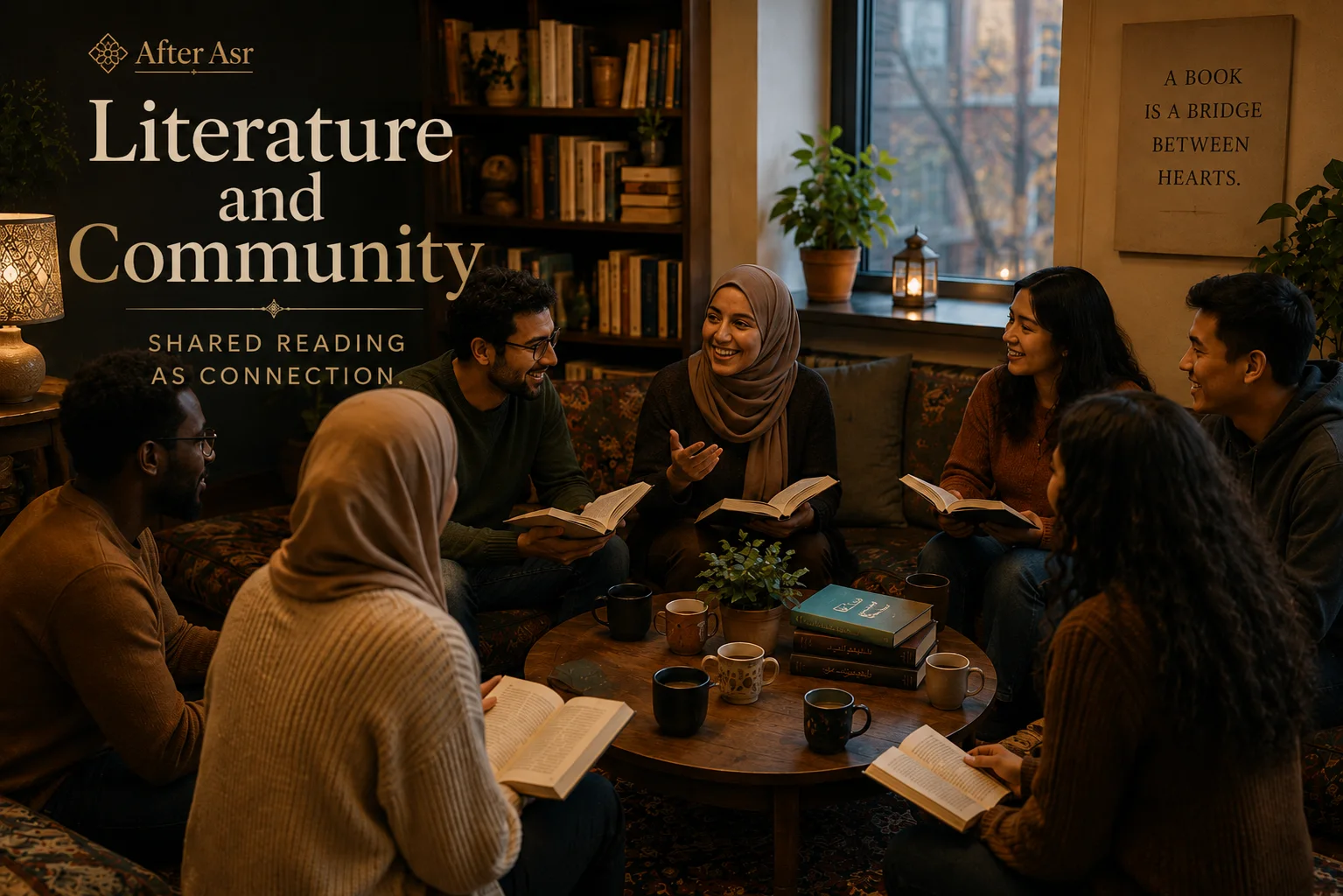
Shared reading as connection.
Reading appears solitary from the outside.
A person sits with a book. The room quiets. The eyes move across the page in private. Even when the world of the text is crowded with characters, cities, arguments, and history, the reader seems alone.
Yet literature has never belonged only to solitude.
Stories were recited before they were printed. Poems were heard in gatherings before they were preserved in anthologies. Scripture was recited in community. Families read aloud. Teachers opened texts before students. Friends passed novels to one another with underlined lines and urgent instructions: read this chapter, tell me what you think, this reminded me of you. Book clubs formed in parlors, libraries, cafés, mosques, churches, classrooms, prisons, neighborhood centers, and now video calls spanning continents.
A book may be read alone. Meaning often grows in company.
Shared reading does not diminish the intimacy of literature. It extends it. A reader may enter a text privately, then discover that another person noticed a grief they missed, laughed where they remained solemn, distrusted a character they had defended, or found in a sentence the language for something neither person had been able to begin discussing directly. The book becomes a third presence in the room, allowing conversation to approach difficult ground without immediately making one person the subject.
This is one of literature’s social gifts. It creates relation without demanding sameness. Readers do not need to agree in order to be connected by a text. In fact, a strong shared reading experience often deepens because interpretations diverge. The book holds the conversation steady while people reveal how differently they see.
In a fragmented age, that matters.
Research on shared reading remains an emerging field, but recent reviews suggest that reading literary texts aloud and discussing them in groups can support adult well-being, social connection, and reflective engagement, even as scholars caution that more rigorous evidence is still needed. A 2025 systematic review of shared reading interventions found promising associations with psychosocial well-being and social outcomes, while a separate 2025 scoping review described shared reading as a growing area of interest for health and well-being research. (pmc.ncbi.nlm.nih.gov) (pmc.ncbi.nlm.nih.gov)
The value of shared reading is not only therapeutic. It is civic, educational, spiritual, and cultural. Communities become deeper when they do more than consume media in parallel. They need places where attention is gathered, where language is taken seriously, where disagreement can be slowed by a common object of care.
A shared book does not automatically create community. But it can give community something increasingly rare: a reason to remain together long enough for thought to unfold.
Reading Together Does Not Mean Reading the Same Way
The first misconception about communal reading is that it seeks uniformity.
A classroom discussion, a family reading hour, or a book club is sometimes imagined as a search for the “correct” interpretation, with one reader eventually arriving at the authoritative conclusion. Good teaching may require correction. Texts do have limits. Some readings are more supported than others. But community around literature becomes impoverished when it exists only to enforce sameness.
Shared reading becomes connective precisely because different readers bring different histories to the page.
One reader notices the class tension in a novel because money has always been concrete in their life. Another notices parental silence because that silence shaped their home. Another focuses on religious imagery because they have learned to read spiritual metaphor carefully. Another hears humor where others heard cruelty, or vice versa. The text does not become anything anyone wishes it to be. Yet it opens differently under different attentions.
This is not a problem to overcome. It is one reason to read together.
A solitary reader may believe their first interpretation is the obvious one. A group reveals that obviousness is often local. What seemed central to one person may be secondary to another. What felt like a minor scene may become, through discussion, the moral hinge of the work. Reading in community does not only teach us about books. It teaches us about perception.
That lesson is humbling. It also builds connection. People become more legible to one another through what they notice.
The Book as a Third Presence
Some conversations are difficult to begin directly.
A community may need to discuss grief, racism, marriage, aging, loneliness, migration, generational conflict, or spiritual burnout, yet the direct question feels too exposing. “How are you handling loss?” may be too intimate. “Do you feel unseen here?” may arrive too bluntly. “What do you fear your children are inheriting?” may silence the room.
A book can create an oblique entry.
Readers may begin by discussing a character’s grief and gradually recognize the contour of their own. They may debate a fictional family’s silence before someone says, quietly, “That felt familiar.” They may speak about exile through a poem long before they speak about their own fractured relation to home. The text provides distance, and distance can make honesty possible.
This is part of why shared reading has attracted interest in health, mental well-being, and community settings. Studies and reviews of reading groups often note the importance of a text-centered conversation that allows participants to reflect without being forced into immediate self-disclosure. The literary work offers enough separation to create safety, while remaining emotionally resonant enough to matter. (frontiersin.org)
The book does not replace friendship, therapy, pastoral care, or community leadership. It should not be asked to. But it can create a shared language where none existed. It can make people less alone in the presence of a question.
A text sometimes succeeds socially because it prevents the conversation from becoming instantly personal, and then gently permits the personal to appear.
Communities Are Built Through Repeated Attention
Community is often discussed as though it emerges from identity alone. People share religion, neighborhood, workplace, culture, or interests, and therefore they are a community. But proximity is not the same as connection. Shared identity does not automatically produce trust. Many people live beside one another while rarely attending together to anything beyond logistics.
Reading groups offer a different rhythm.
They require return. Readers gather around one chapter, then another. They wait for others to finish. They carry questions across weeks. They learn who reads quickly, who marks margins, who hesitates before speaking, who always begins with plot and ends at moral consequence. Over time, these repeated small acts create familiarity.
A book club is not important because every meeting produces brilliant literary insight. Sometimes discussion wanders. Sometimes someone did not finish the reading. Sometimes the tea is more memorable than the chapter. Yet the repeated gathering itself matters. It says: we will make time for thought together.
Recent library research has found that public library clubs can alter how participants experience libraries, shifting them from purely transactional spaces into lively sites of connection and belonging. A 2024 study of public library clubs found that attendees often came to perceive libraries as more socially meaningful and community-centered through participation. (tandfonline.com)
Books become part of that social infrastructure. They give people a reason to return.
The Library as a Community Reading Room
Libraries remain among the most democratic literary institutions in public life.
They offer books without requiring purchase. They welcome readers of different ages, incomes, education levels, and interests. Increasingly, they also host conversations: book clubs, children’s story hours, writing circles, multilingual gatherings, community reads, and social reading spaces designed less around silence than around low-pressure belonging.
A 2025 Social Reading Spaces study across 17 school libraries in the United Kingdom found promising effects from relaxed, pressure-free spaces where young people could gather around books and conversation without the expectation that they all read the same text or complete formal assignments. The project emphasized the role of libraries as safe social environments, especially when paired with empathetic librarians and access to books. (sla.org.uk)
The detail is important. Community reading does not always require a rigid book-club model. Sometimes connection emerges simply from reading beside others. Silent book clubs, which have grown in popularity in recent years, operate on that principle. Readers gather in a café, library, or public space, bring their own books, read quietly together, and converse afterward only if they wish. The format has resonated because it offers fellowship without performance, presence without pressure. (axios.com)
This expands our understanding of literary community. Discussion is one form of connection. Shared quiet is another. Not every reader wants to analyze aloud. Some simply want to experience that reading need not happen in isolation.
A room full of people reading different books can still feel communal. It is a small refusal of the idea that attention must always be solitary or monetized.
Family Reading as First Community
For many people, the first literary community is not a library or classroom. It is a lap, a couch, a bedtime routine, a car ride, a grandparent’s voice.
Shared reading with children has long been associated with language development and literacy. More recent research also examines its role in social and emotional competence, emphasizing that book reading can support conversation about emotions, relationships, and perspective-taking in early childhood. A 2025 review of shared book reading interventions in preschool contexts found that these experiences can contribute to children’s social and emotional development, especially when adults engage children actively rather than merely reading aloud mechanically. (frontiersin.org)
Yet even apart from measurable outcomes, family reading creates memory.
A child may not recall the entire plot of a picture book heard at age four. They may remember the sound of a parent’s voice changing for each character. They may remember the turn of the page, the warm light before sleep, the delight of knowing what line comes next. These are not sentimental extras. They associate language with affection, attention, and belonging.
In Muslim homes, this may include Qur’anic stories told in child-friendly language, prophetic stories, poetry, moral tales, bilingual books, or family stories read and retold. The goal is not only literacy. It is the creation of a household in which words are welcomed, questions are allowed, and reading feels like an inheritance rather than an assignment.
A community of readers often begins with one adult making a child feel that books are part of love.
Shared Reading Across Generations
Literature can also connect generations that otherwise struggle to speak across experience.
An older adult may read a novel of migration with memories the younger members of a group do not possess. A teenager may encounter a classic with impatience, then surprise elders by naming an emotional truth they had overlooked. A parent and adult child may discuss a memoir about family obligation and find, for once, that the conversation can occur through another family’s story.
Shared texts allow generations to approach one another indirectly.
This matters in communities where silence can settle around difficult histories. Older immigrants may not volunteer stories of displacement. Converts may not know how to tell parents what spiritual transformation felt like. Children of refugees may carry inherited grief without having been given coherent language for it. A book can open doors.
Not every text will do this. Not every family will want to read together. But where it happens, literature becomes a bridge not because it erases difference, but because it gives difference a place to sit down.
The Masjid, the Circle, and the Culture of Study
Muslim communities have long known reading as a communal act.
The halaqah, the study circle, places listeners around a shared text, whether Qur’an, hadith, tafsir, fiqh, seerah, poetry, or ethical writing. Knowledge is heard, questioned, clarified, and carried forward in company. The relationship is not identical to a literary book club. Sacred and scholarly texts require their own adab and discipline. Yet the communal structure is instructive. Reading is not treated only as private consumption. It is relational.
This older Muslim habit can inspire wider literary culture without collapsing categories. A masjid library might host discussions of Muslim memoir, poetry, Islamic history, or carefully selected novels about faith, migration, and moral life. A youth group might read short stories that create better conversation than an abstract lecture alone. A convert support circle might share essays that give language to belonging and estrangement. A women’s group might discuss literature on caregiving, intellectual life, or family memory.
The book does not replace religious instruction. It enlarges the community’s vocabulary for discussing life.
A healthy Muslim literary culture should not assume serious reading belongs only to universities or private homes. Communities that gather for worship can also create spaces for thoughtful engagement with literature, provided they do so with discernment, generosity, and an understanding of genre.
Shared Reading Teaches Disagreement Without Collapse
One of the most underappreciated gifts of literary community is the practice of disagreement.
In many public settings, disagreement escalates quickly because people experience challenge as personal threat. Book discussions can offer a gentler training ground. Readers disagree over a character’s motive, the justice of an ending, whether a narrator is trustworthy, whether a work is compassionate or evasive. These disagreements matter, but they do not always demand moral combat. They can teach people to ask, “What in the text leads you there?” rather than, “How could you think that?”
This is a small civic skill.
A good reading group does not pretend every interpretation is equally strong. It asks for evidence. It returns to the page. But it also allows for the possibility that multiple readings may illuminate different aspects of a complex work. Participants learn to revise, defend, clarify, and listen.
These habits are needed beyond literature. A person practiced in discussing books with rigor and warmth may become somewhat better at discussing public questions without immediately reducing others to enemies. The transfer is not guaranteed. But the form trains capacities worth cultivating: patience, citation, self-correction, and the ability to say, “I had not noticed that.”
A community that can read together may be better positioned to think together.
A Shared Text Can Hold a Community’s Memory
Some books become communal touchstones.
A novel read by generations of students. A memoir that circulates widely in a diaspora. A book of poems returned to during political grief. A children’s text beloved across one neighborhood. A local history used to introduce newcomers to a town’s story. A Ramadan reading list that gathers scattered friends around the same reflections.
Such books become part of community memory, not because everyone reads them identically, but because they establish reference points. A line can be invoked years later. A character’s name becomes shorthand. A chapter becomes the place people remember arguing, weeping, or reconsidering.
Public initiatives built around shared reading often recognize this capacity. Programs such as statewide or campus-wide common reads choose one work as a temporary civic text, inviting communities to discuss themes of identity, justice, history, and belonging together. The 2025–2026 Great Michigan Read, for example, selected Curtis Chin’s memoir Everything I Learned, I Learned in a Chinese Restaurant as a statewide prompt for conversations about Asian American experience, family, and community resilience. (bigrapidsnews.com)
These projects do not eliminate division. They may even reveal it. But they affirm that literature can serve as a public commons, a place where a community turns toward the same object long enough to test itself against it.
Literature Does Not Build Community Automatically
It is tempting to idealize book groups and reading circles as inherently generous. They are not.
A book club can become performative. A classroom can reward the most confident voice rather than the most attentive reader. A literary community can become exclusive through jargon, cost, cultural signaling, or assumptions about which books count. Shared reading can reinforce sameness rather than invite growth if groups select only works that confirm their existing worldview.
Even the language of “community” can conceal exclusion. Who feels welcome in the room? Whose interpretation is treated as insightful, and whose as overly personal? Are people of different educational backgrounds permitted to speak without embarrassment? Are translations and audiobooks treated as valid ways of entering the text? Are caregivers, shift workers, and parents excluded by scheduling or format?
A reading community that wants depth must examine its own hospitality.
Books do not automatically make people kind. Shared books do not automatically create belonging. The form offers possibility. The community must choose whether to realize it.
Reading Together in an Age of Isolation
Concerns about loneliness and social disconnection have become more prominent in recent public health discussions. A 2024 review led by Julianne Holt-Lunstad summarized robust evidence linking social connection to mental and physical health, identifying it as a significant factor in human well-being. (pmc.ncbi.nlm.nih.gov)
Shared reading is not a cure for loneliness. It should not be oversold. But it can be one modest practice of reconnection. It asks people to gather not merely around entertainment or networking, but around attention. It gives structure to meeting. It creates continuity. It makes conversation easier for people who struggle with unstructured social settings. It allows introverts, elders, students, newcomers, and neighbors to belong through a common text.
This may help explain the recent interest in varied book club formats, including silent book clubs and social reading spaces. Their appeal lies partly in offering low-pressure companionship at a time when many people want connection but find ordinary social demands draining or artificial. (axios.com)
To read together is not old-fashioned. It may be quietly contemporary, a deliberate response to scattered attention and social fatigue.
Community Changes the Book, Too
A book read alone can be powerful. A book read with others may become a different experience.
The text remains the same. The encounter changes.
A scene that seemed incidental acquires weight because someone else was moved by it. A character one dismissed becomes harder to dismiss after another reader defends them persuasively. A passage one loved gains complexity when someone points out what it omits. The group does not replace private reading. It extends it.
This is one of the reasons literature survives. Books are renewed through communities of interpretation. Teachers pass them forward. Families canonize favorites. Religious communities preserve texts and commentaries. Diasporas carry novels and poems as memory. Readers online create conversations that introduce neglected works to new audiences. Libraries curate. Book clubs revive. Translators bring texts into new languages. Critics challenge complacent readings.
A book lives not only because it was written well, but because communities keep making room for it.
A Muslim Publication Should Care About Shared Reading
After Asr’s interest in literature naturally leads toward community because Muslim life has always understood the power of gathering around words.
The Qur’an is recited in congregation. Hadith are studied in circles. Poetry has been heard before audiences. Knowledge is transmitted through teachers and communities, not merely acquired in isolation. Even where solitary reading is cherished, it remains joined to a larger culture of interpretation and memory.
A Muslim literary culture should therefore resist the idea that reading is only a private luxury. It can be a communal good. A masjid with a thoughtful library. A neighborhood reading circle. Parents reading to children. Young adults discussing novels and essays with seriousness. Elders telling which books shaped them. Friends sending one another poems during grief. These are not marginal acts. They build intellectual and emotional life.
They also help Muslim communities enter wider literary conversations without surrendering their own concerns. A shared reading group might discuss a classic, a contemporary Muslim novel, a book on exile, a work of translation, or a memoir of faith. The act itself says: our community values language, thought, and the slow development of judgment.
That is worth cultivating.
What Shared Reading Gives
Shared reading gives people more than books to talk about.
It gives time.
It gives return.
It gives a reason to listen.
It gives language for difficult subjects.
It gives permission to disagree without abandoning the room.
It gives younger readers models of adult curiosity.
It gives older readers occasions to remain intellectually and socially present.
It gives communities a practice of attention in an age designed to scatter it.
A book read alone may deepen a life.
A book read together may deepen a bond.
Neither form replaces the other. Solitude allows intimacy. Community allows resonance. Literature needs both: the hush of a reader meeting the page, and the murmur that begins when the book is closed and someone says, “I saw it differently.”
That sentence is the beginning of connection.
About the Author
Idris Rahman writes on literary inheritance, civilizational memory, and the long afterlives of books for After Asr. His essays explore how old works remain alive through rereading, translation, critique, and the changing moral questions of later generations.