
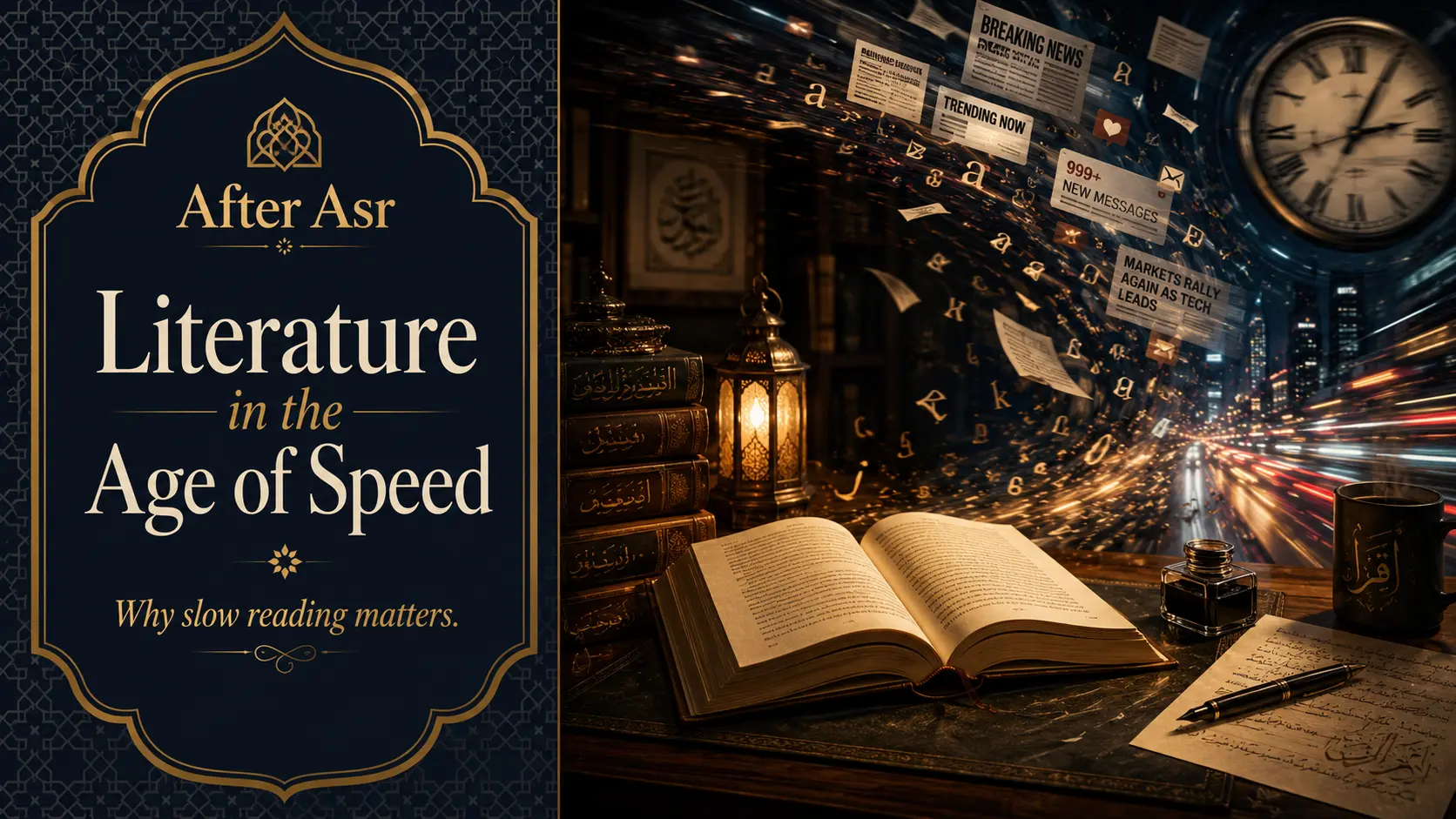
Why slow reading matters.
A book asks for something the modern world has learned to treat as expensive: uninterrupted time.
Not merely time measured in minutes, but time with texture. Time in which the mind is not summoned elsewhere every few seconds. Time in which a sentence can be followed to its conclusion, a chapter allowed to gather force, a character permitted to become complicated before judgment arrives. Time in which reading is not performed beside five competing impulses, but entered as a place.
This kind of time has become harder to defend.
We live amid astonishing access to words. More articles, messages, captions, newsletters, headlines, comments, transcripts, summaries, and searchable texts circulate than any previous generation could have imagined. Information is abundant. Language is everywhere. Yet the ability to remain with language may be weakening precisely because language now arrives in such relentless quantity and speed.
A 2025 study analyzing two decades of American Time Use Survey data found that the share of people in the United States who reported reading for pleasure on an average day declined by roughly 40 percent between 2003 and 2023. The study, based on more than 236,000 respondents, found an average annual decline of about 3 percent in daily leisure reading, with disparities widening across race, education, and income. (turn219241search0)
The finding should not be used to scold individuals. People are tired. Work stretches beyond office hours. Caregiving consumes evenings. Economic pressure crowds out leisure. Digital entertainment is not frivolous merely because it is digital. Nor is every minute not spent reading a symptom of decline.
Still, something culturally important is at stake.
When reading becomes rarer, hurried, or fragmented, we lose more than a pastime. We lose practice in sustained attention. We lose a form of thought that unfolds slowly enough to complicate us. We lose one of the few remaining habits that resists the demand to react before understanding.
Slow reading matters because some truths do not survive speed.
Speed Has Become a Cultural Virtue
Modern life often treats quickness as competence.
We praise rapid response, fast processing, immediate updates, instant access, frictionless delivery. Emails should be answered quickly. Headlines should be grasped at a glance. Videos should begin with a hook before the viewer scrolls away. Opinions are expected while events are still unfolding. To be slow risks appearing uninformed, inefficient, or behind.
Some forms of speed are genuine goods. A medical emergency benefits from rapid response. Accessible information can empower people who were once excluded from knowledge. Searchability, translation tools, and digital archives have transformed what readers can reach. There is no moral nobility in unnecessary inconvenience.
But a virtue in one domain can become a tyranny when applied everywhere.
The mind trained to expect immediate payoff may begin to experience a demanding book as malfunctioning. A novel that delays revelation seems “slow.” An essay that builds carefully seems “too long.” A poem that requires rereading seems needlessly obscure. The question becomes not, “What kind of attention does this text require?” but, “How quickly can I extract what I need?”
The philosopher Yves Citton’s work on the attention economy, discussed in a 2025 essay on reading in the digital age, frames attention as a scarce resource increasingly organized by systems that compete to capture and monetize it. In such an environment, reading is not simply one leisure activity among others. It is a practice shaped by an ecology that repeatedly rewards interruption, switching, and continuous novelty. (turn603451search0)
This does not mean technology makes deep reading impossible. People read serious books on e-readers, long essays on tablets, and scholarship on laptops every day. The issue is not the existence of screens. It is the broader culture of acceleration in which many of those screens operate.
The page asks us to continue. The feed asks us to move.
Reading Is Not Only Decoding
It is possible to look at words without entering them.
One can scan a paragraph, recognize its key terms, infer its conclusion, and move on. That is sometimes enough. Not every text deserves meditation. Weather alerts, instructions, menus, schedules, and many news updates are meant to be processed efficiently. Skimming is a legitimate reading skill when the material calls for it.
The problem begins when skimming becomes our default posture toward everything.
Literature, serious essays, religious reflection, philosophy, history, and long-form journalism often require something beyond information extraction. They ask the reader to track development, absorb atmosphere, notice changes in tone, remember earlier details, tolerate uncertainty, and let meaning accumulate. They work not only through what is stated, but through structure, pacing, omission, and return.
Slow reading is the willingness to give a text the conditions under which it can become itself.
This is not a romantic preference without cognitive stakes. Research continues to show that comprehension is affected by the reading environment, the medium, and the presence of distraction. A 2025 meta-analysis on digital reading distractions found that interruptions and attentional burdens can undermine reading performance, especially in settings where readers must divide attention among competing stimuli. (turn219241search13)
A 2026 network meta-analysis comparing reading across devices also concluded that medium can matter, particularly when readers engage complex texts under different technological conditions. The exact effects vary by device and context, but the broader point is clear: reading is not merely a neutral intake of words. The conditions of attention shape what is understood. (turn219241search4)
To read slowly is not necessarily to read at a low physical pace. A fast reader may still be deeply attentive. A slow reader may still be distracted. Slow reading is less about words per minute than about the refusal to treat the text as disposable.
It is reading with enough patience for consequence.
The Fragmented Mind Struggles With Depth
A long book does not only contain more words than a short post. It demands a different relationship with time.
A novel may plant an image in chapter two that does not reveal its full significance until chapter twenty. A work of history may require the reader to hold several causes together before evaluating an outcome. An essay may begin with a question whose answer must be delayed because premature clarity would be false. This kind of reading depends on continuity. It requires the mind to carry earlier material forward and relate it to what comes later.
Fragmentation disrupts that process.
A 2025 study on reading and multitasking found that divided attention can impair readers’ ability to integrate information across multiple texts, even when they do not accurately perceive the degree to which comprehension has suffered. (turn603451search19)
That last detail matters. Distracted readers may feel more capable than their understanding shows. The problem with fractured attention is not always that it announces itself. It can produce the illusion of keeping up while weakening the ability to synthesize.
This has cultural implications. A population accustomed to fragments may remain informed in the narrow sense of encountering many claims, while becoming less practiced in the slower work of interpretation. It may know the latest controversy without knowing the history behind it. It may recognize a quote without understanding the argument it came from. It may respond to a sentence before noticing the paragraph that qualifies it.
Speed can create a peculiar form of shallowness that feels like fluency.
Slow reading interrupts this. It trains the mind to inhabit sequence, not merely encounter stimuli. It develops tolerance for delayed payoff. It restores the possibility that understanding may emerge after several pages, not before the thumb scrolls again.
A Book Refuses to Compete on the Feed’s Terms
Much digital content is built to capture attention quickly because it must survive competition. It needs a headline, a hook, a thumbnail, a provocation, or a promise of immediate reward. This does not make such content worthless. Some brief forms are brilliant. A short essay can be profound. A post can clarify. A five-minute video can teach something useful.
The problem is not brevity. It is the expectation that all communication should justify itself through instant impact.
Literature often works otherwise. It may begin quietly. Its early pages may be laying moral, psychological, or symbolic groundwork the reader cannot yet appreciate. A character may initially seem minor. A sentence may appear simple before repetition deepens it. The force of a novel can depend on the fact that it does not reveal too much too soon.
Slow reading protects these delayed effects.
It allows the reader to become available to patterns that only show themselves over time. It lets the book alter the pace of consciousness instead of forcing the book to adapt to a consciousness trained for constant novelty.
This matters because literature is not merely a delivery system for takeaways. A summary can tell us that a novel concerns grief, migration, or ambition. It cannot reproduce the experience of slowly realizing that grief has transformed the way a character perceives light in a room, or that ambition has made someone incapable of hearing love unless it arrives as praise.
To read the summary is to receive information about the work.
To read the work is to undergo its timing.
That timing is part of the meaning.
Slow Reading Is Not Elitism
Defending slow reading can sound, if handled poorly, like scolding from people who have time, quiet homes, good libraries, and few interruptions. That danger should be taken seriously.
Reading conditions are unequal. The 2025 American Time Use Survey study found steeper declines in daily leisure reading among Black Americans, people with lower educational attainment, and people with lower annual incomes. The researchers argue that efforts to support reading for pleasure need to account for unequal access and opportunity rather than treating decline as a simple matter of individual preference. (turn219241search2)
A parent working two jobs may not have the same evening available as a professor. A teenager in a crowded home may struggle to find silence. A person exhausted by care work may choose rest that asks less of them than a dense novel. To defend slow reading without acknowledging this would turn a cultural concern into a class performance.
The answer is not to abandon the value of deep reading. It is to treat access to it as a public good rather than a private luxury.
Libraries matter. School reading cultures matter. Affordable books matter. Community literacy efforts matter. Time matters. Public institutions that make reading visible and available matter. Homes where children see adults read matter. So do schools that resist reducing literature to test preparation and allow students to experience books as more than assessment material.
Slow reading should not belong only to those already privileged with stillness. A culture that values it must help create the conditions in which more people can practice it.
What We Lose When Books Become Content
The word content is convenient. It gathers videos, articles, podcasts, books, posts, photographs, and newsletters under one flexible umbrella. But the convenience comes at a cost. It encourages us to think of very different forms as interchangeable units within a stream.
A novel becomes content.
A psalm becomes content.
A investigative report becomes content.
A poem becomes content.
Once this happens, the measure of success drifts toward consumption metrics. Did it hold attention? Did it spread? Was it completed? Was it shareable? Was it optimized?
Literature asks other questions. Did it deepen perception? Did it expose something false? Did it sustain a mood long enough to transform understanding? Did it make the reader more capable of seriousness? Did its language remain after the page was closed?
A culture of speed may still produce books. It may even sell many of them. But if readers increasingly approach books with the restless expectations of the feed, the deeper encounter weakens. The issue is not whether books survive as objects. It is whether book-length attention survives as a human practice.
The National Endowment for the Arts reported in 2024 that the share of American adults who had read at least one book in the previous year declined from 54.6 percent in 2012 to 48.5 percent in 2022, with literary reading also falling over the same period. (turn219241search14)
This does not prove that cultural seriousness is collapsing. But it does suggest that sustained engagement with books is no longer something society can assume will maintain itself without care.
Slow Reading Forms Memory Differently
Some texts are consumed and vanish. Others enter memory.
The difference is not entirely under the reader’s control. A single sentence encountered casually can remain for years. A book read with great effort can fade. But in general, slow reading creates conditions for deeper encoding. It gives the mind time to build associations, imagine scenes, track concepts, and attach language to experience.
This matters especially in literature. A novel is not remembered solely by plot. Readers often carry fragments of atmosphere, moral pressure, images, and sentences. Those elements require time to lodge. They are less likely to endure when the reading experience is continually broken apart.
Research on sustained attention and reading comprehension underscores the connection between attentional stability and understanding. A 2023 study found that sustained attention played a critical role in reading comprehension among adults with and without ADHD, reinforcing the broader idea that the ability to remain mentally engaged is central to making sense of text. (turn603451search17)
Slow reading does not merely help us finish books. It helps books finish forming in us.
A hurried reader may grasp what happened. A patient reader may notice what mattered.
The Ethics of Not Rushing a Text
There is an ethical dimension to reading slowly.
A serious text represents labor. Someone selected those words, arranged that sequence, made choices about what to state and what to withhold. The reader need not admire the result. Criticism is part of literary life. A book may fail. An argument may be flawed. A poem may not justify its own difficulty.
But before judgment, there should be encounter.
Speed can tempt us to decide before we have received. We glance at a passage, infer the position, and react. We read just enough to classify. We enter the text looking for confirmation, offense, or quotable ammunition. Such reading may be useful for debate. It is poor preparation for understanding.
Slow reading is a form of fairness.
It says: I will let this work reveal what it is before I reduce it to what I expected. I will allow complexity to appear. I will not confuse my impatience with the text’s failure. I will distinguish between what is truly unclear and what requires more attention than I first offered.
This ethic matters far beyond books. A person who practices patient interpretation on the page may become less eager to flatten others in conversation. Not automatically, and not always. But the habit of staying with complexity can migrate.
Literature has long trained readers in this. It delays revelation. It presents unreliable narrators. It places generous motives beside harmful actions. It teaches us that first impressions are often provisional. Reading slowly honors that pedagogy.
Some Books Need to Be Lived With
Not every book should be read in one way. Some are designed to race. The pleasure of a thriller may depend on momentum. A comic novel may land best when its timing is brisk. A light book read quickly can be a real delight.
Slow reading is not a universal rule. It is a capacity.
The problem is not that some books are read quickly. It is that readers may lose the ability to slow down when a work asks for it. A dense essay, a serious novel, a work of theology, a philosophical text, or a layered poem cannot always be rushed without damage. Some books need to accompany us. They ask to be paused over, returned to, carried into a walk, set aside briefly so a sentence can settle.
There are books one finishes. There are books one lives with.
A culture of acceleration favors completion. Slow reading restores companionship.
Religious Reading Has Always Known This
Muslim traditions of reading offer a profound counterimage to speed.
The Qur’an is recited, memorized, revisited, contemplated. Its meanings are not exhausted through a single pass. The Qur’an itself describes revelation as a blessed book sent down so that people may reflect upon its verses. (quran.com)
This verse concerns revelation, not literature broadly. The Qur’an’s status remains unique. Yet the principle of tadabbur, reflective consideration, reminds Muslim readers that some words should not be hurried through merely to claim completion. Reading can be devotional precisely because it is attentive. It can involve pause, return, and inward response.
That sensibility has wider implications. A Muslim reader need not treat novels as scripture or literary slowness as worship in the same sense. But they may recognize that hurried contact with words is not the only, nor always the best, form of reading. Language can require reverence proportional to its subject. A legal ruling, a poem of mourning, a letter from a dying parent, a work of sacred history, and a passage of Qur’an do not belong to the same category, but each can be betrayed by haste.
Slow reading is not simply aesthetic preference. It is a posture of receiving.
The Fear of Falling Behind
One reason people rush is the fear that there is too much to read.
The list never ends. New books arrive weekly. Articles pile up in tabs. Newsletters go unread. Recommendations accumulate. Social media presents everyone else as constantly finishing, annotating, reviewing, and moving on. Reading becomes another site of performance anxiety.
Slow reading resists this pressure by accepting limitation.
No one will read everything worth reading. No one will remain current with every conversation. A serious reading life is not a race against abundance. It is a practice of choosing some texts and giving them more than superficial contact.
This acceptance is freeing. It permits rereading. It allows abandonment of books that are not worth continuing. It rejects the idea that a reader’s value can be measured by annual totals. It makes room for the possibility that one difficult book read deeply may matter more than many skimmed for completion.
To read slowly is also to admit finitude. We have limited time. Therefore what receives that time should sometimes receive us fully.
What Slow Reading Protects
Slow reading protects several things at once.
It protects comprehension from fragmentation.
It protects literature from being reduced to “content.”
It protects memory from perpetual novelty.
It protects judgment from premature reaction.
It protects the interior life from becoming entirely optimized for speed.
It also protects forms of pleasure that are increasingly easy to miss.
The pleasure of noticing a motif return.
The pleasure of a sentence whose meaning arrives late.
The pleasure of realizing that a minor character has been quietly carrying the moral center of a book.
The pleasure of rereading a paragraph not because it was confusing, but because it was beautiful.
The pleasure of letting a book change the emotional weather of an afternoon.
These pleasures are not inefficient versions of faster pleasures. They are different goods. A culture that forgets them becomes poorer, even if it remains entertained.
Reading Against the Clock
The age of speed will not disappear. Nor should every form of speed be lamented. We will continue to scan, search, summarize, and move rapidly through much of the language around us. These are useful abilities.
But we should refuse to let them become the only abilities.
There must remain places where the mind is not hurried into usefulness. Where sentences are allowed to ripen. Where difficult books are not punished for failing to behave like clips. Where readers recover the courage to be initially bored, initially confused, initially unconvinced, and still continue long enough to discover whether the text has more to offer.
Slow reading matters because it preserves a form of freedom. It frees us from immediate capture. It reminds us that attention can be chosen, not only seized. It gives us practice in belonging to one thing at a time.
A book does not demand that we outrun the world.
It asks that, for a while, we stop fleeing from it.