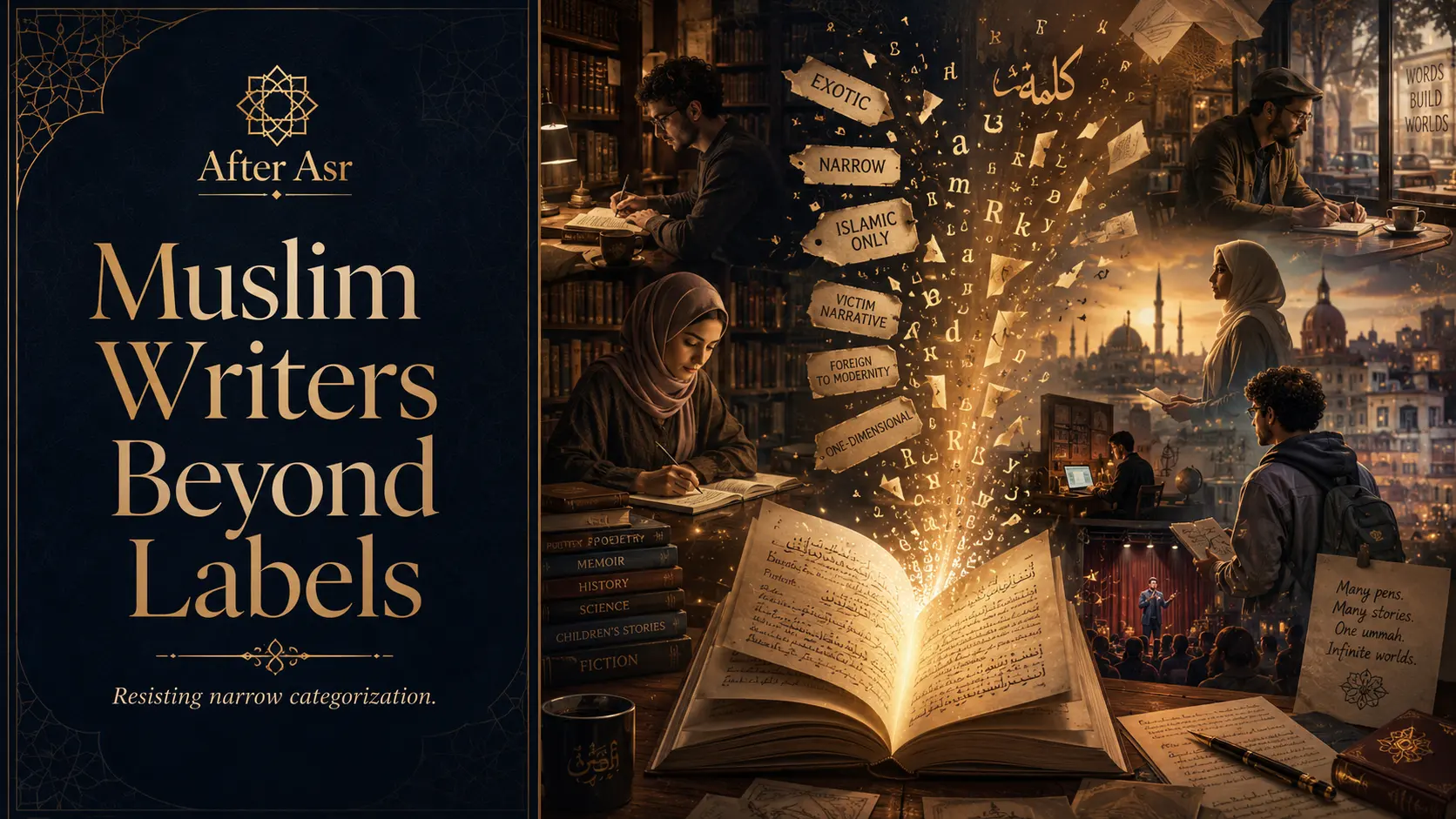
Resisting narrow categorization.
A writer who is Muslim may write about prayer, migration, longing, family, empire, adolescence, grief, money, envy, revolution, marriage, fantasy worlds, detective plots, political violence, village gossip, office boredom, climate anxiety, a childhood kitchen, or the private shame of wanting to be admired.
The adjective Muslim should not make this surprising.
And yet, in many literary spaces, it still does.
Muslim writers are often welcomed most readily when their work arrives already translated into a familiar set of expectations. Faith as conflict. Identity as crisis. The veil as symbol. Migration as wound. Terrorism as shadow. Patriarchy as explanatory key. Assimilation as plot. These subjects can be necessary, profound, and artistically rich. Many Muslim writers have approached them with extraordinary power. The problem is not that they are written. The problem begins when they are treated as the natural limits of what Muslim writers are expected to write.
A label meant to make a body of work visible can quietly become a fence.
“Muslim writer” may be an honest description, a chosen affiliation, a site of solidarity, even a source of artistic clarity. For some authors, Islam is not incidental to their work but central to its moral atmosphere, metaphors, interior life, and sense of reality. Leila Aboulela has spoken explicitly about writing from a Muslim perspective and from within Islamic tradition, while also noting that her characters vary widely in practice and disposition. Her 2025 PEN Pinter Prize recognition further affirmed that writing on faith, migration, and Muslim women’s lives can stand at the center of serious international literature rather than remain confined to a niche shelf.
But the category becomes harmful when it ceases to describe and begins to prescribe. When it tells readers what kind of book to expect before the sentence has begun. When it tells publishers what kind of manuscript is legible. When it tells writers that their cultural and religious identity has made some subjects naturally theirs and other subjects oddly suspect.
The task is not to erase Muslim identity from literary conversation. It is to resist the narrowing of Muslim writers into identity alone.
A Muslim writer should be free to write as Muslim, against Muslim expectation, through Muslim memory, beyond explicitly Muslim subject matter, or in territories where the label does not explain the work’s first meaning. Anything less is not representation. It is containment.
The Difference Between Recognition and Reduction
Labels are not inherently oppressive. They can be clarifying. They help readers find work, help communities recognize themselves, and help critics trace traditions that might otherwise be ignored. “Black literature,” “diasporic fiction,” “Palestinian poetry,” “South Asian writing,” “Muslim women’s memoir,” and similar terms can name real historical and aesthetic currents. They can repair absence in canons that once claimed neutrality while excluding entire worlds.
The problem is that recognition and reduction often look similar from a distance.
To say, “This writer’s Muslimness matters,” may be accurate. To say, “This writer matters because they explain Muslims to us,” is something else entirely. One acknowledges a dimension of the work. The other converts the author into an interpretive service.
This distinction is especially important for Muslim writers working in English-language publishing markets shaped by long histories of Orientalism, securitized public discourse, and uneven curiosity about Muslim life. A 2023 study by Claire Chambers examined the challenges British Muslim writers and publishers face within a largely secular literary marketplace and a society marked by Islamophobia, noting the pressures surrounding publication, representation, and genre expectations. The literary field does not encounter Muslim work in a vacuum. It encounters it after decades in which Muslimness has been publicly narrated through suspicion, crisis, and debate over belonging.
That context changes the stakes of categorization.
A novel by a white British author about an unhappy marriage is usually received first as a novel about marriage. A novel by a Muslim British author about an unhappy marriage may be asked, subtly or directly, to explain Muslim marriage, Muslim gender, Muslim culture, Muslim repression, or Muslim modernity. The first author is granted particularity. The second risks conscription into representation.
This is not because Muslim identity is irrelevant. It may shape the book deeply. But no community should be denied the ordinary privilege of artistic specificity. A character does not become less individual because she prays. A family argument does not automatically become anthropology because the family is Muslim. A writer’s background may illuminate their work without making every work a report on that background.
Representation becomes reduction when identity is treated as the whole interpretive key.
The Burden of Standing for Everyone
One of the heaviest expectations placed upon minority writers is the demand to represent responsibly. Muslim authors are often made to feel that every character, family, mosque, romance, or moral failure they write may be read as a statement about Muslims as such. A novelist does not merely create a flawed mother. She risks being accused of confirming stereotypes about Muslim motherhood. A writer does not merely depict hypocrisy in a religious space. He risks being told he has betrayed the community. A memoirist does not merely narrate personal pain. She may be asked whether she is feeding hostile audiences.
These concerns are not imaginary. In a world where Muslims are frequently misrepresented, the fear of providing easy material for prejudice is understandable. Muslim writers do not create under neutral conditions. They know that certain readers may treat one fictional household as evidence against an entire civilization. They know that complexity can be harvested selectively by people looking for indictment rather than understanding.
But the answer cannot be to require Muslim writers to become public relations officers for the ummah.
Tasneem Abdur-Rashid has written about precisely this pressure, asking whether Muslim authors are expected to represent 1.9 billion Muslims while trying to create truthful fiction for diverse audiences. The question matters because no writer can bear it honestly. A novel is not a census. A poem is not a demographic briefing. A writer may act with care, but care is not the same as total representational accountability.
The demand to represent everyone often produces two distortions. The first is defensive idealization. Characters become too exemplary, communities too polished, conflict too softened. The work may feel safe, but it loses the unevenness of life. The second is reactionary disclosure, in which the writer feels compelled to prove independence by emphasizing damage, rupture, and taboo. Both tendencies can be artistically limiting because they are driven by surveillance, whether communal or external.
Muslim writers deserve a third possibility: truthfulness without captivity.
They should be free to write generous depictions and severe ones, intimate worlds and public conflicts, faithful characters and faithless ones, Muslims who are admirable, foolish, cruel, funny, hesitant, ordinary, contradictory, boring, luminous, or all of these at once. A community gains little from literature that is merely flattering. It also gains little when writers are rewarded only for exposing pain in forms legible to outsiders.
The writer’s first duty is not to reassure every reader. It is to make the work truthful according to its own moral and artistic demands.
The Market Loves a Legible Story
Publishers often speak the language of discovery, diversity, and new voices. Those commitments can be sincere and important. Muslim writers and publishing professionals have worked to create platforms that expand access, challenge exclusion, and make more room for Muslim stories. Muslim Voices in Publishing, for example, was founded to support Muslim creatives and publishing workers while platforming Muslim stories and experiences in an industry where such presence has often been thin.
Yet markets also prefer legibility. They favor stories that can be summarized quickly, positioned clearly, and sold through familiar categories. That tendency affects all writers, but it can become particularly constricting for those from communities already reduced to public narratives.
A manuscript about Muslim teenage friendship might be encouraged to heighten the clash between faith and freedom because that conflict is recognizable. A novel about a Muslim architect consumed by professional ambition may be asked to make identity more central, as though professional obsession is insufficiently distinctive unless tied to communal expectation. A domestic comedy about aunties, weddings, and family absurdity may be embraced, but only so long as it retains the flavor of cultural accessibility. A speculative novel by a Muslim author may be praised for “bringing representation” to the genre, while the complexity of its worldbuilding receives less attention than the author’s demographic function.
The issue is not that identity should disappear from marketing. It is that markets can learn to treat identity as the product rather than one dimension of the art.
Chambers’s work on Muslim genre fiction and publishing highlights this tension within a literary marketplace in which Muslim writers may encounter both opportunities and constraints tied to stereotype, diversity initiatives, and reader expectations. The result is not always blunt censorship. More often, it is shaping pressure, the quiet question of what kind of Muslim story publishers believe there is demand for.
Writers feel these pressures even when they resist them. They know which subjects seem “timely.” They know which narratives are more likely to be described as urgent, brave, or necessary. They know which forms of Muslim life remain less publishable because they do not satisfy the market’s appetite for explanation, crisis, or correction.
A literary culture truly interested in Muslim writers must want more than books that confirm what it already expects Muslims to be.
Muslimness Is Not a Single Subject
One reason narrow categorization fails is that Muslimness itself is not narrow.
There are nearly endless ways Islam may appear in a writer’s work. It may be theological, devotional, cultural, linguistic, inherited, contested, rediscovered, peripheral, structuring, or quietly ambient. It may shape a character’s sense of time through Ramadan and prayer. It may appear in a grandmother’s vocabulary, a father’s ethical seriousness, a community’s humor, a funeral rite, a wedding negotiation, a child’s first shame, a scholar’s discipline, a poet’s metaphor, or a silence where faith is no longer practiced but still present as memory.
To reduce Muslim writing to a few topical markers is to misunderstand both literature and Muslim life.
A Muslim novelist may write a work where Islam is central in every chapter. Another may write a crime novel whose Muslim detective’s faith is simply one element of a full personality. Another may write fantasy that draws on Islamic civilization, Arab folklore, or entirely invented worlds. Hafsah Faizal’s commercial success in young adult fantasy, including New York Times bestselling novels, is one visible reminder that Muslim authors do not belong to a single subject lane. Uzma Jalaluddin’s movement into cozy mystery with the Detective Aunty series likewise reflects how Muslim-centered stories can inhabit genre forms far beyond the expected migration-or-crisis frame.
The literary field should be spacious enough for all of this.
Muslim writers need not prove authenticity by writing constantly about religious struggle. Nor should they be subtly rewarded for making their Muslimness palatable by keeping it shallow or symbolic. A writer may dwell explicitly inside belief. Another may write about chess, river towns, betrayal, space travel, or elderly friendship. The presence or absence of overt religious themes does not by itself determine whether the work is serious, honest, or culturally meaningful.
Identity is not a prison. It is not a costume. It is not a required syllabus.
It is one of the many truths from which writers may create.
“Universal” Often Means Unmarked
When Muslim writers resist narrow categorization, they are sometimes told that everyone is categorized in some way. That is true, but incomplete.
Some writers are labeled by identity, while others are allowed to stand as writers first. Their cultural specifics are treated as human, their references as ordinary, their families as families rather than case studies. A novel about Christmas dinner in a white American household may be called a family novel. A novel about Eid dinner in a Muslim household may be called a Muslim family novel. Both are culturally located. Only one is usually marked as particular.
This is the hidden politics of the word universal.
Works by dominant groups are often granted universality without surrendering their specificity. Works by minority writers are frequently asked to earn universality by transcending, softening, translating, or downplaying their difference. A Muslim character who fasts, makes wudu, or worries about prayer during travel may be read as culturally specific in a way that a Christian character attending church on Christmas Eve may not be. The issue is not whether either detail matters. The issue is which details are permitted to signify ordinary life.
The literary world has begun challenging these habits more openly, but they persist. Debates over pigeonholing in publishing extend beyond Muslim writers, affecting Black, immigrant, and other marginalized authors who have argued that diversity initiatives must not become a new form of containment. Authors from underrepresented communities should be able to write across the full range of human experience, not only the portions that institutions designate as representative.
Muslim writers do not ask for the erasure of identity in pursuit of a false neutrality. They ask for equal permission to be specific without being confined. The path to universality has never required becoming less rooted. It requires being read with enough intelligence to recognize that rootedness is one of the ways literature reaches the human.
The Good Muslim, the Bad Muslim, and the Literary Trap
Muslim characters are often pressed into a public binary before they become fully literary. The “good Muslim” is moderate, explanatory, reassuring, often distanced from any visible seriousness of belief that might trouble outsiders. The “bad Muslim” is rigid, angry, oppressive, or dangerous. Between them lies a vast terrain of actual life that literature is especially well equipped to explore.
Scholars and critics have repeatedly noted how contemporary Muslim writing must negotiate inherited stereotypes, including the good Muslim/bad Muslim binary, racialized suspicion, and the expectation that Muslim characters exist to answer public anxieties. An American Comparative Literature Association seminar on contemporary Muslim writers, for example, framed their work in relation to borders of religion, stereotype, nation, genre, and the good Muslim/bad Muslim distinction.
The danger of this binary is not only political. It is aesthetic.
Characters become predictable when they are built to confirm or rebut a stereotype. The faithful Muslim woman must prove she is not oppressed. The angry Muslim man must be contextualized so thoroughly that he becomes a case study. The doubtful Muslim youth must symbolize generational transition. The secularized Muslim must either represent liberation or loss. These are not impossible characters. They can be richly rendered. But they become tiresome when they are expected roles rather than discoveries of art.
Literature needs surprise. It needs contradiction. It needs people whose meanings are not exhausted by their social function.
A Muslim character should be allowed to fail for reasons not reducible to religion. To be funny in ways that are not comic relief. To be romantic without becoming a cultural debate. To be ambitious, vain, generous, spiritually attentive, emotionally repressed, intellectually brilliant, boring, deluded, or kind in combinations that refuse typology. Muslim life is not a didactic diagram. Writers should not be tasked with drawing it as one.
Writing From Within Is Not the Same as Writing for Outsiders
A particularly important distinction concerns orientation. Some Muslim writing explains Muslims to non-Muslim readers. That work can be valuable. Bridge-building matters. Translation across worlds matters. There are novels, memoirs, essays, and children’s books that have genuinely expanded public understanding by making Muslim experiences more intimate and less abstract.
But explanation should not become the default mode.
Writing from within a Muslim world differs from writing about Muslims for an outside gaze. The first assumes a fuller life. It need not stop to gloss every ritual or justify every value. It trusts that context can emerge through story. It permits Muslim characters to speak to one another rather than constantly turning outward toward an imagined non-Muslim reader.
Leila Aboulela’s comments about writing from within Islamic tradition are helpful here. The importance of such work is not that it refuses all outside readers. It is that it does not treat Muslim experience as material requiring constant translation before it may become literature.
This inwardness can create a different artistic atmosphere. Prayer may appear without explanatory footnote. A character may be moved by Qur’anic recitation without the scene being framed as cultural information. A conflict about marriage may unfold through assumptions the text trusts readers to inhabit, just as countless novels have trusted readers to inhabit Catholic, Jewish, Hindu, secular bourgeois, aristocratic, or rural social worlds without hand-holding.
To resist narrow categorization is also to resist compulsory translation.
Not every Muslim story must begin by explaining why Muslims do what they do. Some stories should simply let Muslims live.
The Community’s Labels Can Also Constrict
External categorization is not the only pressure Muslim writers face. Communities can narrow writers too.
Some readers want Muslim literature to be visibly beneficial, morally unambiguous, and protective of communal image. They worry that portrayals of sin, doubt, hypocrisy, or suffering will reinforce prejudice or spiritually harm readers. These concerns can arise from sincere love of the community and genuine awareness of hostile representation. They should not be mocked.
But they can become suffocating if they demand that literature function only as reassurance.
A writer who depicts a flawed imam is not necessarily attacking religious leadership. A novelist who writes about a Muslim woman’s loneliness in marriage is not necessarily endorsing anti-Muslim stereotypes. A memoirist who recounts a painful mosque experience is not necessarily betraying Islam. Literature must be allowed to distinguish between exposing a wound and weaponizing it.
Communal pressure can also work in the opposite direction, rewarding writers who produce easy condemnation of Muslims for external applause. The point is not that writers should avoid criticism. Communities need truthful critique. The point is that a writer’s relation to their community should not be governed by incentives of flattery or performance.
A serious Muslim literary culture should have enough confidence to welcome complexity without demanding either public relations or public self-disparagement.
The community deserves better than caricature. Writers deserve better than fear.
Freedom Does Not Mean Detachment From Responsibility
Defending writers against labels should not collapse into the claim that writers owe nothing to anyone. Literature is not exempt from ethics. A writer’s imaginative freedom does not absolve them from slander, cruelty, exploitation, lazy stereotype, or contempt disguised as courage. Writers make choices. They are responsible for craft, truthfulness, and the moral consequences of what they romanticize.
But responsibility is not the same as obedience to imposed categories.
A Muslim writer may choose to write about anti-Muslim racism with urgency. Another may choose to write a strange comic novel about failed entrepreneurs. Another may write devotional poetry. Another may write science fiction with no Muslim characters at all. Another may write from a deeply Islamic worldview in a book whose plot concerns seemingly ordinary domestic life. Each should be judged according to what the work attempts and what it achieves, not according to whether it satisfies the reader’s preferred model of Muslim authorship.
The distinction matters because the language of responsibility can be used to smuggle in control. Publishers may say they want “authentic” Muslim stories while favoring a narrow emotional register. Communities may say writers must “represent well” while discouraging any difficult truth. Critics may say they are “celebrating Muslim voices” while treating those voices as documentation more than art.
Real respect for Muslim writers is not the demand that they escape consequence. It is the refusal to assign them smaller imaginative territory than other writers receive.
Awards Are Not Liberation, but They Can Shift the Frame
Recognition alone does not solve structural problems. One celebrated Muslim author does not undo marketplace bias. A prize does not guarantee that unknown writers will be read without suspicion. Institutional approval can itself be selective.
Still, recognition can matter when it expands the frame of what literary excellence is permitted to look like.
Leila Aboulela’s 2025 PEN Pinter Prize is meaningful in part because her body of work has long explored faith, migration, and Muslim women’s lives with seriousness that refuses both apologetic flattening and voyeuristic display. In accepting the significance of the award, she described herself as “a Muslim Sudanese immigrant who writes from a religious perspective probing the limits of secular tolerance,” linking recognition not to assimilation into a supposedly neutral literary space, but to the widening of that space.
Banu Mushtaq’s 2025 International Booker Prize for Heart Lamp, a collection rooted in Kannada literary traditions and concerned with women, injustice, and social life in Muslim communities of southern India, offers another reminder that Muslim writers enter world literature through many languages, forms, and histories. Her work does not fit neatly into the narrow Anglophone scripts often imposed on Muslim authors, and its acclaim challenged several assumptions at once: about translation, regional language writing, short stories, Muslim women’s worlds, and what global literary attention may center.
Such recognition should not become another label. It should enlarge possibility.
It should make it easier to imagine Muslim writers as central participants in literature, not supplemental voices invited in to diversify a conversation that belongs elsewhere.
What Readers Owe Muslim Writers
The struggle against narrow categorization is not only an industry problem. Readers participate too.
We should notice when we are approaching a book by a Muslim author with questions we would not ask of others. Are we seeking art, or evidence? Are we expecting cultural education before we are willing to grant aesthetic seriousness? Are we reading one character as a symbol of Muslims generally? Are we disappointed when a novel by a Muslim writer is not about the public issue we assumed it would address? Are we praising a book mainly for representation while neglecting the quality of its sentences, structure, and vision?
Readers can also overcorrect by insisting identity never matters. That too is careless. A writer’s Muslimness may matter profoundly. It may shape the book’s moral temperature, references, rhythm, metaphysics, humor, or conflicts. The answer is not colorblindness in literary form. The answer is proportion.
Read the work whole.
Allow Muslim writers to be Muslim writers when that phrase illuminates. Allow them also to be satirists, fabulists, historical novelists, essayists, poets of landscape, chroniclers of urban loneliness, architects of fantasy, masters of comedy, and writers of sentences whose significance cannot be reduced to demographic assignment.
Read for identity, but not identity alone. Read for form, voice, image, risk, structure, atmosphere, moral intelligence, surprise, and beauty.
Anything less is a polite form of not reading.
Beyond the Label Is Not Beyond Muslimness
The phrase beyond labels can be misunderstood. It does not mean Muslim writers should shed Muslimness in order to become more literary. It does not mean faith is an embarrassing category that serious artists must outgrow. It does not mean categories of solidarity should vanish.
It means that no label should become total.
A writer may embrace the title “Muslim writer” as an accurate and cherished description. Another may dislike it because it constricts how their work is received. Leila Aboulela has acknowledged this ambivalence, noting in an earlier interview that recognition from Muslims can feel affirming while the tag “Muslim writer” can also feel constricting in some literary contexts. That ambivalence should not be resolved for writers by critics. It should be honored as part of the complexity of creating under labels.
The literary world often wants categories because categories are manageable. They help organize shelves, panels, syllabi, marketing copy, and festival programming. But writers are not manageable things. The best of them exceed the frame prepared for them.
Muslim writers deserve that excess.
They deserve to be read with the fullness granted to other writers. They deserve not to have every metaphor treated as cultural testimony, every domestic conflict turned into civilizational evidence, every success celebrated as representation more than art. They deserve to write books that are explicitly and unmistakably Muslim, and books where Muslimness is quiet, indirect, or absent from the surface. They deserve to disappoint expectations that should never have been imposed.
A label may open the door.
It must not become the room.