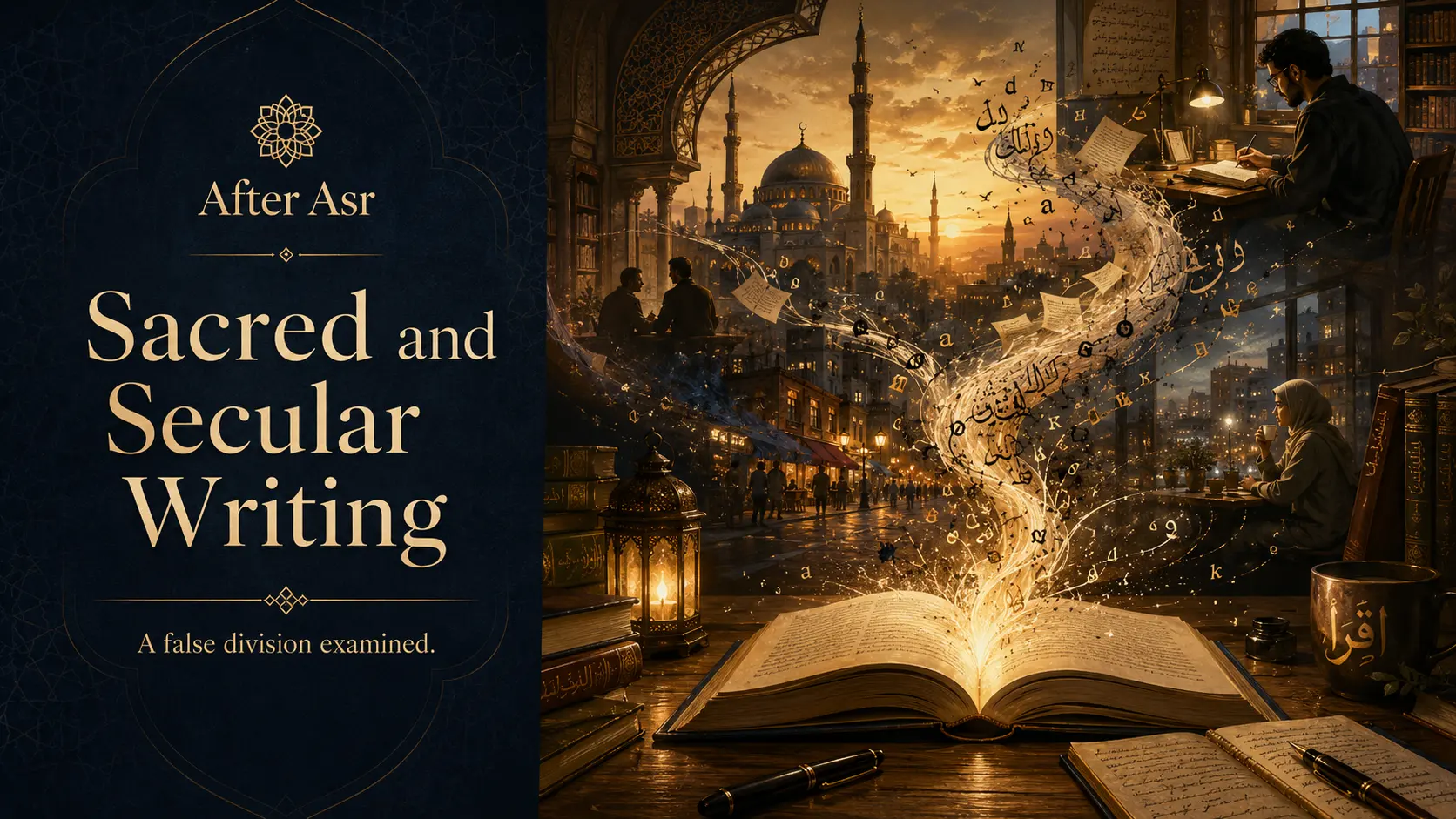
A false division examined.
Some writing is announced as sacred before the first sentence is read. Scripture. Prayer. Devotional reflection. The language arrives already surrounded by reverence. It is approached slowly, quoted carefully, and often received within a community that has taught the reader how to stand before it.
Other writing is placed elsewhere. The novel. The essay. The memoir. The poem about ordinary loneliness, city life, inheritance, labor, desire, exile, or grief. This writing may be admired, even loved, but it is commonly filed under another category: secular. Human. Cultural. Literary rather than spiritual.
The distinction seems tidy. It is not.
There are works that are sacred in a formal and unmistakable sense, and no serious Muslim reader should blur revelation into literature as though the Qur’an were merely one eloquent book among others. The Qur’an occupies a category of its own in Muslim belief and practice. Yet once that necessary distinction is preserved, the broader habit of dividing writing into two sealed realms, one sacred and one secular, becomes far less convincing. The categories begin to leak into each other. A devotional book may be spiritually barren if it is careless, vain, or manipulative. A novel with no religious vocabulary may awaken humility, expose idolatry of the self, or make the reader more attentive to mercy. A poem about rain may become an exercise in wonder. A memoir about migration may become a meditation on trust, loss, and providence without ever naming itself religious.
The false division is not between revelation and everything else. That distinction matters. The false division is the assumption that writing outside explicitly religious forms must therefore be spiritually irrelevant, morally neutral, or detached from ultimate questions.
It is not.
Writing is one of the places where human beings ask what a life is for, what suffering means, what deserves loyalty, what memory owes the dead, what love requires, what power hides, and what remains when ambition fails. These are not small questions. They are not sealed off from faith simply because they appear in a novel rather than a sermon.
The sacred and the secular are not identical. But in writing, they are often more entangled than modern habits of classification allow.
The Appeal of a Clean Divide
The desire to separate sacred from secular writing is understandable.
Categories help readers orient themselves. A work of tafsir is not a short story. A legal manual is not a lyric poem. A devotional text is written with different aims from a satire. Traditions have genres, and genres have expectations. Confusion is not sophistication.
In scholarship and public life, however, the relationship between “the secular” and “the sacred” has long been recognized as historically and theoretically complex. Cornell’s Society for the Humanities once framed the interaction between the two as a difficult problem rather than a settled opposition, noting that secularization itself has been defined and used in multiple, sometimes contested ways. More recent anthropological work similarly emphasizes that secularism is not merely the natural retreat of religion from modern life, but often a political and social process that actively shapes what counts as “religion” in the first place.
That complexity matters for literature.
When we call one piece of writing sacred and another secular, we are not always describing intrinsic qualities. Sometimes we are naming institutional location. A prayer book belongs in one section of the bookstore. A novel belongs in another. Sometimes we are describing subject matter. A poem that mentions God appears religious; a poem that mentions a kitchen table appears ordinary. Sometimes we are making a judgment about intended use. One text is read in worship, another in leisure.
These distinctions can be useful. They become misleading when they are treated as moral or metaphysical verdicts.
A short story about a bereaved father may be categorized as secular because it contains no formal theology. Yet if it compels the reader to confront the fragility of pride, the arrogance of assuming time is guaranteed, or the tenderness hidden inside restraint, has it really remained outside spiritual concern? A religious essay may cite sacred sources throughout and still leave the heart untouched because it is more interested in scoring a point than unveiling truth.
The category cannot do the work of discernment for us.
What Do We Mean by “Sacred”?
The word sacred deserves care.
In religious studies, the sacred is often associated with what is set apart, holy, or understood as touching the core of ultimate reality and human destiny. Britannica describes it as the power, being, or realm regarded by religious persons as central to existence and transformative of their lives. The term is not trivial. It belongs to reverence, prohibition, encounter, and obligation.
For Muslims, the Qur’an is sacred in a sense no ordinary writing can claim. It is revelation, recited in worship, memorized, interpreted through disciplined scholarship, and approached with an adab shaped by centuries of devotion. To speak about “sacred writing” responsibly requires beginning with this asymmetry.
But once that is affirmed, another question remains: does the sacred touch only texts that are themselves formally sacred? Or can ordinary writing become a site where the reader is turned toward what is morally grave, spiritually revealing, or worthy of reverence?
A letter from a mother to a child is not scripture. A prison memoir is not revelation. A poem about the sea is not worship. Yet each may confront the reader with realities that faith also addresses: dependence, injustice, mortality, wonder, arrogance, gratitude, remorse. The work is not sacred in status. But it may move through sacred terrain.
The problem begins when “secular” is made to mean spiritually empty.
The Secular Is Often Treated as Neutral. It Is Not.
In common usage, secular often means nonreligious, not formally tied to worship, clerical authority, or sacred institution. That definition can be descriptive and harmless. A city budget is secular. A traffic ordinance is secular. A sonnet about autumn may be secular in that limited sense.
But the term often carries an unstated assumption: that secular writing is merely human, and because merely human, morally or spiritually neutral.
That assumption deserves scrutiny.
No serious writing is neutral in the deepest sense. Every work carries some vision of what matters. It may exalt freedom, order, pleasure, memory, nation, family, self-expression, skepticism, sacrifice, rebellion, or tenderness. It may treat death as absurd, tragic, natural, transcendent, comic, or unspeakable. It may portray desire as sovereign or as something requiring discipline. It may imagine the human being as self-authoring, socially formed, divinely answerable, economically determined, or some unstable combination of these.
These are not “just” aesthetic choices. They are anthropological and moral ones.
A novel need not mention God to present a theology of the self. A memoir need not discuss sin to reveal assumptions about blame, innocence, and redemption. A film script need not quote scripture to teach viewers what kind of love deserves admiration. So-called secular writing often does spiritual work under another name. It offers an account of meaning, even if that account rejects transcendence.
This is why the sacred/secular division can mislead both religious and nonreligious readers. It tempts the first to underestimate the formative power of “ordinary” literature. It tempts the second to imagine that writing free of religious vocabulary is therefore free of ultimate commitments.
Neither is true.
Writing Becomes Serious When It Asks Ultimate Questions
The most consequential divide in writing may not be sacred versus secular, but shallow versus serious.
Serious writing does not have to be solemn. It may be funny, satirical, playful, even outrageous. Its seriousness lies elsewhere. It asks questions that cannot be exhausted by trend or taste. What does power do to a person? Why do families repeat harm? What must be remembered? What kind of freedom destroys the one who worships it? Why do people betray what they know to be good? What is owed to strangers? What does love become when stripped of possessiveness?
These questions may be explored in explicitly religious works. They may also be explored in novels, plays, essays, and poems that would be shelved as secular. The literary tradition across cultures is full of works that wrestle with guilt, justice, suffering, pride, fate, responsibility, repentance, and death, whether or not they speak in doctrinal language.
This is precisely where writing can unsettle modern categories. If “sacred” means only formally consecrated, then most literature is not sacred. But if sacred concern includes matters of ultimate significance, then literature frequently approaches its border. It stands near it. It circles it. At times, it recoils from it. At times, it opens toward it.
A story about two sisters estranged by inheritance may disclose the moral ugliness of greed more vividly than an abstract condemnation of greed. A poem about a demolished home may return the reader to the dignity of place, belonging, and memory. A novel about ambition may expose an idol long before a reader is willing to name it as one.
None of these works replaces religious teaching. But they can prepare the moral imagination to receive it more honestly.
Islamic Literary History Never Fit a Thin Divide
The false neatness of sacred versus secular writing becomes especially apparent within Islamic intellectual history.
The Arabic term adab eventually came to signify literature, but its earlier meanings were tied to cultivated conduct, refined manners, and ethical formation. Britannica notes that adab evolved from a norm of conduct into a literary category marked by broad humanitarian concerns. In classical Islamic cultures, prose, poetry, ethical reflection, wisdom literature, courtly instruction, historical anecdote, and religious learning often existed in close conversation rather than sealed compartments.
This does not mean every Muslim literary work was pious, nor that all artistic production served religious devotion. Islamic literary traditions were vast, varied, and often worldly in subject. Love poetry, satire, court culture, humor, biography, travel writing, and political counsel all flourished. Yet the modern instinct to sort writing into “religious” and “nonreligious” piles can fail to capture how literature, ethics, eloquence, and civilizational formation were historically intertwined.
Even in later Muslim debates about modernity and reform, literature remained morally charged. Scholarship on the Islamic public sphere has observed that adab, in the sense of literature, became intertwined with ādāb, ethics and morals, in reformist thought. Writing was not simply entertainment. It was part of the making of persons and publics.
This history matters because it offers a more spacious vocabulary than the one many modern readers inherit. It allows us to see that a work may not be devotional and still participate in moral education. It may not be sacred in rank and still concern the formation of a soul.
The question becomes less, “Is this book sacred or secular?” and more, “What vision of human life does this book cultivate?”
Revelation Is Not Literature, But Literature Can Learn From Revelation
A careful Muslim literary sensibility must hold two truths together.
First, revelation is not reducible to literature. The Qur’an is not merely a masterwork of Arabic expression, not merely a cultural artifact, not merely a text admired for rhetorical power. For Muslims, it is divine speech and guidance. Any comparison that dissolves this status into aesthetics misses the matter entirely.
Second, literature can still learn from the way revelation addresses human beings.
The Qur’an does not communicate only through propositions. It uses narrative, parable, contrast, rhythm, repetition, scene, direct address, warning, promise, and arresting images. It speaks to intellect, conscience, memory, fear, hope, and imagination. It does not treat the human being as a disembodied argument machine. It addresses the whole person.
This is not a claim that ordinary writers should imitate the Qur’an. That would be both impossible and irreverent. It is simply to observe that Muslims should have no difficulty recognizing that language, form, and imagination matter in the communication of truth. The Qur’an itself repeatedly invites reflection. It also identifies the diversity of human languages as among the signs of God.
A Muslim reader can therefore resist two impoverished habits at once: reducing religious writing to dry instruction, and reducing nonreligious writing to frivolous ornament. The human heart is moved by form. Attention is awakened by image. Meaning often becomes memorable because it has been made beautiful, precise, or piercing.
Literature, at its best, respects that truth.
A Religious Book Can Be Spiritually Thin
One reason the sacred/secular division fails is that it can flatter religious writing merely for its topic.
A book filled with religious vocabulary may still be careless. It may rely on cliché instead of thought. It may exploit fear without deepening reverence. It may trade in sentimental uplift while avoiding the hard work of honesty. It may speak about humility in a voice swollen with self-importance. It may quote the pious past without understanding the present.
Its subject is religious. Its effect may not be spiritually serious.
This is not an argument against devotional literature. Quite the opposite. Religious writing deserves better than automatic praise based on category alone. If a work claims to speak about faith, it should be held to standards of truthfulness, clarity, responsibility, and inward sincerity. The more sacred its subject, the less excusable its laziness.
A weakly written reflection on prayer may not help a struggling reader pray. A simplistic book about suffering may wound those who are already suffering. A careless religious memoir may convert private emotion into public authority without enough self-examination. Sacred subject matter does not sanctify bad craft or shallow thought.
Respect for the sacred requires more, not less, literary and moral care.
A Secular Book Can Disturb the Soul
The reverse is equally important. A book that does not present itself as religious may still confront the reader with spiritually consequential truth.
A novel about the emptiness of status may expose vanity. A dystopia may reveal the fragility of conscience under pressure. A story about a father and son may illuminate duty, pride, tenderness, and regret. A poem about a ruined landscape may awaken gratitude for creation and grief over waste. A memoir of incarceration may force the reader to confront how easily societies rationalize abandonment.
The work may not preach. That may be why it reaches the reader.
Direct exhortation has its place. So does indirection. Some truths are resisted when declared but recognized when dramatized. A reader may reject the sentence “you are worshiping success,” yet feel its force while watching a fictional character trade integrity for prestige until nothing remains worth possessing. Literature can enter through the side door of the imagination.
This is not a mystical claim about all art. Some books are shallow. Some are manipulative. Some are morally confused. But serious literature often refuses the fantasy that the material world is all surface. It listens for depth in ordinary life. It knows that a dinner table can become the site of estrangement, that a city street can carry exile, that a silence between spouses can be more revealing than a speech.
When writing attends this closely to reality, it approaches reverence, even if it never uses the word.
The Danger of Treating “Secular” as Suspect
Among some religious readers, the label secular functions as a warning sign. It can suggest danger, contamination, or irrelevance. There are understandable reasons for caution. Literature can carry values hostile to faith. Entertainment industries often normalize desires and assumptions that Muslims may rightly challenge. Not every acclaimed book deserves a reader’s time.
Discernment is necessary.
But suspicion should not become intellectual retreat. If “secular” simply means “not explicitly religious,” then most of the world we inhabit is secular in that ordinary sense: workplaces, public schools, city planning, medical research, history writing, journalism, and much of art. Muslims live within these spaces, interpret them, contribute to them, and answer for how they engage them. Withdrawal from serious literature will not protect the soul from influence. It may simply leave the soul less trained to recognize influence when it comes through more powerful, less reflective channels.
A young person who never reads a serious novel about ambition may still be formed by advertising that glorifies status. A community that dismisses literature as irrelevant may remain highly vulnerable to crude political storytelling. A reader who refuses to engage difficult texts may not become pure. They may become unpracticed.
The question is not whether nonreligious writing influences us. It does. The question is whether we engage it passively or intelligently.
Muslim readers need criteria, not panic. They need literary judgment, theological grounding, and moral seriousness. They need to ask what a work sees clearly, what it misses, what it glamorizes, what it mourns, and what assumptions it smuggles in beneath beautiful prose.
Calling something secular is not enough.
The Danger of Treating “Sacred” as Untouchable Sentiment
The opposite error appears in literary spaces that become nervous around religious seriousness. Here, sacred writing is sometimes tolerated as heritage, symbol, or aesthetic artifact, but treated warily when it makes claims on life. Religious language may be admired for poetry while its truth claims are bracketed. Devotion may be welcomed as cultural texture but not as a serious account of reality.
This too is a narrowing.
A reader need not share a faith tradition to recognize that religious writing has shaped civilizations, ethical systems, metaphors, genres, concepts of selfhood, and entire literary imaginations. To approach sacred texts only as aesthetic objects can flatten them as much as pious anti-literary reading flattens novels. One form of reduction says, “Only the spiritual message matters; form is secondary.” Another says, “Only the cultural form matters; metaphysical claim is secondary.” Both may fail to receive the text on its own terms.
Respectful literary criticism should not require religious agreement. But it should require enough interpretive generosity to understand that sacred writing often intends more than beauty. It may demand response. It may form ritual. It may govern conduct. It may establish a community’s sense of time, history, and accountability.
To read it merely as verbal art is not neutrality. It is a choice.
The Better Question: What Does This Writing Revere?
Every serious work reveres something.
Sometimes openly. God. Justice. Freedom. Memory. Motherhood. Nation. Desire. Truth. The dead. The self. Sometimes the object of reverence is hidden from the writer. A novel may claim to expose vanity while secretly admiring power. A memoir may celebrate authenticity while treating obligation as oppression. A religious polemic may defend orthodoxy while revering victory more than truth.
Ask what a work reveres and much becomes clearer.
A so-called secular poem may revere creaturely life with a humility many overtly religious works never achieve. A theological treatise may revere argument more than worship. A political novel may revere the vulnerable. A romance may revere desire without discipline. A spiritual memoir may revere the author’s own emotional journey more than God.
This question cuts more finely than the sacred/secular divide. It directs attention toward formation.
What does this writing teach me to love?
What does it train me to despise?
What does it trivialize?
What does it refuse to see?
What kind of person feels admirable within its world?
What kind of silence does it leave behind?
These questions can be asked of scripture commentaries, sermons, novels, films, essays, and poems alike, while still respecting the distinct authority of revelation. They help readers move beyond labels into discernment.
Worldliness Is Not the Same as Profanity
The secular is often associated with “the world,” and from there it is easy to assume that worldly writing is spiritually inferior. But the world is not, in itself, profane. Creation is not the enemy of devotion. Bodies, cities, weather, hunger, marriage, work, childbirth, aging, migration, and grief are not distractions from meaning. They are among the places meaning is lived.
A poem about bread may be about labor, gratitude, poverty, or human dependence. A story about a house may be about inheritance, pride, hospitality, and the ache of displacement. A novel about city traffic may reveal class, time, impatience, and the erosion of attention. The material is ordinary. The significance need not be.
The Qur’an repeatedly draws attention to creation, history, speech, difference, and the signs embedded in the world. The diversity of human languages itself is named among those signs.
This does not automatically sacralize every artistic treatment of worldly life. But it does challenge any simplistic spirituality that assumes only explicitly devotional themes are worthy of serious attention. A literature that attends faithfully to the world may help readers resist numbness. It can remind them that ordinary life is not empty background, but the very theater in which gratitude, injustice, patience, greed, mercy, and accountability take form.
Worldliness becomes spiritually dangerous not because the world exists, but because the self learns to see it without reference to responsibility.
Faith Does Not Make Writing Small
Some readers worry that faith constrains literature. If a writer begins from moral commitments, will the work not become predictable? If certain truths are held sacred, does art lose its freedom to ask difficult questions?
The concern is not baseless. Didactic writing can become flat. Characters can be reduced to examples. Stories can be forced toward conclusions rather than allowed to breathe. Literature written only to prove a point often fails as literature.
But the failure lies in bad art, not in faith.
All writers begin with commitments, whether acknowledged or not. Some believe human beings are fundamentally self-inventing. Some believe desire is the highest authority. Some believe power explains nearly everything. Some believe history bends toward liberation. Some believe meaning is constructed, provisional, or tragically absent. These are not neutral starting points. They shape art.
Faith does not uniquely burden writing with a worldview. It makes one worldview more visible.
A Muslim writer can ask difficult questions about doubt, suffering, hypocrisy, loneliness, failure, desire, and moral injury without abandoning belief. Indeed, faith may intensify those questions by refusing easy nihilism. If human beings are accountable, then betrayal matters. If mercy is real, then despair is not the last word. If pride deforms the soul, then success cannot be judged only by acquisition. If creation is meaningful, then attention becomes a moral act.
The challenge is not to make literature “safe.” It is to make it truthful.
The Reader’s Task Is Not Sorting, but Discernment
A mature reader does not ask only whether a work is sacred or secular. They ask what it does.
Does it deepen attention or scatter it?
Does it enlarge moral vision or flatter appetite?
Does it dignify persons or convert them into props?
Does it invite humility or self-worship?
Does it face suffering honestly or aestheticize it?
Does it make the reader more awake to truth, more alert to deception, more capable of gratitude, repentance, or care?
Such questions require more work than category labels. They cannot be answered from a book jacket. They demand patient reading.
This is why the false division matters. It encourages lazy confidence. The religious reader may trust a book too quickly because it sounds pious. The secular literary reader may dismiss a work too quickly because it speaks from faith. Both fail the text. Both fail themselves.
Discernment is more demanding, and more rewarding. It allows revelation to remain sacred without exiling all other writing from spiritual significance. It allows literature to remain art without pretending art is morally weightless. It allows the reader to inhabit a fuller world, where language may be formally devotional, culturally ordinary, morally formative, spiritually dangerous, spiritually awakening, or several of these at once.
A Better Way to Name the Terrain
Sacred and secular writing are not identical. They should not be collapsed into one category. Revelation remains revelation. Worship remains worship. The devotional use of language differs from literary entertainment, political argument, or artistic exploration.
But the boundary between spiritually significant writing and spiritually irrelevant writing cannot be drawn simply by whether the word God appears on the page.
Some books with religious titles leave the reader unchanged except perhaps more certain of themselves. Some books without religious intention disturb complacency, uncover idolatry, sharpen conscience, or awaken longing for what exceeds consumption. Some writing belongs inside ritual. Some belongs beside the lamp at midnight. Some belongs in classrooms. Some belongs in private grief. All of it asks to be judged by more than shelf placement.
The sacred should not be diluted. The secular should not be trivialized. Literature should not be forced to choose between beauty and moral seriousness, between the world and the soul, between human complexity and ultimate concern.
A better reading life begins when we stop asking whether writing is sacred or secular as though those were the only meaningful possibilities. We might ask instead:
What truth does this work seek?
What human depth does it reveal?
What does it train me to notice?
What does it tempt me to ignore?
What kind of reverence, if any, gathers beneath its words?
The page may not answer immediately.
But serious reading begins there.