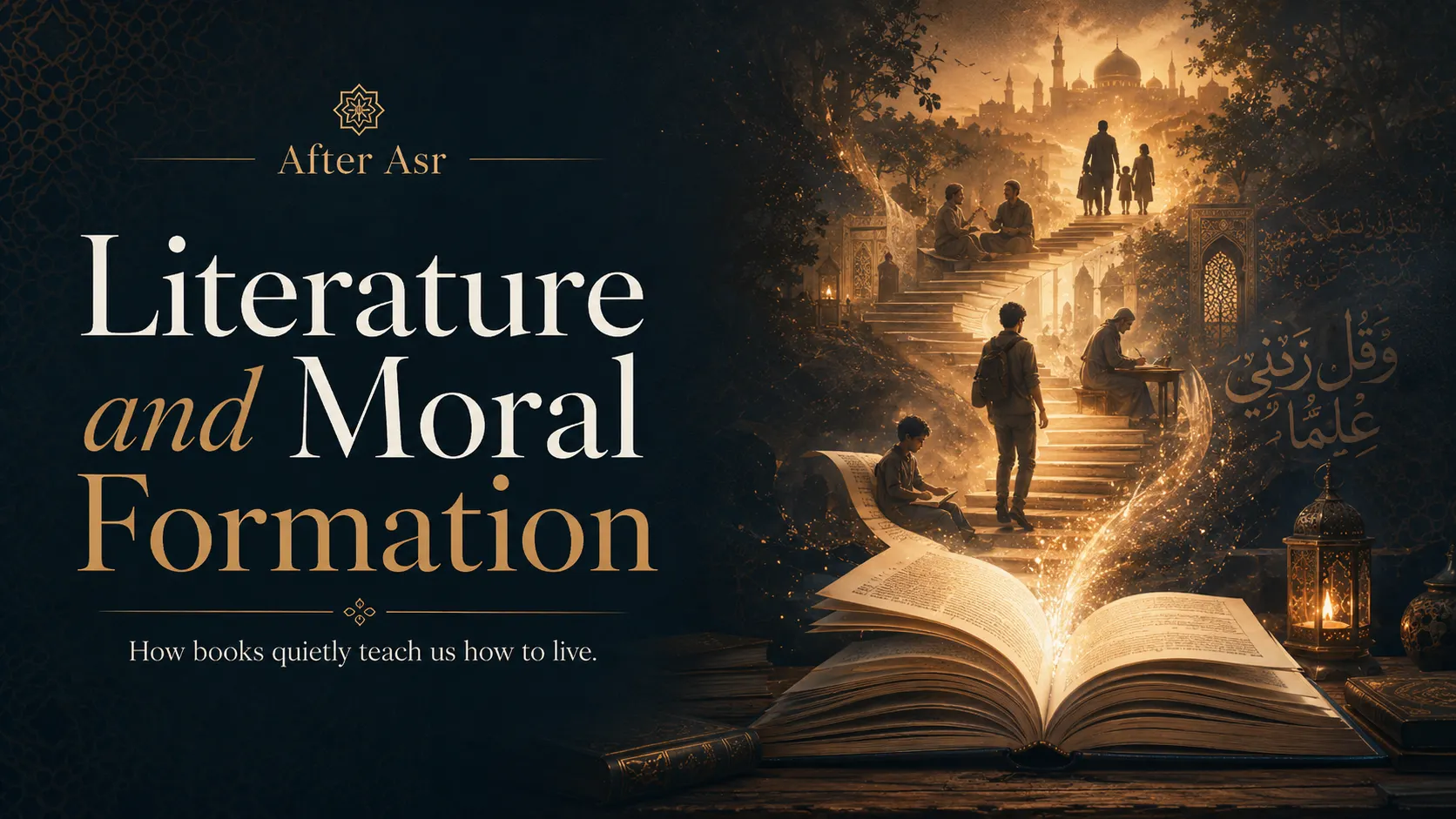
How books quietly teach us how to live.
Most books do not tell us what to do.
They do something more lasting. They teach us what to notice.
A novel may never announce that pride isolates a person, yet page by page it shows a character misreading affection, mistaking control for strength, and reaching the end of a life surrounded by people they have never truly known. A memoir may not state that poverty distorts time, but it reveals how every delayed paycheck, every bus transfer, every unreturned call from an office becomes part of the architecture of exhaustion. A poem may not define grief, but it teaches the reader to recognize the strange coexistence of ordinary objects and unbearable absence.
Literature forms us less often through instruction than through attention.
It arranges situations before us and asks us to look. It gives us motives, consequences, self-deceptions, flashes of courage, acts of cowardice, tenderness misplaced, mercy withheld, mercy offered too late. It lets us watch human beings choose. Then, often without warning, it turns the light back toward us.
What did we excuse because we liked the character?
What did we condemn because the suffering was unfamiliar?
When did we recognize ourselves only after trying not to?
This is moral formation, though it rarely arrives wearing the clothes of moral education. Books do not automatically make readers better. The evidence does not support such a clean promise, and history certainly does not. Well-read people have participated in cruelty. Beautiful libraries have stood inside unjust societies. Literary taste is not the same as virtue.
Yet it would be equally shallow to conclude that literature has no moral force. Stories can shape attitudes, influence social perception, and create imaginative contact with lives beyond our own. Research suggests that fiction reading is associated with small but meaningful cognitive and social benefits, while studies of narrative persuasion indicate that stories can shift beliefs, attitudes, intentions, and, in some contexts, behavior. These effects are not simple, uniform, or morally guaranteed. But they are real enough to take seriously.
Literature matters because it trains the inner life. Quietly. Repeatedly. Often long before we know what it has done.
Books Do Not Only Communicate Ideas. They Shape Perception.
Moral failure does not always begin with openly choosing evil. Often it begins with not seeing clearly.
A person fails to notice how humiliating their joke was because everyone laughed. A manager interprets an employee’s quietness as indifference rather than strain. A community becomes accustomed to speaking about some people only as problems, never as neighbors. A family mistakes silence for peace because the cost of that silence falls most heavily on the person least able to interrupt it.
Literature interrupts this kind of blindness by slowing perception down.
In ordinary life, we encounter people from the outside. We see a decision, a tone, a visible reaction. Fiction can move inward. It can reveal the hesitation before the sharp reply, the memory behind the fear, the tangled mixture of love and resentment behind a harmful choice. It does not necessarily ask us to approve. It asks us to see more completely.
That distinction matters.
Understanding a character is not the same as absolving them. A serious novel may allow us to perceive how jealousy ripened into betrayal without suggesting that betrayal was justified. It may show how a parent’s wounds became a child’s burden without sentimentalizing the harm. Literature deepens judgment when it refuses both simplification and excuse.
The morally formative power of such reading lies in the practice of perceiving complexity before delivering verdicts. Empirical work on fiction has explored its relationship to social cognition, including empathy, theory of mind, and the ability to interpret others’ mental states. A 2024 meta-analysis found a small positive relationship between fiction reading and several cognitive benefits, while other experimental studies suggest the mechanisms are not reducible to any single narrative technique or point of view. The findings are meaningful precisely because they are modest. Literature may cultivate social understanding, but it does not mechanically produce goodness.
That modesty is important. Books are not moral machines. They are environments of attention. What they form depends partly on what they contain, partly on how they are read, and partly on the dispositions readers bring to them.
Still, a person who has spent time inside many carefully rendered consciousnesses may become more hesitant to reduce real people to first impressions. Not always. Not automatically. But the possibility is one literature continually holds open.
The Moral Imagination Needs More Than Rules
Rules matter. Principles matter. Communities cannot live by feeling alone. Justice requires standards, not only sympathetic moods.
Yet rules without imagination can become brittle. A person may know that cruelty is wrong and still fail to recognize cruelty when it arrives politely dressed. A society may affirm human dignity in law and still permit patterns of humiliation that fall beneath the threshold of formal abuse. Moral life requires more than memorized conclusions. It requires the imagination to detect where those conclusions are being tested.
Literature helps develop that imagination.
A book can place readers in situations where no slogan is sufficient. What does loyalty require when a friend is wrong? When does patience become avoidance? What is courage when there is no applause waiting? Can a person tell the truth in a way that is technically honest but spiritually cowardly? How does a decent person become complicit through convenience?
The moral imagination does not provide easy answers. It expands the field of moral recognition.
This is one reason complex characters matter. A flawless hero is often less instructive than a compromised person who must decide whether to continue lying to themselves. A villain who is evil in every scene may provoke disgust, but a character who becomes cruel through small rationalizations can provoke self-examination. Literature often teaches most powerfully not through exemplars of perfection, but through the anatomy of drift.
People rarely wake one morning and announce that they will become unjust. They get used to a lesser honesty. They accept a convenient omission. They interpret warning signs generously when those warnings implicate themselves. They let vanity become a worldview. Literature shows the stages. It teaches us that the distance between an admirable self-image and a damaged character can be traveled one compromise at a time.
In this sense, books do not merely ask, “What is right?” They ask, “What habits make right action harder to recognize when the moment comes?”
That question belongs to moral formation.
Fiction as a Rehearsal Space for Judgment
One reason stories endure is that they let us enter moral difficulty without demanding that real lives bear the consequences of our learning.
In a novel, we can misjudge a character, then discover our mistake. We can admire someone whose charm conceals cowardice. We can distrust someone whose reserve hides integrity. We can feel the emotional satisfaction of revenge, then watch it deform the avenger. We can spend time with a narrator whose account gradually exposes its own unreliability.
Such experiences rehearse judgment.
They do not guarantee wisdom in real life, but they provide repeated encounters with patterns of self-deception, moral conflict, and consequence. Some scholars have described fiction as a kind of social or moral simulation, a space in which readers encounter scenarios beyond the range of their own experience and practice making sense of human behavior. Research on fiction and morality has found associations between fiction exposure, empathy, moral agency, and other morally relevant traits, while still stopping short of claiming simple causation.
The caution matters. Reading about sacrifice does not make one sacrificial. We can admire a brave character and remain cowardly. We can weep over injustice and tolerate it nearby. Moral emotion is not moral achievement.
But rehearsal matters in every serious domain of formation. Musicians rehearse scales before performance. Athletes train movement before competition. Religious practice disciplines the body and heart before trials arrive. Literature, in its own register, can rehearse perception, sympathy, suspicion, courage, and regret.
It gives the reader practice in asking:
- What is this person refusing to admit?
- Who bears the cost of this decision?
- Which value is being protected, and which one is being sacrificed?
- What would I be tempted to excuse here?
- What does this scene reveal about the kind of life that leads to flourishing, and the kind that leads elsewhere?
Those questions do not remain neatly confined to the page. A reader who has asked them hundreds of times in literature may begin asking them more instinctively in life.
The Books That Stay With Us Usually Change Our Standards, Not Our Opinions
People sometimes speak of formative books as though they deliver a thesis that the reader adopts. This happens. A political work may sharpen conviction. A philosophical book may reorganize belief. A work of history may overturn a false inheritance.
But literature often changes us in a quieter way. It alters our standards of recognition.
After reading a penetrating portrayal of loneliness, we may become less impressed by performative cheerfulness. After entering the interior world of a character trapped by debt, we may hear public discussions of “bad choices” differently. After following a story of slow moral compromise, we may recognize that a person’s downfall often begins long before the visible scandal.
The book has not necessarily handed us a new opinion. It has made certain simplifications harder to accept.
That is one of literature’s most ethical gifts. It can complicate the categories through which we sort the world. Not so thoroughly that moral clarity disappears, but enough that moral laziness becomes uncomfortable.
A reader of great literature should not emerge unable to say that cruelty is cruelty or betrayal is betrayal. Nuance is not the suspension of judgment. It is the refinement of judgment. It is knowing enough about human frailty to condemn wrong without becoming intoxicated by condemnation. It is recognizing the difference between explanation and excuse. It is seeing that accountability without insight often becomes mere punishment, while insight without accountability becomes indulgence.
Books can teach that balance, not by announcing it, but by making us feel the inadequacy of one-sided readings of human life.
Literature Can Form Us Badly Too
To speak of moral formation is not to assume that literature always forms us well.
Stories can ennoble. They can also distort. They can romanticize cruelty, dignify selfishness, flatter resentment, normalize contempt, or make domination seem glamorous. A skillfully told story does not become morally sound simply because it is aesthetically compelling. Beauty and danger have often traveled together.
Research on narrative persuasion reinforces the point. Stories can influence beliefs and attitudes partly because they immerse readers in a world of causality, motive, and emotion. A meta-analysis of narrative persuasion found that narratives can affect narrative-consistent beliefs, attitudes, intentions, and behaviors. That capacity is not inherently virtuous. It depends on the vision of the human being that the story carries.
This does not mean readers should approach literature with fear or reduce art to ideological inspection. It does mean discernment matters.
A book may be morally serious precisely because it depicts evil. A novel centered on corruption is not necessarily corrupting. A story may portray desire, violence, vanity, or despair in order to expose them, not celebrate them. Conversely, a book may speak constantly in the language of uplift while quietly teaching shallowness, self-absorption, and emotional manipulation.
The moral question is not always, “Does this book contain bad things?” Serious literature often must. The deeper questions are:
- What does the book invite the reader to admire?
- What does it treat as trivial?
- Whose interior life receives dignity?
- Whose suffering is used merely as scenery?
- Does the work deepen our understanding of responsibility, or erode it?
- Does it make us more truthful about desire, or more eager to excuse whatever desire demands?
These are not questions for censors alone. They are questions for readers, parents, teachers, critics, and communities that care about formation without becoming afraid of thought.
Character Is Often Formed Through Admiration
Human beings become, in part, what they learn to admire.
A child admires the older cousin who seems brave. A teenager admires the singer, athlete, or creator who appears free. An adult admires the colleague who commands respect, the parent who endured quietly, the public figure who seems unafraid. Admiration directs aspiration. It tells the self, “Something about that life is worth moving toward.”
Literature enters this terrain with immense force.
Characters can become moral companions, warnings, or temptations. A reader may admire integrity before they possess the words to define it. They may encounter a fictional person who refuses to betray the vulnerable, who accepts loss rather than participate in dishonor, who repents when repentance costs pride. Such characters do not act upon us like commandments. They act upon imagination. They make a form of life visible.
This can be especially powerful when the character’s goodness is not pristine or simplistic. A character who is afraid but acts anyway may teach courage more persuasively than one who never trembles. A character who errs, recognizes harm, and changes may teach repentance more deeply than one who was never tempted. A character who resists becoming cruel after suffering may show that pain explains much, but does not excuse everything.
Books also teach negative admiration, sometimes before we realize it. A charismatic manipulator may become fascinating. A ruthless protagonist may seduce the reader into equating power with depth. A story may invite us to cheer cleverness detached from conscience. The formation of admiration is therefore one of literature’s most morally serious domains.
What we admire in stories may not dictate who we become. But repeated admiration carves pathways in desire. It shapes what we excuse, what we pursue, and what kind of person strikes us as impressive.
Literature Enlarges the Scale of Responsibility
Much of ordinary life is immediate. We attend to the day’s demands, the nearest relationships, the obligations already pressing against us. Literature can widen that field. It can make distant lives present, past generations audible, future consequences imaginable.
A historical novel may reveal how choices made in government offices ripple into kitchens, prisons, ports, and family names. A work about migration may show that displacement is not merely movement from one territory to another, but a rearrangement of memory, language, dignity, and inheritance. A climate novel may press readers to feel time differently, not just as personal lifespan but as stewardship. A war story may refuse to let victory erase the wounded.
This widening of scale is part of moral formation because moral immaturity often narrows concern to what is immediate, visible, and self-relevant. Literature can ask us to inhabit consequences that exceed our usual radius.
It can also challenge the fantasy that private goodness alone is enough. A person may be kind in intimate settings while benefiting from systems that degrade others. A society may celebrate compassion while organizing indifference institutionally. Books that place individual choices inside larger structures can help readers understand that morality operates at more than one level.
We are responsible for how we treat the person in front of us. We are also responsible for the arrangements we defend, the stories we accept about who matters, the policies we normalize, and the absences we learn not to notice.
Literature can make those absences visible.
The Reader Is Also Being Revealed
When we read, we evaluate the book. But the book, in a certain sense, also evaluates us.
Not consciously, of course. A novel is not watching. Yet our reactions expose us. Whom do we believe? Whose grief bores us? Whose mistakes do we interpret with generosity, and whose with contempt? When does our patience thin? Which scenes embarrass us because they resemble us too closely?
A morally serious reader does not treat these responses as final evidence of character, but as material for examination.
Sometimes our discomfort is a sign that a book is shallow, manipulative, or false. Sometimes it is a sign that the book has found a guarded room within us. Distinguishing between the two requires honesty. Literature invites that honesty by making our habits of sympathy and judgment visible.
A reader may discover that they instinctively respect eloquence more than goodness. That they forgive emotional coldness in brilliant characters because they envy control. That they are impatient with weakness until weakness is rendered in a form they recognize. That they dismiss domestic labor as background until a writer makes its repetition unbearable and holy.
This is another way books teach us how to live. They do not only offer lives for our assessment. They reveal the assessor.
A Muslim Reader and the Moral Weight of Story
For Muslims, the idea that stories can carry moral instruction is not novel. The Qur’an repeatedly presents human beings through narrative, not only through direct exhortation. The stories of prophets, tyrants, families, communities, and moral turning points are not ornamental. They are given for reflection. In Surah Yusuf, the Qur’an says that in their stories there is “a lesson for people of reason.” In Surah Al-A‘raf, the Prophet is instructed to relate stories so that people may reflect.
The distinction between revelation and literature must remain clear. The Qur’an is not one literary work among others, and Muslim readers should not collapse sacred narrative into secular aesthetic categories. Yet the Qur’anic use of story affirms a profound truth about human receptivity: narrative reaches places abstraction alone may not.
A command can tell us that envy is destructive. A story can make us watch envy speak, plot, justify itself, and wound a family. A principle can teach that arrogance blinds. A narrative can show a ruler surrounded by signs he refuses to read. A theological truth can be stated plainly. A story can prepare the heart to feel its urgency.
Islamic intellectual and literary traditions also developed rich understandings of adab, a term associated not only with manners and ethical comportment, but with cultivated perception, learning, and forms of literary refinement. Historical scholarship on adab literature shows that literary culture in the Muslim world often participated in shaping character, taste, wisdom, and social conduct together rather than treating them as wholly separate domains.
This offers an important corrective to two opposite errors.
The first error is to assume literature matters only when it preaches explicitly. The second is to assume art becomes more sophisticated the further it drifts from moral seriousness. A Muslim literary sensibility need not accept either view. It can value ambiguity without worshipping confusion. It can appreciate beauty without separating beauty from responsibility. It can recognize that moral formation often happens indirectly, through what a work teaches us to love, grieve, fear, or refuse.
Books Do Not Replace Life. They Prepare Us to Meet It.
No one learns generosity solely by reading about generous characters. No one becomes patient by admiring patient protagonists while mistreating people in their own home. Literature cannot substitute for action, worship, service, apology, or self-discipline.
But it can prepare the inward ground on which those acts become more intelligible.
A book may make a future apology possible by giving someone language for harm. It may make a young reader more resistant to cruelty because they have already encountered cruelty’s logic stripped of glamour. It may make a parent gentler because they have seen, through narrative, how children metabolize careless words. It may make a citizen less susceptible to propaganda because they have learned to recognize stories that deny complexity in order to recruit resentment.
Such formation is difficult to measure in any single life. It unfolds slowly. A paragraph remembered years later. A character whose example returns in a moment of temptation. A scene that unsettles a prejudice the reader had never named. A tragedy that teaches consequences more deeply than a lecture could have done.
Books work on us by accumulation.
They leave deposits of language, patterns of recognition, standards of seriousness. They help build the interior architecture from which choices later emerge. That architecture can be noble or degraded, spacious or cramped, honest or flattering. Which is why what we read matters, and how we read matters too.
The Quiet Curriculum of Literature
Every life is being educated by something.
By family sayings. By entertainment. By advertising. By jokes repeated without thought. By political scripts. By religious teaching, or its absence. By the stories a culture rewards and the stories it avoids. No one escapes formation. The question is whether we recognize the curriculum.
Literature belongs to that curriculum.
It teaches us how betrayal sounds before it is named. How grief interrupts ordinary time. How power justifies itself. How courage may arrive without grand speeches. How love can be possessive when it refuses the beloved’s freedom. How repentance begins not in self-hatred, but in truth. How institutions speak when they wish to hide responsibility. How loneliness changes a person’s sense of proportion. How mercy is often most meaningful when it costs pride.
A good book does not hand these lessons over like a worksheet. It lets us discover them through encounter. That is why the learning can endure. We do not simply receive a conclusion. We accompany it into being.
To read seriously is not to outsource conscience to authors. It is to place conscience in conversation with lives beyond one’s own. It is to become answerable, in some degree, to what one has seen.
Books quietly teach us how to live because they quietly show us what living does.
They show that choices accumulate. That character has momentum. That no private vice is entirely private when others must live near it. That goodness is rarely loud at first. That self-deception can be elegant. That tenderness is not weakness. That a society’s moral condition can often be read in how it treats the inconvenient, the dependent, the unseen.
And perhaps most importantly, literature reminds us that a human being is always more than a label, more than a use, more than the quickest judgment available.
That reminder is not the whole of morality.
But without it, morality grows thin.