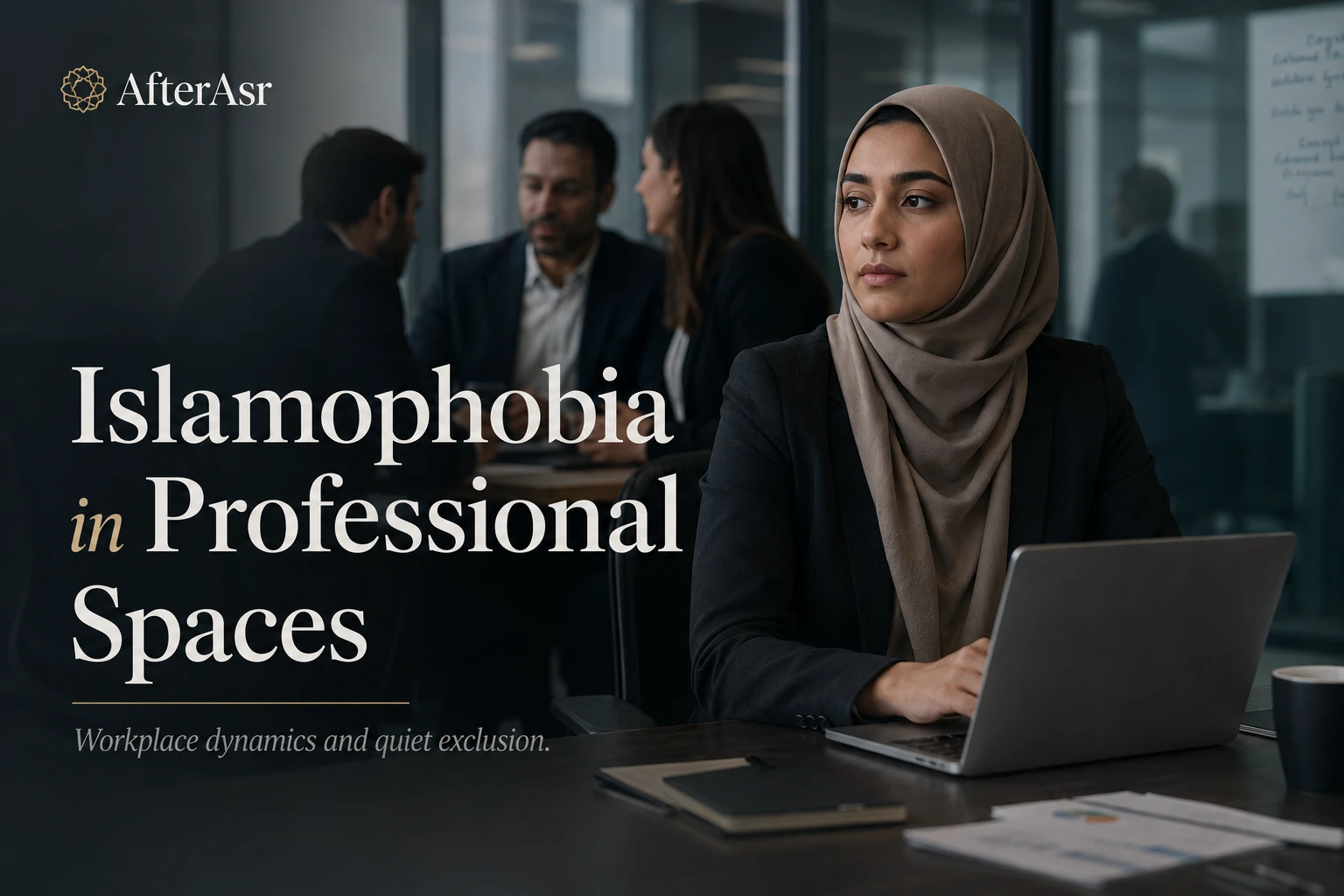
Workplace dynamics and quiet exclusion.
Professional spaces often pride themselves on neutrality.
A workplace has policies.
A hiring process has criteria.
A manager claims to value performance.
A company says it welcomes everyone.
And yet, exclusion does not always arrive in openly discriminatory language. It may never say, “We do not want Muslims here.” It may sound more polished than that.
“Culture fit.”
“Client-facing concerns.”
“Professional appearance.”
“Communication style.”
“Team dynamics.”
“Not quite the right match.”
Sometimes these phrases describe legitimate considerations. Sometimes they conceal something harder to admit: discomfort with Muslim identity, especially when that identity is visible, voiced, or inconvenient to existing norms.
Islamophobia in professional spaces is often quiet. It does not always take the form of direct insult or explicit refusal. It can appear in hiring hesitation, promotion stagnation, social exclusion, pressure to minimize religious needs, and the persistent sense that Muslim employees must remain slightly more reassuring than everyone else.
The office may look orderly.
The exclusion may still be there.
The Workplace Is Not Separate From Society
Employers do not hire, promote, evaluate, or socialize in a vacuum. They operate inside the same society that produces media stereotypes, political suspicion, and assumptions about who seems competent, approachable, or trustworthy.
A manager may believe they are evaluating only “professionalism,” while still reacting differently to a Muslim name, a hijab, a beard, or a request for prayer accommodation. A colleague may consider themselves friendly while excluding a Muslim coworker from informal bonding rituals centered on alcohol or repeated political commentary that makes the room feel hostile. A recruiter may never articulate bias, yet still perceive one candidate as a smoother “fit” than another with identical qualifications.
Research on workplace discrimination toward Muslims has grown substantially in recent years, with a 2023 systematic review identifying discrimination across macro-level public climates, organizational structures, and interpersonal workplace dynamics. (journals.sagepub.com)
The professional world is not insulated from Islamophobia.
It can translate it into corporate language.
Hiring Is Often Where Quiet Exclusion Begins
The first barrier may appear before a Muslim employee ever enters the workplace.
Studies have repeatedly found disadvantages for applicants perceived to be Muslim, especially when religious identity is visible. A field experiment in Germany found that women with Turkish names and headscarves faced severe discrimination in the application process, with markedly lower callback rates than otherwise comparable applicants. Research on Muslim women’s employment in the United States has similarly examined how hijab can shape hiring and employer perception. (pmc.ncbi.nlm.nih.gov) (sciencedirect.com)
A résumé is meant to reduce a person to qualifications. Yet the signals surrounding a name, photo, or perceived religious identity can alter how those qualifications are read.
The applicant may never know why the silence came.
They simply learn that some doors do not open, even when the résumé should have reached them.
“Professional Appearance” Can Become a Pressure Point
Few workplace concepts are more subjective than professionalism.
In theory, it concerns competence, reliability, and conduct. In practice, it can become a way to privilege what is already culturally familiar.
A hijab may be treated as less polished than uncovered hair.
A beard kept for religious reasons may be regarded as less “clean-cut.”
Modest dress may be interpreted as rigid or unfriendly.
A Muslim employee’s refusal to participate in certain social activities may be read as detachment rather than conviction.
These judgments are often not announced as anti-Muslim. They appear through evaluation language, dress-code pressure, or the subtle implication that visible faith makes a person less universally presentable.
U.S. law is clear that employers cannot discriminate based on religion and must provide reasonable religious accommodations unless doing so creates an undue hardship under the applicable legal standard. The EEOC specifically notes that these protections apply to Muslims and to practices such as wearing religious clothing, maintaining facial hair, and scheduling around religious observance. (eeoc.gov) (eeoc.gov)
The law may prohibit overt exclusion.
Culture can still pressure people to preempt it by becoming less visibly themselves.
Accommodation Is Often Treated as Disruption
A request for prayer space, scheduling flexibility for Friday prayer, time off for Eid, or permission to observe religious dress should not be extraordinary. Yet in some workplaces, such requests are received as complications rather than ordinary aspects of a diverse staff.
The employee may be told:
“We’ve never had that request before.”
“Can’t you do it later?”
“We need consistency.”
“We don’t want to open the door to too many exceptions.”
Some operational constraints are real. Not every request can be granted in exactly the form requested. But employers are required to consider religious accommodation in good faith, and the EEOC states that no “magic words” are required for an employee to seek one. (eeoc.gov)
The problem arises when Muslim religious needs are treated as abnormal before they are even evaluated.
An employee asking to practice their faith is not necessarily asking to disrupt the workplace. Often, they are asking the workplace to recognize that its “normal” was built around someone else’s customs.
The Social Side of Work Can Also Exclude
Workplace belonging is not made only in meetings and performance reviews. It is shaped in lunch invitations, after-hours gatherings, group chats, holiday events, informal mentorship, and the social closeness that often precedes opportunity.
Muslim employees can find themselves excluded in ways that are difficult to challenge formally:
- team bonding that consistently centers alcohol
- jokes about Muslims framed as harmless banter
- political conversations that assume no Muslim is present
- colleagues who grow distant after learning someone is observant
- networking spaces where modesty, dietary practice, or religious boundaries are treated as awkwardness
None of these moments may become a formal complaint. Together, they can create the sense of being tolerated professionally but not fully welcomed socially.
A 2025 article on Muslim professionals in the workplace described recurring concerns around pressure to conform, invisibility in organizational DEI initiatives, and a lack of institutional understanding of Muslim religious life at work. (forbes.com)
A job can be technically accessible while the culture around it remains subtly closed.
Muslims May Feel Pressure to Manage Others’ Comfort
In many professional spaces, Muslim employees do more than perform their jobs. They also manage perception.
They may decide not to mention Ramadan because they do not want to become a discussion topic. They may avoid correcting a false statement in a meeting because they do not want to be seen as difficult. They may soften their reaction to a joke, not because it was harmless, but because escalation feels professionally risky. They may work extra hard to appear calm, positive, and collegial in environments where visible frustration could be interpreted through stereotype.
This pressure is difficult to quantify, but research on workplace Islamophobia has examined how employees navigate religious identity disclosure, bias management, and organizational climates that reward conformity. One 2023 report on Islamophobia and employment found that many Muslims selectively concealed or minimized religious identity at work, raising questions about whether such choices reflect personal preference or strategic avoidance of discrimination. (researchgate.net)
A workplace becomes unequal when one employee is hired to do a job and another is hired to do the job while quietly proving that their identity will not trouble the room.
The Problem With “Fit”
Few words in hiring and promotion carry more ambiguity than fit.
A candidate may be rejected because they are not the right fit.
An employee may be overlooked because leadership seeks someone who “aligns more naturally” with the culture.
A Muslim woman may be read as too reserved.
A Muslim man may be read as too intense.
A candidate who avoids alcohol-centered networking may be interpreted as less socially engaged.
The language of fit can describe real organizational needs. But it can also disguise a preference for familiarity.
If an office culture rewards only those who resemble the people already comfortable within it, then “fit” becomes a gate. It excludes without needing to name what it excludes.
Workplace discrimination researchers have emphasized that anti-Muslim bias can operate not only through formal exclusion, but through relational, organizational, and cultural mechanisms that disadvantage Muslims while preserving the appearance of neutrality. (journals.sagepub.com)
A professional environment should ask whether a person can do the work.
Too often, it asks whether others are already comfortable imagining them there.
Promotion Can Reveal What Hiring Conceals
An organization may hire Muslims and still limit how far they rise.
Entry-level diversity is easier than leadership inclusion. An employee may be welcomed as part of the workforce but not readily imagined as the face of a department, the voice in a client meeting, or the person representing the company in public.
This is where stereotypes about Muslim communication, supposed rigidity, perceived foreignness, or discomfort with visible religious identity can become especially consequential. They may not prevent employment, but they can quietly influence advancement.
Formal anti-discrimination law covers promotion, training, job duties, and other aspects of employment, not only hiring and firing. The EEOC explicitly notes that discrimination based on religion, ethnicity, national origin, race, or color is prohibited across the employment relationship. (eeoc.gov)
Yet formal rights do not automatically remove informal ceilings.
A workplace may say that leadership is open to everyone.
Its promotion patterns may say something else.
Politics at Work Can Become a Minefield
For Muslims, the professional environment can grow especially tense during moments of international crisis, domestic political conflict, or public debate involving Islam and Muslim-majority regions.
A Muslim employee may feel watched after posting about Palestine. A colleague may suddenly ask for their opinion on terrorism or foreign policy. An employer may treat political speech by Muslim workers as unusually sensitive or reputationally risky, even where comparable expression by others passes without similar scrutiny.
CAIR’s 2025 civil rights report stated that employment discrimination became the highest-reported category across its offices nationwide, accounting for 15.4 percent of complaints, with many complaints connected to retaliation or smears involving speech about Palestine. While advocacy organizations’ complaint data do not represent all workplace experiences, they do signal an important pattern in reported concerns. (ca.cair.com)
The workplace becomes difficult when Muslim employees understand that some views may be read not merely as views, but as evidence of disloyalty, extremism, or risk.
That is not normal professional disagreement.
It is politicized suspicion.
Harassment Is Not Always Loud
Workplace Islamophobia is often imagined as an explicit slur. That exists, and it is prohibited. But harassment can be quieter.
A recurring joke.
A nickname.
A colleague repeatedly asking whether someone supports violence.
A manager warning a Muslim employee to avoid “controversial” religious conversations while permitting others to discuss religion freely.
A peer who sends sensationalist articles about Islam “just to get your thoughts.”
The EEOC states that unlawful harassment can include offensive remarks about a person’s religious beliefs or practices when such conduct becomes severe or pervasive enough to create a hostile work environment or leads to adverse employment decisions. (eeoc.gov)
The legal threshold may be specific.
The emotional climate begins earlier.
A person can feel unwelcome well before a workplace becomes legally actionable.
Women May Face Layered Forms of Exclusion
Muslim women, especially those who wear hijab, often confront overlapping forms of discrimination tied to gender, religion, race, and perceptions of foreignness.
Research on employment discrimination faced by Muslim women wearing hijab has found that bias can emerge in hiring, interpersonal treatment, and expectations of professionalism. A 2023 exploratory meta-analysis described these women as facing “triple to quadruple jeopardy” in employment contexts. (tandfonline.com)
A hijab-wearing woman may be seen as less competent by some, too conservative by others, less socially flexible, or harder to place in customer-facing roles. At the same time, she may be expected to prove warmth and approachability beyond what colleagues are asked to perform.
The workplace may claim to value inclusion.
Its assumptions may still demand that some women arrive already defended against them.
Men Can Be Read Through a Security Lens
Muslim men may encounter a different, though related, form of workplace bias.
A beard, a name, an accent, or visible prayer may be interpreted through suspicion rather than ordinary religious life. A strong opinion may be read as aggression. A quiet demeanor may be read as withholding. A request related to religious practice may be received less as accommodation and more as an unexpected assertion.
Workplace research on anti-Muslim discrimination emphasizes that bias does not operate identically across gender, ethnicity, immigration status, and visibility. The mechanisms differ, but the outcome can be similar: Muslim employees enter professional environments where they are not always granted the same presumption of harmless normalcy as others. (journals.sagepub.com)
A person should not have to outperform suspicion in order to be treated as ordinary.
DEI Can Miss Religion
Many organizations have expanded their diversity, equity, and inclusion work in recent years. Yet religion, and Muslim identity in particular, can remain underdeveloped within those efforts.
A company may have affinity groups, trainings, and public statements about inclusion, while still lacking basic competence around prayer accommodations, Ramadan, Eid, halal needs at events, religious dress, or anti-Muslim stereotyping. Employees may see race and gender discussed with some fluency, while religion remains awkwardly avoided.
The 2026 workplace faith data reported by the Religious Freedom & Business Foundation found that many employees believe religious discrimination exists at work, while a sizable share feel uncomfortable discussing religion in professional settings at all. (religiousfreedomandbusiness.org)
Avoiding religion does not create neutrality.
It can create ignorance.
And ignorance, when combined with public prejudice, becomes a fertile place for quiet exclusion.
Legal Protection Matters, but Culture Determines Daily Life
Legal rights are essential. They give employees recourse. They shape employer responsibilities. They establish that religious discrimination is not a matter of mere etiquette, but of civil rights.
The EEOC has increasingly emphasized religious discrimination and accommodation in recent enforcement activity. In May 2026, the agency reported that since January 2025 it had filed 16 religious discrimination lawsuits and recovered more than $63 million for religious workers through settlements and resolutions. (eeoc.gov)
Still, law enters after something has gone wrong.
Culture determines much of what happens before that point.
Does the manager know how to respond to a prayer request?
Does the team understand that Ramadan can affect scheduling and energy without reducing competence?
Does leadership notice when Muslim employees are excluded from informal networks?
Does HR understand the difference between a neutral policy and a policy that burdens religious practice unnecessarily?
A workplace can be legally compliant and still emotionally narrow.
The goal should be more than avoiding liability.
It should be making professional life genuinely livable.
What Better Professional Spaces Require
A workplace serious about inclusion should ask harder questions of itself.
Are religious accommodations handled respectfully and consistently?
Are Muslim employees represented only at entry levels, or also in leadership?
Do social events assume one narrow model of participation?
Are managers trained to respond to religious needs without defensiveness?
Do employees know where to report harassment safely?
Are jokes and stereotypes interrupted early?
Does “professionalism” quietly mean cultural sameness?
Does “fit” reward only those who feel familiar to existing power?
These questions are not special favors.
They are tests of whether an organization’s stated values survive contact with real difference.
The Employee Should Not Have to Become the Policy
In many workplaces, Muslim employees end up educating managers, correcting HR, explaining holidays, clarifying accommodation needs, and establishing basic norms that the organization should have developed already.
One employee becomes the Ramadan memo.
Another becomes the prayer-room consultant.
Another becomes the person everyone asks whether a comment was offensive.
Another becomes the unofficial point of contact for all things Muslim.
This labor may be welcomed in some contexts if chosen and recognized. But it should not be assumed. Professional inclusion should not depend on marginalized employees personally building the infrastructure that others benefit from.
A workplace that waits for a Muslim employee to become its first Muslim policy is already behind.
Quiet Exclusion Has Career Consequences
Bias in professional spaces is not merely uncomfortable. It can shape careers.
An employee who is left out of informal mentorship may miss advancement.
A candidate overlooked because of “fit” may lose years of opportunity.
A worker who fears speaking up may remain silent about mistreatment.
A woman whose visible faith is treated as reputational risk may be passed over for client-facing work.
A Muslim employee who leaves an organization because the culture is wearying pays a professional cost others never see.
These outcomes accumulate. They affect income, confidence, networks, and long-term mobility.
That is why workplace Islamophobia should not be minimized as a matter of awkward interactions. It is part of how opportunity is distributed.
Conclusion
Islamophobia in professional spaces does not always appear as an outright refusal or explicit insult.
Often, it is quieter.
It appears in the résumé that receives less interest, the accommodation treated as a burden, the promotion that never materializes, the joke dismissed as harmless, the holiday overlooked, the networking space built around someone else’s norms, the “culture fit” that somehow excludes those who remain visibly Muslim.
The workplace likes to imagine itself as rational.
But bias can wear a badge, sit in a conference room, and speak fluent corporate language.
Professional inclusion requires more than polite coexistence. It requires examining the habits, assumptions, and structures that make some employees feel they must arrive not only qualified, but also carefully reassuring.
A Muslim should be able to enter a workplace as a professional.
Not as a question mark.