
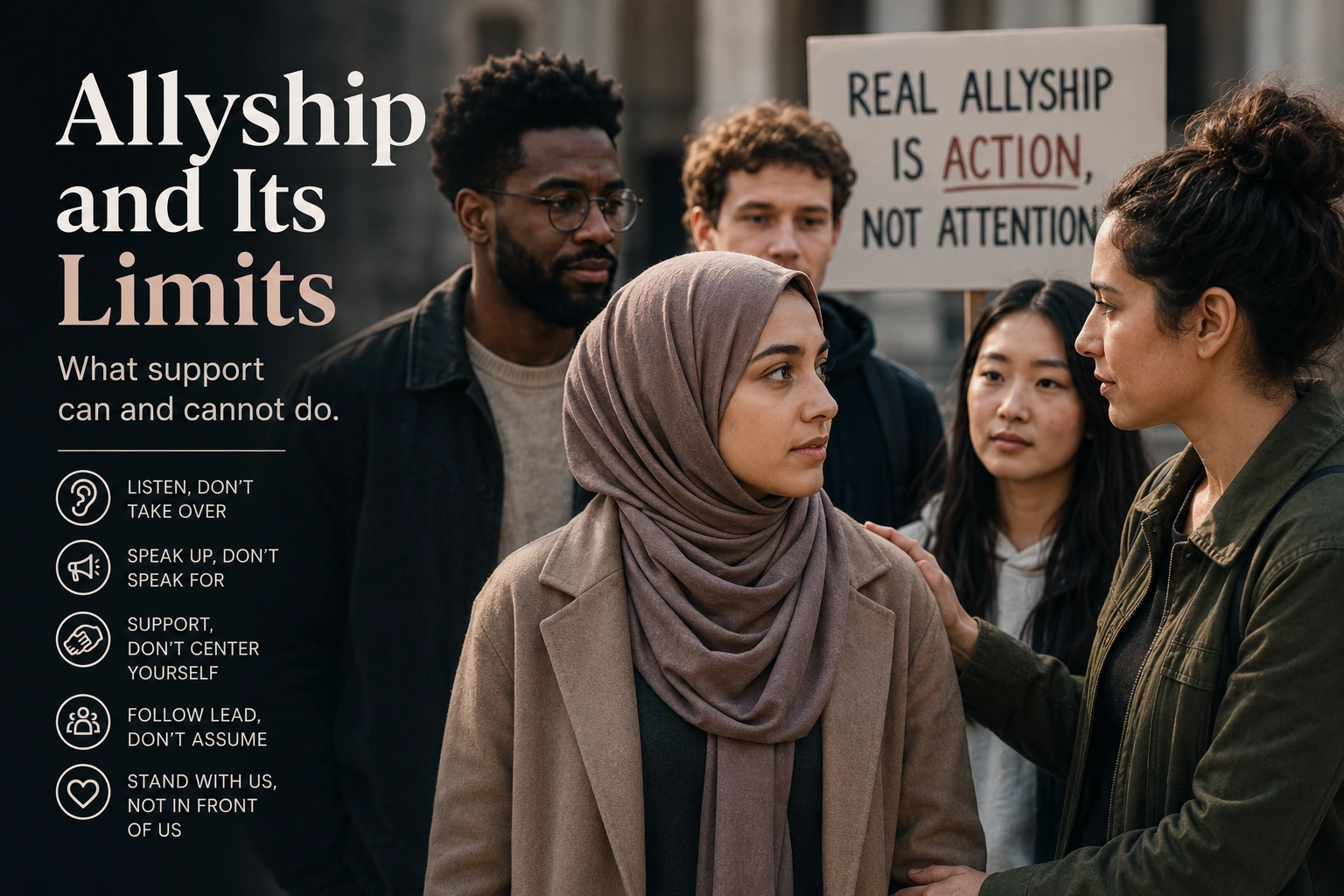
What support can and cannot do.
Support matters.
When Muslims are targeted by harassment, misrepresented in public debate, excluded from institutions, or made to feel alone in spaces where they should belong, the presence of others who refuse that treatment can be deeply meaningful. A colleague who challenges an Islamophobic joke. A teacher who intervenes when a student is singled out. A neighbor who speaks against hostility toward a mosque. A public official who names anti-Muslim hate clearly rather than softening it into vague language about “tensions.”
These acts do not solve everything.
But they matter.
Allyship can interrupt isolation. It can signal that prejudice is not universally accepted. It can shift the burden of confrontation away from Muslims alone. Research on prejudice confrontation and bystander response suggests that speaking up against bias can reduce intergroup prejudice, shape social norms, and provide meaningful support to those targeted.
Yet allyship also has limits. It can become shallow, self-congratulatory, poorly timed, or overly centered on the ally rather than the people experiencing harm. It can mistake visibility for effectiveness. It can speak over Muslims while claiming to speak for them. It can demand emotional labor from the very communities it says it wants to support.
Support is necessary.
But support is not ownership.
Allyship Begins With Refusing Neutrality
There are moments when neutrality protects the wrong person.
A Muslim coworker is mocked in a meeting.
A student is asked an invasive question about terrorism.
A mosque faces fearmongering disguised as a zoning concern.
A public conversation turns Muslims into a problem to be managed.
In such moments, silence is often interpreted as permission. It tells the target that they are alone, and it tells the speaker that the room is safe for prejudice.
Allyship begins when someone declines that silence.
This does not always require a speech. Sometimes it is as simple as:
“That’s not appropriate.”
“That is not a fair generalization.”
“Let’s not put them on the spot.”
“That claim is misleading.”
“We should hear directly from the Muslim community involved.”
Studies of ally confrontation suggest that when members of a dominant group challenge bias, it can reduce prejudicial behavior and establish more egalitarian norms. In some research, targets of racism also reported better self-esteem when an ally confronted prejudice rather than remaining silent.
The intervention matters because it changes the social meaning of the moment.
Prejudice no longer owns the room uncontested.
Support Can Ease the Burden of Always Responding
One of the quiet harms of Islamophobia is that Muslims are often expected to do all the correcting themselves.
They must answer the falsehood.
Clarify the stereotype.
Respond to the comment.
Calm the room.
Explain why something was offensive.
Prove that the harm was real.
Allyship can interrupt that pattern.
A non-Muslim friend who corrects a misconception before a Muslim person has to is not taking over the conversation. They may be reducing the demand that Muslims constantly defend their own dignity. A coworker who says, “We should not be asking her to explain an entire religion,” can relieve a pressure that others in the room failed to notice.
This matters. Research on allyship and bystander support shows that targets of bias can benefit psychologically when others acknowledge harm or intervene constructively.
But support should not create a new burden. A 2026 Cornell study found that well-meaning allies can increase stress when they ask marginalized people to join or validate a prejudice confrontation in the moment. The request may shift emotional labor back onto the very person the ally intended to help.
The lesson is clear:
Help should lighten the burden, not rearrange it.
Allies Should Not Require Applause
Not every act of support needs public recognition.
In the age of social media, allyship can drift toward performance. A person posts a statement, shares a graphic, adopts the right language, and receives social approval. Some public expressions of solidarity are useful, especially when silence dominates. They can raise awareness, normalize support, and make targeted communities feel less abandoned.
But visibility is not the same as commitment.
Researchers studying performative allyship describe it as action that is often easy, low-cost, and motivated partly by personal or reputational benefit rather than meaningful challenge to the status quo. Such allyship can harm marginalized groups when it creates an illusion of progress without real change, or when it recenters the ally’s self-image over the community’s needs.
A public post may matter.
A private intervention may matter more.
A donation may matter.
Long-term institutional pressure may matter more.
A statement after a tragedy may matter.
Consistent attention before and after the tragedy matters more.
Support becomes credible when it survives the moment of social reward.
Allyship Is Not a Substitute for Muslim Voice
There are times when an ally should speak.
There are also times when an ally should step back.
Muslims do not need others to narrate their lives over them. They do not need outside interpreters to define Islamophobia, explain Muslim experience, decide what Muslims should prioritize, or convert Muslim pain into a project of someone else’s moral growth.
Meaningful allyship centers those affected.
That may mean amplifying Muslim-led organizations, inviting Muslim experts rather than non-Muslim commentators to speak on Muslim issues, following the stated needs of local communities, and resisting the temptation to become the protagonist of someone else’s struggle. Toolkits and anti-Islamophobia guidance from Muslim-focused organizations emphasize the importance of building direct relationships with Muslim communities, understanding their specific concerns, and confronting misinformation without displacing Muslim leadership.
An ally’s role is not to become the voice.
It is to help ensure the voice can be heard.
Good Intentions Do Not Guarantee Good Allyship
A person may sincerely want to help and still act clumsily.
They may ask a Muslim friend to explain whether a public comment was offensive, when the friend is already tired.
They may organize a panel on Islamophobia without inviting Muslims to shape it.
They may post support online while ignoring anti-Muslim bias in their own workplace.
They may intervene loudly in public but fail to ask the targeted person afterward what support would actually feel helpful.
Intent matters, but impact matters too.
Allyship requires the humility to learn when one’s first instinct is not the most useful response. Research on ally behavior has increasingly emphasized that allyship is not one single act, but a range of practices that vary in effectiveness depending on context, cost, and whether they meaningfully support marginalized people.
The question is not merely, “Did I mean well?”
It is also:
“Did this reduce harm?”
“Did this center the affected person?”
“Did this challenge the conditions that allowed the harm?”
“Did this create more work for the person I hoped to support?”
There Is a Difference Between Comfort and Solidarity
Some forms of allyship are designed to preserve comfort.
They oppose Islamophobia in principle, but avoid conflict when it appears in family, workplace, religious, or political spaces. They support Muslims generally, but become quiet when support may cost them social standing. They condemn hate after violence, but hesitate to challenge the narratives that made violence more likely.
Solidarity is less convenient.
It may mean disappointing friends.
Correcting relatives.
Losing approval.
Speaking at a meeting where one would rather remain quiet.
Questioning institutional policies, not just individual manners.
Supporting Muslim communities when they are unpopular, not only when they are publicly sympathetic.
This distinction matters because Islamophobia is not only interpersonal. It is also structural, shaping institutions, media narratives, and public policy. Organizations working on anti-Islamophobia efforts emphasize that meaningful response must address both individual prejudice and systems that embed fear and suspicion into public life.
Comfort says, “I support you as long as it does not unsettle me.”
Solidarity says, “Your dignity is worth some discomfort.”
Allies Cannot Remove the Experience Itself
Support can help. It cannot erase what happened.
A Muslim student may feel grateful when a teacher intervenes after a cruel comment. That intervention does not undo the humiliation of having been targeted. A Muslim woman may appreciate a stranger confronting harassment on a train. That does not remove the fear she felt before anyone stepped in. A mosque may welcome interfaith support after threats. That support does not cancel the fact that worshippers had to consider security while gathering for prayer.
Allyship should not be romanticized as a cure.
It is a response, not a rewind.
This matters because supporters sometimes expect their presence to make a situation “better” quickly. But targeted people may remain angry, shaken, or distrustful even after others act well. Their emotional timeline does not belong to the ally.
Support is not validated by immediate gratitude.
Sometimes the most mature allyship is helping without requiring the harmed person to perform relief.
Speaking Up Is Valuable, But It Is Not the Whole Work
Confronting a prejudiced remark is important. It is also only one level of response.
Islamophobia can be embedded in hiring patterns, school policies, media framing, law enforcement practice, zoning fights over mosques, workplace accommodation, and political messaging. A person who wants to be supportive must eventually ask whether they are willing to move from interpersonal reaction to institutional attention.
That may mean:
- supporting Muslim-led civil rights work
- advocating for stronger anti-bullying policies
- challenging discriminatory workplace practices
- pressing institutions to accommodate religious needs fairly
- backing local mosque communities during organized opposition
- scrutinizing policies that treat Muslim identity as a proxy for suspicion
Recent public initiatives have increasingly framed anti-Muslim hate as requiring structural and cross-community action, not only individual goodwill. For example, philanthropic and policy efforts announced in 2024 and 2026 have emphasized coalition-building, institutional protection, and support for organizations combating anti-Muslim hate alongside other forms of religious prejudice.
The ally who only corrects comments but never questions systems is helping at one level while leaving larger patterns intact.
Allyship Should Not Demand Access
Sometimes people confuse support with entitlement to closeness.
They believe that because they defend Muslims publicly, they deserve Muslim friendship, trust, gratitude, invitations, explanations, or emotional intimacy. When those do not arrive, they feel unappreciated.
But allyship is not a transaction.
A Muslim colleague does not owe personal disclosure because someone supported a workplace accommodation. A Muslim friend does not owe a full political education because someone posted against Islamophobia. A Muslim community does not owe internal access because an outsider attended one event in solidarity.
Trust grows through time and conduct. It is not purchased through a single decent act.
Support becomes distorted when it seeks return on investment.
There Are Times to Follow, Not Lead
An ally does not always know the most urgent issue.
A local Muslim community may want help responding to a zoning battle, not a symbolic awareness event. Muslim students may need institutional backing after harassment, not another vague statement about inclusion. A family facing targeted abuse may want privacy, not public visibility. A civil rights organization may ask supporters to call officials, donate, document incidents, or amplify a specific demand.
The best allyship listens before it mobilizes.
This is especially important because Muslim communities are not monolithic. They differ by race, class, nationality, theology, gender, migration history, and local circumstance. Effective solidarity cannot be built from assumptions. It must be responsive to actual needs. Frameworks for allyship in Muslim contexts emphasize intersectionality and the need to avoid reproducing patterns of inequality while trying to help.
Support is stronger when it is informed.
It is weaker when it arrives with a preset script.
Allyship Cannot Replace Accountability Within Institutions
Institutions often use the language of support while avoiding deeper correction.
A university issues a message after anti-Muslim harassment, but does not revise reporting processes.
A company celebrates religious diversity, but makes prayer accommodation difficult.
A public agency attends an interfaith gathering, but fails to investigate discriminatory treatment seriously.
A school hosts a cultural event, but teachers remain untrained on Islamophobic bullying.
These gestures may have value. They are not meaningless. But without accountability, they risk becoming symbolic insulation against criticism.
Performative allyship is not only an individual problem. Organizations can perform support too, signaling virtue while leaving everyday conditions unchanged. Research on performative allyship warns that surface-level displays can undercut real change by satisfying the appearance of action without challenging the status quo.
Institutional allyship must be measurable.
What changed?
Who was protected?
What policy shifted?
What complaint pathway improved?
What resources were committed?
What will be different next time?
A banner is not accountability.
The Limits of “Humanizing” Muslims
A common form of support is the attempt to humanize Muslims through stories of kindness, achievement, family life, and normalcy. These stories can be beautiful. They can counter flattening stereotypes and expand public imagination.
But there is a limit.
Muslims should not have to be constantly humanized, as though their humanity were in question and needed regular proof. Nor does exposure to warm stories automatically dismantle entrenched prejudice. Research on media messages suggests that humanizing outgroups may rally people already inclined toward empathy, but may be less effective at changing the minds of those most committed to bias.
This does not mean human stories are useless. They matter greatly.
It means they are not enough.
A society must move beyond “Look, Muslims are people too” toward “Muslims do not need to prove their humanity in order to receive equal treatment.”
What Support Can Do
Allyship cannot end Islamophobia by itself.
But it can do real things.
It can interrupt prejudice in the moment.
It can make targeted people feel less alone.
It can shift norms in a room.
It can amplify Muslim-led work.
It can challenge institutions.
It can carry some of the burden that would otherwise fall repeatedly on Muslims.
It can help create climates where anti-Muslim bias is less easily expressed and less easily ignored.
Research on bystander intervention and confrontation suggests that these actions can matter for both targets of prejudice and broader social norms.
Support is not everything.
It is still something.
What Support Cannot Do
Allyship cannot:
- speak for Muslims better than Muslims can speak for themselves
- erase harm after the fact
- substitute for policy change
- replace long-term relationship-building
- absolve institutions through symbolic gestures
- demand gratitude or personal access
- make prejudice disappear through good intentions
- turn a supporter into the center of someone else’s struggle
These limits do not make allyship pointless. They make it more honest.
Mature support understands its role precisely. It does not inflate itself. It does not retreat because it cannot solve everything. It acts where action is needed and listens where leadership belongs elsewhere.
The Best Allyship Makes Itself Less Necessary
There is a paradox at the heart of allyship.
Its purpose is not to remain permanently impressive.
Its purpose is to help build conditions where intervention becomes less necessary: where Muslims are not isolated in confronting prejudice, where institutions respond before harm escalates, where misinformation is less casually accepted, where ordinary people understand that anti-Muslim bias is not an issue Muslims alone must manage.
The best allyship does not create dependency.
It helps create fairness.
And fairness, if it grows strong enough, reduces the need for heroic intervention in the first place.
Conclusion
Allyship matters because silence has consequences.
When people challenge Islamophobia, defend those being targeted, amplify Muslim voices, and pressure institutions to do better, they help prevent prejudice from becoming the uncontested norm. Support can change a room, a policy conversation, a community climate, or the experience of a single person who thought no one would intervene.
But allyship must remain disciplined. It cannot become performance, ownership, emotional extraction, or a substitute for structural change. It cannot center the supporter more than the people harmed. It cannot assume that good intention makes every action useful.
Support is most trustworthy when it is humble, informed, and willing to bear cost.
Not every ally needs to lead.
Not every ally needs to be seen.
Not every ally needs to speak first.
But when prejudice appears, someone besides the target should be willing to stand up.
That is not the whole work.
It is part of it.