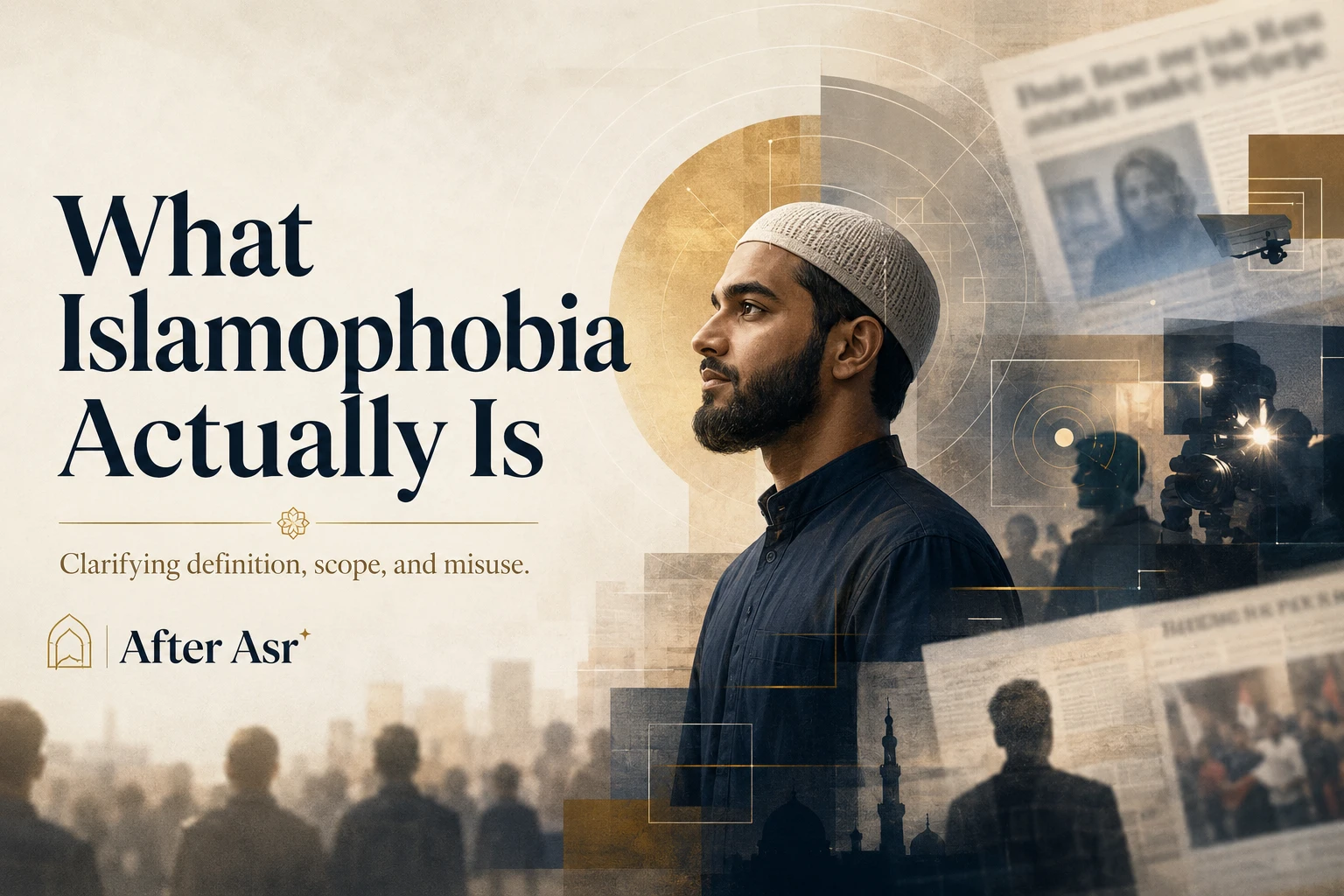
Clarifying definition, scope, and misuse.
The word Islamophobia is often used in public debate, but rarely with the care it requires. For some, it describes hostility toward Muslims. For others, it is treated as a political accusation used to shut down criticism. Between these two reactions, the term itself is often misunderstood.
That misunderstanding matters.
Islamophobia is not simply a matter of personal dislike, nor is it a shield against every criticism of Muslim individuals, institutions, governments, or interpretations of religion. At its core, Islamophobia refers to prejudice, hostility, suspicion, or discriminatory treatment directed at Muslims, or people perceived to be Muslim, because of their association with Islam.
In that sense, Islamophobia is not only about what someone says. It is also about how Muslims are imagined, categorized, excluded, and treated.
More Than Fear of Islam
The word can be misleading if taken too literally. Phobia suggests fear, but Islamophobia is not limited to fear. It can include contempt, suspicion, disgust, dehumanization, collective blame, conspiracy thinking, and unequal treatment.
A person does not need to feel afraid of Muslims to participate in Islamophobia. They may instead believe Muslims are inherently violent, politically disloyal, culturally backward, oppressive by nature, or incapable of belonging in a plural society.
These assumptions do not treat Muslims as individuals. They treat them as representatives of a threatening category.
That is one of the defining features of Islamophobia: the individual Muslim disappears, and a fixed image takes their place.
The Role of Collective Blame
One of the clearest forms of Islamophobia is collective blame.
When an individual Muslim commits a crime, Muslims as a whole are often asked to explain themselves. Their faith becomes part of the public trial. Their communities are expected to condemn, clarify, distance, and prove loyalty.
This expectation is rarely applied in the same way to other groups. A violent act by a person from another background may be understood as individual criminality, political extremism, mental instability, or social failure. But when the person is Muslim, the act is often treated as evidence of something deeper about Islam itself.
This does not mean Muslims, Muslim institutions, or Muslim-majority societies are beyond criticism. They are not. But criticism becomes Islamophobic when it moves from specific accountability to inherited suspicion.
The difference is important. To criticize a person’s action is normal. To hold millions of unrelated people responsible for that action is prejudice.
Criticism of Islam Is Not Automatically Islamophobia
A careful definition of Islamophobia must make room for legitimate criticism.
People can criticize religious ideas, historical claims, political movements, legal interpretations, cultural practices, or Muslim-majority governments without necessarily being Islamophobic. Muslims themselves engage in these debates constantly. Islamic scholarship has always included disagreement, correction, argument, and moral critique.
The question is not whether Islam or Muslims can be criticized. They can.
The question is whether the criticism is fair, specific, consistent, and grounded in reality, or whether it relies on stereotypes, double standards, and collective suspicion.
For example, it is not Islamophobic to criticize corruption in a Muslim-majority government. It may become Islamophobic to claim that such corruption proves Muslims are incapable of democracy or civilization.
It is not Islamophobic to debate religious law. It may become Islamophobic to portray all Muslims as secretly committed to domination.
It is not Islamophobic to object to an individual preacher’s statement. It may become Islamophobic to use that statement as proof that every mosque is dangerous.
The distinction is not always complicated. Good-faith criticism aims at truth. Islamophobia aims at suspicion.
Islamophobia Targets “Muslimness”
Modern definitions often emphasize that Islamophobia targets not only Muslims, but also “Muslimness,” including visible signs, names, clothing, places of worship, accents, cultural associations, and perceived religious identity. The Runnymede Trust describes Islamophobia as anti-Muslim racism embedded in wider systems of power, while the All-Party Parliamentary Group on British Muslims proposed the widely cited definition that Islamophobia is a type of racism targeting “expressions of Muslimness or perceived Muslimness.”
This matters because Islamophobia does not always require accurate identification. Sikhs, Arabs, South Asians, Africans, and others have been targeted by anti-Muslim hostility because they were assumed to be Muslim. A person may be attacked for a turban, a beard, a name, a language, or a brown body read through a political imagination of Islam.
In such cases, Islamophobia is not simply about theology. It is about racialized suspicion.
The target is not only a set of beliefs. It is a visible or imagined identity.
The Difference Between Discomfort and Discrimination
Not every uncomfortable conversation about Islam is Islamophobia. A person may have questions, confusion, fear shaped by media exposure, or limited personal experience with Muslims. Those things can be addressed through conversation, education, and encounter.
Islamophobia becomes more serious when discomfort hardens into a social judgment.
It appears when Muslims are treated as less trustworthy before they have spoken. It appears when a Muslim woman’s hijab is treated as a sign that she cannot think for herself. It appears when mosques are viewed as security threats by default. It appears when Muslim students, employees, travelers, or neighbors are expected to prove they are “safe” in ways others are not.
The issue is not that Muslims want exemption from scrutiny. The issue is that Muslims are often placed under suspicion before there is anything to scrutinize.
How Misuse Weakens the Term
The misuse of the word Islamophobia can also create problems.
If the term is used for every disagreement, every theological critique, or every uncomfortable question, it becomes less precise. That imprecision can make it easier for critics to dismiss real anti-Muslim hatred when it occurs.
A strong definition must therefore be disciplined. It should protect Muslims from prejudice without protecting every Muslim idea, leader, government, or institution from criticism.
This balance is not a concession. It is necessary for credibility.
Muslims should not have to accept bigotry disguised as debate. At the same time, public debate should not be flattened by treating all criticism as bigotry.
The strength of the term depends on its clarity.
Islamophobia as a Public Problem
Islamophobia is not only an interpersonal attitude. It can also shape institutions, media narratives, political campaigns, security policies, and public expectations.
This is why international bodies and civil society organizations increasingly treat Islamophobia as more than private prejudice. The United Nations marks March 15 as the International Day to Combat Islamophobia, emphasizing that terrorism and violent extremism should not be associated with any religion, nationality, civilization, or ethnic group.
Public narratives have consequences. When Muslims are repeatedly associated with threat, invasion, extremism, backwardness, or foreignness, those associations influence how people vote, hire, police, report, teach, and interact.
A stereotype repeated often enough does not remain only an opinion. It becomes atmosphere.
And atmosphere shapes treatment.
The Double Standard Test
One useful way to identify Islamophobia is to ask whether the same standard would be applied to others.
Would members of another faith be asked to condemn the actions of strangers across the world?
Would another religious group be treated as politically suspect because of foreign governments they do not control?
Would another minority be expected to prove loyalty every time violence appears in the news?
Would the worst examples from a tradition be treated as the essence of that tradition?
Would ordinary believers be denied complexity, disagreement, reform, innocence, or individuality?
If the answer is no, then the issue may not be criticism. It may be a double standard.
Islamophobia often hides inside that double standard.
What Islamophobia Is Not
Because the term is contested, it is useful to say clearly what Islamophobia is not.
It is not disagreement with Islam.
It is not asking sincere questions about Islamic beliefs.
It is not criticism of Muslim-majority governments.
It is not opposition to violence committed by Muslims.
It is not debate over theology, law, history, gender, politics, or religious authority.
It is not a demand that Islam be treated as beyond analysis.
What makes something Islamophobic is not that Islam is mentioned negatively. It is that Muslims are reduced, demonized, collectively blamed, excluded, or treated as inherently suspect because of Islam.
That distinction protects both Muslims and honest discourse.
Conclusion
Islamophobia is best understood as anti-Muslim prejudice that targets Muslims, or those perceived to be Muslim, through fear, hostility, stereotyping, collective blame, and unequal treatment.
It can appear in personal insults, media framing, political rhetoric, institutional decisions, and everyday suspicion. It can be crude and open, or polite and coded. It can target religious belief, visible identity, cultural association, or imagined Muslimness.
But defining Islamophobia carefully also means refusing to use the term carelessly. Not every criticism is bigotry. Not every discomfort is hatred. Not every debate is an attack.
The purpose of naming Islamophobia is not to end discussion. It is to make discussion more honest.
A society that takes Islamophobia seriously does not have to stop asking hard questions. It has to stop treating Muslims as the answer before the question has even been asked.
About the Author
Mariam Qadir covers Islamophobia, civil rights, media narratives, and public life, with a focus on how Muslims are represented, protected, and misunderstood in modern societies.