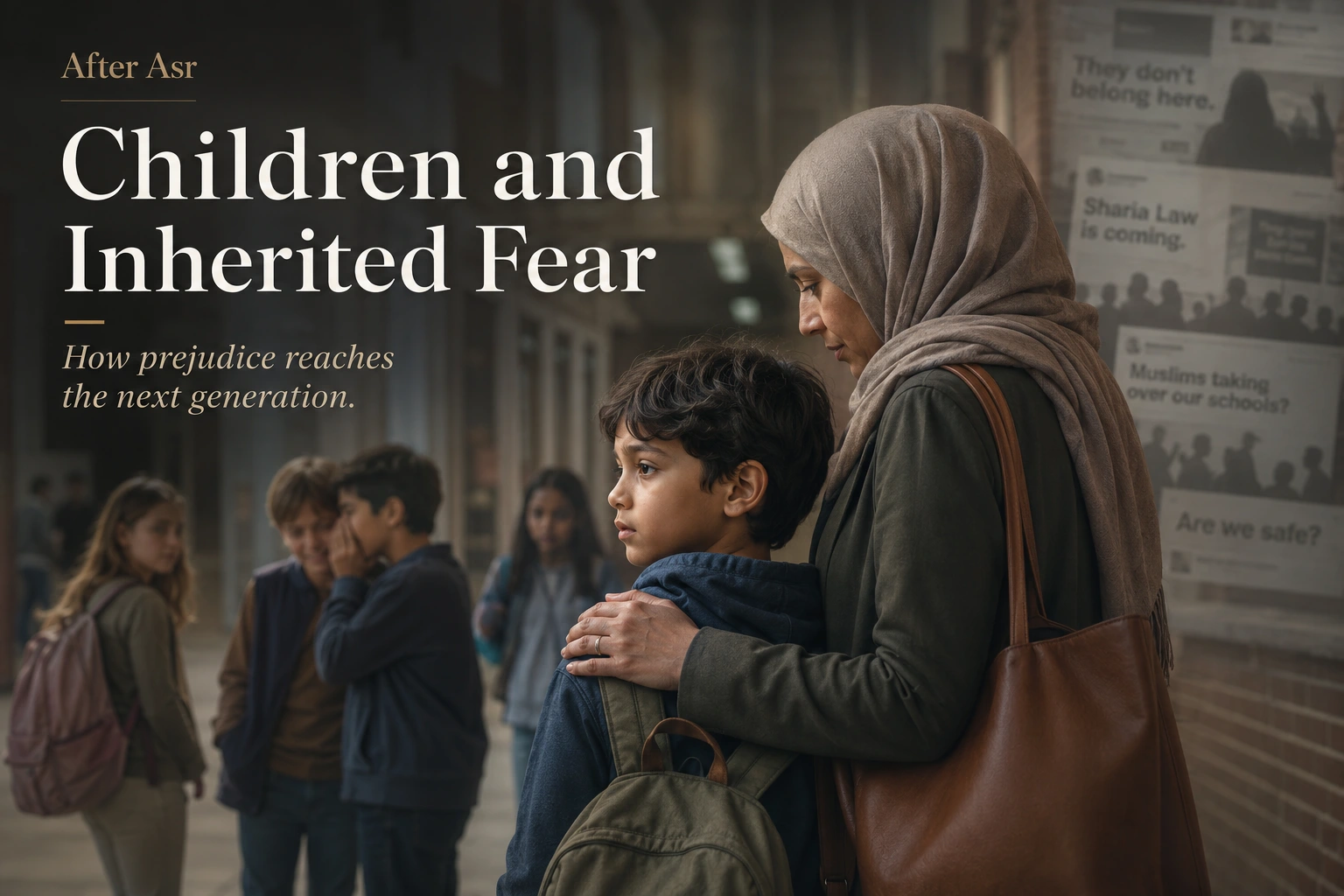
How prejudice reaches the next generation.
Children do not enter the world already knowing whom to fear.
They learn.
They learn from the warnings adults give, the jokes classmates repeat, the images that circulate online, the stories television treats as familiar, the slurs heard in passing, the questions teachers handle carefully or poorly, and the silence that follows when someone says something cruel.
Prejudice does not always announce itself as a lesson. Often, it arrives as atmosphere.
A child watches a parent lower their voice in public.
A Muslim student notices that their faith becomes a classroom topic only when something violent happens in the news.
A non-Muslim child repeatedly sees Muslims associated with danger and begins to absorb a pattern before they can name it.
A Muslim parent explains why their child should be cautious, not because they want to transfer fear, but because the world has already shown itself capable of harm.
This is how fear becomes inherited.
Not biologically. Socially.
And once prejudice reaches children, it begins shaping the future before that future has had a fair chance to form.
Children Absorb the World Adults Build
Adults often imagine prejudice as an opinion formed later in life, after exposure to politics, media, or personal experience. But children begin constructing social categories early. They notice who is treated as normal, who is treated as different, and which groups seem to carry negative associations in the culture around them.
A 2017 study of U.S. elementary-school children found that children held prejudicial stereotypes toward Arab Muslims relative to several other groups. Arab Muslim men were perceived as less American and angrier than others, and children who viewed Arab Muslims as more prototypically American expressed warmer attitudes toward them. The findings suggested that anti-Muslim bias can appear at a young age and is tied to broader ideas about national belonging.
This matters because children are not merely repeating adult talking points word for word. They are forming emotional associations.
Who looks safe.
Who looks foreign.
Who belongs.
Who requires explanation.
Those impressions can become durable if they are never challenged.
Fear Is Taught Through Repetition
A child does not need to hear an adult say, “Muslims are dangerous,” in order to absorb suspicion.
They may notice that Muslims appear in news stories about terrorism more often than in stories about ordinary life. They may hear relatives speak nervously about mosques, immigrants, or people wearing hijab. They may see online videos framing Muslims as a threat to national identity. They may encounter schoolyard jokes that combine religion with violence.
The repeated message does not need to be explicit. Its consistency does the teaching.
When a group is discussed primarily in relation to danger, even casual exposure can shape the imagination. Children begin to associate a name, a garment, a language, or a place of worship with a feeling before they possess the vocabulary to critique that feeling.
Prejudice often reaches children not through a single dramatic lesson, but through accumulated cues.
Muslim Children Learn Fear From the Other Side
For Muslim children, inherited fear can arrive differently.
They may not be taught to fear Muslims. They may be taught to fear how others respond to Muslims.
A parent tells a child to ignore rude comments.
A mother explains why someone stared at her hijab.
A father warns a teenager to be careful about joking in an airport.
A family discusses what to do if someone says something hateful at school.
A child learns that their religion may make other people uncomfortable, suspicious, or cruel.
Resources for families coping with Islamophobia recognize this reality. The National Child Traumatic Stress Network notes that children may feel fear that they, their loved ones, or their places of worship could be targeted during periods of rising anti-Muslim rhetoric or violence, and recommends age-appropriate conversations that help children process prejudice without being overwhelmed by it.
The parent is not creating the fear. They are trying to prepare the child for it.
That distinction matters.
The School as an Early Site of Islamophobia
For many children, school is where inherited fear becomes personal.
It may begin with teasing about a name, a lunch, a headscarf, a parent’s accent, or fasting during Ramadan. It may escalate into slurs, exclusion, physical bullying, or teachers mishandling religious identity in the classroom. Sometimes adults are the source of the problem. Sometimes they are bystanders. Sometimes they intervene well. Sometimes they dismiss what they do not understand.
A 2024 federal anti-bullying resource cited data from the Institute for Social Policy and Understanding showing that 48 percent of Muslim families with school-age children reported religious-based bullying in the prior year, and that one in five said the bullying occurred nearly every school day. The same resource noted that bullying was reported not only from peers, but also from trusted adults in school settings.
More recent state-level reporting has shown the issue remains serious. A 2025 California report found that Muslim students continue to experience bullying and discrimination that affect attendance, mental well-being, and sense of belonging in school communities.
Children do not experience these incidents as abstract social problems. They experience them at lunch tables, in hallways, on buses, during group projects, and in classrooms where they are trying to learn.
A place meant to develop confidence can instead become where a child first learns to brace.
The Child Who Becomes a Representative
Muslim children are often asked to explain things they are too young to carry.
A teacher mentions Islam during a lesson and turns toward the only Muslim student in the room. A classmate asks whether their family supports violence. Someone wants to know if their mother is oppressed. A discussion of current events makes a child feel suddenly visible, though they came to school hoping only to get through math and lunch.
This representational burden is not reserved for adults.
Children may become miniature ambassadors for a religion they are still learning themselves. They may feel pressure to answer correctly, to avoid embarrassing their family, to make Islam seem acceptable, or simply to survive the moment without becoming the center of attention.
Studies of Muslim children’s experiences have found that Islamophobia can affect children’s feelings of safety, identity, and belonging, particularly when discrimination is encountered in schools and public life. Child-participatory research has emphasized that Muslim children themselves describe these experiences in ways that reveal fear, frustration, and the need to manage how others perceive them.
A child should be allowed to be a child before being made into a spokesperson.
Fear Changes Behavior Early
Children adapt quickly.
A Muslim child who is mocked for a lunch item may stop bringing it.
A girl who hears comments about hijab may delay wearing it, remove it in certain spaces, or worry about what will happen if she begins.
A boy whose name becomes a punchline may ask to use a nickname.
A student who is repeatedly asked about terrorism may stop speaking in class when religion or politics comes up.
These are not always dramatic decisions. Some are small, almost invisible. Yet they show how prejudice narrows a child’s sense of freedom.
A 2026 study on diverse Muslim youth in the United States described discrimination, bullying, and Islamophobia as factors that can affect mental health and learning outcomes. Earlier research examining exposure to post-9/11 Islamophobia found effects on educational trajectories among Arab-Muslim-origin youth, including increased school dropout rates for one affected cohort.
When fear influences how children present themselves, how they participate, or whether school feels emotionally safe, prejudice is no longer merely a social attitude. It is shaping development.
Non-Muslim Children Inherit Fear Too
The transmission of prejudice harms more than Muslim children.
Non-Muslim children who absorb anti-Muslim bias are also being formed by it. They learn to treat suspicion as wisdom. They learn that unfamiliar religious practices are threatening. They learn that belonging can be ranked. They learn to interpret some classmates through stereotype before friendship has a chance to interrupt it.
This inheritance damages moral imagination.
A child taught to fear Muslims may later become an adult who votes through fear, hires through fear, teaches through fear, or remains silent when someone else is targeted. The prejudice may soften with life experience, or it may deepen if reinforced. But it begins somewhere.
That is why early intervention matters. Children who perceive Muslims as part of the national “us,” rather than an alien “them,” show warmer attitudes, according to the 2017 study of U.S. children’s perceptions of Arab Muslims.
Belonging is learned too.
Parents Cannot Protect Children From Everything
Muslim parents face a painful task. They want their children to be confident, open, and proud of who they are. They do not want to raise them in fear. Yet they may also know that pretending prejudice does not exist leaves children unprepared when it appears.
So they calibrate.
They explain that some people misunderstand Islam.
They teach children how to ask for help if bullied.
They prepare them for questions without wanting them to feel perpetually on display.
They encourage kindness while warning against naivete.
They try to keep innocence intact without making ignorance the cost.
This is difficult parenting terrain.
Recent scholarship on Muslim family life has examined how Islamophobia shapes the home itself, influencing the ways Muslim families think about belonging, religious socialization, and the world their children are entering.
A family should be able to teach faith without simultaneously teaching defense.
Yet many feel they must do both.
The Inheritance of Caution
Fear does not always get passed down as panic. Sometimes it is inherited as caution.
Do not argue with strangers.
Do not assume people will understand.
Be careful what you post.
Know when to walk away.
Tell a teacher if someone says that again.
Call us if you feel unsafe.
Do not let anyone make you ashamed of being Muslim.
These lessons can be loving and necessary. They are often wise responses to real conditions. But their necessity reveals something painful about the society surrounding the child.
Caution becomes part of upbringing because prejudice has been allowed to remain part of the environment.
The child inherits not only a faith, culture, or family story. They inherit a set of protective instincts built in response to other people’s bias.
Schools Can Interrupt the Transmission
If prejudice can be inherited, it can also be interrupted.
Schools play a central role. They can treat anti-Muslim bullying as a serious issue rather than an occasional misunderstanding. They can train educators to recognize Islamophobia, avoid singling out Muslim students as classroom authorities, and respond clearly when bias appears. They can include Muslim histories, communities, and contributions in ways that move beyond war, terrorism, or cultural controversy. They can build systems that make reporting safer and follow-up more credible.
Reports and school-focused research increasingly emphasize the need for more effective educator preparation, better recognition of anti-Muslim bias, and stronger institutional responses to bullying and exclusion.
Children learn from what adults tolerate.
They also learn from what adults refuse to normalize.
The Role of Ordinary Representation
Not every solution arrives through a formal curriculum. Sometimes, ordinary representation does powerful work.
Children who encounter Muslims as teachers, coaches, librarians, doctors, classmates, neighbors, authors, artists, and public servants are less likely to encounter Islam only through crisis. Muslim children who see themselves reflected in books, lessons, and school culture gain evidence that their presence is not an exception requiring explanation.
Positive images alone do not eliminate prejudice. But absence leaves stereotypes with less competition.
Children need to see Muslim life as part of the social landscape, not as a special topic reserved for conflict or diversity days.
Normality is educational.
Fear Can Be Broken Before It Hardens
Adults often wait too long to talk about prejudice. They assume children are too young, too innocent, or too unaware. But research suggests that children are already noticing difference and absorbing social attitudes in the early school years.
Silence does not preserve innocence if bias is already present. It merely leaves children to interpret it alone.
Careful conversations can help. Children can be taught that no religion or ethnicity makes someone less human. They can be taught that disagreement is not permission for mockery. They can be taught that news stories do not define classmates. They can be taught that curiosity should be respectful and that questions do not entitle them to someone else’s discomfort.
Most importantly, they can be taught that Muslims belong.
The fear inherited from society does not have to be passed forward unchanged.
Conclusion
Prejudice reaches the next generation in two directions.
It teaches some children whom to fear.
It teaches others when to fear being seen.
Muslim children may inherit caution from parents trying to keep them safe. Non-Muslim children may inherit suspicion from a culture that has repeatedly portrayed Muslims as different, dangerous, or foreign. Schools can deepen these patterns, ignore them, or interrupt them. Adults can repeat them casually or confront them intentionally.
Children are not born carrying Islamophobia.
They are introduced to it.
That should trouble us. But it should also give us hope. What is learned can be unlearned. What is modeled can be changed. What is passed down can be interrupted before it becomes the next generation’s common sense.
A child should not grow up believing that Muslims are to be feared.
A Muslim child should not grow up believing that fear is the price of being known.