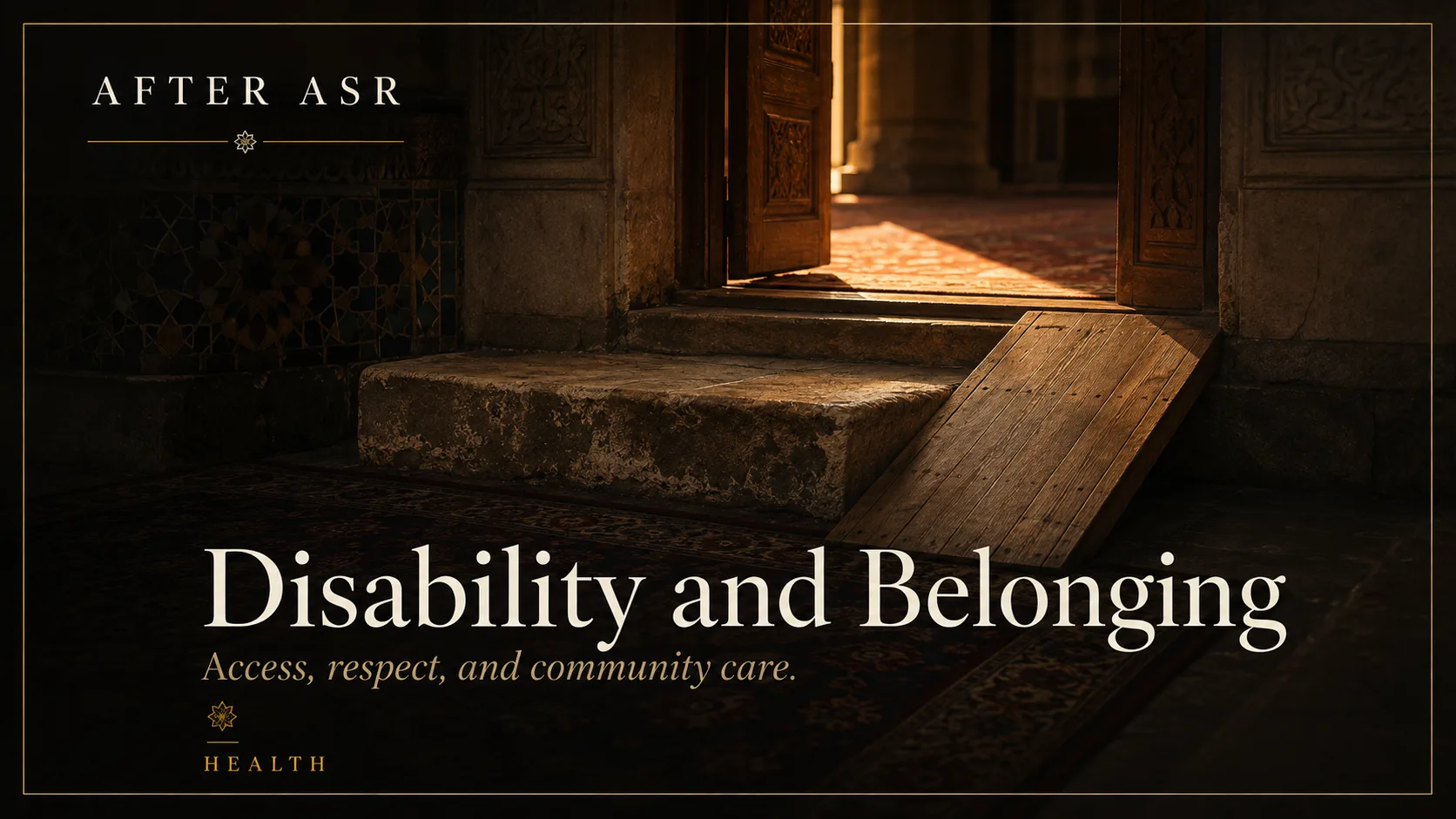
There is a single step at the front of the masjid, worn smooth by decades of feet. For most of us it is nothing, a thing we clear without noticing. For the man in the wheelchair at the bottom of it, waiting while someone goes to find a board or a few strong arms, that step is a wall. He has come to pray with his community, and his community has, without meaning to, built its house so that he must be carried into it.
He does not complain. He has learned not to. But he should not have to be carried into the house of God.
Every Body Is a Different Body
There is no standard body. We build our world as though there were, as though everyone could climb the step, read the small print, hear the announcement, stand for the length of the prayer. But bodies vary enormously, and always have. Some cannot walk, some cannot see, some cannot hear, some carry pain or fatigue invisible to everyone around them. This is not the exception to the human condition. It is part of its ordinary range.
To speak of disability is simply to speak of the full variety of bodies that God has made. The disabled are not a category apart from the rest of us; they are us, in the range we have always contained. When we design our spaces and our gatherings for only one kind of body, we are not being neutral. We are quietly deciding whose body counts as normal, and leaving everyone else to manage at the edges. Every body is a different body. Our arrangements should begin from that truth, not deny it.
The Disabilities No One Sees
Not every disability announces itself. Many are invisible, carried inside a body that looks, to the passing eye, entirely ordinary. The chronic pain that never lifts. The fatigue that makes a short errand a mountain. The illness that flares and recedes. The mind that struggles in ways no one can observe. These people move among us unrecognized, and often disbelieved.
The invisible disability carries a particular loneliness, the burden of a suffering no one can see and many will doubt. The person who parks in the accessible space and walks in without a cane. The friend who cancels again because their body has failed them today, and hears the unspoken suspicion that they are simply unreliable. We owe these people the same belief we would give a visible wound. A body can be struggling terribly and show nothing on the surface. To believe someone about their own body, even when we cannot see the trouble, is one of the plainest mercies we can offer.
The Step That Says You Do Not Belong
A step is never only a step. To the person who cannot climb it, it is a message, and the message is that this place was not built with you in mind. The narrow doorway, the stairs with no ramp, the bathroom the wheelchair cannot enter, the program with no interpreter. Each one, however unintended, tells someone that they were not thought of, that they are welcome only if they can overcome an obstacle no one placed for anyone else.
We rarely mean these messages. That is precisely the problem. They are built from thoughtlessness, not malice, from simply never having pictured a body different from our own using the space. But the person excluded feels the exclusion just the same, whether or not it was intended. Belonging is communicated in architecture as much as in words. A community that says all are welcome while its every threshold says otherwise has not yet meant what it says.
Access Is a Form of Love
The ramp is an act of love. So is the wide door, the reserved parking space, the chair placed in the prayer row, the large-print copy of the Quran, the willingness to face someone as you speak so they can read your lips. These are not bureaucratic requirements to be met grudgingly. They are the concrete, physical ways a community says to a person, we thought of you, we want you here, we made room.
This is why access matters far beyond its function. It is the built form of belonging. When a community installs the ramp before anyone demands it, adds the accommodation before anyone has to ask, it is extending a welcome that requires no one to plead for their place. To ask for access should not be the price of admission. Love, in its practical form, anticipates. It makes the room ready before the guest arrives, so that they may enter as everyone else does, through the front, on their own.
Worship Was Made to Bend Toward the Body
Our own tradition is remarkably gentle with the varying body. The law of prayer bends toward the worshipper, not the worshipper toward the law. One who cannot stand may pray sitting. One who cannot sit may pray lying down. One who cannot use water may purify with clean earth. One who cannot fast may feed the poor instead. At every turn, the practice was designed to reach the body wherever it is, rather than to demand a body it is not.
There is a profound principle in this. The religion does not treat the standard body as the only acceptable one and grudgingly excuse the rest. It treats accommodation as normal, built into the very structure of worship, so that no one is left outside the practice because of how their body is made. If the law itself bends this readily toward the body, then surely our buildings and our gatherings can bend a little too. The mercy is already in our tradition. We need only extend it into brick and doorway.
The Blind Man and the Frown
There is a moment in the Quran that should humble every community. The Prophet, peace be upon him, was speaking with the powerful men of Quraysh, hoping to win them to the faith, when a blind man came seeking to learn. The Prophet frowned and turned away, absorbed in the notables. And God revealed a correction, opening a whole surah with the reproach: he frowned and turned away, because the blind man came to him.
Consider what this means. God interrupted the highest human being to defend the dignity of a blind man whom others had overlooked. The lesson is placed permanently in the Book: the seeker’s worth is not in his status or his body, and the one who comes sincerely is not to be passed over for the powerful and the whole. That blind companion, Ibn Umm Maktum, was later honored deeply, entrusted with the call to prayer and left in charge of Medina itself. The tradition does not merely tolerate the disabled. It corrects the Prophet on their behalf and raises them to honor.
Pity Is Not Respect
There is a way of treating disabled people that looks like kindness and is not. It is pity, the soft condescension that sees a person as an object of sorrow rather than a full human being, that speaks over them to their companion, that praises them for the smallest ordinary act, that treats their life as a tragedy to be endured. Pity keeps a person at a distance while appearing to draw them close.
Respect is different, and it is what disabled people ask for, when we bother to listen. Respect treats the person as a whole adult with a life, opinions, competence, and dignity, whose body works differently but whose personhood is entire. It does not marvel that they manage to live; it simply includes them in living. To respect rather than pity is to stop seeing the disability first and the person second. The person is not their body’s limitation. They are a person, and they would like, very reasonably, to be treated as one.
The Inspiration Trap
We have a habit of turning disabled people into inspiration for the rest of us. We share their images with captions about overcoming, we tell ourselves that if they can smile then we have no right to complain, we make their existence into a motivational lesson for the able-bodied. It feels like admiration. It is, in fact, another way of not seeing them.
The disabled person going about their day is not doing it to inspire you. They are living their life, as you are living yours, and to make their ordinary existence into a lesson for your own is to reduce them once more to a symbol rather than a self. Real respect does not need them to be inspiring. It lets them be tired, ordinary, complicated, fully human, exactly as we let ourselves be. The kindest thing is not to be moved by them. It is to know them, and to make room for them, and then to get on with being their neighbor.
The Words We Choose
Belonging is built in language too, in the small words we use without thinking. We reach for a person’s disability as an insult, use the names of conditions as casual slurs, describe as suffering or affliction a life the person themselves may not experience that way. The words seem harmless to those who say them. They land differently on those they describe.
To speak of disabled people with care is not a matter of fussy correctness. It is a matter of whether our language makes room for them or pushes them out. The person is not their diagnosis; they are a person who has it. The wheelchair is not a prison to be confined to; it is a tool that grants freedom. These distinctions matter to the people who live them, and attending to them costs us nothing but a little thought. How we speak of a group teaches everyone, including that group, where they stand. Let our words seat them at the table, not below it.
Belonging Is More Than Access
Access gets a person through the door. Belonging is what happens after. It is possible to build every ramp and still leave a person profoundly alone, admitted to the space but not to the community, present at the gathering but not truly part of it. Access is the necessary beginning. It is not the whole of what a person needs.
Belonging is being wanted, not merely permitted. It is the invitation extended, the conversation entered, the friendship offered, the sense that one’s absence would be noticed and one’s presence is a gladness. A disabled person can be fully accommodated and still feel that they are a guest to be managed rather than a member who is missed. We must build the ramps, and then we must do the harder, warmer work of actual welcome, the work that no architecture can do for us. Belonging lives in the heart of a community, and it must be offered there.
The Table Sets a Place
Nowhere is belonging clearer than at the table. To set a place for someone is to declare that they were expected, that the gathering assumed them, that their seat was ready before they arrived. The table that makes room for the wheelchair, that thinks of the dietary need, that seats the deaf guest where they can follow the conversation, is a table that has already said you belong here in the most concrete way there is.
And the table that forgets says the opposite, however warmly it means. The gathering held up a flight of stairs, the meal that ignores the guest who cannot eat it, the seat that was not planned for. These are not small oversights to the one left out. Food is our oldest language of welcome, and a place set or not set speaks louder than any assurance. To include someone at the table, truly, with forethought, is to fold them into the family of the meal. That is belonging you can taste.
Any of Us, at Any Time
We speak of the disabled as though they were a separate people, a group we are kind to from a safe distance. But the truth is more intimate than that. Every one of us is only temporarily able-bodied. An accident, an illness, the simple passage into age, and the body that climbs the step today may need the ramp tomorrow. Disability is not a foreign country. It is a place most of us will visit, and many of us will stay.
This should change how we build and how we welcome. The access we create for others we are also creating for our future selves, for the day our own bodies ask for it. The ramp we install is one we may one day need. There is no us and them here, only us, at different points in the one human story of bodies that change. To build a world that holds every body is to build a world that will hold us, when our turn comes, as it will.
Community Care Is Everyone’s Work
The care of the disabled is not the job of a committee or a family alone. It is the work of the whole community, distributed among many hands, so that no single person carries it to exhaustion. The ride to the masjid, the help with the stairs, the meal delivered, the visit paid, the child watched so a caregiver can rest. These are shared duties, and a healthy community spreads them widely.
Too often we leave the whole weight on the family, and especially on one member of it, until they are worn to nothing while everyone else looks on. This is a failure of community, not of the family. Our tradition made us responsible for one another, tied us together so that the burden of any one of us would be lifted by many. To care for the disabled among us is to honor that tie, to make real the body that the community is meant to be, in which the pain of one part is felt and shared by all.
Ask, and Then Listen
We make many decisions about disabled people without ever asking them. We assume we know what they need, build what we imagine helps, decide on their behalf what would serve them, and are sometimes surprised to learn we were wrong. The simplest and most respectful thing is also the one we skip. We can ask.
Disabled people are the experts on their own lives. They know what helps and what merely looks like help, what dignity requires and what wounds it, which accommodations matter and which we invented for our own comfort. To ask them, and then to actually listen, is to treat them as the competent adults they are, rather than as problems to be solved by others. So much goes wrong when we act for people instead of with them. The remedy is not complicated. Ask the person what they need, believe them, and then do it.
The Dignity That Does Not Depend on the Body
Here is the truth beneath all the rest. Human dignity does not come from the body’s capacities. It does not increase with strength or decrease with weakness, does not depend on walking or seeing or hearing. It is bestowed, given by the One who made us, held equally by every soul regardless of what its body can or cannot do. The Quran honors the children of Adam as such, not the able-bodied among them alone.
This is the ground everything else stands on. If dignity were a matter of ability, then the strong would be worth more than the weak, and the world’s cruel arithmetic would be right. But it is not right. The disabled person holds the same full dignity as anyone, complete and inviolable, owed the same respect and the same place. To build for every body, to welcome every body, is simply to act as though this were true, because it is.
Lower the Step
So look again at the step at the front of the masjid. It is small. It would not take much to lay a ramp beside it, to make the house of God a house that everyone can enter through the front, on their own, with their dignity intact.
The man at the bottom of it is your brother. He has come to pray. He should not have to be lifted into worship like cargo.
Build the ramp. Set the place. Ask what is needed, and then make room. Belonging is not a feeling we owe people. It is a thing we build, one lowered threshold at a time.