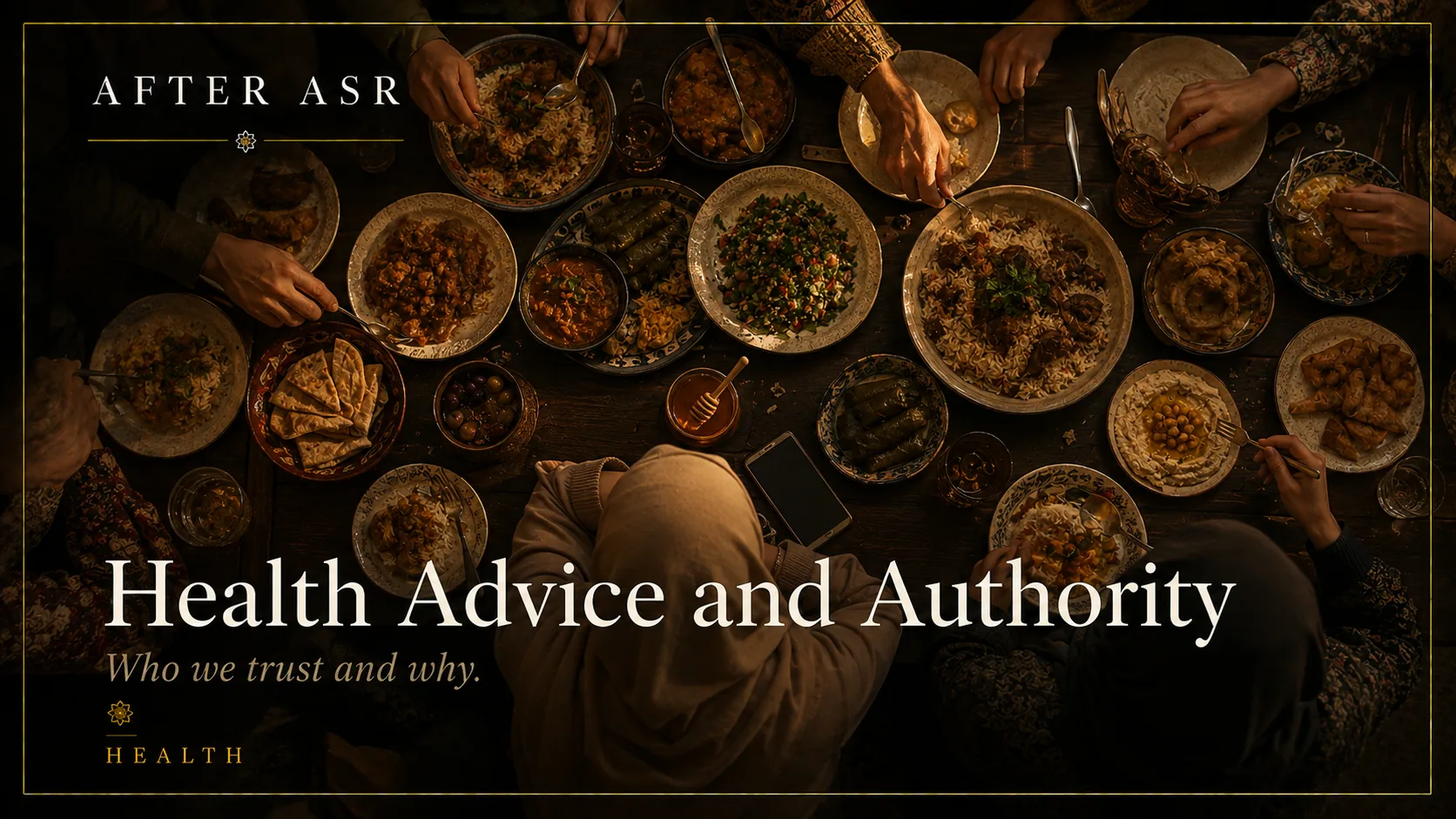
The child had a cough, and by the end of dinner she had received five cures. One aunt swore by honey and black seed. Another insisted it was the cold air and a scarf would fix it. An uncle recommended a supplement he had read about. The grandmother had a paste her own mother had used. And someone at the far end of the table had seen a video that explained the real cause of all coughs, which was something else entirely.
The mother nodded at each, thanked them all, and went home with a cough and a headache of her own.
We Are Drowning in Advice
There has never been more health advice available, and never less certainty about which of it to believe. It pours in from every direction, the family table, the phone, the pharmacy aisle, the endless voices online, each confident, many contradicting the others. We are not starved for information about our bodies. We are drowning in it, and drowning is its own kind of helplessness.
The abundance was supposed to empower us. Instead it often paralyzes. When ten sources say ten different things, all with equal confidence, the ordinary person has no way to sort the sound from the foolish, and so retreats into either blind trust of whoever spoke last or blanket suspicion of everyone. Neither serves the body well. The flood of advice has made the simple question, what should I do for this, harder to answer than it has ever been. We need not more information but better judgment about which to trust.
Everyone Is Suddenly an Expert
The tools that let anyone speak have made everyone an authority. The person with a camera and confidence can reach millions, dispensing health advice with no training behind it and no accountability for its results. Sincerity is mistaken for expertise, popularity for reliability, a good story for good evidence. The loudest voice on the body is frequently the least qualified to speak about it.
This is not to say only credentialed people may speak of health; much real wisdom lives outside the clinic. It is to say that the ability to broadcast is not the ability to know. The person telling you with total assurance what will cure your ailment may have nothing behind that assurance but a following to grow. We have collapsed the difference between having an audience and having knowledge, and our bodies pay for the confusion. Before we take advice about the body, it is worth asking quietly, what does this person actually know, and how do they know it.
Fear Makes Us Grasp
The body in distress is not a careful judge. When we are sick, frightened, in pain, or watching someone we love suffer, we grasp at whatever offers hope, and our usual caution deserts us. Fear makes us credulous. It sends us reaching for the confident promise, the miracle remedy, the voice that says it knows, precisely when we are least able to weigh whether the voice deserves belief.
This is human and forgivable, and it is also where we are most easily misled. Those who would sell us false cures know that fear opens the hand and the wallet both, and they aim their promises at exactly our most desperate moments. To know this about ourselves is a small protection. When you notice that you are frightened, notice too that you are more vulnerable to a confident lie. The moments we most want to believe are the moments to slow down and ask the hardest questions. Fear is a poor guide to the body. It grasps where it should weigh.
Confidence Is Not Competence
We are drawn to certainty. The advisor who speaks without hesitation, who promises results, who has no doubt, feels more trustworthy than the one who hedges and qualifies. But this instinct betrays us, because in matters of the body, confidence and competence often run in opposite directions. The truly knowledgeable are usually the most careful, aware of how much they do not know.
The body is complicated, and honest expertise reflects that complication with caution, with it depends and we are not certain and this may help. The charlatan offers no such uncertainty; certainty is what they are selling. So the very confidence that attracts us should give us pause. When someone promises a sure cure for a stubborn condition, their certainty is a warning, not a credential. The advisor worth trusting is often the one willing to say, I do not know. That humility is not weakness. It is the sound of someone telling the truth about a difficult thing.
The Wisdom in the Old Remedies
The grandmother’s remedies are not to be dismissed. Much traditional knowledge holds real wisdom, tested over generations, remedies that soothe and comfort and sometimes genuinely heal, refined by long experience in a way no study captures. The honey for the throat, the warm compress, the foods that settle a troubled stomach. There is knowledge in these hands, passed down and worth honoring.
Our tradition itself points us toward some of this. The Prophet, peace be upon him, spoke of the healing in honey, in black seed, in the practices of his time, and these have carried real benefit across centuries. To sneer at all folk wisdom as backward is its own kind of arrogance, the arrogance of a present that thinks it invented knowledge. The grandmothers knew things. Their remedies deserve respect, tried with an open mind, kept where they help. Not everything worth knowing about the body comes with a citation.
But Old Is Not Always Right
And yet age alone does not make a remedy true. Some traditional practices are harmless comfort, some genuinely heal, and some cause real damage, passed down faithfully for generations precisely because no one questioned them. The fact that our grandmothers did a thing is not proof the thing was good; they also lived when many died of what we now easily cure. Tradition preserves error as faithfully as it preserves wisdom.
So we honor the old remedies without surrendering our judgment to them. We keep what helps, discard what harms, and hold the humility to tell the difference through more than sentiment. This is not disrespect to our elders; it is the responsible use of what they gave us. The grandmother deserves our gratitude and our discernment both. To follow a harmful practice because it is old is not loyalty. It is a failure to think, dressed up as respect. We can love our inheritance and still weigh it.
The Doctor’s Knowledge and Its Limits
Trained medical knowledge is a genuine authority, hard-won and worth trusting. The doctor has studied the body in ways the influencer has not, has seen thousands of cases, works within a discipline that tests its claims and corrects its errors over time. To dismiss this expertise in favor of a stranger’s video is to throw away one of the real goods of our age. When the body is seriously troubled, trained knowledge is where wisdom usually lies.
But doctors are human, and medicine is not infallible. Individual physicians can be rushed, mistaken, or blind to what does not fit their training. The system around them has its own pressures and gaps. To trust medical expertise is right; to trust it as beyond all question is not. The wise patient neither rejects the doctor nor worships them, but engages, asks questions, seeks a second view when something seems wrong, and remains an active participant in the care of their own body. Respect the knowledge. Keep your own eyes open too.
When Distrust Becomes Its Own Danger
There is a distrust of medicine that has curdled into something dangerous. Stung by real failures and real arrogance in the medical world, some people have swung to rejecting it wholesale, refusing proven treatments, embracing any alternative precisely because it is alternative. This is not healthy skepticism. It is a mirror image of the credulity it thinks it has escaped.
The danger here is severe, because real illnesses go untreated while people pursue remedies that cannot help them. To distrust everything is not wiser than to trust everything; both are the abandonment of judgment, in opposite directions. The goal is not to reject authority but to weigh it, to distinguish the trustworthy from the false rather than throwing out all of it together. When suspicion becomes a reflex, it stops protecting us and starts endangering us. The body needs discernment, not blanket refusal. Rejecting the cure along with the quackery helps no one, least of all the one who is sick.
Follow Who Profits
One question cuts through much of the confusion. Who profits if you believe this? The advice that comes attached to a product for sale, the cure that only its promoter can provide, the fear that conveniently points toward a purchase. When the person giving health advice also happens to be selling the solution, their certainty has a motive, and the motive is worth naming.
This is not to say that anyone who sells anything is lying; people must earn a living. But the entanglement of advice and sales should sharpen our caution considerably. The doctor who recommends rest earns nothing from your rest. The influencer who recommends their supplement earns from every bottle. Follow the incentive, and much of what glitters loses its shine. The purest health advice is usually the advice that asks nothing of your wallet, that would be given the same whether or not you bought a thing. When the counsel and the cash register are the same voice, listen with a very careful ear.
The Wellness Industry Sells Certainty
An enormous industry has grown up promising what medicine honestly cannot, total wellness, perfect health, certainty about the uncertain body. It thrives precisely because real medicine is humble and cautious, leaving a hunger for confident answers that the industry rushes to fill. It sells the assurance that if you follow this plan, buy this product, trust this guru, you will finally be well and safe.
But the certainty it sells is false, and expensive, and never quite delivered. There is always a next product, a further protocol, a new deficiency to correct, because the promise can never actually be fulfilled. What it offers is not health but the feeling of control over a body that will always, in the end, exceed our control. To recognize this is to be freed from a great deal of anxious spending. The body cannot be made certain. Anyone who promises otherwise is selling comfort, not truth, and charging for it besides.
Let the Body Be the Test
Amid all the competing voices, there is one witness we too often ignore, and it is the most reliable of all. The body itself. When we try a remedy, a food, a change, the body reports back in the only language it has, in energy and ache, in sleep and digestion, in how we actually feel over the following days. This report is data no influencer can override.
We are strangely willing to trust a stranger’s confident claim over our own body’s plain response. The diet that everyone praises but that leaves us weak and miserable. The regimen we are told is optimal but that our body clearly rejects. Listen to the body over the marketing. It knows what agrees with it and what does not, and it will tell you honestly if you attend to it. No advice, however authoritative, outranks the steady testimony of the body that must live with the results. Let the body be the final test of what is said about it.
Humility Is the Mark of Good Advice
If there is a single sign of trustworthy health advice, it is humility. The advisor worth heeding acknowledges complexity, admits uncertainty, says this usually helps rather than this always cures, and does not promise more than the body can deliver. Humility is not the absence of knowledge. It is the presence of honest knowledge, which always knows its own limits.
The false authorities offer the opposite, and their very confidence should warn us. Real wisdom about the body speaks softly, hedges honestly, and leaves room for the mystery that remains no matter how much we learn. When you are weighing whom to trust, weigh their humility. The one who admits what they do not know is usually safer to follow than the one who claims to know everything. Certainty sells better, but humility heals better. Trust the voice that is honest about its own limits.
Weighing It at the Table
So return to that dinner table, and the mother with her five cures. She need not accept all of them, nor reject them out of hand. She can weigh. The honey is harmless and may soothe, so why not. The scarf will not hurt. The supplement she will look into before giving to a child. The internet video she will hold at arm’s length until she knows who made it and why. And the grandmother’s paste she will consider with love and a little caution both.
This is discernment, and it is a skill more than a set of rules. It holds respect and judgment together, takes advice seriously without swallowing it whole, and keeps the final decision where it belongs, with the one responsible for the body in question. The table will always offer more advice than we can use. Our task is not to refuse it or to obey it, but to weigh it, calmly, and to keep what helps. The cough will pass. The judgment we practice on it will serve us for life.
The Advice We Pass On
We are not only receivers of advice; we are givers too, and this carries a weight we rarely feel. Every time we press a remedy on a relative, forward a health claim we have not checked, tell a worried friend what they should do, we are taking a small share of responsibility for their body. The aunt at the table pressing her cure means only kindness, but her advice has consequences all the same.
Our tradition treats the passing on of knowledge as a serious thing, warns against speaking of what we do not know. This applies to the body as much as anywhere. Before we hand someone advice about their health, we might pause and ask whether we actually know it to be sound, or are merely repeating something confident we once heard. To give health advice is to touch another person’s amanah. It should be done with the same care we would want for our own, humbly, honestly, and never more certainly than we have earned. Kindness that misleads is not kindness. Careful counsel is.
Trust Is Not All or Nothing
The mistake underneath most of our confusion is treating trust as a switch, all the way on or all the way off. We either believe a source completely or dismiss it entirely, when wisdom lives in the space between. We can trust a doctor’s diagnosis and still question a particular recommendation. We can honor a tradition and still set aside one of its practices. We can learn from a source without surrendering to it.
This graduated trust is harder than the switch, because it requires us to keep thinking rather than to settle the matter once and hand our judgment away. But it is the only kind of trust suited to the body, which is too important for either blind faith or blanket refusal. Give your trust in measures, proportioned to the evidence and the humility and the incentive behind each voice. Keep some judgment always in your own hands. The body is yours to steward, and stewardship cannot be delegated whole to anyone.
Keep the Judgment Close
In the end, no one will care for your body with the attention you can. The advisors come and go, confident and contradicting, each with a piece of the truth or none of it. You are the one who lives in the body, who must weigh the counsel and bear the results.
So take the advice, all of it, gratefully and skeptically at once. Weigh it. Keep what helps and the humility to know you might be wrong.
Trust the qualified, honor the old wisdom, follow the incentives, and hold your own judgment close. The body was entrusted to you. So, in the end, was the deciding.