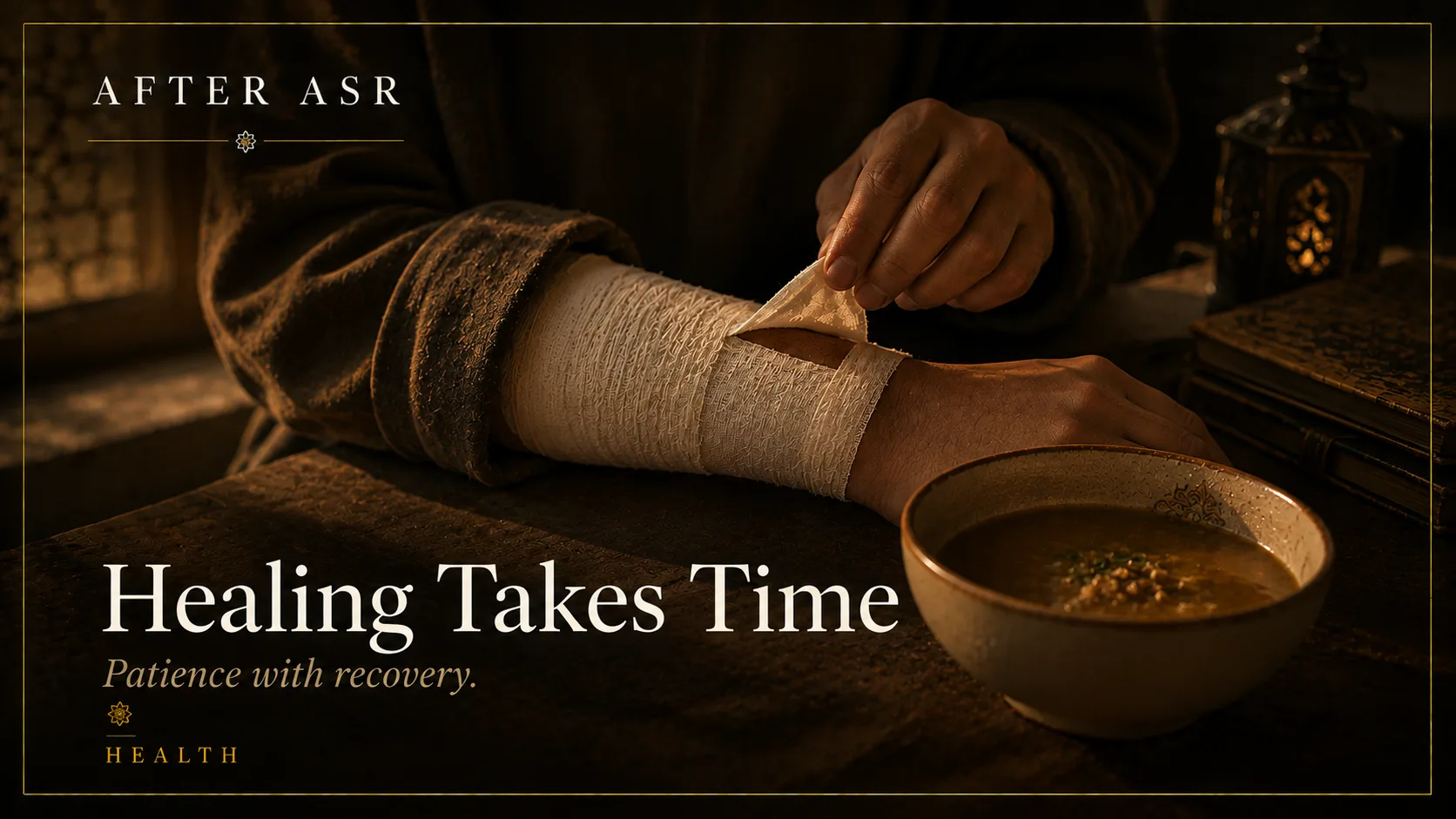
I keep lifting the bandage to look. The cut is still there, of course, a little less angry than yesterday but nowhere near gone, and every time I peel back the edge to check, I interrupt the very work I am impatient to see finished. The body is trying to close the wound. I keep opening it to ask why it is taking so long.
This is how most of us handle healing. We stand over it, willing it to hurry, unable to leave it alone long enough to work.
The Body Heals on Its Own Schedule
Healing runs on a clock we do not control. The wound closes at its own pace, the bone knits over its own weeks, the illness lifts when the body has done its unseen labor, and no amount of wanting speeds it. We can support the process, keep it clean and fed and rested, but we cannot command it. The timeline belongs to the body, not to us.
This is a hard thing for people accustomed to controlling their lives. We are used to making things happen on our schedule, and healing refuses the arrangement. It cannot be rushed, hurried, or willed to completion. It answers to a wisdom older than our impatience, the same wisdom that built the body in the first place. To heal is to be reminded, sometimes against our will, that we are not the masters of our own bodies. We are their keepers, waiting on a work we did not design and cannot command.
We Have Forgotten How to Convalesce
There used to be a word for the season of getting better. Convalescence, the in-between time, when one was no longer acutely ill but not yet well, and life made room for it. There were convalescent weeks, gentle days of broth and rest and slow returning strength, a whole understood stage of recovery that the world patiently allowed.
We have nearly lost this. Now we are sick, and then we are expected to be immediately well, with no season in between. The surgery on Friday and the desk on Monday. The illness endured while still working, the recovery squeezed into evenings and weekends. We have deleted convalescence from the schedule and wondered why we heal so poorly. The body still needs that in-between time; we have simply stopped granting it. To recover well, we must first give recovery back its room, the unhurried days it has always required.
Healing Is Not a Straight Line
We imagine recovery as a steady climb, a little better each day until we are well. The body rarely obliges. Healing moves in fits and starts, two steps forward and one back, good days followed by worse ones for no reason we can name. The line we expect to rise smoothly instead zigzags, and every dip frightens us into thinking we are getting worse.
But the dips are part of the pattern, not a departure from it. A bad day in the middle of recovery does not erase the progress made; it is simply the uneven way that bodies mend. If we expect a straight line, every setback feels like failure, and we lose heart precisely when heart is most needed. If we expect the zigzag, we can weather the low days without despair, trusting the overall direction even when a single day points down. Healing is not betrayal when it stumbles. Stumbling is how it walks.
The Plateau That Frightens Us
There often comes a stretch in recovery where nothing seems to change. The rapid early gains have slowed, the wound looks the same for days, the strength returns so gradually as to seem stalled. This plateau is where many lose faith, concluding that they have healed as much as they will, that this diminished state is now permanent.
Usually it is not. The plateau is frequently the body doing its deepest and slowest work, the kind that shows little on the surface while much happens beneath it. The visible healing came first and fast; the invisible healing, the real consolidation, takes longer and announces itself less. To mistake this quiet phase for the end is to give up in the middle. The plateau asks for the hardest patience of all, the patience to keep faith when no progress is visible. But the body is often working hardest exactly when it appears to be doing nothing.
Rushing Recovery Costs More Than Waiting
Impatience with healing is expensive. The wound reopened by too much too soon takes longer to close the second time. The injury returned to before it was ready becomes a chronic complaint. The illness pushed through instead of rested off lingers for months. In our hurry to be done with recovery, we frequently lengthen it, paying in weeks for the days we tried to save.
The body keeps a strict account here. What we deny it in rest now, it collects later, with interest. The person who takes the full recovery time, unhurried and complete, is usually back to full strength sooner than the one who rushed and relapsed. There is a false economy in pushing through, a haste that costs more than the patience it refuses. Slow healing done once is faster, in the end, than fast healing done three times. The body’s timeline is not an obstacle to efficiency. It is efficiency, correctly understood.
The Pressure to Be Back to Normal
Much of our impatience is not our own. It comes from outside, from a world that wants us back to normal quickly, that has little room for the slowly recovering. The employer expecting return, the family needing us functional, the friends whose sympathy has a shorter shelf life than our healing. We feel we must perform wellness before we have achieved it, to relieve everyone else of the burden of our recovery.
This pressure does real harm. It pushes people to declare themselves well before they are, to hide their ongoing struggle, to return to full load on a body still mending. We must resist it, both in ourselves and on behalf of others. When someone is recovering, the kindest thing we can do is lower our expectations and hold them there, refusing to rush the person back to usefulness before their body is ready. Give the recovering the gift of a slow return. Do not make them perform a wellness they have not yet reached.
Patience Is Not Passive
We treat patience as doing nothing, mere passive waiting for time to pass. But the patience that healing requires is an active thing, a discipline, a daily choosing to trust the process when everything in us wants to force it. It takes real strength to leave the wound alone, to rest when we would rather push, to wait without despairing. Sabr, in our tradition, was never idleness.
The patient person in recovery is working hard, though the work is invisible. They are restraining the impulse to rush, tending the body faithfully without demanding results, holding faith through the plateau and the setback. This is labor of the highest kind, the labor of not-doing when doing would harm. Our tradition ties patience to some of the greatest rewards precisely because it is so difficult, because it asks us to endure what we cannot control with grace rather than rage. To wait well is not to do nothing. It is to do the hardest thing there is.
The Wound Closes From the Bottom
A deep wound heals from the bottom up. The tissue rebuilds from underneath, slowly filling in, and only at the very end does the surface close over. If it closed on top first, while the depths were still raw, it would trap the injury inside and fester. The visible healing is meant to come last, after the hidden healing is done.
There is a whole wisdom in this for every kind of recovery. What heals on the surface first, before the depths have mended, heals falsely. The grief papered over too soon, the trauma buried before it was worked through, the illness suppressed rather than resolved. Real healing goes deep first and shows itself last. When we rush to close the surface, to look better before we are better, we do the body’s process backward. Trust the order the body keeps. It mends from the bottom for a reason, and the reason is that the depths must be sound before the surface can safely close.
Setbacks Are Part of It
The setback feels like a verdict. You were getting better, and then a bad day, a flare, a return of the pain you thought you had left behind, and the whole recovery seems undone. In that moment it is easy to despair, to conclude that all the progress was illusion and you are back where you started.
But a setback is not a return to the beginning. It is a dip in a road that still, overall, climbs. The strength you built is not erased by one bad day; the healing you have done is not undone by one flare. Recovery includes setbacks the way a long journey includes wrong turns and delays, none of which mean you will not arrive. What matters is not that the setback happened, but that you do not let it convince you to stop. Absorb it, rest through it, and continue. The road goes on past the dip, and so do you.
The Table During Recovery
Watch how the old wisdom feeds the recovering. The broth, the simple soup, the soft and easy food set before the one whose body is busy mending. There is knowledge in this, gathered over centuries. The recovering body wants gentle fuel, warmth, nourishment that asks little to digest and gives much in return. The kitchen has always known how to tend the healing.
And there is more than nutrition at that table. The soup carried to the sick is patience made edible, a way of saying, take your time, we will feed you until you are strong. To cook for the recovering is to participate in their healing, to give the body the raw materials it needs and the reassurance that it need not hurry. The table, during recovery, becomes a place of slow restoration, meal by gentle meal. We heal not only in the clinic but in the kitchen, fed by hands that understand the body needs time.
The Unseen Wounds Heal Slowest
If the body’s wounds test our patience, the unseen ones test it far more. Grief, heartbreak, the aftermath of hard experience, these heal on a timeline that makes the mending of flesh look swift. There is no cast, no visible scar to mark the progress, no doctor to declare it finished. The healing happens in the dark, slowly, over seasons and sometimes years.
We are even more impatient with these wounds, because we cannot see them and neither can anyone else. We expect ourselves to be over it long before we are, and feel ashamed that the hurt still lingers. But the heart heals like the deep wound, from the bottom up, in its own long time. To rush it, to demand of ourselves a recovery we have not reached, only drives the wound deeper. The unseen healing deserves the most patience of all, precisely because no one, including us, can see how much work is being done.
Someone Else’s Timeline Is Not Yours
We wound our own recovery by comparison. We hear of another who healed faster, returned sooner, bounced back from the same injury in half the time, and we feel we are failing at our own recovery. We measure our mending against theirs and find ourselves slow, and the measuring itself becomes a fresh source of distress.
But no two bodies heal alike. The same injury mends differently in different people, on timelines set by age and constitution and a hundred factors we cannot see. Another’s fast recovery is no rebuke to your slower one; it is simply their body, not yours. To compare is to add a needless suffering to the one you already carry. Your healing takes exactly as long as your body needs, and that is neither too long nor a failure. It is your own timeline, and it is the only one you are answerable to.
The Scar That Stays
We imagine healing as a return to exactly how we were, the body restored without a trace of what it endured. But healing rarely erases; more often it leaves a mark. The scar where the cut was. The joint that aches before rain. The body subtly reshaped by what it came through, carrying forever some small record of the injury.
To heal is not always to become as if nothing happened. Sometimes it is to become whole again in a changed body, one that bears its history. This is worth accepting rather than resenting. The scar is not a failure of healing; it is healing’s signature, the sign that the body did its work and closed the wound. We can make peace with the marks our recoveries leave, seeing them not as damage but as evidence of survival. The body that carries a scar is a body that mended. That is not less than whole. It is whole, with a story.
The Body Knows How to Mend
Beneath all our impatience lies a distrust of the body, a suspicion that it will not heal unless we manage it. But the body is remarkably good at mending; it has been doing so since long before we understood the first thing about it. Left supported and unhurried, it closes wounds, fights infection, rebuilds strength, and restores itself through processes we did not invent and do not direct.
To heal well is largely to get out of the body’s way, to give it what it needs and then to trust it to do what it knows. This is not neglect; we still tend, still follow good counsel, still do our part. But we do it in cooperation with a body that already knows how to heal, rather than in anxious opposition to it. The wisdom that knits the bone is not ours. It was placed in us, a mercy woven into the flesh. Our task is to trust it, and to wait.
Time Is the Medicine We Distrust
Of all the medicines, time is the one we believe in least. We want the pill, the procedure, the intervention that acts now, and we are impatient with the oldest remedy of all, which is simply the passage of enough days. Yet time does more healing than we credit it for. A great many troubles resolve on their own, given only patience, if we can bear to grant it.
This is not to dismiss real treatment, which time cannot replace. It is to restore time to its place among the healers, to remember that waiting is often not the absence of a cure but the cure itself. The body mends in time, and time is not wasted while it does. To trust time is a kind of faith, a willingness to believe that the days are working even when we cannot see them work. They usually are. Time is the medicine we distrust, and it is often the one that heals us.
Leave the Bandage On
So I am trying, now, to stop lifting the bandage. To leave the wound to its work. To let the days do what the days are for.
It will heal when it heals. My checking does not hasten it; it only interrupts. The body knows the way, and it does not need my supervision, only my patience.
You are healing, even now, even when you cannot feel it. Give it time. That is not doing nothing. That is doing the one thing healing has always asked.