
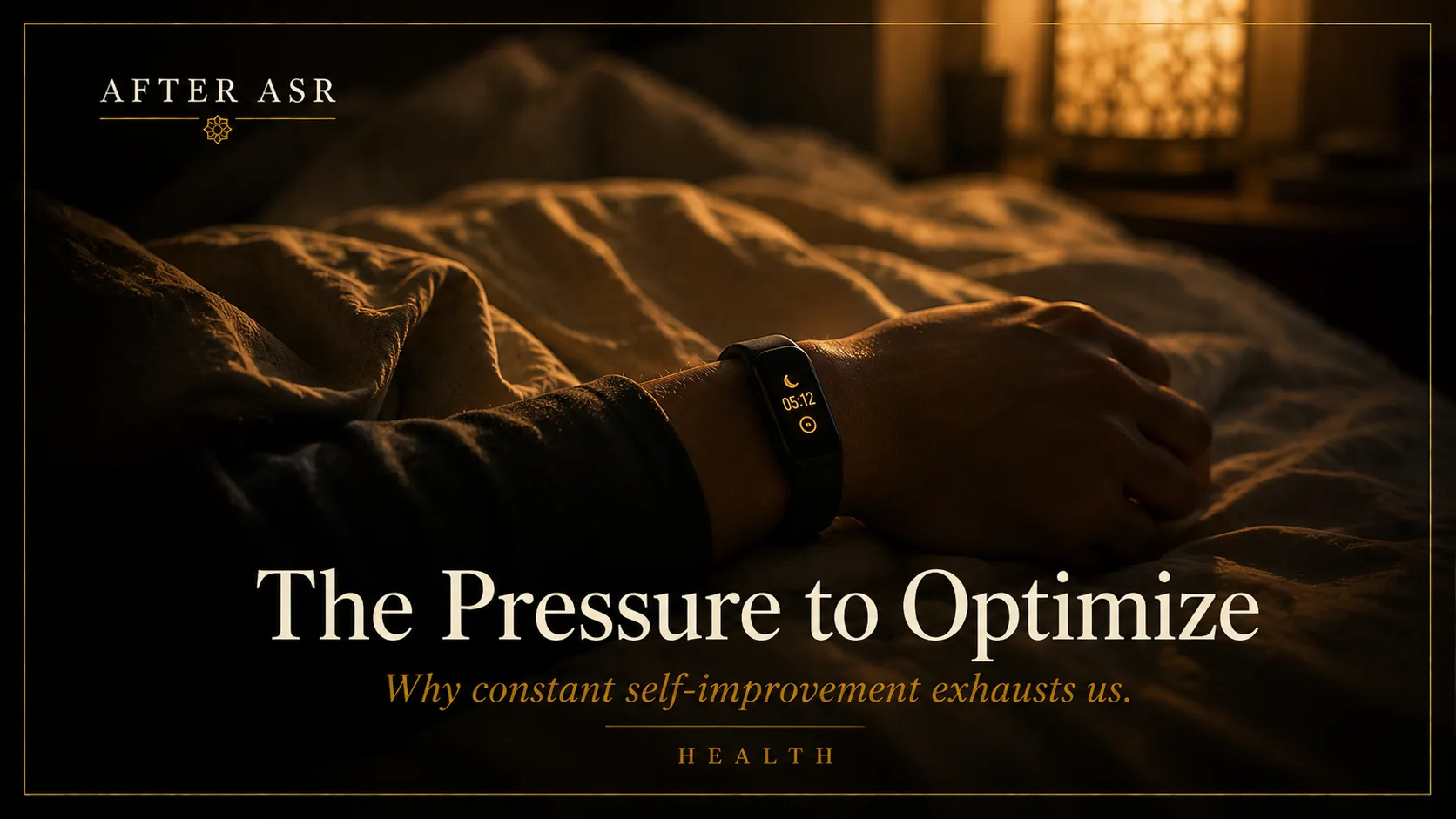
Before her feet touch the floor, she checks her wrist. The number is there waiting, a score for the sleep she just had, and it is lower than she wanted. She has not yet stood up, not yet prayed, not yet tasted the morning, and already the day has been graded and found wanting. She lies there a moment longer, feeling behind, in a race she never agreed to enter.
This is a strange way to begin a day. It has become, for many of us, the only way we know.
The Self as a Project
Somewhere along the way, we began to treat ourselves as projects. Not as souls to be tended or creatures to be kept, but as projects to be managed, improved, optimized, forever under construction. The self became a thing with metrics, a performance to be measured against its own potential, a startup of one that must show growth quarter after quarter or be judged a failure.
It is an exhausting way to hold a life. A project is never finished; there is always another version, another upgrade, another gap between what you are and what you could be. To live as a project is to live permanently dissatisfied, because dissatisfaction is the engine that drives improvement, and the improvement never ends. We were not made to be projects. We were made to be servants, and there is rest in the difference.
The Body Turned Into a Machine
Nowhere is this clearer than in how we now treat the body. We speak of it in the language of machinery, of inputs and outputs, fuel and performance, recovery and efficiency. We track its sleep, its steps, its heart, its every function, and we read the numbers the way a manager reads a report, looking for what to fix.
But the body is not a machine, and it suffers under the pretense that it is. A machine has no feelings about being optimized. A body does. It grows anxious under constant measurement, tense under the endless demand to perform better, weary of being treated as a mechanism rather than a self. The strange result of all this optimizing is a body more stressed, not less, because it is never simply allowed to be a body. It is always on the clock, always being assessed, never off duty.
Optimization Never Arrives
Here is the cruelty at the center of it. Optimization has no destination. There is no score at which the wrist finally says, enough, you may rest now. Every target reached reveals a further one. Sleep better, and there is deeper sleep to chase. Eat cleaner, and there is a cleaner still. The finish line is painted onto the horizon, and the horizon, by its nature, recedes as you approach.
This is why the pursuit exhausts even those who succeed at it. They arrive at the goal only to find it has moved, and the small satisfaction of reaching it evaporates before it can be enjoyed. A life spent optimizing is a life spent almost-there, forever climbing toward a summit that keeps rising. The body was not built for a climb without a top. Somewhere in it, it knows there is no arriving, and it grows tired in a way that no amount of improvement can touch.
The Moving Goalpost
What counts as well keeps changing, and rarely in our favor. A generation ago, to be healthy was to be free of illness. Now it is to be optimal, and optimal is a standard that no one can hold for long and that grows more demanding each year. The definition of enough keeps sliding just past where we stand.
Much of this movement is not accidental. There is money in dissatisfaction, in the supplement that promises the next gain, the device that measures the thing you did not know to worry about, the program that reveals a new deficiency to correct. An entire economy depends on our never feeling finished. It profits precisely from the gap between us and the ideal, and so it works, quietly and constantly, to keep that gap open. To recognize this is not cynicism. It is the beginning of freedom from a game that was designed so that we could not win.
Comparison Feeds the Fire
The pressure would be bearable if we felt it alone. But we carry in our pockets a window onto everyone else’s optimized life, the morning routines and the flawless plates and the bodies shaped by hours we do not see. We compare our unedited insides to their edited outsides, and we always come up short, because the comparison was rigged from the start.
This is the fuel that keeps the fire hot. Left to itself, a body is not dissatisfied; it does not know it is falling behind. It learns dissatisfaction by looking sideways, endlessly, at images built to make us feel unfinished. The one who looks less often at the highlight reels of strangers is not less healthy. They are frequently more at peace, because they have stopped measuring their ordinary life against a montage. Some of the deepest care you can offer your body is to stop comparing it to bodies you will never actually meet.
When Rest Becomes a Protocol
Even rest has been captured. We no longer simply rest; we optimize our recovery. Sleep becomes a performance to be scored, a discipline with rules and metrics and a failing grade. The nap is justified as productivity by other means. Stillness is permitted only as a strategy for greater output. We have found a way to make even our rest into work.
But rest that must be earned and measured is not rest. It is another task. The whole mercy of rest is that it asks nothing, produces nothing, justifies itself by nothing. To turn it into a protocol is to strip it of the very quality that heals. The body lying down to sleep should be released from the day, not handed one more test to pass in the dark. When we optimize our rest, we lose the thing rest was for. We lie down still on the clock.
Even Worship Gets Optimized
The pressure reaches even into our devotion. We track our prayers and our recitation, gamify our worship, measure our spiritual life the way we measure our steps, and feel the same familiar failure when the numbers fall short. The heart’s quiet turning toward God becomes another metric on another dashboard, another arena in which we are behind.
Something is deeply wrong when worship, of all things, becomes a source of the very anxiety it was meant to dissolve. The prayer was given as a rest, a return, a coming home five times a day to the One who asks only that we come. To optimize it, to compete with ourselves at it, is to miss its entire mercy. Devotion measured like productivity stops being devotion. It becomes one more place we are failing to be optimal, and there is no rest for the soul in that.
The Table Under Surveillance
Watch what optimization does to a meal. The food is weighed, its parts counted and logged, each bite entered into an app that will pass judgment at the end of the day. The plate is no longer a pleasure or a gift. It is data, an input to be managed, a source of numbers that will be measured against a target. The table has been placed under surveillance.
A meal eaten this way cannot nourish the whole person, however precisely it nourishes the body. Gone is the gratitude, the presence, the simple animal joy of being fed. In its place is calculation, and often quiet guilt, the sense of having eaten wrong. This is not health. Health does not stand over your plate with a clipboard. The most optimized eater at the table is frequently the least at peace with food, and peace with food is worth more than any perfect ratio.
Dissatisfaction Dressed as Ambition
We are told this striving is a virtue. We call it ambition, discipline, taking ownership of our health, and we admire those who seem to embody it. But much of what we praise as self-improvement is simply dissatisfaction wearing better clothes. It is the inability to be content with a good-enough body, a good-enough life, dressed up as commitment to excellence.
There is a real difference between caring for yourself and being unable to accept yourself. The first is gratitude in action; the second is a low, constant refusal of the gift you have been given. Optimization culture blurs the two, so that self-rejection can pass for self-care, and chronic dissatisfaction can be worn as a badge of seriousness. But a heart that cannot rest in what it has been given is not ambitious. It is unwell, in the way that matters most, and no achievement will cure it.
What the Grandmothers Knew
I think often of the grandmothers, who kept themselves and their households well without a single metric. They rose, they prayed, they cooked, they walked to the market, they rested when the body asked and worked when it could. They ate what was in season and enough of it. They did not track their sleep or count their steps, and many of them lived long, sturdy, contented lives inside bodies they never once thought to optimize.
They knew something we are unlearning. They knew that the care of the body is mostly a matter of steady, humble rhythms, kept without fuss, repeated across the ordinary days. There was wisdom in the pot of soup for the sick, the early night, the walk taken for its own sake, the meal shared without measurement. It was not primitive. It was whole. We have gained a thousand instruments and lost the ease those grandmothers held, and it is worth asking what, in all our optimizing, we have actually improved.
The Body Is a Trust, Not a Product
The body was given to us as an amanah, a trust, something lent to be cared for and returned. A trust is tended, not perfected. You keep it in good and honest condition, you do not run it ragged, you do not neglect it, and you also do not torment it in pursuit of an ideal it was never required to meet. Faithfulness to a trust is a modest and steady thing.
Optimization asks something different. It treats the body as a product to be maximized, its worth measured by its output and appearance, always fallible, always improvable. This is a heavier burden than any trust imposes. To hold the body as an amanah is to be released from the tyranny of the ideal. You owe it care. You do not owe it perfection. The One who lent it did not ask for a flawless return. He asked only that you keep it well and be grateful.
We Are Creatures, Not Machines
At the root of all this striving is a forgotten truth. We are creatures, made and dependent, finite by design. A machine can, in principle, be tuned toward perfection. A creature cannot, because a creature is meant to have limits, to age, to tire, to be imperfect in the particular ways that make it human. Our limits are not defects in the design. They are the design.
To accept that we are creatures is to be freed from a war we were never meant to fight. The body will decline no matter how we optimize it; the years will come; the perfect state, if we reached it, would not hold. This is not a tragedy to be defeated by better technique. It is the honest shape of a human life, and there is peace in accepting it. The machine strives to escape its limits. The creature learns to live gratefully within them.
The Exhaustion of Never Enough
Notice the tiredness underneath it all. Not the clean tiredness of good work done, but a deeper fatigue, the exhaustion of a person who can never rest because they are never enough. It shows in the body, in the tight shoulders and the shallow sleep, in the meal that brings no peace and the morning that begins already behind.
This exhaustion does not come from doing too little. It comes from a standard that cannot be met, held over every hour of the day. The person chasing optimal is running from a shadow, and the running wears them down in body and soul. No supplement addresses this fatigue, because it is not a deficiency of the body. It is a wound in the way we hold ourselves. The cure is not to strive better. It is to stop demanding of yourself what no creature was ever meant to give.
What Optimization Cannot Give
For all it promises, there is one thing optimization can never deliver, and it is the one thing we are truly after. It cannot give contentment. It is built on the opposite, on the endless conviction that you are not yet enough, and so it can no more produce peace than a fire can produce cold. The more perfectly you optimize, the further contentment retreats, because contentment does not live at the end of the climb. It lives in the willingness to stop climbing.
This is why the most optimized among us are so often the least at rest. They have organized their whole lives around a pursuit that structurally excludes satisfaction. The peace they are chasing cannot be reached by chasing; it can only be received, as a gift, in the moment they consent to be enough. All the tracking in the world cannot buy that consent. It is free, and it is available now, and optimization is precisely what stands in its way.
Enough Is a Spiritual Achievement
To arrive at enough is not a failure of ambition. It is one of the quiet triumphs of a life. To look at your good-enough body, your good-enough health, your ordinary and imperfect days, and to feel gratitude rather than lack, is a spiritual achievement that no optimizer ever reaches. It is the state our tradition calls contentment, and it was named a treasure for a reason.
Enough does not mean giving up on care. You still eat well, move, rest, keep the trust. But you do these things from a place of sufficiency rather than deficiency, out of gratitude rather than fear, and everything changes in that shift. The same walk taken as gratitude is a different walk than the one taken to hit a number. Enough is not the absence of effort. It is effort set free from the tyranny of never quite being enough.
Permission to Stop Improving
So here is a permission you may not have given yourself. You are allowed to stop improving. You are allowed to be, for whole hours and whole days, simply a person living in a body, not a project under management. You are allowed to eat a meal you do not log, sleep a night you do not score, live a day you do not optimize.
Nothing will collapse. You will not fall apart the moment you stop striving. What will happen, more likely, is that some old tightness will loosen, some held breath will finally release, and you will remember what it felt like to inhabit your life rather than to manage it. The wrist can keep its number. You have a morning to be present for, and it does not need to be graded to be good.
Set Down the Ledger
Tomorrow, when you wake, try not looking at the number first. Let your feet find the floor before anything is measured. Let the day begin ungraded.
Say thanks for the sleep you had, whatever its score. Taste the morning. Pray without counting.
You are not a project to be finished. You are a trust to be kept, well enough, with gratitude. That is the whole of it, and it is more than enough.