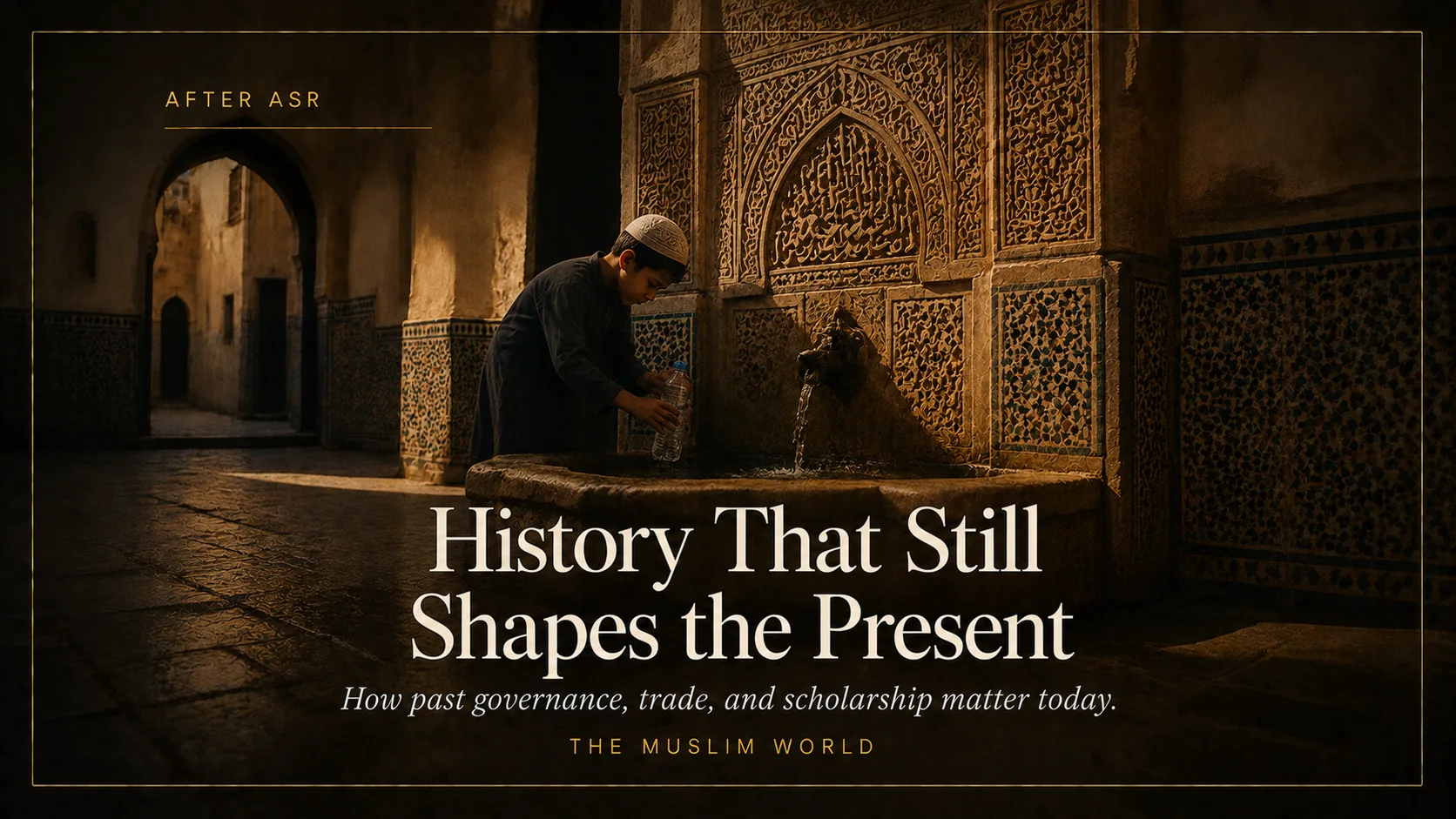
In a courtyard in Fez, a fountain still runs.
It was paid for eight hundred years ago by a woman whose name is half remembered, as a gift to travelers and the thirsty. She endowed it, and the endowment still holds. Her water still comes.
A boy fills a bottle and runs off to school. He drinks history and does not taste it.
The Past Is Not Behind You, It Is Under Your Feet
We are taught to picture history as a road behind us, receding. In much of the Muslim world it is better pictured as the ground itself.
It is in the street plan of the old city, laid out before Columbus sailed. It is in the numbers a shopkeeper writes, in the word for the coffee on the table, in the law that governs a marriage. The past here is not a museum you visit. It is the floor you stand on.
Zoom out from that fountain in Fez and you see a whole civilization built on gifts that outlived their givers. Then narrow back to the boy with the bottle. He is late for algebra, a subject named in the language of the man who invented it, in a city his ancestors made. He carries more history in his backpack than he will learn in class.
Baghdad Once Invented the Modern Book
In the ninth century, Baghdad was the largest city on earth and the busiest mind. Its caliphs funded a translation movement of astonishing ambition.
Scholars in the House of Wisdom translated Greek, Persian, and Indian works into Arabic, then argued with them and improved them. Paper, a technology carried west from China, made books cheap enough to multiply. For the first time a scholar could own a library rather than memorize one.
Widen the lens and this was a hinge of world history, the moment much of ancient knowledge was saved and extended. Narrow it back and it was daily work: copyists bent over desks, ink on fingers, a bookseller’s market that ran for streets. A single Baghdad street held more books than some kingdoms owned. The reader today who trusts a footnote is standing in a habit those copyists built, without ever hearing one of their names.
The Numbers on Your Phone Came This Way
Look at the digits on any screen. They traveled a long road, and part of it ran through the Muslim world.
A scholar named al-Khwarizmi, working in Baghdad, wrote the book that gave us the word algebra. His own name, worn down through Latin, became the word algorithm. The numeral system he helped spread, taken from India and carried west, is the one the whole planet now counts with.
Zoom in on a market stall in Cairo where a vendor tallies a bill in his head. Zoom out to every trading floor and phone on earth doing the same arithmetic. The line between them is not a metaphor. It is a real inheritance, passed hand to hand across a thousand years, until it became so ordinary we forgot it had a birthplace.
The Endowment Built the City
Return to that fountain, because it explains how these cities were made. The engine was the waqf, the charitable endowment.
A wealthy person would tie a piece of property, a shop, a farm, a caravanserai, to a permanent charitable purpose. The rent would forever fund a mosque, a school, a hospital, a public fountain, a soup kitchen. No modern government built these old cities. Private piety did, one endowment at a time.
Widen the lens and you see an entire civilization of public goods financed without a treasury. Then narrow to one hospital in old Damascus, where the poor were treated free and musicians were paid to soothe the sleepless. That the sick had a right to care was not invented in the modern West. It was written into deeds signed by the dead.
Cordoba Remembers What Europe Forgot
For a stretch of centuries, the brightest city in Western Europe was a Muslim one. Cordoba had paved streets, running water, and libraries when Paris was mud.
Its scholars, Muslim, Jewish, and Christian in uneasy proximity, translated and transmitted. Through Cordoba and Toledo, the learning of the ancient world and the advances of the Muslim east crossed into Latin Europe. The Renaissance had many parents. One of them lived in Andalusia.
Stand in the great mosque of Cordoba, now a cathedral, and you can read the whole story in the stone: the arches of one faith, the altar of another, layered on the same ground. The building did not choose sides in history. It simply kept what each age left behind. Widen the lens and this is how civilizations actually work, borrowing and burying and building over. No one owns knowledge. Everyone inherits it, and everyone passes it on changed.
The Trade Route Made the Faith
We imagine religions spread by armies. Islam spread at least as much by merchants.
Along the monsoon roads of the Indian Ocean, traders carried the faith to the Swahili coast, to the ports of India, to the islands of the Malay world. It arrived not on a horse but in a ledger, in the honesty of a merchant, in the marriage of a trader to a local family. This is why the largest Muslim populations sit far from Arabia.
Zoom in on one dhow riding the wind toward Zanzibar, its hold full of cloth and dates. Zoom out to the whole ocean, a web of ports linked by faith and profit long before Europe drew its trade maps. The believer in Jakarta today prays because a businessman, not a general, once found his ancestor worth talking to.
Timbuktu Was a University Town
Say the name Timbuktu and many hear a word for nowhere. For centuries it was somewhere, and somewhere important.
On the southern edge of the Sahara, it grew rich on gold and salt and richer on books. Its scholars taught at Sankore and filled private libraries with tens of thousands of manuscripts on law, poetry, astronomy, and medicine. Students came from across the region to study under named masters.
Widen the lens and Africa was never the blank the textbooks drew. It held cities of learning while parts of Europe could not sign their names. Narrow back to one family in Timbuktu today, still guarding a chest of inherited manuscripts through war and weather. They are not keeping antiques. They are keeping a rebuttal.
Knowledge Passed Through a Chain of Teachers
In the Muslim tradition, learning was never only in the book. It ran through people, in an unbroken chain.
A student did not simply read a text. He read it with a teacher who had read it with a teacher, back and back, and received a license, an ijaza, certifying the chain. Knowledge had a lineage you could name, teacher by teacher, like a family tree. The isnad, the chain of transmission, guarded the faith itself.
Zoom in on one circle in a mosque courtyard, boys reciting, a shaykh correcting a single vowel. Zoom out and that circle connects, link by human link, to circles a thousand years back. The graduate today who values a credential is honoring an old instinct: that trust in knowledge must be traceable to a face.
Law Older Than the Nation-State
The borders on the modern map are mostly a century or two old. The law inside many Muslim homes is far older.
The great schools of jurisprudence, worked out over centuries of debate, still shape how marriage, inheritance, and charity are handled across the region. A judge in one country and a grandmother in another may reach the same ruling because both draw from the same deep well. The nation is young. The law it borrows is not.
Widen the lens and you see legal traditions that crossed empires and outlived them. Narrow back to one family dividing a father’s land among his children, counting shares by a formula set down in the early centuries of Islam. The state stamps the paper. The tradition wrote the sum.
The Ottoman Shadow Still Falls on the Map
An empire can end and still run your morning. The Ottomans governed a vast stretch of the Muslim world for six hundred years, and their shadow has not lifted.
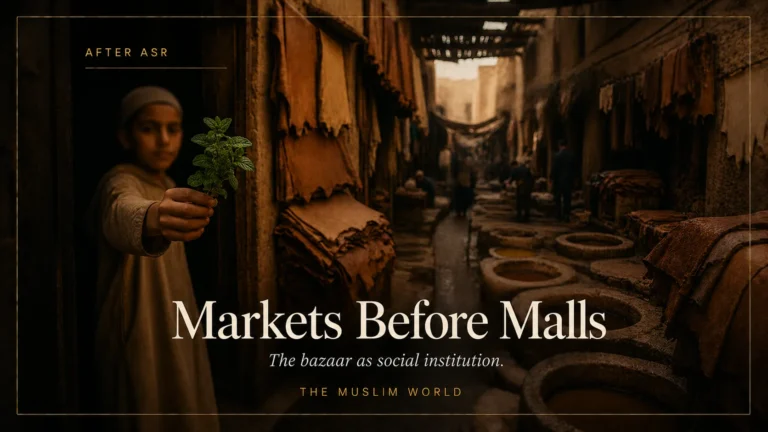
Their administrative habits, their organization of religious communities, their very land records still underlie modern states from the Balkans to the Levant. The coffeehouse culture, the guild traditions, the shape of the bazaar: much of it is Ottoman inheritance worn smooth by use.
Zoom in on one deed dispute in a Jerusalem court, lawyers citing a registry an Ottoman clerk once kept. Zoom out and half a dozen modern nations are quietly arguing inside the ruins of one old order. When the empire fell, it did not vanish. It dissolved into the paperwork.
Coffee Was a Muslim Revolution
Consider the cup. The drink that runs the modern world was, at its start, a devotional aid.
Coffee came from the highlands of Yemen, where Sufi worshipers used it to stay awake through the long night prayers. From there it spread to Mecca, Cairo, and Istanbul, and with it came a new institution: the coffeehouse, where men gathered to talk, argue, and read. Rulers feared these rooms, and sometimes banned them, because ideas brewed there too.
Widen the lens and the European cafe, that cradle of revolutions and newspapers, is a borrowed room. Narrow back to one Sufi in a Yemeni highland, five hundred years ago, sipping something bitter to keep his eyes open for God. He was not trying to change the world. He changed it anyway.
The Physicians Who Kept the Ancients
For centuries, the standard medical textbook in Europe was written by a Muslim in Central Asia. His name was Ibn Sina, and Europe called him Avicenna.
His Canon of Medicine, and the works of physicians like al-Razi, gathered Greek learning, tested it, corrected it, and pushed it forward. In the hospitals of the Muslim world, medicine was taught at the bedside, and the mad were treated as ill rather than cursed. This knowledge crossed into Europe and shaped its universities for five hundred years.
Zoom in on one lecture in a Baghdad hospital, a teacher reasoning aloud over a patient. Zoom out to every medical school on earth that inherited the method. The idea that the body can be studied, and healing taught, owes a debt few of its beneficiaries could name.
The Hajj Was an Early Internet
Once a year, for fourteen centuries, the Muslim world has gathered in one valley. The Hajj was never only a rite. It was also a network.
Pilgrims arrived from West Africa, India, Central Asia, and Andalusia, and for a season Mecca became a switchboard of the whole civilization. Scholars met and exchanged texts. Merchants traded goods and news. A ruling issued in one land traveled home in the memory of a pilgrim from another. Ideas moved along the pilgrim roads the way data moves now.
Zoom in on one traveler from Mali returning home with a book bought in the Hijaz. Zoom out and the annual pilgrimage is knitting a scattered world into a single conversation, once a year, without a wire. The believer who saves for the Hajj today joins a traffic of minds far older than any modern web.
Astronomy Still Sets the Hour of Prayer
Open a prayer-time app and you are consulting a science the Muslim world spent centuries perfecting. The faith made astronomers of its scholars.
To pray, one must know the times of dawn and dusk. To face Mecca, one must solve for direction across a curved earth. These needs drove real mathematics: better trigonometry, refined star tables, the astrolabe polished into a fine instrument. The great mosques employed timekeepers whose whole vocation was the sky.
Zoom in on one astronomer in a Samarkand observatory, measuring a single star to correct a table. Zoom out to a billion phones today computing the same angles automatically before dawn. The worshiper who trusts the app to tell her when to pray is leaning, without knowing it, on the patient labor of the men who first read the hour in the heavens.
The Water Engineers of the Dry Lands
Much of the Muslim world is dry, and dryness forces genius. The old engineers moved water where rain would not go.
Across Iran and beyond they dug qanats, gently sloping tunnels that carried mountain groundwater for miles underground to the fields. In Oman the falaj channels have watered date palms for a thousand years and still do. This was hydrology of a high order, worked out without a single modern instrument, and much of it still functions today.
Zoom in on one farmer in an Omani village opening a sluice at his appointed hour, his turn on the water fixed by a schedule centuries old. Zoom out and a whole civilization learned to live inside the discipline of scarcity. The green of these oases is not luck. It is inherited engineering, still keeping its promise.
History as Inheritance, Not Trophy
There is a danger in all of this, and honesty requires naming it. The glorious past can become a place to hide.
Some retreat into the golden age as a comfort, reciting old triumphs to avoid present failures. That is not history honored. It is history embalmed. The same centuries also held slavery, tyranny, and cruelty, and the ledger must be read whole. A living inheritance is not a trophy on a shelf. It is a task handed down.
Widen the lens and every civilization tells itself flattering stories. Narrow back to the boy at the fountain in Fez. His inheritance is not a reason to boast. It is a reason to build the next fountain, and to sign the deed for someone he will never meet.
What the Ordinary Believer Carries
All of this deep history arrives, in the end, in ordinary hands. That is where it matters, or it does not matter at all.
It is in the grandmother’s recipe that follows a route no one mapped. It is in the loan word for the fruit at the market. It is in the way a family divides a legacy, the arch over a doorway, the name of the neighborhood. The past is not carried by the scholar alone. It is carried by everyone, mostly without knowing.
This is the correspondent’s real subject. Not the empire, but the endowment that still pours water. Not the caliph, but the boy who drinks from it on his way to a class he would rather skip.
The Fountain Does Not Know
The woman who built the fountain has been dead for centuries.
Her water does not know that. It arrives on time.
The boy grows up. He forgets the courtyard, then remembers it, then endows something of his own.
This is how a civilization survives. Not in the monument, but in the habit.
The past is not finished. It is simply waiting to be paid forward.