The most consequential thing that happened in her neighborhood yesterday was a wedding.
It did not make the news. It never does.
A correspondent learns this slowly. The headline is a searchlight. It finds the fire, the crackdown, the man with the gun. It cannot find the wedding, the bread line, the boy failing his math exam. Those are the country.
The News Is a Bad Map of a Country
Think of everything you know about a Muslim country you have never visited. Now ask where you learned it. Almost all of it arrived through a headline: an election, a bombing, a protest, a decree.
Headlines are not lies. They are a bad map. A map that marks only the volcanoes and leaves out the farms, the schools, the tea houses, the ten thousand streets where nothing is burning. Read that map long enough and you start to believe the whole country is on fire.
Zoom down from the headline to a single street in Amman or Tashkent, and the fire is nowhere in sight. A man waters basil on a balcony. A girl walks to school with her books held to her chest. This essay is about that street. It is the largest thing in the country and the least reported.
Bread Before Everything
In much of the Muslim world the day begins with bread. Not as a metaphor. As an errand.
In Egypt, families send someone out before breakfast for baladi bread, the round flat loaves baked in the millions and sold for a few coins under a long-standing subsidy. There are queues. There is banter. There is a whole social choreography at the bakery window, and the price of that loaf can set the mood of a nation.
Watch the queue, then widen the lens. Bread subsidies have shaken governments across this region. A ruler can survive many things, but not a hungry breakfast. Then narrow back to the window, where a boy carries eight hot loaves stacked along his forearm, balancing them home the way his mother taught him. The politics live in that stack. So does the tenderness.
The Building Is a Village
Enter an apartment block in Cairo or Casablanca and you have entered a vertical village. The city outside may be enormous. This staircase is small and known.
Often there is a bawwab, a doorman who lives at the base of the building and knows everything: who is home, who is expecting a parcel, whose son came in late. He is gatekeeper, messenger, and memory. Neighbors send food up and down the stairs on plates that must be returned full, never empty.
A sociologist could write a book about the trust economy of one stairwell. Widen the lens and this pattern repeats across a hundred cities, millions of buildings, each a little republic of favors and gossip and borrowed sugar. Then a door opens, a child is called in for dinner, and the republic shrinks back to one family at one table.
Traffic Is a Way of Life, Not an Emergency
Outsiders see the traffic of Cairo or Dhaka or Tehran as chaos. Insiders see a language.
The horn is not only anger. It is a vocabulary: I am here, I am passing, watch the corner, thank you, go ahead. Lanes are suggestions. Eye contact settles more than any signal. A whole society negotiates a thousand small agreements a minute, and mostly it works.
Sit in one taxi in Lagos and you can read the entire economy through the windshield: the hawkers selling phone chargers, the almsgivers at the light, the motorbikes weaving with schoolchildren on the back. The correspondent who calls this merely disorder has missed the order inside it. It is not the absence of rules. It is a different set of them, learned by everyone before they could drive.
The Tea House Holds the Street
Every society has a room where the men gather, and often the women in another, and the day gets discussed. In much of the Muslim world that room serves tea.
In Turkey it is the tea garden, small tulip glasses refilled without asking. In Morocco it is mint tea, poured from a height so it foams. In Iran the samovar hums in the corner of the chaikhaneh. The drink is different. The function is identical: a place to sit long past any reason to.
Here is where politics gets chewed over, marriages arranged, jobs found, grievances aired and softened. Widen the lens and these rooms form an informal parliament that no constitution names. Narrow back, and it is just two old friends over a backgammon board, one of them stalling because he does not want to go home yet.
School Runs and the Weight of Exams
Ask a mother in Amman or Karachi what worries her most, and she will rarely say the things the headlines fear. She will say her children’s exams.
Education is the great obsession of the Muslim middle class and the aspiring poor alike. Families spend what they do not have on tutoring. National exam days can quiet an entire country. In some places the results are read out like sports scores, and a whole neighborhood knows whose daughter placed first.
Stand at one school gate at closing time and you see the future being assembled: the fathers on motorbikes, the grandmothers with snacks, the anxiety and the pride braided together. Then multiply that gate by every town in the region. The most powerful force in these societies is not an army. It is a parent who wants better for a child.
Friday Is Not the Weekend You Imagine
The Western week bends toward Saturday. Much of the Muslim world bends toward Friday, and the shape of the day is different.
Friday noon is the congregational prayer, the one gathering of the week that fills the largest hall in town. Shops shutter for an hour or two. Streets empty, then flood. The sermon is heard, argued with, forgotten, remembered. Afterward comes the long family lunch that anchors the whole day.
Zoom out and you can watch a hundred cities inhale at the same hour, the working week pausing to breathe. Zoom back in and it is one family at one table, the grandfather carving, a child sent to fetch the yogurt from the fridge. The sacred and the domestic share the same afternoon, and neither seems to mind.
The Wedding Everyone Attends
A wedding in these societies is not a private party. It is a civic event.
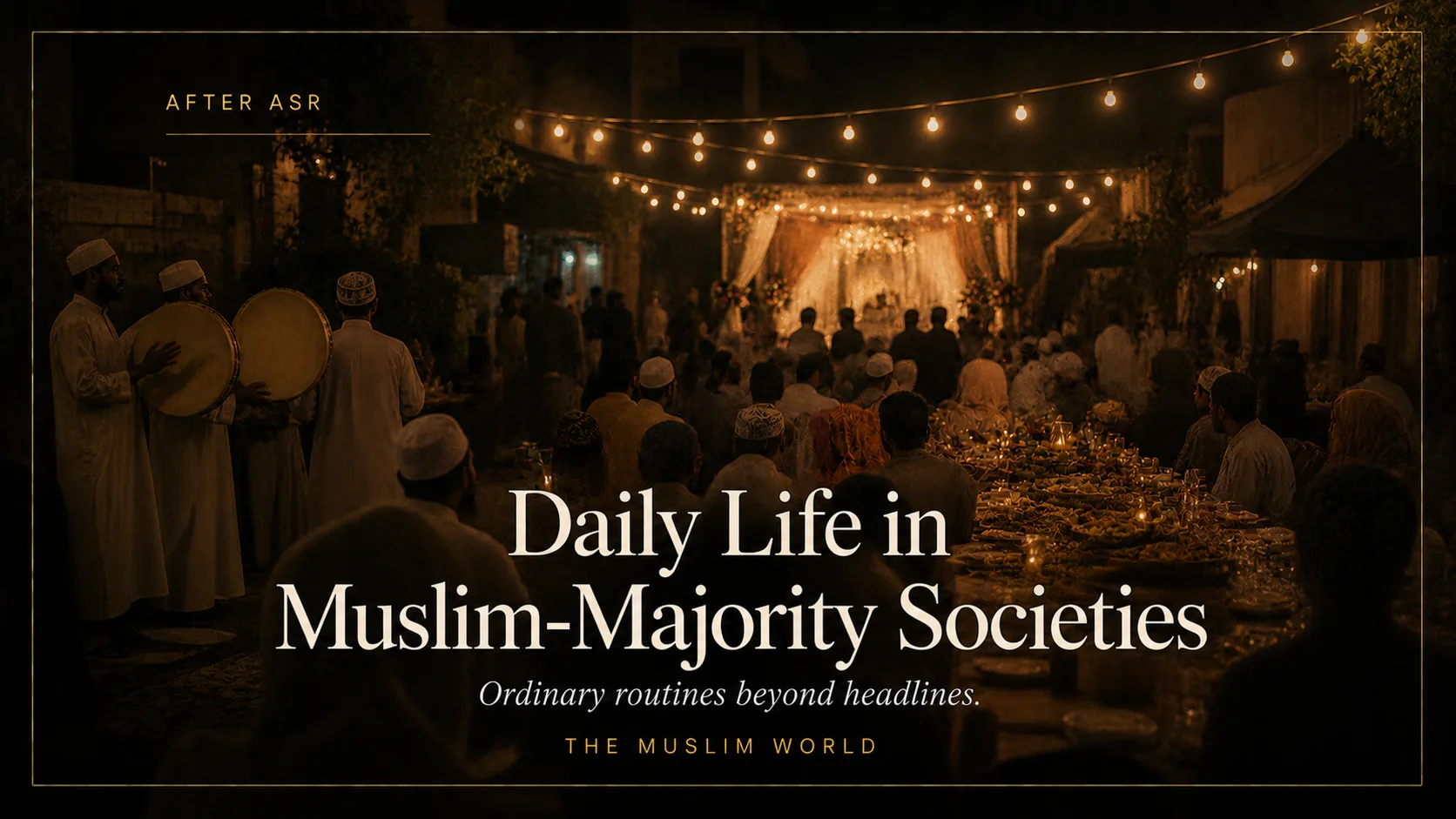
Guest lists run into the hundreds because to leave someone off is an injury that lasts years. The whole street knows the date. Money is given openly, recorded, remembered, and one day returned at another family’s wedding. It is insurance, celebration, and obligation folded into one long night of drums and food.
See one bride’s henna evening and you are seeing a small economy: the caterers, the musicians, the women who do hair, the uncle who quietly covers the shortfall. Widen the lens and the region runs on these networks of reciprocal joy. Narrow back, and it is a nervous groom checking his phone, wondering if enough chairs were rented.
The Funeral No One Skips
If the wedding is a duty, the funeral is a stronger one. In much of the Muslim world you do not send flowers. You come.
Burial happens quickly, often within a day, and the mourning is communal. The house fills. Food arrives from neighbors so the grieving family need not cook. Men sit in one room, women in another, and the Quran is recited in shifts. Grief here is not carried alone in a quiet home. It is shared out among many hands.
Attend one such gathering and you understand something the headlines cannot show: how thick the social fabric still is, how present death remains, how a whole community organizes itself around a single loss. Then the visitors leave, the plates are washed, and a widow sits with her children in a house that is suddenly quiet.
The Corner Shop Runs on Trust
The small grocery, the dukan, the warung, the tiny shop on the corner, is one of the true institutions of daily life. And much of it runs on credit that no bank would recognize.
The shopkeeper knows his customers by name and by need. He lets the schoolteacher pay at month’s end. He notes debts in a worn book, or in his head. Trust, not paperwork, holds the ledger. This informal economy feeds families the formal statistics never fully see.
Watch one transaction, a woman buying rice and lentils on account until her husband is paid, and you are watching the real financial system of the neighborhood. Widen the lens and this quiet web of obligation stretches across continents. It is not backward. It is a design, tuned over centuries, for surviving where the state does not reach.
Women Hold More Than the Headlines Admit
The Western image of the Muslim woman is a still photograph: veiled, silent, waiting. Daily life is a moving picture, and it tells another story.
In the markets of Fez and Kano, women run the stalls. In the hospitals of Tehran and Dhaka, women are the doctors and the majority of the pharmacy students. Grandmothers govern households with an authority no man in the family would challenge. The teacher, the tailor, the moneylender of the lane is often a woman.
This is not to deny real constraints, which vary enormously and must not be flattened either. It is to say the camera lies by holding still. Zoom in on one clinic in Cairo and count the white coats. Then widen the lens across the region and you will find, again and again, the load being carried by hands the headline never films.
Prayer Punctuates the Day, Not the News Cycle
Five times a day the day pauses. This is the metronome of ordinary life, and it barely registers abroad.
A shopkeeper spreads a mat between customers. A taxi pulls over at the roadside. An office keeps a small room with a clean carpet and a direction marked on the wall. The prayer is short. The interruption is total, and then life resumes exactly where it stopped.
Follow one man through his Tuesday and you can set your watch by his kneeling: dawn, midday, afternoon, sunset, night. Widen the lens and a billion people are keeping the same appointments at their own local hours. The rhythm is so constant it becomes invisible, which is precisely why the correspondent must learn to see it.
The Same Phone, a Different Evening
It is easy to assume that smartphones have made every evening the same. They have not.
Yes, the teenager in Marrakesh scrolls the same apps as the teenager in Manchester. But then the call to sunset prayer sounds, the grandmother needs help to the couch, the cousins arrive unannounced, and the evening turns into something the app did not script. Technology arrived on top of the old evening. It did not erase it.
Sit in one living room in Istanbul at night and you will see both centuries at once: the television murmuring, the tespih beads clicking, the tea coming around a third time. Widen the lens and this doubled life runs across the region, modern and traditional in the same room, arguing gently, sharing the same couch.
The Neighborhood Raises the Child
Children in these societies belong to a street before they belong to a schedule. They spill out of the house after prayers and play until dark.
No parent watches every minute, because every adult is watching. The shopkeeper feeds them sweets and scolds them for running. The old woman on the step knows each one by name and by parent. A child who misbehaves three lanes over will find the news reaches home before he does.
Widen the lens and this is a whole system of care with no budget line, no agency, no forms. It is simply understood that a child is a shared trust. Then narrow back to one boy chasing a punctured football down an alley in Tunis, trailed by four smaller cousins, all of them somebody’s, all of them everybody’s.
Seasons Still Set the Clock in the Countryside
The city runs on a monthly salary. Much of the countryside still runs on the harvest, and most Muslim-majority nations are more rural than the headlines suppose.
In the olive groves of Palestine and Tunisia, the autumn picking pulls whole families back from the towns. In the date palms of Iraq and the Gulf, the summer harvest has its own festivals. In the rice paddies of Indonesia and Bangladesh, the planting and the flooding order the year more firmly than any ministry does.
Stand in one grove at picking time and you see three generations on ladders, a lunch spread on a cloth beneath the trees, the year’s oil being decided branch by branch. Widen the lens and the same season is turning across a belt of the earth. The soil keeps a calendar older than the flag flying over it.
The Family Is the Safety Net
Where the state is thin, the family is thick. This is the quiet law of daily life across much of the Muslim world.
There is little need for a nursing home when three generations share a house. The unemployed cousin is fed until he finds work. The widowed aunt has a room. The money sent home by the son in the Gulf pays for the whole family’s medicine. What a Western country routes through an agency, these societies route through blood and obligation.
It is not a soft arrangement. It carries real cost: the daughter who cannot leave, the son bound to a business he did not choose, the freedoms traded for security. Widen the lens and you see a civilization that made the family its institution of first resort. Narrow back, and it is one grandmother, surrounded, who will never spend a night alone.
What the Correspondent Learns to Look For
After enough years, you stop chasing the fire. You learn to report the street.
You count the bakeries, not the barricades. You notice who greets whom, and how long the greeting lasts. You watch what a family does with a free afternoon. The story of a society is written in its ordinary Tuesdays, not its worst Fridays.
The headline will always exist, and sometimes it must. But it is a searchlight, and a searchlight is a poor way to know a house. To know the house you must sit in it, at an ordinary hour, and let it forget you are there.
The Country Is the Kitchen
Somewhere tonight a woman is chopping onions for a dinner no reporter will attend.
Her radio plays the news. She half listens.
The news is loud and far away. The onions are quiet and close.
She has lived through many headlines. She has cooked through all of them.
This is the country. It was always the country. The rest was only weather.