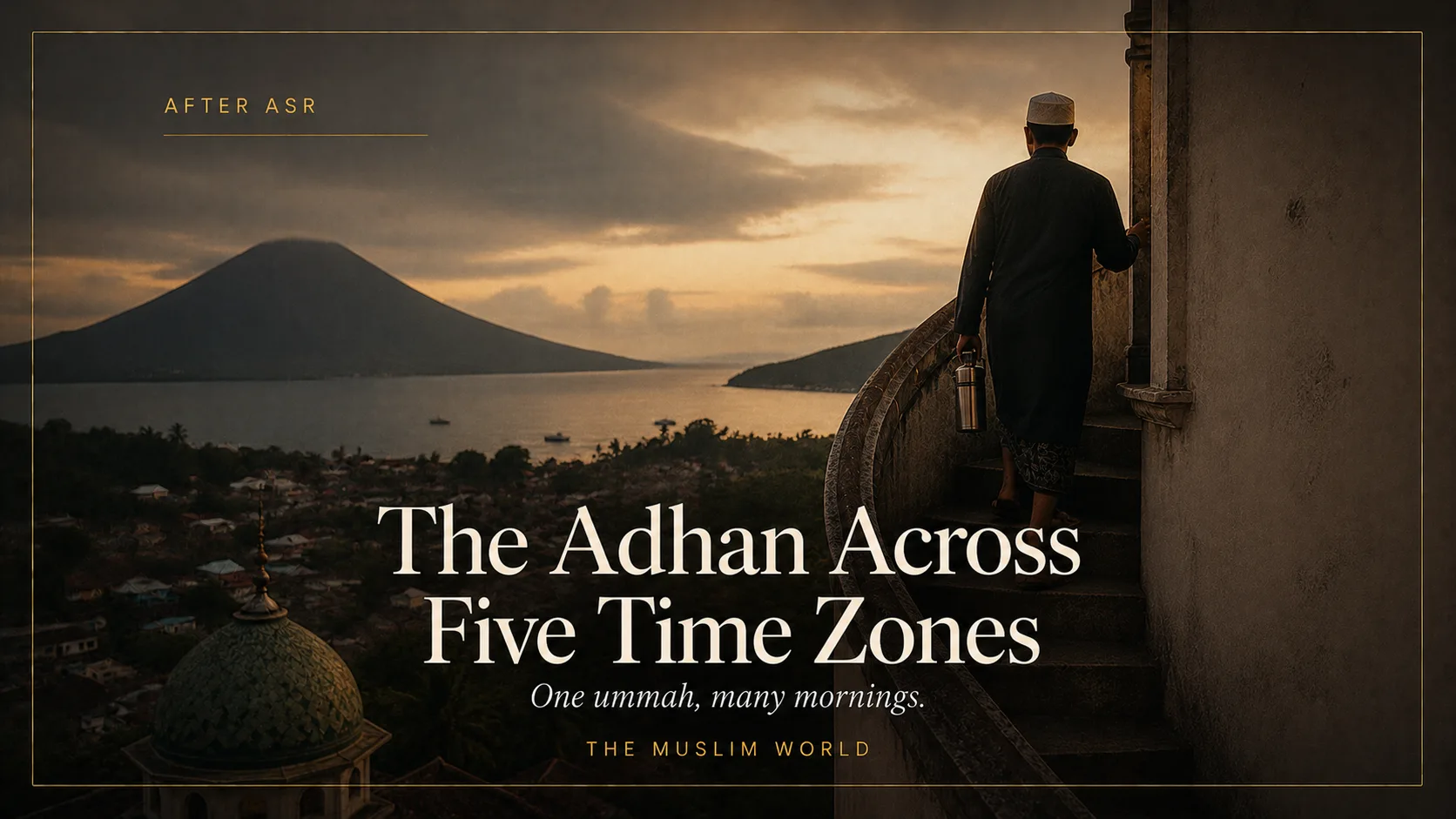
Before the sky over Ternate turns gray, a man climbs a narrow stair.
His name will not appear in any newspaper. He carries a steel thermos and a throat still rough with sleep.
In a few minutes he will call the first Fajr that the ummah hears today.
The First Throat to Open
Ternate is a small island in eastern Indonesia, a green cone rising from a blue sea. Clove trees grow on its slopes. The Portuguese once fought over those cloves, and the Dutch came after them. Traders, sultans, and soldiers have all wanted this island. History has visited Ternate many times. This morning, only the muezzin has.
He is one of perhaps two billion. Somewhere in the archipelago the earliest daylight touches a Muslim rooftop, and the call begins. From that single stairwell, imagine the whole turning earth. A planet with a dawn crawling across it, and one human voice riding the edge of the light.
Then narrow back. The man is not thinking about the planet. He is thinking about whether the microphone will crackle again, as it did on Tuesday. He taps it once with a finger and waits for the hum.
A Wave, Not a Chorus
People imagine the adhan as a single sound the whole world makes at once. It is not. The call to prayer is a wave. It follows the sun westward, minute by minute, and never arrives everywhere together.
When Ternate finishes, the villages of Java have not yet begun. When Jakarta calls, parts of Sumatra still sleep. The wave does not pause at borders. It moves the way weather moves, indifferent to the lines we drew on maps. No customs officer can stamp it. No parliament can schedule it. By the hour it reaches West Africa, the worshipers of Indonesia are already at their midday prayer, a full step ahead in the same day.
So there is never one morning in the ummah. There are thousands, handed forward like a bucket down a line of neighbors. This is the first thing the adhan teaches a person who listens across time zones. The ummah is not a chord struck at once. It is a melody, passed.
What Ternate Knows That Maps Forget
On most maps of the Muslim world, Indonesia is a smear of green far from the center. The center, we are told, lies elsewhere: Mecca, Cairo, Istanbul. Yet more Muslims wake in Indonesia than in any Arab country. The largest Muslim population on earth speaks no Arabic at home.
Ternate knows this without being told. Its mosques carry Malay inflection and local adat, custom older than the sultanate itself. Spice money once built these prayer halls. The call here is Arabic, as it is everywhere, but the man on the stair thinks and dreams in Ternate Malay.
Zoom out once more. The idea of a single Muslim world, centered and uniform, dies on an island like this. Particularity is the truth. The generalization is only the lie we tell because the real map is too large to hold in one hand.
The Handoff to Dhaka
Roughly an hour after Ternate, the wave reaches Bangladesh. Dhaka does not wake gently. It wakes in millions.
In a city so dense that the air itself feels crowded, Fajr competes with rickshaw bells and the first diesel engines. Loudspeakers on a thousand minarets overlap. The sound is not tidy. It is a city clearing its throat. A tea vendor lights his burner in the dark and listens without pausing his hands.
Stand in one alley of Old Dhaka and you hear four mosques at once, each a half second apart. The believer there does not experience one adhan. He experiences a tide of them. And inside that overlapping tide is the whole delta, its rivers and jute fields and shrimp farms, waking to the same first word: Allahu akbar. Then the alley returns, and the vendor pours his first cup.
The Same Words, a Hundred Melodies
The words of the adhan have not changed in fourteen centuries. The tune has changed constantly.
In Egypt the muezzin may stretch a single syllable into a long, ornamented line, following the maqam, the modal system of Arab music. In Turkey the call is often statelier, trained in conservatories where students learn breath and pitch. In West Africa it can run plainer, closer to speech. In Indonesia it carries a lilt a Cairene would find unfamiliar. In the Balkans it can sound almost like a folk song.
Children learn the local tune before they learn its meaning. A boy in Fez and a boy in Surabaya can both call Fajr, and neither would recognize the other’s version as his own. Yet each is correct. Each is complete.
Same sentence, countless mouths. The theology is fixed and the music is free. A person who travels with his ears learns that unity was never meant to mean sameness. The ummah agreed on the words and left the melody to every throat that carries them.
Karachi Between Grace and Traffic
West of Dhaka, the wave crosses into Pakistan. Karachi is a port of more than twenty million, a city that never fully rests.
Here the adhan threads through different weather: the smell of the Arabian Sea, the grind of trucks hauling to the docks, the political tension that hums beneath a megacity. A fisherman on the Korangi coast hears Fajr and pushes his boat out before the heat arrives. His father did the same, and his grandfather, from this same broken jetty.
Follow that boat to the horizon and you are looking at the old sea road. These waters carried Islam to India, to East Africa, to the Malay coast, centuries before any European sail appeared. The call the fisherman hears is the descendant of calls that crossed this exact water a thousand years ago. Then he baits a hook, and the epic shrinks back to breakfast.
Mecca Is Only One Point on the Wave
We are trained to think of Mecca as the middle of everything. In prayer it is. Every worshiper on earth turns toward it. But in the story of this morning, Mecca is one node on the wave, not the source of it.
The sun reached Indonesia hours before it reached the Hijaz. By the time the Grand Mosque calls Fajr, half the ummah has already prayed. The believers of Ternate did not wait for Arabia. They could not. The earth would not let them.
This is a quiet correction the adhan makes to our mental map. The heart of the faith has a direction, not a monopoly on the hour. Every place keeps its own dawn. The Kaaba gathers our faces, and still the morning belongs to no single country.
Istanbul and the Weight of a State
Two more hours, and the wave reaches the Bosphorus. Istanbul sits on two continents, and its call to prayer has always carried the weight of empires.
The muezzins of the great mosques are often civil servants, trained and salaried. For decades in the last century the state controlled how, and even whether, the adhan could sound. There was a period when the call was ordered into Turkish rather than Arabic, and the people quietly resisted. Old men are said to have wept the day the Arabic returned.
Beneath a dome raised by Sinan, the master architect, the call rises past stone that has heard it for five hundred years. Widen the lens. Every empire that ruled this strait believed it was permanent. The empires ended. The call did not. It outlived the ones who tried to own it.
Cairo Answers Before Istanbul Finishes
Because time zones overlap, Cairo and Istanbul often call within the same hour. The wave is not a single line. It is a broad front.
Cairo is the loudest voice in this story. For a long time the city ran on a chaos of mosques, each muezzin timing the call by his own watch, some a minute early, some a minute late. A famous project tried to unify them under one broadcast signal. Some welcomed the order. Others mourned the loss of a thousand human imperfections.
That argument, order against texture, runs through the whole Muslim world. It is not really about loudspeakers. It is about how much sameness a living tradition should accept before it stops being alive. Stand in a Cairo alley at Fajr and you can hear both sides of that argument, calling at once.
The Sahel Takes the Call
South and west of the Mediterranean, the wave enters the dry heart of Africa. In Kano, an ancient trading city in northern Nigeria, Fajr rises over mud brick and cellphone towers together.
Kano was a terminus of the trans-Saharan trade, a place where salt, gold, and manuscripts moved across the desert on camel. Scholars here kept libraries when much of Europe could not read. The call to prayer in Kano is older than most of the nations that now presume to teach the world about civilization.
Not far off, in the desert north, lie the manuscript libraries of Timbuktu, tens of thousands of hand-copied books on law, astronomy, and medicine. Families guarded them through drought, invasion, and fire. The call the scholars of Kano hear each dawn belongs to that same long labor of keeping.
Farther west, in Senegal, the Sufi brotherhoods shape the texture of faith. In Touba, the holy city of the Mouride order, the adhan carries a particular tenderness, bound up with the memory of a shaykh who resisted French rule without a sword. Zoom in on one worshiper counting beads after Fajr, and you are holding a whole history of dignity under empire.
The Boy Who Sleeps Through It
Not everyone who hears the call answers it. That belongs in the story too.
In a house outside Fez, a boy of fifteen hears Fajr through the wall and pulls the blanket higher. His grandmother is already at her prayer mat. His father has gone to the mosque. The boy tells himself he will pray when he wakes for school, and sometimes he does, and sometimes he does not.
Multiply that boy across every country the wave touches. The ummah is not only the devout on the front row. It is also the sleepers, the strugglers, the ones halfway back to faith. The call reaches all of them. What they do with it is the oldest private negotiation there is. The morning does not force the hand.
Crossing the Atlantic
The wave does not stop at the ocean. It crosses.
By the time Fajr reaches the eastern coast of the Americas, it has traveled most of the globe. In a converted storefront in Houston, a small congregation gathers before their work shifts begin. The muezzin is a machinist from Hyderabad. The man beside him is a convert from East Texas, three years into the faith, still learning the Arabic by ear.
This is not the first adhan called on American soil. Among the men and women brought here in chains were West African Muslims who kept their prayers in secret, some writing Arabic in the sand, some calling Fajr under their breath so the overseer would not hear. The wave reached these shores in bondage long before it reached a storefront in Houston.
Outside, the lot is nearly empty and the freeway already roars. The call that began on a clove island in the Pacific now sounds under a Gulf Coast sky. Widen the lens one last time and you can see the whole belt of it, a band of voices circling the planet, each unaware of the others, all saying the same first word.
Five Time Zones, One Sentence
Count the anchors of this morning. Ternate, Dhaka, Karachi, Istanbul and Cairo, the Sahel, and finally America. More than five zones, in truth. I chose five because a person can hold five in the mind. The real number is beyond holding.
Across every one of them, a single sentence does not move. Allahu akbar, ashhadu an la ilaha illa Allah. God is greater. I bear witness that there is no god but God. Everything else varies: the melody, the accent, the politics, the weather, the debts of the man on the stair. The sentence holds. It is the one thing the wave never bends.
Who Is Not Called
Honesty asks for a harder section. Not every believer hears a call.
In parts of China the adhan has been silenced by the state, minarets stripped of their speakers. In some Western towns a Muslim family lives an hour from the nearest mosque and hears Fajr only through a phone on the nightstand. A convert in a rural county may pray alone for years, calling the adhan to no one but herself, in a kitchen, at a whisper.
The wave I have described is real, but it has gaps. There are believers inside the silence, keeping the words alive with nothing but memory. They belong to this morning too. Perhaps they belong to it most.
The Muezzin Is Also a Neighbor
Return to the man in Ternate, because the essay owes him a return. When the call is finished he climbs back down the stair.
He is a fisherman himself, or a teacher, or a clerk at the harbor office. He has a wife already boiling water. He has a son who does not always pray, and he thinks of that son during the call. He worries about the price of fuel and the crack in the mosque speaker. He is not a symbol. He is a neighbor who happened to have the voice for it.
This is what the maps and the headlines miss. The ummah is not an abstraction floating over the earth. It is two billion ordinary mornings, each one belonging to a person with a name and a thermos.
There Is No Single Morning
Writers love to speak of the Muslim world as one thing. One mood, one grievance, one mind. Stand inside the call for a single dawn and the idea collapses.
The fisherman in Karachi and the machinist in Houston share four words and almost nothing else. Their governments, their languages, their fears, their foods, their arguments with their children: all different. To flatten them into a single Muslim world is not analysis. It is laziness dressed as insight.
What they hold in common is real, and it is also small enough to say in one breath. They believe the same sentence. The rest is theirs alone, and it should stay theirs.
What the Call Asks of the One Who Hears
The adhan is not information. It is a summons.
It does not tell you the time so much as ask what you will do with it. It interrupts sleep, commerce, argument, grief. It says the same thing to the governor and the fisherman, and it waits for neither.
To hear it across five time zones is to be reminded that you are small. Not diminished. Small in the good way, the way a person feels standing under real stars.
The Wave Reaches You
Somewhere, right now, a throat is opening.
The light is moving. The call is moving with it.
It began before you woke, on an island you will never see.
It will reach you, then pass you, and carry on west without you.
Listen while it is yours. Morning is only ever borrowed.