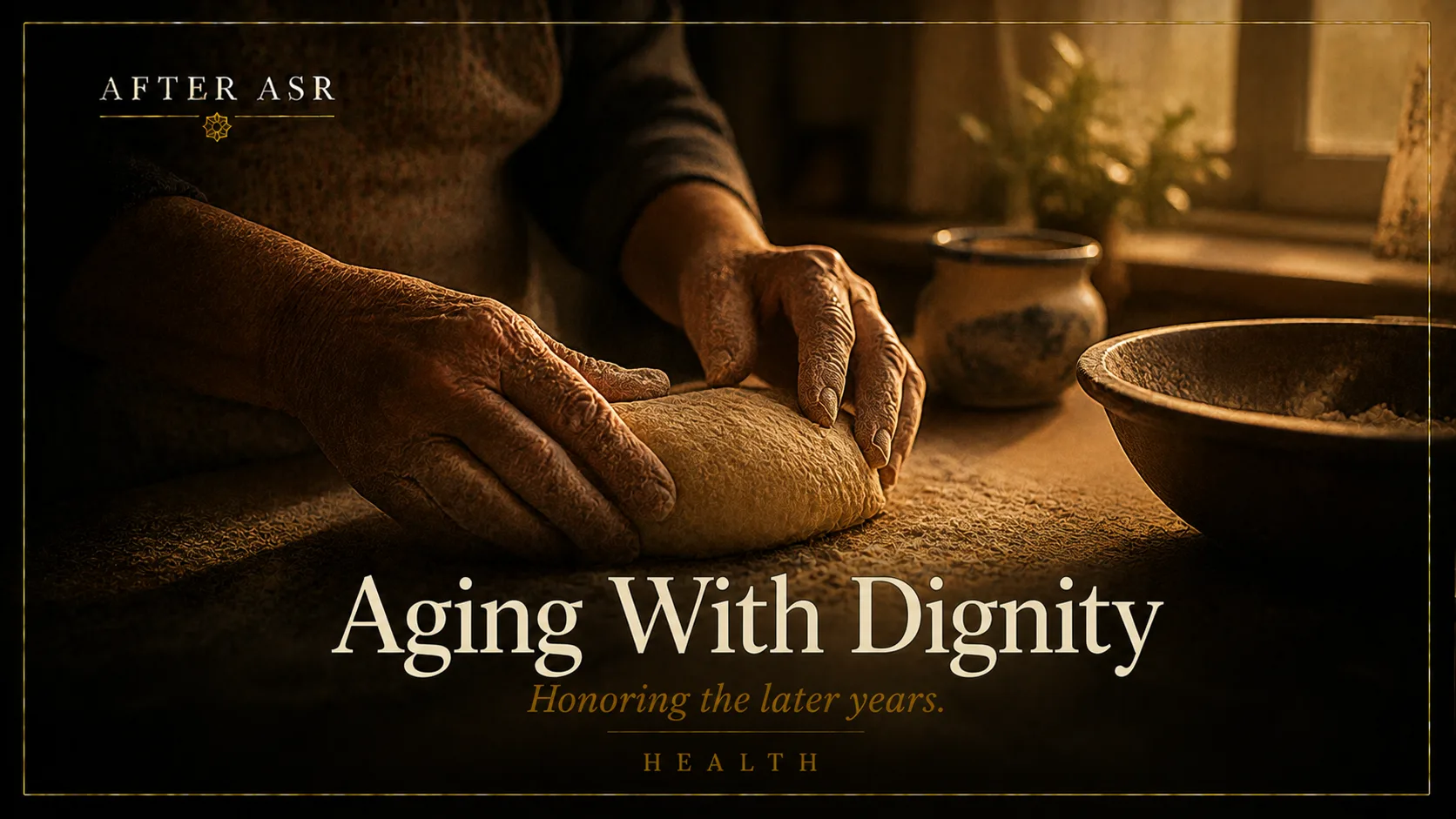
My mother’s hands were the fastest I have ever seen at the dough. She could shape bread while carrying on three conversations, her fingers moving on their own, sure and quick, turning flour and water into something warm without ever seeming to look. I learned the whole geography of our kitchen watching those hands.
They are slower now. Spotted, a little stiff in the mornings, pausing where they used to fly. I watch them shape the same dough and I feel two things at once, tenderness and a small grief, because the hands are telling me what the years have been doing.
The Body Keeps Time
The body is our truest calendar. It marks the passing years in the knee that complains on the stairs, the hearing that asks you to repeat yourself, the hair gone silver, the hand that no longer grips as it did. We may feel unchanged inside, the same self we always were, but the body keeps the honest count, and it does not flatter us.
There is no arguing with this record. The body ages whether we consent or not, whether we fight it or accept it, whether we spend fortunes against it or let it move at its own pace. It is one of the few certainties we are given. To live is to age, and to age is to be handed, slowly, a different body than the one we started with. The only real question is how we will meet the change, with dignity or with dread.
Aging Is Not a Failure
We have been taught, quietly and constantly, to experience aging as a defeat. The gray hair is a problem to be covered, the wrinkle a flaw to be erased, the slowing a decline to be resisted with every tool available. Underneath it all runs a strange assumption, that to age is to fail at the project of staying young, and that the young body is the only good one.
But aging is not a failure. It is the natural unfolding of a life doing exactly what life does. The body that ages is not broken; it is fulfilling its design, moving through the seasons it was made to move through. To treat this as a defeat is to be at war with the shape of existence itself, a war no one has ever won. There is another way to hold it, one that does not require pretending the years are not passing. It begins with refusing to see the later body as a lesser one.
We Fear It Because We Hide It
Part of why we dread aging is that we have hidden it from view. The old are increasingly kept apart, in their own homes and facilities and social worlds, so that the young grow up rarely seeing what a long life actually looks like up close. Aging becomes a rumor, a thing that happens elsewhere, and what we do not see, we learn to fear.
It was not always so. In households where three generations shared a table, the young watched the old up close, saw the dignity and the difficulty of the later years, learned that a slowing body still held a whole person. Aging was not frightening because it was familiar. When we push the elderly to the margins, we do not only fail them. We rob ourselves of the education their presence provides, the quiet lesson that a good life includes growing old, and that there is nothing shameful in it.
The Slowing Is Not the End of Worth
We live in a world that measures worth by output, and the aging body produces less of it. It works slower, tires sooner, can do less than it once could. And so a society obsessed with productivity quietly concludes that the old are worth less, a conclusion it rarely says aloud but everywhere acts upon.
This is a lie, and a cruel one. A person’s worth was never in their output, though we have been trained to think so. The value of a human being does not decline as their pace does. The grandmother who can no longer cook the feast is worth no less than the young woman who can; she is, if anything, worth more, for all she carries and all she has given. To honor the later years is to reject, firmly, the arithmetic that ties a person’s dignity to their usefulness. We are not valued for what we produce. We are valued because we were made.
Honoring the Elders
Our tradition is unambiguous about the old. To honor the elderly is not optional kindness; it is commanded. We are taught that respecting the aged is part of glorifying God, that the young who do not honor their elders are not truly of us. The rights of parents in particular are placed so high that God mentions them alongside His own worship, and forbids us even the smallest word of impatience toward them in their old age.
Read that instruction closely. We are told not even to say the mildest expression of annoyance to an aging parent, not to sigh at them, but to lower to them the wing of humility and to speak to them with gentleness. This is a demanding standard, and it is meant to be. It recognizes that the old can be difficult, that caring for them tests our patience, and it asks for that patience anyway, precisely because they once gave it to us when we were the difficult ones.
The Reversal of Care
There comes a moment in many lives when the current of care reverses. The parent who fed you now needs to be fed. The hands that lifted you now need lifting. The one who stayed awake through your childhood fevers now depends on you through the long nights of their frailty. It is one of the most poignant turns a life can take, and one of the most sacred.
We are not always ready for it. It can be strange, even painful, to see a parent grow dependent, to help them with things they once did for us. But there is a rightness buried in the difficulty. The Quran ties our gratitude to our parents directly to the care they gave us, tired and unasked, when we could do nothing for ourselves. To return that care in their old age is not a burden imposed on us. It is a debt we are privileged to repay, and the repaying is its own reward.
Dignity in Dependence
The hardest part of aging, for many, is not the pain but the dependence. To need help with the body’s most basic tasks, to lose the privacy and self-sufficiency of a lifetime, can feel like a stripping away of dignity itself. The proud body that managed alone for decades must now be helped, and the helping can wound as much as it relieves.
So the manner of the care matters as much as the care. To help an aging person while preserving their dignity is a fine art, made of small mercies, of asking rather than assuming, of protecting their privacy and their choices wherever we can, of never letting them feel like a task. Dependence does not erase dignity; only our carelessness does that. The one who is cared for gently, whose remaining autonomy is honored, whose person is respected even as their body fails, keeps their dignity intact to the end. It is ours to protect, and easy to damage.
The Table Makes Room
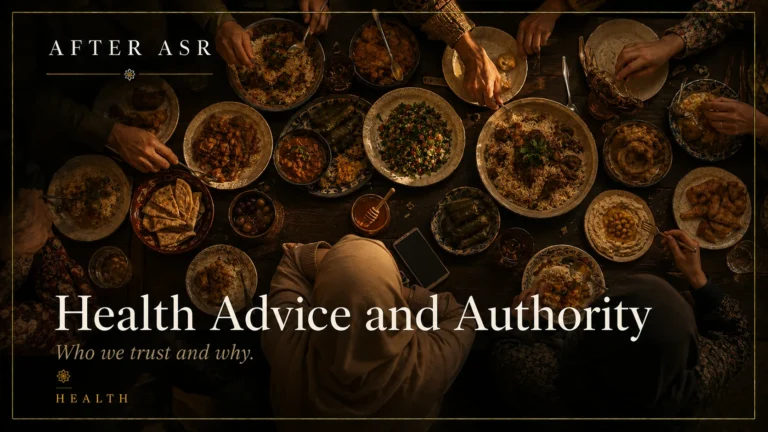
Watch a family table and you will see how it treats its old. In some homes the elder sits at the head, served first, deferred to, their presence the reason the others gathered. In others the old eat alone, apart, an afterthought at the edges of a busy household. The table tells the truth about a family’s heart.
To age with dignity is easier at a table that makes room. The elder who is drawn into the gathering, whose slower eating is patiently waited for, whose old stories are received rather than rushed, remains a full member of the family life. Food is how we say you belong here, and the elder fed at the center of the table hears that message with every meal. The smallest thing, a chair kept for them, a plate made the way they like it, says more about their worth than any speech. Make room at the table, and half the work of honoring is done.
Patience With the Repeated Story
The old tell the same stories. They ask the question you already answered, forget the thing you just said, return again to the memory they have shared a hundred times. This tests us in a low, daily way, and our impatience, though we swallow it, often shows in the face, the tightened jaw, the flat reply.
But patience here is precisely what is asked of us. The repeated story is not a nuisance to be endured; it is often the old holding onto the pieces of themselves that still feel solid, returning to the memories that made them who they are. To listen again, as though for the first time, is a small and real act of love. And it is practice for our own later years, when we too will repeat ourselves, and will hope to be met with the gentleness we are called to give now. The wing of humility is lowered one patient conversation at a time.
The One Who Does the Caring
We should not speak only of the old without speaking of those who care for them. The daughter, the wife, the son, often carrying the weight of an aging parent alongside their own children and their own work, until their body too begins to bend under a load that has no scheduled end. Caregiving is real physical labor, and it exhausts the one who gives it in ways that go unseen.
These caregivers need care themselves, and too often receive none, running themselves to the edge in the name of duty. To honor the old well, a family must also tend the one doing the tending, sharing the load, relieving them, feeding them, insisting they rest. The caregiver who collapses helps no one. There is no dishonor in a caregiver needing support; there is only wisdom in it. The body that carries an aging parent is itself a body, an amanah, owed the same mercy it is spending so freely on another.
The Body That Served You Long
There is a way of looking at an aging body that changes everything. Not as a thing failing, but as a thing that has served long and faithfully, and is tired, and has earned its rest. The knees that ache carried you up a lifetime of stairs. The hands that shake worked for decades without complaint. The heart that tires has beaten a billion times to keep you here.
Held this way, the aging body deserves not our frustration but our gratitude. It is a loyal servant nearing the end of long service, and it should be honored as such, treated with tenderness rather than resentment. This is true of our parents’ bodies and it will be true of our own. To look at the marks of age as medals rather than defects is to age, and to help others age, with grace. The old body has done its work. Let it be thanked.
What the Old Carry
The elderly are our libraries. They carry the memory of a family, the recipes and the stories and the names of the dead, the history that lives nowhere else once they are gone. Every old person is an archive on the verge of closing, holding knowledge that no book contains, the particular texture of a world that is passing with them.
We forget this in our hurry. We treat the old as people who have fallen behind the times, when they are in fact the keepers of times we can reach no other way. To sit with an elder and truly listen, to ask them about their life while there is still time to ask, is to receive an inheritance more valuable than any object. The tragedy is how often we realize this only after the archive has closed, and the questions we meant to ask can no longer be answered. Ask now, while the library is open.
The War Against Time
An entire industry has arisen to help us fight aging, to erase its signs and delay its arrival, promising a body that never gives up its youth. It sells creams and procedures and regimens, all built on the premise that aging is an enemy to be defeated. And it profits enormously from our fear of the thing that will happen to every one of us regardless.
There is nothing wrong with caring for the body as it ages; that is stewardship. But the war against time is a different thing, a refusal to accept the terms of a human life, and it cannot be won. Every dollar spent to deny the years buys, at most, a brief postponement and a deeper dread. To make peace with aging is not to give up on the body. It is to stop treating its natural course as a catastrophe. The years are not an enemy. They are the gift of having lived, and the mark of the mercy that let us live long.
Preparing for Our Own Later Years
Everything we do for the old, we are also learning to receive. The way we treat our aging parents is, in part, a rehearsal for our own age, and a lesson to our children, who are watching how the old are held in our homes. We are teaching them, without words, what they will one day do with us.
This is a sobering thought, and a useful one. It asks us to build the kind of care we will ourselves need, to make aging a season that is honored rather than hidden, to keep the old at the center of our lives so that we too, in our turn, will be kept there. And it asks us to prepare our own hearts, to begin now the long work of accepting our own eventual frailty with grace. The dignity we want in our later years is grown from the dignity we extend now. We reap what we plant at the table today.
The Last Season Is Still Life
We speak of the later years as a winding down, and they are. But they are still life, fully life, as worth living as any season that came before. The old are not waiting to die; they are living, still, with their own joys and sorrows and small daily pleasures, their tea and their prayers and their grandchildren’s visits. To treat the last season as mere prelude to the end is to miss the life still happening in it.
Death will come, to them and to us, and faith does not ask us to pretend otherwise. But the road to it is meant to be walked with dignity, in the company of people who honor us, at a table that keeps our place. That is what aging with dignity means. Not the denial of the end, but the full honoring of the life that remains before it.
The Slower Hands
So I watch my mother’s slower hands at the dough, and I have stopped grieving them. They are the hands that fed me. That they move slowly now is not a tragedy. It is the record of everything they have done.
One day my hands will slow too. I hope someone will watch them with tenderness, and wait patiently while they work, and keep my place at the table.
Honor the old. You are watching your own future, and teaching it, with every gentleness you offer now.