
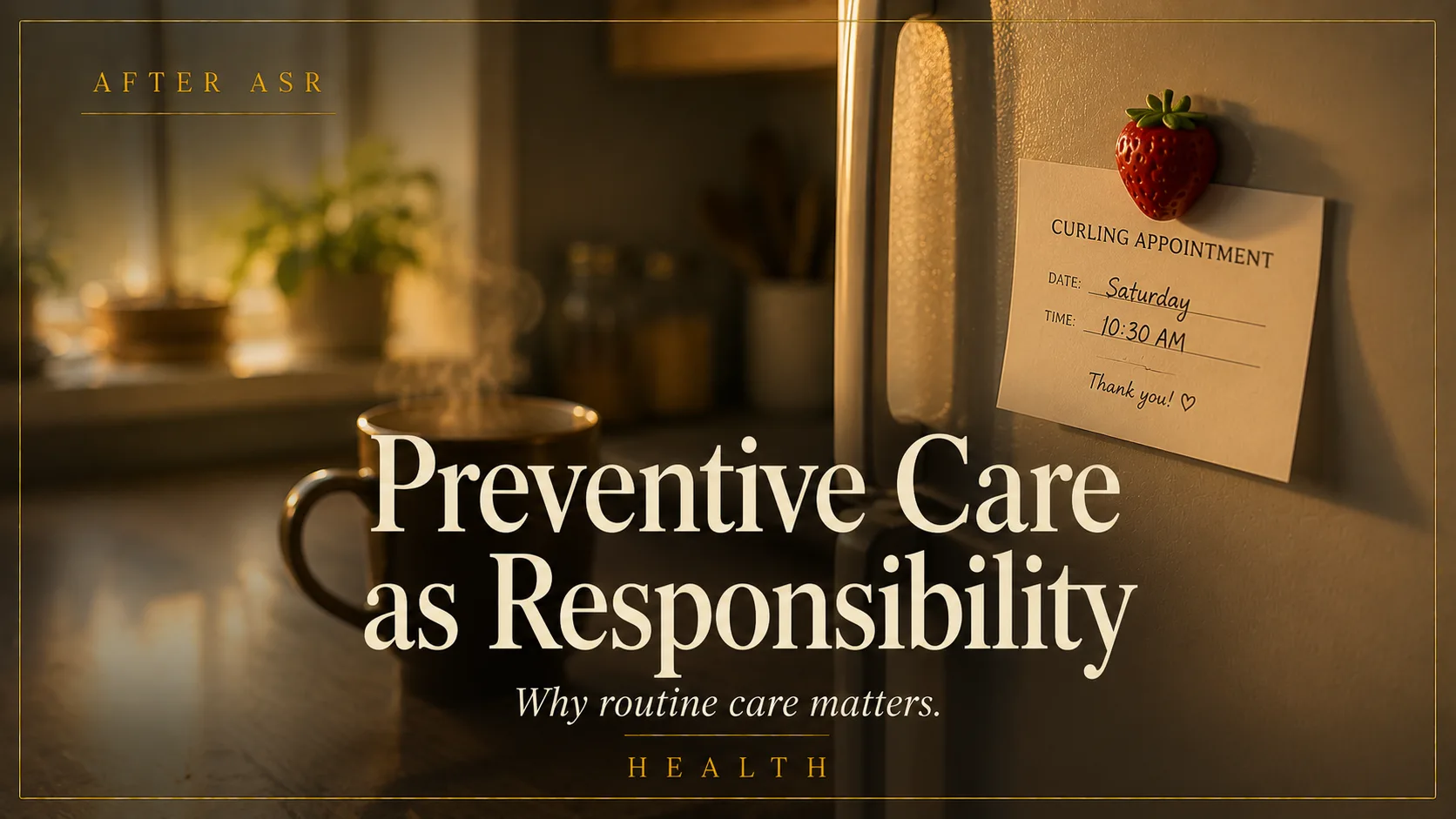
There is a reminder card held to the refrigerator by a magnet shaped like a strawberry. It says your cleaning was due four months ago. You have read it every morning while pouring the coffee, and every morning you have decided to call later, and later has not come. The card has gone soft at the corners now, curling under the magnet, part of the kitchen’s furniture.
We are, most of us, very good at postponing the care of the one body we have been given.
The Care We Keep Postponing
Preventive care is the least dramatic thing in medicine, and that is exactly why we neglect it. There is no crisis to force our hand. Nothing hurts. The appointment is for a body that feels, at the moment, perfectly fine, and so it slides to the bottom of every list, under the errands that announce themselves more loudly. We tend the squeaky wheel and let the quiet one go.
But the body does its most important work in silence. The slow changes that matter most give no warning at first. A number drifts upward. A small thing begins that is easy to address early and hard to address late. Preventive care is simply the practice of looking, on purpose, before the body is forced to shout. It is unglamorous, and it is one of the truest ways we keep the trust of our own health.
The Trouble With Feeling Fine
Feeling fine is a poor guide to being well. This is the hard truth that preventive care rests on. The body can carry a developing trouble for a long while without any felt sign of it, running its quiet processes beneath the surface of an ordinary day. By the time it hurts, the early window has often closed.
We put enormous trust in the absence of symptoms. No pain, we reason, means no problem, and so the checkup can wait. But the whole point of looking early is that it happens before there is anything to feel. To go to the doctor when you feel well is not foolish or excessive. It is the only time some things can be caught. Feeling fine is a blessing to be grateful for, not a diagnosis to rely on.
The Body Does Its Quiet Work Unseen
Think of all the work your body has done today without asking you. It has beaten and breathed and digested and repaired, ten thousand quiet processes you never once directed. You woke, and it was already working. You will sleep, and it will work on. The body is faithful in a way we rarely return.
Preventive care is one of the few ways we answer that faithfulness. It is the act of turning our attention, for an hour or two a year, to the servant that has carried us without complaint. We check on it not because we suspect it of failing, but because it has done so much for us unwatched. To look after a body that has never let us down is not paranoia. It is the barest form of gratitude, offered back to a thing that has earned it many times over.
Why We Avoid the Room
Let us be honest about why the appointment does not get made. It is not only busyness, though we blame busyness. It is fear, most often, the small dread that they will find something, and that not knowing feels safer than knowing. It is the strange logic of the frightened body, which reasons that a trouble unseen is a trouble that does not yet exist.
And it is other things too. It is the memory of a cold room and a rushed doctor. It is the cost, which for many is not a small matter but a real wall. It is the sheer effort of arranging the day around it. None of these are foolish. They are human, and they deserve to be named rather than scolded away. We do not talk people into care by shaming their reasons for avoiding it. We start by admitting the reasons are real.
The Pride of Never Going
Some people wear their avoidance as a badge. They say, with a certain pride, that they have not seen a doctor in twenty years and feel just fine, as though endurance itself were a form of health. There is a whole way of being, often taught to us young, that treats the need for care as a weakness and the refusal of it as strength.
But there is nothing strong in ignoring a body until it forces your hand. The pride of never going is a gamble that pays out quietly for years and then, sometimes, presents a bill that was entirely avoidable. Real strength is not the refusal to be looked after. It is the humility to be looked after in time. The one who tends the body early is not weak. They are wise, and they will likely be around longer to prove it.
The Fear Is Real, and Worth Naming
The fear deserves its own honest hearing. To go looking for trouble in your own body is a frightening thing, and no amount of sensible advice makes it less so. There is a part of us that would rather not know, that experiences the checkup not as reassurance but as a door we are afraid to open.
But fear kept in the dark only grows. The thing avoided becomes larger in the imagination than it usually is in fact. Most visits end in the plain relief of nothing wrong, or in the manageable news of something caught in time. The dread is almost always heavier than the appointment itself. I say this not to dismiss the fear, which is real, but to gently loosen its grip. You can be afraid and still go. Most of us are. The going is the brave part, and it is enough.
Cost Is a Wall, Not a Character Flaw
For a great many people, the obstacle is not fear but money. In this country, care is expensive, and the choice between a bill and a screening is a genuine one, made by people doing their honest best with too little. It would be cruel to speak of preventive care as a simple matter of responsibility and ignore this. Responsibility assumes access, and access is not evenly given.
So I will say it plainly. If you have avoided care because you cannot afford it, that is not a failure of yours. It is a failure of the arrangements around you. And still, there are more doors than we sometimes think, community clinics, sliding scales, health fairs, screenings offered at the masjid or the community center. Part of caring for one another is knowing these doors and pointing each other toward them. No one should have to carry a preventable illness because the price of looking was set beyond their reach.
Care Is Gratitude, Not Vanity
There is a suspicion, among some sincere people, that fussing over the body is a kind of vanity, a worldly attachment unbecoming of someone whose heart should be set elsewhere. But tending the body is not the same as worshipping it. We look after the house we were lent precisely because it is not ours to ruin. The care is offered up, not hoarded.
Preventive care, at its best, is gratitude in practical form. It says that the body is a gift worth keeping in good repair, not for its own sake, but for the sake of everything the body allows, the prayer, the work, the lifting of grandchildren, the years of service still ahead. To maintain the trust is to honor the One who gave it. There is nothing vain in keeping a gift well. The vanity would be in taking it for granted.
The Ones Who Depend on You
You are not the only one with a stake in your health. There is a table that expects you at it. There are people whose lives are woven through yours, who would feel your absence in ways you do not let yourself imagine. When you postpone your own care, you are quietly gambling with something that is not entirely yours to gamble.
This is the argument that reaches the people who will not go for their own sake. They will skip the screening to save the cost or spare the fear, but they will go for the sake of a child, a spouse, a parent who needs them present and whole. There is no shame in needing that reason. The love that gets us into the doctor’s chair is as good as any other. We keep our bodies, in part, because we are kept in the hearts of others, and they are counting on us to stay.
Teaching the Young to Tend Themselves
Children learn the care of the body the way they learn everything, by watching us. They see whether the checkup is kept or dodged, whether the dentist is spoken of with dread or with calm, whether a parent tends themselves or runs themselves into the ground and calls it devotion. We are writing their future habits without meaning to, in the ordinary choices they observe.
A child raised to see care as normal, as unremarkable as brushing teeth or eating breakfast, carries that ease into adulthood. A child raised on avoidance and fear inherits the fear. So when we keep our own appointments, we are not only tending ourselves. We are teaching the next hands at our table how to hold the trust of their own bodies. It is one of the quieter inheritances we leave, and one of the most useful.
Routine Is Not Glamorous, and That Is the Point
Preventive care will never feel like an achievement. There is no story in the checkup that finds nothing, no drama in the cleaning kept on time. It is the quiet, repetitive, unremarkable maintenance of an ordinary life, and it asks to be done again and again, forever, with no applause.
But the unglamorous things are the ones that hold a life together. The daily meal, the regular sleep, the small kept promise to look after yourself before you must. These are the humble rhythms beneath everything larger. A life is not saved in a single heroic moment nearly so often as it is quietly protected by a thousand dull, faithful acts of attention. Preventive care belongs to that humble order of things. Its very ordinariness is what makes it matter.
The Body Has a Right Over You
Our tradition is clear that the body is owed something. The Prophet, peace be upon him, told a companion who wished to worship without pause that his own body had a right over him, that he could not spend himself endlessly even in devotion without honoring the vessel that carried the devotion. The body is not an obstacle to the spiritual life. It is the instrument of it.
He also taught that God did not send down an illness without sending down its cure, and urged the seeking of treatment. To look after the body, then, to seek care and to catch trouble early, is not a distraction from faith. It is part of the faithful handling of a trust. The one who neglects the body in the name of higher things has misread what the higher things ask. The care of the vessel is itself an act of religion.
Prevention Begins at the Table
Not all preventive care happens in a clinic. A great deal of it happens at the table, three times a day, in the ordinary and repeated act of feeding the body well enough. The daily meal is quiet medicine, taken so regularly that we forget it is medicine at all. What we set before ourselves and our families, over years, does more to keep or lose our health than any single appointment.
I say well enough, and I mean it. Not perfectly, not fearfully, not according to some anxious regimen that turns every plate into a test. The table should remain a place of pleasure and gathering, not a site of dread. But a table tended with reasonable care, with real food and honest portions and the occasional joyful excess, is preventive care of the oldest and warmest kind. We protect the body most by how we feed it on the unremarkable days.
The Screenings We Dread
Some forms of care are simply unpleasant, and there is no dressing that up. The screenings that probe and pinch, the fasting before the blood draw, the machines that press and hum. Nobody looks forward to them. We are allowed to dislike them and to go anyway, which is what most courage actually looks like.
What helps is remembering how brief they are against what they protect. An uncomfortable hour, weighed against years, is a small price, though it does not feel small in the moment. And what helps even more is not going alone. The dread of the waiting room shrinks when there is someone in the next chair, someone who drove you, someone who will take you for tea after. We were not made to face the frightening rooms of this life by ourselves.
Bringing Someone With You
Here is a form of community care that costs almost nothing and gives a great deal. Drive the elderly neighbor to her appointment. Sit in the waiting room with the friend who is afraid. Offer to mind the children so a tired mother can finally keep the checkup she has postponed for a year. Make the phone call for the relative who cannot navigate the system alone.
So much preventive care goes undone not for lack of will but for lack of a hand. The ride that does not exist. The person who cannot manage the appointment while managing everything else. When we help one another across these small gaps, we are doing quiet, real, life-protecting work. The health of a community is not only a matter of clinics and insurance. It is a matter of whether we show up for each other in the ordinary, unglamorous places where a little help changes everything.
This Is Not About Perfection
Let me be clear about what I am not asking. I am not asking you to become vigilant, to turn your health into a project, to live in fear of every symptom and chase every test. That way lies its own kind of illness, the anxious over-monitoring that mistakes worry for care. The goal is not to be perfectly maintained. The goal is to be reasonably attended, and then to get on with living.
Preventive care, done rightly, buys you the freedom to stop thinking about it. You keep the appointment so that you can forget the appointment. You look, on purpose, once in a while, so that the rest of the time you may live in your body freely, without either denial or dread. That is the balance we are after. Not obsession, not neglect, but a steady, unremarkable faithfulness to the vessel we were lent.
Make the Call
So take the card off the refrigerator. Uncurl its soft corner. Make the call you have been meaning to make since the strawberry magnet first pinned it there.
It will take ten minutes, most of which you will spend on hold. The appointment will be for a body that feels fine, and it will probably stay fine, and that is precisely the point. You are not looking for trouble. You are keeping a trust.
The body has carried you faithfully this far. Once in a while, turn and carry it.