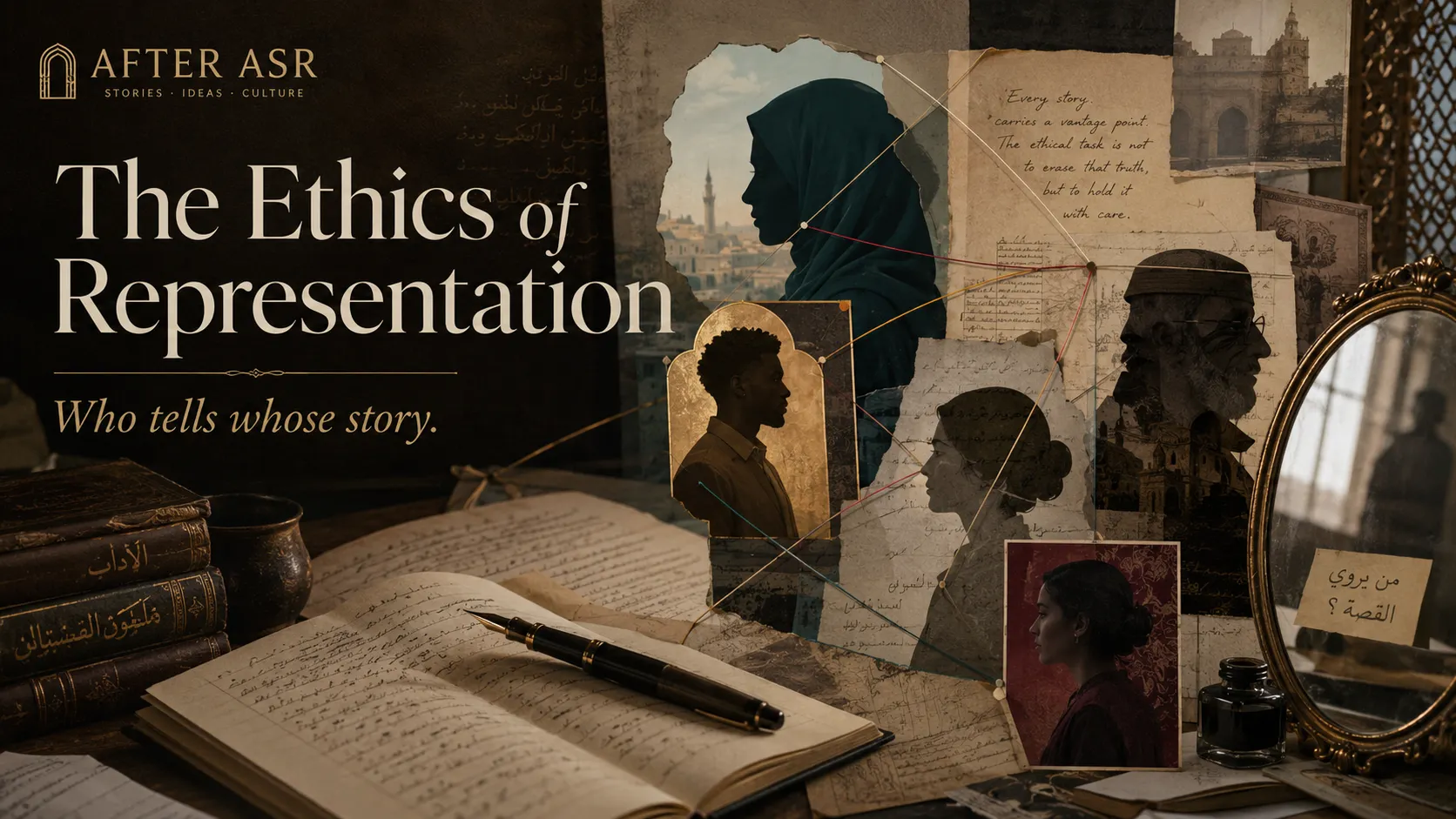
Who tells whose story.
Every writer reaches beyond the self.
A novelist invents a childhood they did not live. A poet imagines a voice from another century. A playwright writes across gender, class, geography, age, faith, language, illness, grief, and desire. Literature would wither if authors were permitted to describe only their own exact biographies. The imagination is not a fenced property. It crosses.
And yet, not every crossing is innocent.
A powerful writer may borrow the life of a vulnerable community and receive praise, money, and authority while writers from that community remain unpublished or unheard. A novel may use someone else’s suffering as atmosphere. A memoirist may expose family members whose consent is impossible or compromised. A filmmaker may claim to amplify a marginalized voice while shaping the story entirely around what outsiders expect to see. A writer may research carefully and still mistake access for understanding.
The question, then, is not whether writers may write beyond themselves. They must. The harder question is how.
Who tells whose story?
To whom?
For what purpose?
With what knowledge?
With what consequences?
And who is missing from the room when the story is praised?
The ethics of representation begin where artistic freedom meets unequal power.
Literature cannot be reduced to identity matching. A Muslim writer is not automatically the best writer of every Muslim character. A non-Muslim writer is not automatically incapable of writing a Muslim life with intelligence and care. Shared identity does not guarantee depth. Difference does not guarantee failure. But such caveats should not be used to erase the historical reality that some communities have been described endlessly by outsiders while being denied equal access to narrating themselves.
The moral task is not to replace literature with credentials. It is to make representation answerable to humility, accuracy, power, and care.
A story is not ethically sound simply because it is beautifully told. Beauty can misrepresent. Sympathy can patronize. Skill can make distortion more persuasive. If writing gives human lives shape in the public imagination, then writers and readers alike must ask whether that shape dignifies, falsifies, narrows, or frees.
Representation Is Never Merely Decorative
Representation is sometimes treated as a modern publishing concern, as though it were primarily about marketing categories, casting announcements, or diversity checklists. It is much older and much deeper than that.
Representation determines who appears fully human in a culture’s stories. It shapes who receives interiority, complexity, humor, sexuality, faith, contradiction, heroism, failure, and ordinary life. It influences whether readers encounter a group as neighbors, problems, threats, victims, symbols, or people whose worlds extend beyond what the dominant culture finds interesting.
Recent scholarship on representation in literature continues to emphasize that portrayals of marginalized communities can influence social attitudes, identity formation, and what kinds of lives readers come to regard as narratively significant. Representation does not act alone, and readers are not blank slates, but stories participate in the larger moral weather of a culture.
This is why absence matters. If certain communities appear only rarely, or appear repeatedly in a narrow range of roles, readers learn those limits. The problem is not merely that some people “do not see themselves.” It is also that everyone else learns to see them incompletely.
A Muslim child who encounters Muslims in books mostly as conflict, suspicion, or cultural explanation absorbs something. So does the non-Muslim child reading beside them. A disabled character used only to teach nondisabled protagonists gratitude communicates something. A poor family appearing only as misery or moral failure communicates something. A refugee represented only at the border, never at a birthday table, in a joke, or in a moment of boredom, becomes less a person than a condition.
Representation is not a supplement to literature. It is one of the ways literature teaches what a human life is allowed to look like.
The Old Argument: Imagination Versus Ownership
Debates over representation often collapse into a blunt opposition.
One side asks, “Are writers no longer allowed to imagine?”
The other asks, “Why do outsiders keep profiting from stories that insiders struggle to publish?”
Both questions contain truth. Neither is sufficient alone.
If authors wrote only autobiographically, fiction would shrink into disguised memoir. Historical novels would disappear. Fantasy would become impossible. Great literature has always involved acts of imaginative projection. Writers must be free to inhabit lives unlike their own, or literature loses one of its central powers: the capacity to reach toward otherness.
At the same time, the phrase “writers can write anything” often functions as a dodge. Of course they can, in the literal sense. The meaningful question is not permission. It is responsibility.
Philosophical work on cultural appropriation in fiction has argued that the moral concern is not simply crossing cultural boundaries, but crossing them under conditions of unequal power, weak understanding, or extractive benefit. Appropriation becomes ethically charged when the artist borrows from communities whose traditions, histories, and voices have been marginalized, especially if the result reinforces distortion or displaces those with stronger claims to the material.
The imagination is expansive. It is not exempt from ethics.
A writer may imagine a life unlike their own. They should also ask why they are drawn to it, what they know, what they do not know, who has already told similar stories from within, and whether their work is entering a field of abundance or one already crowded with outsider authority.
Access Is Not the Same as Understanding
One common defense of problematic representation is proximity.
The writer lived near that community.
They had friends from it.
They spent months researching.
They traveled there.
They interviewed people.
All of this can matter. Research matters. Listening matters. Long attention matters. A writer who refuses research while claiming imaginative freedom is not brave. They are lazy.
But access is not the same as understanding.
A person may spend years around a community while seeing only what confirms prior assumptions. An anthropologist may record details accurately and still miss the moral center of what they observed. A novelist may accumulate cultural markers while failing to grasp how people within that world interpret them. Someone may know the food, phrases, and rituals of a community and still misrepresent its inner logic.
The 2026 article on authentic representation in research and publishing argues that ethical representation requires more than gathering stories; it requires relationality, integrity, and attention to the networks of power through which stories are collected, edited, and circulated. While the article concerns research, its core warning applies sharply to literature: the ethics of representation are shaped not only by what is said, but by how the storyteller came to speak and who bears the consequences.
A writer should not use interviews as moral insurance. Consultation is not absolution. “I asked someone” cannot replace depth. Sensitivity readers, community conversations, translators, and historians can expose mistakes. They do not automatically make a work just.
Understanding requires more than information. It requires restraint before what one cannot fully possess.
Some Stories Are Over-Told From the Outside
Not all communities suffer from the same representational problem.
Some are unseen. Others are hyperseen, but through distorted frames.
Muslims, for instance, have long been discussed in Western public culture through security, gender, migration, extremism, and “integration.” These subjects matter, but their repetition narrows the field. A Muslim character may appear in literature and immediately be made to symbolize faith versus freedom, tradition versus modernity, or suspicion versus belonging. The ordinary becomes difficult to access because the public script arrives first.
This is where the ethics of representation intersects with literary fatigue. A story may be individually competent and still participate in a collective distortion if it reproduces the same narrow frame already dominant in culture.
The issue is not that writers should avoid painful realities. Muslim communities contain conflict, hypocrisy, generational tension, political division, and injustice like any other. Literature should not be forced into public relations. But when outsiders repeatedly choose the same wounds while rarely attending to Muslim humor, interior faith, friendship, intellectual life, domestic normalcy, or moral complexity, the pattern deserves scrutiny.
Ethical representation asks not only, “Is this story plausible?” but also, “Why this story again?” and “What larger cultural appetite does it feed?”
Self-Representation Matters, but It Is Not Magic
The rise of the #OwnVoices conversation emerged from a legitimate desire: authors from marginalized communities should have more opportunity to tell stories connected to their own identities and experiences. The term entered literary discourse in 2015 and became influential in children’s and young adult publishing, encouraging readers and institutions to notice who was writing stories about whom. Later, organizations such as We Need Diverse Books moved away from the hashtag because it could pressure authors to disclose personal identities or flatten the complexity of authorship, preferring more specific descriptions when relevant.
That evolution is instructive.
Self-representation matters profoundly. People living within a tradition, disability, race, class, migration history, or religious world often notice things outsiders overlook. They may know what is unspoken. They may understand which details are central and which are merely visible. They may write against inherited caricatures with authority grounded in lived proximity.
But identity does not produce automatic excellence or moral immunity. A writer can belong to a community and still exploit it. They can flatten others within it. They can write toward outsider approval. They can mistake personal experience for communal totality. They can reproduce class prejudice, sectarian bias, racism, misogyny, or elitism from within.
The point of self-representation is not that insider voices are always correct. It is that literary ecosystems become unjust when outsiders are over-authorized and insiders underpublished. Diversity of authorship matters because no community should be known primarily through those looking in from elsewhere.
Representation becomes healthier when more people can speak, not when any single person is crowned definitive.
No Writer Represents an Entire People
One of the cruelest burdens placed on marginalized writers is the burden of total representation.
A white novelist may write an unhappy marriage and be read as writing about an unhappy marriage. A Muslim novelist may write an unhappy marriage and be asked whether the book “represents Muslim marriage.” A disabled poet may write about frustration and be evaluated as a spokesperson for disability. A Black fantasy writer may be praised or criticized not merely for building a fictional world, but for what that world says about “Black representation.”
This pressure narrows artistic freedom from another direction. The writer is not only asked to tell their story. They are asked to carry everyone.
Ethical representation should reject this burden. A single book need not be comprehensive. A single character need not redeem or explain a community. A flawed Muslim character is not a referendum on Muslims. A cruel mother in a novel by an immigrant writer is not an indictment of immigrant mothers. A queer character’s loneliness does not summarize queer life.
The problem is not particularity. It is scarcity. When only a few stories are available, each one is asked to stand for too much. The solution is not to demand impossible completeness from individual authors, but to build literary abundance.
More books. More angles. More voices. More contradictions. More room for one work to be partial because many others exist beside it.
The Reader Also Bears Responsibility
Representation is not only the writer’s ethics. It is also the reader’s.
A reader can misrepresent a book through the way they consume it. They can treat a novel as anthropology. They can read a memoir by one Muslim woman as evidence about Muslim women generally. They can search only for confirmation of what they already believe. They can praise a book not for its art, but because it supports a social narrative they prefer.
Readers should ask themselves:
- Am I taking this work as one story or as the story?
- Am I granting the character individuality, or making them stand in for a group?
- Am I reading for complexity, or for evidence?
- Would I ask the same representational questions if the author belonged to a dominant group?
Narrative ethics scholarship emphasizes that stories become morally significant through comparison, interpretation, and the way they challenge or reinforce the narratives by which communities live. The reader is therefore not passive. They participate in the ethical life of representation by the frames they bring and the conclusions they draw.
A bad reading can convert a nuanced book into a stereotype. A good reading can resist that conversion.
Consultation, Consent, and the Limits of Use
Some representation concerns become sharper when writers work with real lives rather than invented characters.
Journalists, documentarians, memoirists, oral historians, and narrative nonfiction writers often tell stories rooted in the experiences of identifiable people. Here the questions intensify. Was consent informed? Did the subject understand how their story would be used? Could they refuse without consequence? Will publication expose them to harm? Has the storyteller preserved dignity, or merely secured dramatic material?
The documentary field has increasingly foregrounded the question “Who is telling whose story, to whom, and why?” precisely because representational ethics are inseparable from power, framing, and audience. The concern is not only factual accuracy, but narrative control.
Literary nonfiction faces the same challenge. A writer may have the legal right to describe a family member. That does not answer whether doing so is ethical. A person may consent in a moment of need, unaware that their pain will be circulated for years. A marginalized subject may cooperate with a writer who controls the contract, platform, editing, and interpretation. The imbalance remains even when no one behaves maliciously.
Ethical storytelling requires more than extraction of permission. It asks whether the story is being handled as a trust.
Suffering Is Not Raw Material
One of the gravest failures of representation is the aestheticization of suffering.
A writer becomes enamored with the beauty of another person’s pain. War produces exquisite imagery. Poverty offers atmosphere. Trauma deepens character. Displacement supplies melancholy. The prose glows while the subjects lose specificity.
This is not always easy to identify. Literature must create beauty even when addressing terrible things. A sentence about grief may be beautiful without exploiting grief. A novel about dispossession may be artistically magnificent and morally urgent. The problem is not beauty. It is when beauty detaches from accountability.
A story exploits suffering when pain exists mainly to enrich the work, ennoble the writer, instruct privileged readers, or add emotional weight without preserving the dignity and complexity of those who suffer.
Ethical representation asks writers to resist turning another person’s wound into decorative depth.
This is particularly important when writing about communities already consumed as spectacle by media, humanitarian campaigns, or political rhetoric. Refugees, victims of war, incarcerated people, poor communities, and survivors of abuse have often been represented more frequently than they have been heard. A writer entering such terrain should ask whether they are adding understanding or merely adding another layer of consumption.
The Danger of “Universalizing” Too Quickly
Writers sometimes defend thin representation by saying they wanted to emphasize universal humanity rather than cultural specificity. The intention may be generous. The effect can be erasure.
A Muslim character’s prayer life, dietary choices, idioms, family structures, or moral vocabulary are not obstacles to universality. They are part of the form through which universality becomes concrete. A disabled character’s life should not be stripped of embodied realities so nondisabled readers can “relate.” A rural character need not be made urban in sensibility for metropolitan readers to understand them.
The universal is not what remains after difference is removed. It is what becomes recognizable through truthful particularity.
When writers rush to universalize, they often sand down the very features that make a life real. Ethical representation respects specificity even when that specificity requires readers to stretch.
Writing Across Difference Can Be Done Well
The ethics of representation should not produce paralysis.
There are writers who work across difference with rigor, humility, and imagination. They study deeply. They listen without treating consultation as a checkbox. They recognize that a character from another community is not an occasion to display research. They avoid making cultural difference carry more symbolic weight than the story requires. They write with enough human intelligence that characters remain people rather than case studies.
The philosopher Patrica Haynes’s work on appropriation in literature notes that appropriative strategies can sometimes resist dominant cultural standards rather than merely reproduce them. This matters because writing across difference is not always extractive. Under certain conditions, it can challenge power, create solidarity, and expand literature’s field of concern.
The question is not whether crossing is permitted. It is whether the crossing is responsible.
A writer approaching unfamiliar life should perhaps imagine themselves not as a conqueror of material, but as a guest. Guests may enter. They may learn. They may participate. But they should not assume possession.
The Market Shapes Representation Too
Writers do not work in isolation. Publishers, agents, editors, prizes, media outlets, schools, and reviewers all shape which representations circulate widely.
A manuscript that complicates a community may be praised for nuance. Another that confirms dominant expectations may be more easily marketed. Stories of trauma may receive more institutional urgency than stories of joy or ordinary life. Narratives that explain minorities to dominant readers may be acquired more readily than narratives that assume minority readers from the start.
The ethical question therefore extends beyond the author. Who is being acquired? Who is being edited? Who is asked to “make this more accessible”? Who is told a story is “not relatable”? Who is praised as authentic, and by whom?
Recent publishing initiatives aimed at expanding underrepresented voices reflect recognition that the problem is structural, not merely individual. The launch of new imprints dedicated to Black authors, for example, has been framed explicitly around addressing historical underrepresentation through acquisitions, staffing, and community partnerships.
Representation improves not only when individual writers behave better, but when institutions distribute opportunity more fairly.
Muslim Writers and the Ethics of Being Interpreted
For Muslim writers, the issue of representation has a particular sharpness.
They may be asked to explain Islam, defend Islam, critique Islam, modernize Islam, humanize Muslims, expose Muslim communities, or reassure non-Muslim audiences that they are not dangerous. These expectations can come from publishers, reviewers, classrooms, media, and sometimes from Muslim communities themselves. The writer risks being overread from every direction.
A novel by a Muslim author may be treated as theological evidence. A memoir may be taken as civilizational commentary. A satire may be praised or condemned for “what it says about Muslims” rather than read as a work of art with its own scope. This is not only unfair to writers. It is intellectually lazy.
Muslim writers should be able to write devotional fiction, secular comedy, intimate family novels, speculative epics, political thrillers, literary essays, children’s books, romance, horror, and anything else their craft can sustain. Their Muslimness may be central, peripheral, or simply ambient. It should not become a cage built by either outsiders or insiders.
At the same time, Muslim writers telling stories beyond their own communities should bring the same care they rightly demand from others. The ethics of representation are not a weapon to be used only when one’s own group is misrepresented. They are a discipline for everyone.
A Faithful Representation Need Not Be Flattering
One persistent confusion in debates about representation is the assumption that ethical representation must be positive representation.
It does not.
A community deserves complexity, not propaganda. An ethically represented Muslim character may be petty, cruel, dishonest, spiritually complacent, or ridiculous. A family may be loving and harmful. A mosque may be a place of refuge for one person and alienation for another. A tradition may be cherished and mishandled. Ethical representation does not require washing away conflict.
What it requires is proportion, context, and humanity.
A flawed character should be more than a stereotype. A damaging community practice should be represented with enough understanding that it is not mistaken for the whole of a people. Harm should not be denied. It should also not be recruited into narratives of contempt.
Writers from inside and outside a community alike must resist two failures: sentimental protection and opportunistic exposure. One falsifies by concealment. The other falsifies by imbalance.
The Story Is Never Only Yours Once It Is Published
Writers often speak of “my story,” and that claim can be valid. One’s experience belongs to oneself. One’s imagination belongs to oneself. One’s labor belongs to oneself.
But published stories enter shared space. They influence readers who may know little else about the world depicted. They shape public feeling. They affect the reputations of living communities. They may become teaching texts, book club texts, prize texts, interview subjects, or adaptation material. They acquire consequences beyond the writer’s intention.
This does not mean writers should become timid. It means they should become serious.
A story need not satisfy every reader. It may provoke. It may offend. It may challenge cherished illusions. Ethical representation is not the avoidance of controversy. It is the refusal to be careless with the lives one renders.
Who Tells Whose Story?
The question should not be used to police imagination into silence. It should be used to deepen imagination until it becomes worthy of trust.
Who tells whose story?
Sometimes the answer should be: the person who lived it.
Sometimes: the community that has been denied the chance to speak.
Sometimes: a writer from elsewhere who has listened rigorously and entered with humility.
Sometimes: no one yet, because the material has not been approached with enough care.
Sometimes: many people, because no one story can bear the whole truth.
The question does not end literature. It protects literature from becoming a beautiful instrument of theft.
A responsible writer may cross borders of experience. But they cross carrying obligations. They do not presume that desire equals entitlement. They do not mistake research for mastery. They do not use one person’s pain to produce another person’s prestige. They do not ask readers to applaud empathy while leaving structures of exclusion untouched.
Representation is ethical when it enlarges the world without dispossessing those whose world it enters.
It does not require sameness.
It requires seriousness.