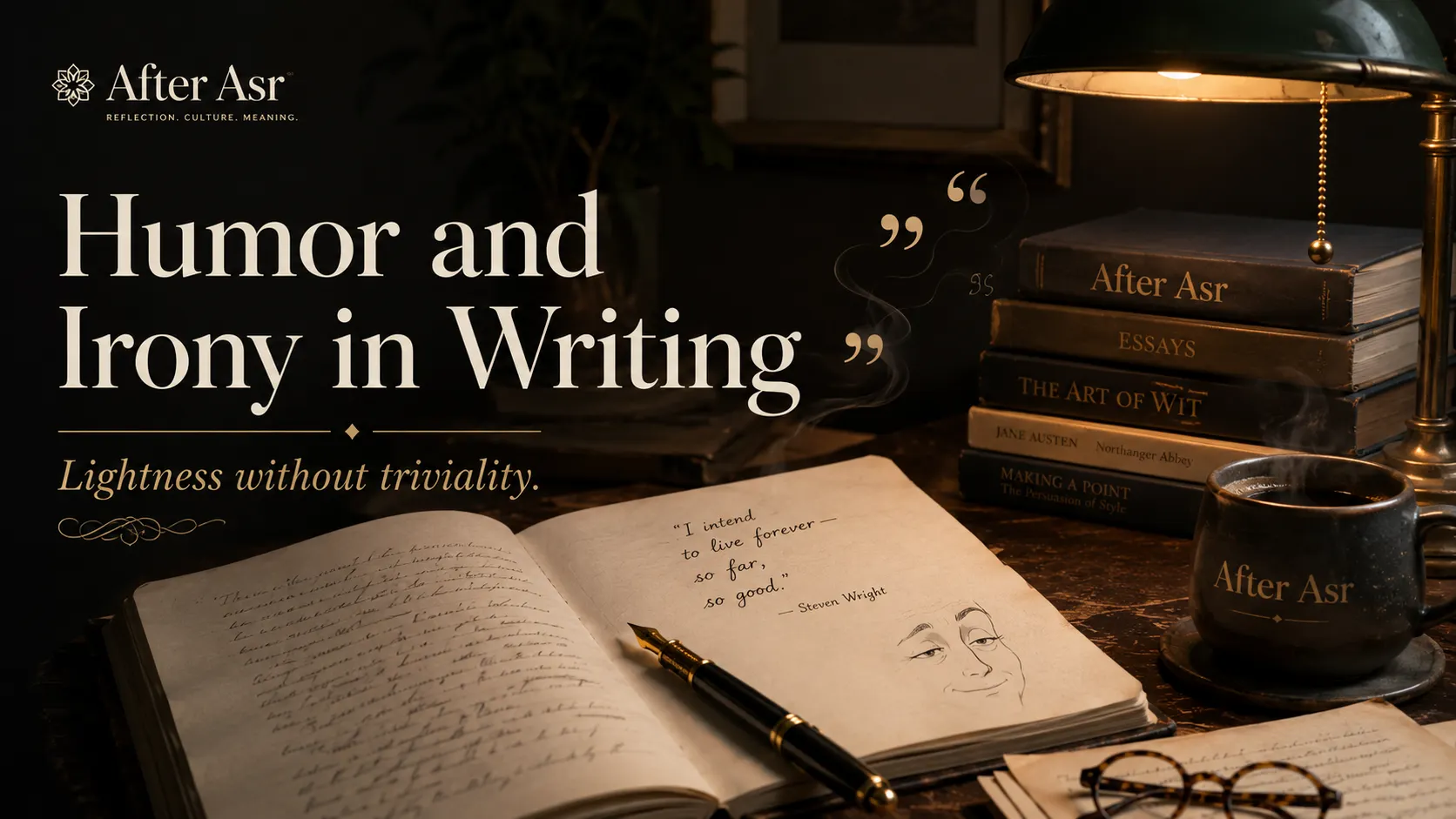
Lightness without triviality.
A serious writer is not required to sound solemn.
Some truths arrive more cleanly through laughter than through declaration. Vanity may be exposed by a joke before it can defend itself. Hypocrisy may look grand in a speech and ridiculous in a scene. A character’s self-importance may require no denunciation if the writer simply lets them continue speaking. A society may tolerate a critique in comic form that it would reject if delivered as a scold.
Humor is not the enemy of seriousness. Often, it is seriousness freed from stiffness.
Irony, too, is frequently misunderstood. It is treated as aloofness, sarcasm, or the fashionable refusal to mean anything directly. Irony can become those things, especially in cultures that turn detachment into identity. But literary irony at its best is not empty distance. It is a sharpened way of perceiving contradiction. It notices the gap between what is said and what is meant, what is promised and what occurs, what a person believes about themselves and what the story quietly reveals.
Humor makes room. Irony creates perspective. Together, they allow writers to approach foolishness, suffering, pretension, power, and moral contradiction without making prose heavy-handed or thinly didactic.
This matters because not every grave subject is best handled gravely on the surface. A comic novel may understand cruelty better than a melodrama. A satirical essay may reveal corruption more memorably than a polite report. A scene of domestic absurdity may say more about loneliness than a paragraph naming it directly. Lightness, when earned, does not trivialize. It gives truth mobility.
The danger, of course, is real. Humor can humiliate rather than illuminate. Satire can turn persons into caricatures. Irony can become a refusal of conviction. Jokes can relieve pressure that should not be relieved, making the intolerable feel merely amusing. A 2025 study reported by the American Psychological Association found that satire can sometimes damage a target’s reputation more than direct criticism because it reduces people into comic objects and may invite dehumanizing interpretation. (apa.org)
So the question is not whether serious writing should laugh. It must, at times, if it wants to remain human. The question is what kind of laughter it produces, at whose expense, and toward what end.
The False Opposition Between Funny and Important
A common mistake in literary culture is to divide writing into two camps: the serious and the comic. The serious work addresses war, injustice, death, exile, faith, politics, memory. The comic work entertains. It lightens. It belongs to leisure.
Great literature has never respected this division.
Cervantes’s Don Quixote is ridiculous and profound. Jane Austen’s novels are comic masterpieces of social observation and among the keenest anatomies of class, vanity, and self-deception in English. Gogol’s bureaucrats are laughable until we realize the world they inhabit is terrifying. Molière’s hypocrites and misers amuse precisely because they reveal moral deformation. Al-Jahiz’s Book of Misers remains funny because avarice, rationalized with extraordinary ingenuity, is both absurd and recognizably human.
Satire, as described in The Cambridge Introduction to Satire, has long worked by holding folly, weakness, fraud, and vice up to ridicule. It may seek reform, or it may simply revel in provocation, but its literary power rests in the capacity to expose what polite language often conceals. (cambridge.org)
The funny and the serious frequently occupy the same sentence because life itself refuses clean separation. People joke at funerals. Families laugh during hardship. Oppressive institutions produce absurd rituals. Lovers misunderstand one another in ways that are painful and comic at once. A person may be ridiculous in the very moment they are suffering, and acknowledging that does not diminish the suffering. It may make the portrayal more truthful.
Writing that refuses all humor in the name of seriousness can become inhuman. It treats dignity as though it requires gravity at every moment. But human beings are not only dignified when sorrowful. They are dignified when witty, awkward, playful, teasing, and capable of seeing their own smallness without collapse.
Humor belongs to the full account of life.
Laughter Can Tell the Truth Sideways
Direct accusation is powerful, but not always the most effective literary method.
If a writer declares, “This official is vain,” the sentence may be accurate and still unmemorable. If the official spends half a page congratulating himself for “humble service” while correcting the order in which his titles appear on a poster, the vanity becomes visible from within. The reader is invited to discover it, not merely receive it.
Humor often tells the truth sideways. It creates a scene in which the target reveals itself.
This is especially valuable when confronting pretension. Pretension depends on atmosphere. It requires that everyone behave as though the inflated thing deserves solemnity. Humor punctures that atmosphere. It asks, quietly or explosively, whether the emperor’s robes are as magnificent as everyone has agreed to pretend.
Irony operates similarly. In literature, irony often depends on disparity: between appearance and reality, knowledge and ignorance, intention and outcome. Oregon State University’s literary guide defines irony in accessible terms as a departure between what one expects and what actually happens or is meant, distinguishing verbal, dramatic, and situational forms. (oregonstate.edu)
A proud character insists they are acting nobly while the reader sees the pettiness beneath the gesture. A tyrant builds a monument to permanence shortly before losing power. A person chasing admiration becomes ridiculous in proportion to their seriousness. The irony does not merely produce amusement. It produces moral distance, allowing the reader to see what the character cannot.
This distance can be merciful. It spares the writer from overexplaining. It trusts the reader. It also creates a more durable insight, because discoveries made through irony often remain sharper than lessons delivered plainly.
Irony Is a Discipline of Double Vision
Irony requires the mind to hold two levels of meaning at once.
There is the surface statement, and there is the fuller reality beneath or around it. There is what a character knows, and what the reader knows. There is what a social ritual claims to honor, and what it actually protects. Irony trains readers to notice disjunction.
Recent research on irony comprehension continues to emphasize its cognitive complexity. A 2025 study on verbal irony found that understanding ironic language involves flexibility, inhibition, and the ability to navigate meaning beyond literal statement. A 2024 study of irony processing in text likewise examined how readers track contextual cues to recognize that a sentence means more than its surface form. (pmc.ncbi.nlm.nih.gov) (tandfonline.com)
Literature uses this complexity to produce ethical insight. Irony teaches that language can mask as well as reveal, that institutions may speak nobly while acting basely, that people are often least accurate when describing themselves. It is therefore a mode especially suited to writing about hypocrisy, bureaucracy, ideology, and self-deception.
Consider a fictional university announcing a “bold commitment to open inquiry” in the same letter that quietly disinvites a controversial speaker. The irony need not be explained. The juxtaposition does the work. Or consider a family that prides itself on honesty while carefully avoiding the one conversation everyone knows is overdue. The irony is not just funny. It reveals the mechanism of denial.
Irony sees two things together that a flatter form of narration might separate. It is not merely a style. It is a way of perceiving contradiction without immediately smoothing it into a moral slogan.
Humor Makes Critique Memorable
Some arguments are correct and forgettable. Humor can give them afterlife.
A sharp comic image compresses critique into a portable form. The miser who spends more energy avoiding generosity than generosity would have cost. The official who orders a study on efficiency that requires nine committees to approve. The pompous scholar who quotes endlessly about humility but refuses to sit on an ordinary chair. These figures travel because they are vivid.
Humor also changes the reader’s posture. A direct reprimand may trigger resistance. A joke can lower defenses, at least initially, making room for recognition. Research on humor in communication has long found that laughter can influence social connection, reduce tension, and shape how difficult material is received, though effects vary greatly depending on context and target. Humor is not automatically persuasive, but it can alter the atmosphere in which persuasion occurs. (pmc.ncbi.nlm.nih.gov)
Writers have understood this intuitively for centuries. Satire may expose corruption by exaggerating its logic until it becomes ridiculous. Comic realism may reveal how people collaborate with absurd systems because those systems are easier to obey than resist. A humorous memoir may reach readers who would avoid a more overtly sorrowful account, then surprise them with grief once trust has formed.
The comedy does not dilute the seriousness. It opens a path toward it.
The Comic Is Often Close to the Tragic
Humor and sorrow are not opposites. They are often neighbors.
People laugh in hospitals. They joke during funerals. They invent absurd phrases inside oppressive environments. Prison memoirs, war diaries, family narratives of poverty, and migration stories often contain moments of intense humor. These moments should not be misread as evidence that suffering was minor. They may be evidence that human beings resist being reduced entirely to suffering.
The comic can preserve dignity because it refuses total domination by pain. It says: even here, consciousness remains agile. Even here, absurdity can be noticed. Even here, the self has not been fully conquered by circumstance.
At the same time, laughter can reveal tragedy by contrast. A comic scene may suddenly turn and expose the loneliness underneath. A character’s ridiculous habits may become heartbreaking once we understand what fear sustains them. A family’s jokes may conceal a grief none of them know how to name directly.
The best comic writing does not keep sorrow out. It knows sorrow well enough not to parade it constantly.
This is why writers who use humor effectively often seem more, not less, serious than those who maintain a single heavy tone. They understand emotional variation. They know that unrelieved gravity can become monotonous and false. Life does not speak in one register. Literature should not either.
Lightness Requires Precision
Humor can look effortless on the page. It rarely is.
A joke lands because of timing, placement, rhythm, omission, and the exact degree of excess. A sentence becomes funny because one word arrives later than expected, or because the writer withholds explanation long enough for recognition to occur. A comic scene collapses if overexplained. Irony weakens if under-signaled so completely that readers cannot perceive the gap. Satire fails if the target is vague, the exaggeration careless, or the writer’s contempt too blunt.
Lightness is technically demanding.
It requires control of proportion. A writer must know when to stop. One additional sentence can turn wit into labor. One heavy-handed clarification can flatten irony. One indulgent flourish can transform sharp comedy into noise.
This technical discipline is part of why humor deserves literary respect. It is not the easy alternative to seriousness. It is a craft of serious exactness. The writer must hear cadence, anticipate the reader’s expectation, and place surprise with confidence.
Comic writing also demands intelligence about the target. Mocking mere weakness is easy. Mocking pretension, cruelty, hypocrisy, or vanity in a way that reveals something larger requires judgment. The ethical question and the aesthetic question meet here. Bad humor often fails morally and artistically for the same reason: it chooses an easy victim.
When Satire Punches Down
Humor becomes trivial or ugly when it mistakes vulnerability for absurdity.
There is a difference between exposing a powerful institution and humiliating people already denied dignity. A satire of bureaucratic indifference may sharpen public perception. A joke about a poor person’s speech, a disabled body, a migrant’s accent, or a religious minority’s unfamiliar practice may simply reaffirm dominance. The fact that laughter occurs does not make the laughter wise.
The recent APA-reported study on satire’s reputational effects is useful here because it challenges the assumption that humorous criticism is automatically gentler than direct critique. Researchers found that satire can intensify reputational harm by reducing targets to caricature. (apa.org)
Literary writers should not treat this as a reason to abandon satire. They should treat it as a reminder that ridicule has force. It can expose a fraud. It can also simplify a human being until the simplification feels entertaining.
The moral quality of humor depends partly on whether it reveals complexity or destroys it. Satire may rightly reduce an institution’s pompous language to absurdity because institutions often hide behind abstraction. But when satire reduces an already stereotyped community to a comic type, it does not expose power. It serves it.
Lightness without triviality requires ethical aim.
Irony Can Become Cowardice
If humor can become cruelty, irony can become evasion.
There is a form of contemporary irony that refuses full commitment to anything. It signals intelligence by remaining above sincerity. It smiles before it can be moved. It turns earnestness into embarrassment. Nothing is defended plainly because plain defense risks vulnerability.
This posture can influence writing. A novel may gesture toward serious concerns while undercutting every moment of emotional directness. An essay may wrap conviction in layers of joking distance until no reader can tell what the author actually believes. A character may be written as “self-aware” simply because they mock their own faults before anyone else can.
Irony used this way does not deepen meaning. It protects the writer from being caught meaning too much.
That protection has cultural costs. A 2025 essay in The New Yorker criticized the ubiquity of humor and ironic detachment in contemporary public life, arguing that reflexive joking can sometimes replace meaningful engagement with serious realities. The critique should not be taken as a rejection of humor itself, but it does name a danger: comedy becomes impoverished when it functions only as insulation from responsibility. (newyorker.com)
Literary irony is strongest when it serves insight, not self-protection. It should reveal false seriousness, not make all seriousness impossible. It should clear away pomposity so truth can breathe, not leave the room empty.
A writer who can only mock sincerity is not sophisticated. They are limited.
The Muslim Literary Inheritance Includes Laughter
Muslim literary culture is sometimes misrepresented as uniformly grave, as though piety and humor were natural enemies. The historical record is far richer.
Al-Jahiz, the ninth-century Basran prose master, wrote on theology, politics, language, animals, and society, but he also produced one of Arabic literature’s great comic works, The Book of Misers. The book gathers portraits of people whose stinginess becomes ingenious, excessive, and revealing. Its humor is not frivolous. It exposes self-justification, greed, absurd rationalization, and the ways vice recruits intelligence to defend itself. Cambridge’s overview of al-Jahiz identifies adab as one of his main literary domains, while classic scholarship on humor in early Islam highlights the substantial place of wit, jest, and comic anecdote in Arabic prose culture. (cambridge.org) (jstor.org)
This inheritance matters. It shows that Muslim literary seriousness has not always meant solemnity. Adab literature made space for anecdote, wit, misers, boasters, fools, and comic reversals because moral formation does not occur only through heavy instruction. Sometimes a person recognizes their own pettiness more readily after laughing at someone else’s.
Islamic ethics, of course, place limits on mockery, slander, humiliation, and speech that harms. Humor does not become virtuous merely because it is funny. But neither should Muslim writers imagine that dignity requires a banishment of comedy. Laughter can be clean. Wit can be generous. Irony can discipline arrogance. Humor can make a moral point more humane than severity alone would allow.
A tradition mature enough for theology, law, poetry, epic, and lament is also mature enough for laughter.
Humor Creates Fellowship
Not all literary humor is satirical. Some of it is hospitable.
A comic line can make a narrator lovable. A shared joke can build trust between writer and reader. A novel may use warmth, not ridicule, to reveal the oddity of ordinary life. A memoir may tell an embarrassing story not to condemn anyone, but to invite the reader into the writer’s humanity.
This kind of humor matters because it reduces unnecessary distance. It reminds us that people are not only their wounds, beliefs, roles, or public identities. They are also ridiculous in familiar ways. They misplace things, overprepare, say the wrong sentence at the wrong time, cling to tiny habits, invent implausible excuses, and try to retain dignity while life repeatedly exposes how little control they have.
Benevolent humor has been associated in psychological research with lower levels of depression, anxiety, and stress, though such findings concern lived coping rather than literature directly. Still, the broader point resonates: humor can sustain people without denying difficulty. (pmc.ncbi.nlm.nih.gov)
Writers who understand this create work that is lighter without being thinner. They allow readers to exhale. They make seriousness bearable because they refuse to confuse seriousness with emotional monotony.
Comedy Can Make Characters More Real
A character who is only tragic can become a symbol. A character who is only noble can become an instruction. Humor restores irregularity.
The grieving father who cannot stop correcting everyone’s pronunciation. The devout aunt whose generosity is limitless except when someone touches her preferred serving spoon. The revolutionary who writes magnificent manifestos but cannot assemble a bookshelf. The brilliant professor who becomes childishly competitive during a family board game. These details do not diminish characters. They rescue them from abstraction.
Real people are mixed.
They may be courageous and petty, wise and vain, wounded and funny. Literature that omits this mixture in pursuit of dignity can accidentally dehumanize. It turns people into representative suffering or exemplary goodness. Humor puts back the oddness that makes a person feel alive.
This is especially important when writing about marginalized communities. A novel about displaced people, Muslims under suspicion, workers under exploitation, or families enduring poverty should not feel obligated to maintain a constant register of pain in order to prove the pain is real. People in difficulty joke. Communities under pressure develop comic languages of survival. To omit that entirely can produce a form of flattening just as distorting as sentimentalization.
Humor says: these lives are not only burdens to be documented. They are lives.
Irony Protects Writing From Propaganda
Propaganda hates irony because irony multiplies perspective.
Propaganda wants one meaning, one emotional direction, one approved conclusion. It wants heroes without flaw, enemies without interiority, and institutions whose stated purposes require no examination. Irony introduces a second angle. It notices that the heroic official keeps adjusting the camera. It notices that the slogan about freedom appears beside a locked door. It notices that the speech about equality is delivered from a room no ordinary person can enter.
This does not mean irony is always politically liberating. It can be cynical, anesthetizing, or merely clever. But it has a natural affinity for puncturing inflated language. It tests whether words correspond to reality.
That is why authoritarian cultures often tolerate flattery more easily than jokes. A joke may reveal what a speech conceals. A comic character may make an ideology look silly, and silliness can be corrosive to power. Institutions built on fear often depend on the aura of inevitability. Laughter can weaken that aura.
Satire remains risky because it rearranges dignity. It asks whether the people commanding reverence deserve it. Sometimes this is justice. Sometimes it is irresponsibility. The writer must know the difference.
Humor Should Reveal, Not Distract
There are times when humor becomes a way not to face what deserves gravity.
A writer may crack jokes during a scene of suffering because they fear earnestness. A culture may turn every scandal into memes before moral attention can develop. A novel may use comic banter to prevent emotional depth. A speaker may hide cruelty inside “just kidding.” In such cases humor does not deepen truth. It diverts from it.
The test is whether laughter opens the subject or closes it.
After the joke, do we see more?
Do we understand more sharply?
Are we closer to the human stakes?
Or have we been relieved of the obligation to care?
Lightness without triviality depends on this distinction. The finest humorous writing leaves something behind after the laugh: embarrassment, recognition, tenderness, anger, humility, clarity. The joke is not the end. It is a door.
Writing That Can Smile Is Often More Trustworthy
A writer who knows how to be funny often understands proportion.
They know that not every observation deserves thunder. They know that human beings are frequently absurd without being contemptible. They know that solemn language can hide nonsense just as comic language can reveal it. They know that a sentence need not wear a black coat to matter.
This does not make all comic writers wiser than serious ones. But it does mean that humor can signal a certain freedom from self-importance. A writer capable of smiling at their own subject, and sometimes at themselves, may be less tempted to inflate every claim beyond scale.
Readers trust writers who can vary tone because variation feels closer to life. A book that contains only one emotional temperature, however noble, may begin to feel controlled. Humor introduces air. Irony introduces intelligence. Together they prevent seriousness from becoming pompous.
The Dignity of Laughter
There is dignity in laughter when laughter is truthful.
It can humble pride without humiliating the weak.
It can expose the ridiculousness of vice.
It can make grief more bearable without denying grief.
It can build fellowship between writer and reader.
It can resist the false grandeur of power.
It can reveal that human life, even in its pain, has not surrendered all agility.
Humor and irony in writing matter because they protect literature from becoming a lecture, a slogan, or a shrine to its own seriousness. They allow writers to tell difficult truths with movement, surprise, and tonal complexity. They acknowledge that the world is not only tragic, not only beautiful, not only unjust, not only absurd, but often all of these at once.
A writer who understands humor does not make light of what matters.
They know how to let light reach it.