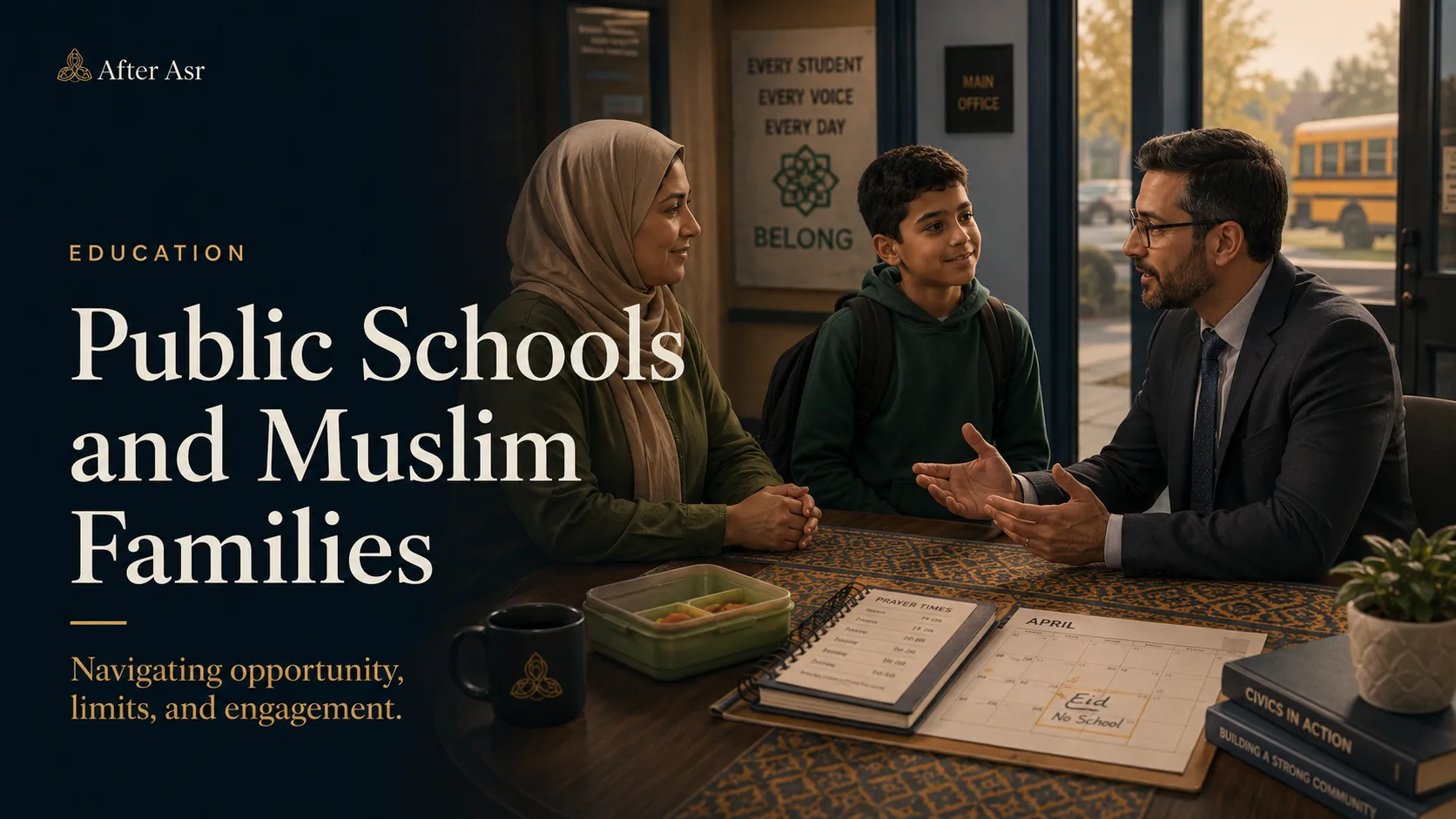
Navigating opportunity, limits, and engagement.
For many Muslim families in America, public school is not an abstract policy question.
It is the place where their children spend most of the day.
It is the hallway where a daughter may be asked about her hijab.
It is the lunchroom where a son may explain why he does not eat pork.
It is the classroom where a child may hear history, science, literature, politics, sexuality, identity, religion, and culture discussed through assumptions the family does not always share.
It is the playground where friendships form.
It is the office where parents sign forms they may not fully understand.
It is the gym where modesty questions arise.
It is the calendar where Eid may be invisible.
It is the place where a child may gain confidence, opportunity, and knowledge—or quietly learn to feel strange, embarrassed, or alone.
Public school is one of the most important institutions shaping Muslim children in America.
For some families, it is a blessing. For others, it is a compromise. For many, it is both.
A serious conversation about Muslim families and public schools must avoid two extremes.
The first extreme is fear. It treats public schools as if they are only places of corruption, confusion, and danger. This view may notice real concerns, but it can become so suspicious that it fails to see teachers who care, programs that help, friendships that matter, and knowledge that benefits.
The second extreme is naïveté. It treats public schools as neutral spaces where children simply learn math, reading, science, and social skills without deeper formation. This view may appreciate opportunity, but it overlooks the powerful moral, cultural, emotional, and spiritual education children receive indirectly.
Muslim families need a wiser posture.
Not panic.
Not passivity.
Engagement.
Public schools are not perfect. They are not designed around Islamic formation. They reflect the values, conflicts, strengths, and weaknesses of the society around them. But they are also real places filled with real people: teachers, counselors, students, bus drivers, librarians, coaches, principals, nurses, and parents.
The question is not simply, “Should Muslim children attend public school?”
Many already do. Many will continue to.
The deeper question is, “How can Muslim families engage public schools with clarity, confidence, and responsibility?”
Public school as opportunity
Public schools can offer real benefits.
They provide broad access to education without tuition. They often offer libraries, laboratories, sports, music, art, special education services, counseling, English language support, gifted programs, advanced classes, career and technical education, transportation, meals, and extracurricular activities.
For families with limited income, public schools may provide resources that would otherwise be difficult to access. For immigrant families, they can help children learn English and navigate American society. For children in isolated communities, they can create friendships and exposure to people from different backgrounds.
A public school can introduce a child to a gifted teacher who changes the course of their life.
A good teacher can notice talent.
A good counselor can help with college planning.
A good coach can build discipline.
A good librarian can awaken love of reading.
A good special education team can help a struggling child receive needed support.
A good friend can make school feel less lonely.
Muslim families should not speak about public schools as if nothing good can happen there.
There are teachers who stay late to help students. There are principals who want every child safe. There are classmates who show kindness. There are school staff members who will gladly make room for prayer, fasting, modest dress, Eid absences, and halal concerns when families communicate clearly.
Public school can also teach Muslim children how to live with confidence in a pluralistic society. They may learn how to explain their faith calmly, work with people unlike themselves, resist peer pressure, and carry Islamic identity without hiding.
These are not small things.
The world our children inherit will require them to interact with difference. Public school can become one place where they practice doing so.
But opportunity is not the whole story.
Public school has limits
Public school is not a Muslim institution.
This obvious fact is sometimes forgotten.
A public school may respect Muslim students. It may accommodate religious practice. It may include Islam in a history unit. It may celebrate diversity. It may punish bullying. It may provide safe classrooms and kind teachers.
But it is not responsible for forming a child’s Islamic worldview.
It will not organize the day around salah.
It will not teach every subject through tawheed.
It will not treat Qur’an as revelation.
It will not necessarily share the family’s view of modesty, gender, sexuality, authority, adab, worship, family structure, or moral responsibility.
It will not automatically protect a child from every harmful influence.
It will not replace the home, the masjid, the family, or the Muslim community.
This does not mean public school is evil. It means it has limits.
Many problems begin when parents expect public school to do what it was never designed to do.
If a family wants a child to love Qur’an, the school cannot be the main plan.
If a family wants a child to know how to pray, fast, lower the gaze, honor parents, respect elders, speak with adab, understand Islamic history, love the Prophet ﷺ, and develop a Muslim moral imagination, the public school cannot carry that responsibility.
It may not actively oppose these things. But it will not form them deeply.
That work belongs to the family and community.
Public school can provide academic structure. It can offer social experience. It can teach many useful subjects. But Muslim formation must be intentionally built elsewhere.
A child cannot receive forty hours of public culture each week and five minutes of scattered Islamic reminders, then be expected to grow into strong faith by accident.
The hidden curriculum
Public school teaches more than official subjects.
It teaches through atmosphere.
It teaches students what is normal, what is embarrassing, what earns attention, what is rewarded, what is mocked, what is ignored, and what adults treat as important.
This is sometimes called the hidden curriculum.
A Muslim child in public school may learn math, reading, science, and history. But the child may also learn other lessons:
That prayer is something unusual.
That religious commitment is private and slightly awkward.
That modesty must be explained.
That lunch is complicated.
That dating is assumed.
That popularity can matter more than character.
That confidence sometimes looks like disrespect.
That everyone is expected to have an opinion before they have wisdom.
That the loudest voices shape the room.
That being different can be tiring.
Not every child experiences this the same way. Some Muslim students thrive socially and spiritually. Others feel pressure to hide pieces of themselves. Some become confident ambassadors of their faith. Others become exhausted by always being the representative Muslim in the classroom.
Parents should pay attention not only to grades, but to identity.
Does my child feel embarrassed to be Muslim?
Does my child know how to explain basic practices?
Does my child have Muslim friends or mentors?
Does my child feel safe at school?
Does my child know what to do if mocked or pressured?
Does my child understand why our family lives differently?
Does my child have space to ask hard questions without being shamed?
The hidden curriculum must be answered by a stronger home curriculum.
The lunchroom matters
Sometimes the most important school issues are not dramatic.
They are ordinary.
Lunch matters.
A Muslim child may sit in a cafeteria where pork is served, where halal options are unavailable, where fasting during Ramadan feels awkward, where classmates ask questions, where teachers may not understand why a child is not eating, or where a young student feels left out because food is tied to celebration.
Parents may think, “It is only lunch.”
But children experience daily difference through small moments.
The lunchroom can teach confidence or embarrassment. It can teach practical responsibility or social anxiety. It can become a place where a child learns to explain, “I do not eat that,” without shame.
Families can help by preparing children ahead of time.
A child should know what they can eat.
A child should know what to say politely.
A child should know whether school meals are allowed or not.
A child should know how to ask an adult for help.
A child should not feel that being Muslim means being a problem.
During Ramadan, parents should communicate with the school early. Younger children may not be fasting, but older students may need support. Some may prefer to sit in the library or another quiet space during lunch. Some may need reduced physical strain during intense activity. Some may simply need teachers to understand why energy levels are different.
These details matter because faith is lived in details.
Prayer during the school day
Prayer is another important issue.
Depending on the school schedule and season, a Muslim student may need to pray Dhuhr during school hours. In some cases, Asr may also become a concern, especially during shorter winter days or after-school activities.
Families should not wait until the child feels embarrassed or conflicted.
A respectful request can often solve much of the issue.
Parents can ask for a clean, quiet, private or semi-private space where the student may pray for a few minutes. This does not require the school to become religious. It simply allows the student to practice their faith.
The child should also be taught how to handle the situation maturely.
They should know how to make wudu if possible.
They should know what to do if water access is awkward.
They should know how long prayer will take.
They should know how to speak respectfully to staff.
They should know that salah is not something shameful.
At the same time, parents should be realistic. A young child may need more guidance. A teenager may resist being visibly different. Some students may need encouragement. Others may need logistical help.
The goal is not to create unnecessary confrontation.
The goal is to make obedience to Allah feel possible in ordinary life.
Religious holidays and school calendars
For many Muslim children, Eid can feel strange in public school because the school world often continues as if nothing special is happening.
Christmas may transform the entire atmosphere of the school. Halloween may be everywhere. Valentine’s Day may be built into classroom activities. But Eid may receive little attention unless Muslim families speak up.
This invisibility can affect children.
A child may wonder why their holidays are absent.
A child may feel that their joy does not belong in public.
A child may feel pressure to attend school on Eid because missing class feels inconvenient.
A child may not know how to explain the significance of the day.
Families can respond constructively.
They can notify the school about Eid absences.
They can ask teachers to avoid major tests or deadlines on Eid when possible.
They can provide a short explanation of the holiday.
They can offer to share age-appropriate information with the class.
They can help children feel proud and joyful, not apologetic.
Muslim communities can also work together. If a district has a growing Muslim population, families and community leaders may request that Eid be acknowledged on school calendars or treated with greater awareness.
Not every request will be granted. But silence guarantees invisibility.
Bullying, jokes, and quiet exclusion
Islamophobia in school does not always appear as a dramatic hate incident.
Sometimes it appears as jokes.
Sometimes as questions that are really accusations.
Sometimes as teachers mispronouncing names for years without trying.
Sometimes as classmates calling a child a terrorist.
Sometimes as pressure to explain global politics.
Sometimes as suspicion toward Arabic words.
Sometimes as mockery of hijab, fasting, prayer, or family rules.
Sometimes as exclusion from social life because the Muslim child is seen as too different.
Parents should take this seriously without teaching children to see enemies everywhere.
Children need language.
They should know the difference between a sincere question and a disrespectful comment.
They should know when to answer and when to walk away.
They should know which adults at school can help.
They should know that bullying should be reported.
They should know that patience does not mean accepting humiliation.
Parents should document serious incidents. Dates, names, screenshots, emails, and written summaries matter. A calm written record is often more effective than an emotional phone call.
At the same time, parents should build children’s inner confidence before problems arise. A child who knows who they are will be less easily shattered by ignorance.
Muslim identity should not be introduced only as defense against hostility. It should be taught as beauty, gratitude, belonging, worship, history, and purpose.
Curriculum concerns
Parents often worry about curriculum.
Sometimes the concern is history. Sometimes it is sex education. Sometimes literature. Sometimes holidays. Sometimes music, dance, evolution, politics, gender, race, or religious representation.
These concerns should not be dismissed. What children study shapes how they understand the world.
But parents need a thoughtful approach.
Not every disagreement is an emergency.
Not every classroom mention requires outrage.
Not every teacher is trying to undermine the family.
Not every uncomfortable topic can or should be avoided.
Not every school concern is solved by withdrawal.
Muslim parents should know what is being taught. They should read school communications. They should ask for curriculum information when needed. They should understand opt-out policies where they exist. They should speak with teachers respectfully before assuming bad intent.
But they should also teach their children how to encounter ideas without collapsing.
A Muslim student will eventually meet views that differ from Islam. The question is whether that happens with preparation or without it.
If parents only say, “That is haram, do not listen,” some children may obey. Others may become curious in secret. Others may conclude that Islam cannot handle questions.
A stronger approach teaches children the Islamic view, explains why it matters, and helps them understand how to respond when others believe differently.
Public school makes this necessary earlier than some parents expect.
The importance of teacher relationships
A teacher can make a major difference in a Muslim child’s school experience.
Many teachers want to do right by their students but do not know what Muslim families need. They may not understand Ramadan, Eid, prayer, halal food, modesty, names, religious dress, or family expectations.
Parents should not assume teachers already know.
A short, kind introduction at the beginning of the school year can prevent many problems.
Parents might say:
“Our family is Muslim, and I wanted to share a few things that may come up during the year. Our child does not eat pork. During Ramadan, fasting may affect lunch and energy levels. We observe Eid, so we may request an excused absence. Please let us know if any questions come up.”
This kind of communication is not demanding. It is helpful.
Parents should also avoid contacting teachers only when something goes wrong. A relationship built before conflict is stronger than one created during crisis.
Thank the teacher when they accommodate.
Ask questions early.
Respond to messages.
Attend conferences if possible.
Treat teachers as partners, not enemies.
This does not mean parents should be passive if something serious happens. But adab and advocacy can exist together.
Parents must know their rights and responsibilities
Muslim families should understand that public school students have rights, but rights work best when families are informed and organized.
Students generally may wear religious clothing, discuss their faith when appropriate, pray privately or in student-led ways that do not disrupt instruction, and receive reasonable accommodations for religious practice. Families may request information, raise concerns, and seek support.
But parents also have responsibilities.
They should communicate clearly.
They should follow school procedures.
They should keep records.
They should make requests in writing when needed.
They should avoid exaggeration.
They should teach children respectful conduct.
They should understand that not every inconvenience is discrimination.
They should know when an issue is serious enough to escalate.
A family that knows both rights and responsibilities can advocate with dignity.
Muslim communities should consider offering parent workshops on navigating schools. Many families do not know what to ask, how to write emails, how to request meetings, how to document concerns, or how to seek accommodations.
Community knowledge is protection.
The role of the masjid
The masjid cannot ignore public school.
If most Muslim children in a community attend public schools, then public school is part of the community’s spiritual environment, whether leaders acknowledge it or not.
The masjid should not only teach children how to recite. It should help them live as Muslims where they actually spend their lives.
This may include:
Youth discussions about school pressure.
Workshops on prayer at school.
Parent sessions on public school rights.
Mentorship for Muslim students.
College and career guidance.
Support for students facing bullying.
Ramadan preparation for school schedules.
Teacher appreciation or community outreach.
Tutoring programs.
Conversations about identity, modesty, friendship, dating, social media, and faith.
A masjid that only sees children for weekend Islamic school may underestimate the number of hours children spend being formed elsewhere.
If public school is where Muslim children face daily questions, then Muslim institutions must prepare them for those questions.
Not with fear.
With knowledge, confidence, and companionship.
Muslim students should not become isolated ambassadors
Many Muslim students in public school feel pressure to represent Islam.
Sometimes this is positive. A student may enjoy explaining Ramadan or Eid. They may feel proud answering questions. They may become a bridge of understanding.
But this role can also become tiring.
A child should not have to answer every question about terrorism, war, hijab, gender, politics, the Middle East, or every Muslim in the world.
A Muslim student is a student, not a spokesperson for nearly two billion people.
Teachers should be careful not to put Muslim students on the spot. Parents can also prepare children with simple phrases:
“I do not know enough to answer that.”
“That is a big question. You can ask my parents or look for a reliable source.”
“I can tell you what my family does, but Muslims are not all the same.”
“I do not want to discuss that right now.”
“That comment feels disrespectful.”
These phrases protect dignity.
Muslim children should be confident, but they should not be burdened with adult debates before they are ready.
Friendship and belonging
One of the greatest concerns for Muslim families is friendship.
Friends shape children deeply. They influence language, humor, clothing, confidence, habits, entertainment, values, and self-image.
Public school exposes children to many kinds of friends. Some will be kind and principled. Some will be careless. Some will challenge a child in good ways. Others may pull the child toward harmful behavior.
Parents cannot control every friendship, especially as children grow older. But they can shape the environment around friendship.
They can know their child’s friends.
They can welcome friends into the home.
They can ask about lunch, group projects, clubs, and social life.
They can create spaces where Muslim friendships are available.
They can talk openly about peer pressure.
They can teach children how to be kind without surrendering values.
Muslim children need belonging.
If they do not find healthy belonging among Muslims, they may seek belonging elsewhere without guidance. If every Muslim space feels boring, judgmental, or disconnected from their real life, then public school peer culture may become more emotionally powerful than family or masjid.
The answer is not to lock children away from all non-Muslim friendships. Islam teaches good conduct with neighbors and society. Many non-Muslim friends may be sincere, loyal, respectful, and morally serious.
The answer is to help children choose friends wisely and maintain Islamic identity within friendship.
The danger of overprotection
Some parents respond to public school challenges by becoming extremely restrictive.
Their fears may be understandable. They want to protect faith, modesty, innocence, and family values. They see real problems in youth culture. They do not want their children swallowed by confusion.
But overprotection can create its own harm.
If children are never taught how to think, only what to avoid, they may become fragile.
If they are never trusted with responsibility, they may hide their lives.
If every outside influence is treated as contamination, they may become curious in secret.
If Islam is presented mainly as a list of dangers, they may associate faith with anxiety.
If parents never explain the wisdom behind boundaries, children may obey only until they are unsupervised.
Protection is necessary. But protection must mature into preparation.
A five-year-old needs direct boundaries.
A ten-year-old needs explanations.
A fifteen-year-old needs serious conversation and guided responsibility.
An eighteen-year-old needs internal conviction, not only external control.
The goal is not to keep children innocent forever by preventing all contact with difficulty. The goal is to help them become strong enough to meet difficulty with faith and judgment.
Public school makes this work urgent.
The danger of disengagement
The opposite problem is disengagement.
Some parents send children to public school and barely interact with the system. They do not know the teachers. They do not check assignments. They do not understand curriculum. They do not attend meetings. They do not ask about social life. They do not discuss faith challenges. They assume everything is fine unless grades collapse.
This is dangerous.
Children may be struggling silently.
They may be bullied.
They may be confused by what they hear.
They may be hiding friendships or habits.
They may be losing interest in salah.
They may be performing well academically while drifting spiritually.
They may be lonely and afraid to disappoint their parents.
Disengagement leaves children to navigate public school alone.
Parents do not need to hover over every detail. But they must remain present.
Presence does not mean suspicion. It means attention.
Read the emails.
Know the schedule.
Ask about friends.
Discuss assignments.
Meet teachers.
Watch mood changes.
Make Islamic practice normal at home.
Create time for conversation.
Do not wait for crisis.
Public school requires parental engagement, not because every school is hostile, but because children are being formed every day.
Practical engagement
Muslim families can build a healthier relationship with public schools through simple, consistent practices.
At the beginning of the school year, parents can introduce themselves to teachers and share relevant religious needs.
Before Ramadan, they can explain fasting and ask about lunch or physical education accommodations if needed.
Before Eid, they can request excused absences early.
If the child needs prayer space, they can communicate respectfully with the school.
If bullying occurs, they can document and report clearly.
If a curriculum concern arises, they can ask to review materials before reacting.
If a child is struggling academically, they can request help early.
If a child may have a learning difference, they can ask about evaluation and support.
If language is a barrier, they can request interpretation or ask community members for help.
If a school is doing something well, they can express appreciation.
This kind of engagement builds credibility.
Schools are more likely to listen when parents are known, clear, respectful, and consistent.
What children need from parents
Muslim children in public schools need more than rules.
They need a strong Islamic identity that is not built only on fear.
They need to understand why Muslims pray, fast, dress modestly, avoid certain foods, guard speech, respect parents, and live with accountability.
They need stories of the Prophet ﷺ and the companions that feel alive.
They need Muslim friendships and mentors.
They need parents who can listen without immediately panicking.
They need room to admit confusion.
They need help responding to questions.
They need reassurance that being different does not mean being inferior.
They need to see Islam practiced with beauty at home.
If a child only hears Islam mentioned when something is forbidden, then public school may feel like the place of life and Islam may feel like the place of restriction.
That is a failure of presentation.
Islam must be more than the answer to public school problems. It must be the source of meaning, worship, mercy, discipline, dignity, and joy.
A child who loves being Muslim will navigate public school differently from a child who merely fears parental disappointment.
What schools need from Muslim families
Schools also need something from Muslim families.
They need clarity. Many educators are willing to accommodate but do not know what is required.
They need patience. A teacher with twenty-five students may not remember every detail immediately.
They need partnership. Parents should not appear only during conflict.
They need honesty. If a child is struggling, hiding the issue helps no one.
They need cultural humility from families too. Not every school mistake is malicious. Not every uncomfortable moment is discrimination. Some issues come from ignorance, busyness, or lack of exposure.
But schools also need to be challenged when necessary.
Respect does not require silence in the face of harm.
Patience does not mean accepting bullying.
Partnership does not mean surrendering values.
Gratitude does not mean pretending everything is fine.
A mature relationship between Muslim families and public schools includes both cooperation and boundaries.
A community approach
Individual families can do much, but communities can do more.
Muslim communities should not leave each family to reinvent the same solutions alone.
A mosque or community organization could create a public school resource guide for parents.
It could include sample letters for Ramadan, Eid, prayer accommodations, halal food concerns, and bullying reports. It could list local school contacts, district policies, parent rights, special education resources, tutoring options, and recommended questions for teacher conferences.
The community could also build relationships with local schools.
Invite principals to meet Muslim parents.
Offer cultural awareness sessions.
Create Eid information sheets.
Recognize helpful teachers.
Support Muslim students in leadership roles.
Encourage parents to attend school board meetings.
Provide translation support for families.
Build tutoring and mentorship programs.
This turns anxiety into institution-building.
Muslim communities often talk about wanting the next generation to remain strong. That strength requires more than speeches. It requires systems of support.
Public school is not the whole education
In the end, public school should be understood clearly.
It is a major part of many children’s lives. It can provide academic opportunity, social experience, and access to valuable resources. It can help children grow in confidence and competence. It can introduce them to teachers and friends who leave lasting good.
But it is not the whole education.
It is not the source of a Muslim child’s ultimate identity.
It is not responsible for the child’s entire moral formation.
It is not a substitute for Islamic learning.
It is not a replacement for parents.
It is not a replacement for the masjid.
It is not a replacement for community.
Muslim families must neither demonize public school nor surrender their children to it uncritically.
They must engage it.
They must know its opportunities and its limits. They must build relationships and maintain boundaries. They must advocate without paranoia and cooperate without passivity. They must teach their children how to belong without disappearing.
The Muslim child in public school should not feel like a visitor in their own life.
They should know who they are.
They should know how to ask for what they need.
They should know how to treat others well.
They should know how to carry difference with dignity.
They should know that learning is valuable.
They should know that faith is not something to hide until the school day ends.
Public school is one part of the child’s formation.
The family must provide another.
The masjid must provide another.
The community must provide another.
The child, gradually, must learn to carry all of it with wisdom.
That is the real work.
Not escape.
Not surrender.
Engagement with purpose.