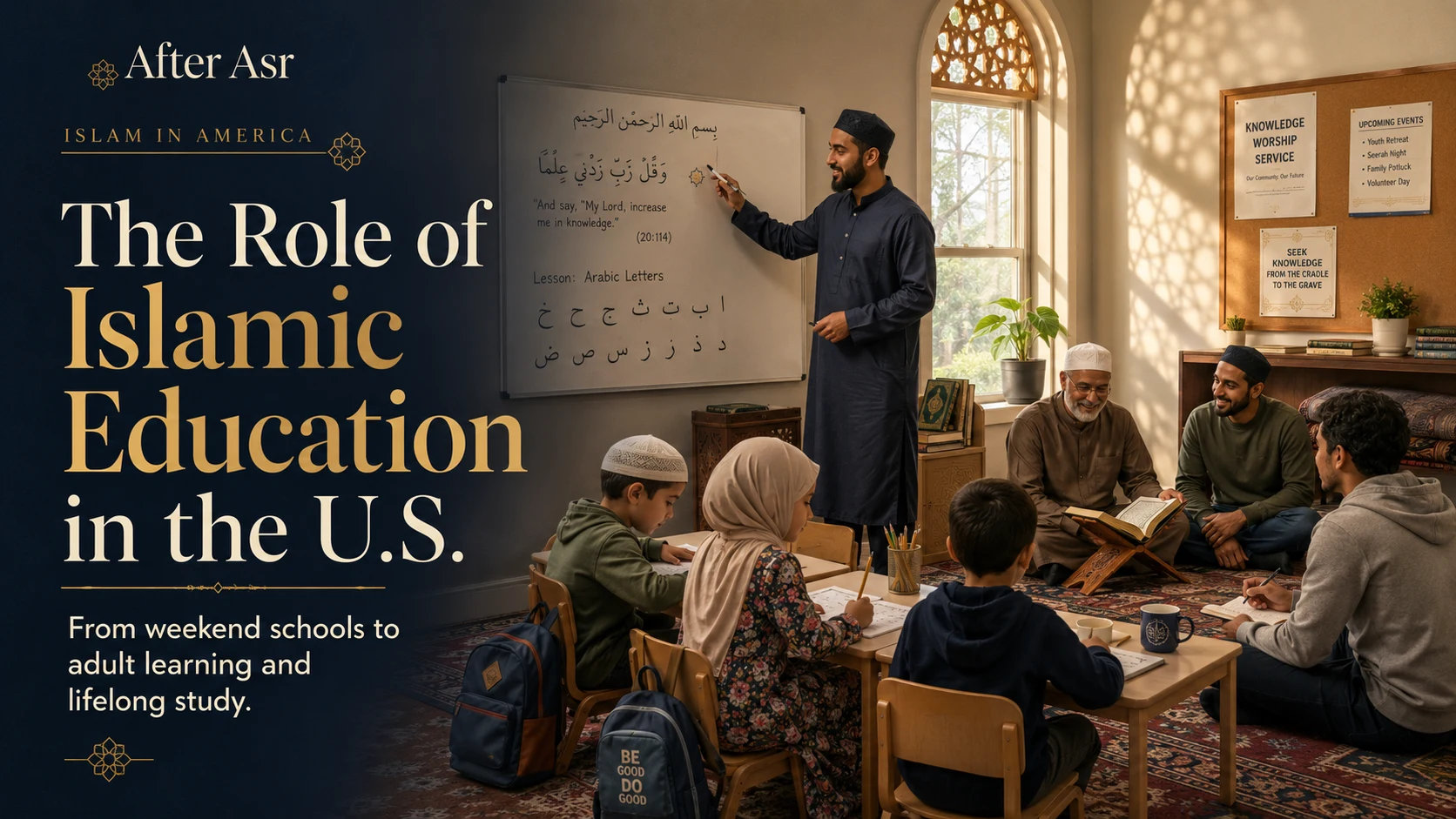
From weekend schools to adult learning and lifelong study.
Islamic education in America often begins in borrowed rooms.
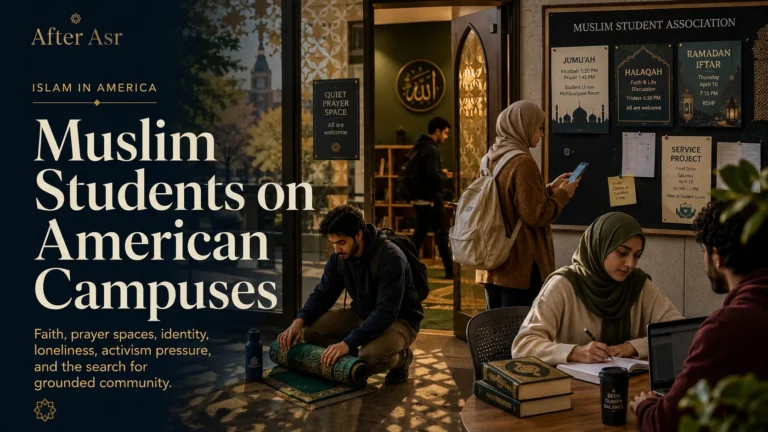
A child sits at a folding table in the mosque multipurpose hall, tracing Arabic letters with a pencil. A volunteer teacher tapes a poster to the wall before class. Parents stand near the doorway, discussing soccer practice, homework, and whether their child has memorized enough Qur’an this week. In another room, teenagers reluctantly gather for a halaqah they may later remember more fondly than they admit. Down the hall, a convert class meets with three students, two notebooks, and many questions. After Maghrib, adults sit in a circle to study purification, prayer, marriage, parenting, tafsir, or the diseases of the heart.
This is the quiet landscape of Islamic education in the United States.
It is not one system. It is weekend schools, full-time Islamic schools, homeschooling co-ops, Qur’an classes, youth circles, university Muslim Student Association programs, prison chaplaincy lessons, convert care sessions, online courses, family study nights, private tutoring, summer camps, adult seminars, khutbahs, WhatsApp reminders, and grandparents teaching children the short surahs at kitchen tables. It is structured and improvised, professional and volunteer-led, deeply sincere and sometimes under-resourced.
Its importance cannot be overstated.
For American Muslims, Islamic education is not a luxury added to religious life after everything else is stable. It is one of the means by which the community remains Muslim across generations. It teaches children how to pray, but also why prayer matters. It teaches adults what they missed, forgot, or were never given. It helps converts move from the joy of shahadah into the steadiness of practice. It gives families language for faith. It protects the heart from confusion. It builds continuity in a country whose public institutions do not naturally form people around Allah.
At its best, Islamic education does not simply produce information. It forms a person.
More than weekend survival
For many Muslim families, the weekend school is the most familiar form of Islamic education.
Every Sunday, or Saturday, or both, children arrive with backpacks, snacks, half-finished homework, and varying levels of enthusiasm. They learn Qur’an, Arabic letters, basic fiqh, stories of the Prophets, seerah, adab, duas, Islamic history, and the essentials of belief. Parents hope that a few hours a week will help anchor what the rest of the week may not reinforce.
The weekend school carries an enormous burden.
It is often expected to compensate for public school, secular culture, limited home instruction, peer pressure, social media, weak Arabic exposure, parental exhaustion, and the general fragmentation of modern life. A child may spend thirty or forty hours a week in a school environment where Islam is absent or treated as occasional cultural content, then two hours on Sunday in Islamic class, and the Sunday teacher is expected to make faith feel clear, beautiful, and durable.
This expectation is unfair, but it is common.
Weekend schools matter deeply, but they cannot carry everything alone. They should not be treated as religious drop-off centers where parents outsource Islamic formation. They are most effective when they reinforce a home culture of prayer, Qur’an, adab, and conversation. A teacher can explain salah, but a child learns its weight when they see adults protect it. A teacher can speak about the Prophet ﷺ, but love grows when his name is spoken with tenderness at home. A teacher can assign memorization, but consistency often depends on family rhythms.
Still, weekend schools are precious. Many adults remember a teacher, a story, a nasheed, a field trip, a Ramadan craft, a stern but loving elder, a first memorized surah, or the smell of the mosque hallway after class. These memories become part of religious identity. The weekend school may feel chaotic in the moment, but it often plants seeds whose fruit appears years later.
The task is not to abandon weekend schools because they are imperfect. The task is to strengthen them, support teachers, clarify goals, involve parents, and stop asking them to do alone what only a whole community can do together.
Islamic education as formation
Modern education often treats learning as the transfer of information. A student receives facts, demonstrates comprehension, earns a grade, and moves forward. Islamic education includes information, but it cannot be reduced to it.
A child may know the steps of wudu and still not understand purity as preparation to stand before Allah. A student may memorize surahs and still not feel the Qur’an as guidance. A teenager may know that prayer is obligatory and still experience salah as interruption rather than refuge. An adult may learn rulings and still lack humility. A convert may collect answers quickly and still need companionship, patience, and spiritual grounding.
Islamic education must aim at formation: belief, worship, character, discipline, love, reverence, judgment, and belonging.
This means the teacher is not only delivering content. The teacher is shaping how students relate to Allah, to the Prophet ﷺ, to the Qur’an, to the ummah, to themselves, and to the world around them. The teacher’s adab matters. Their patience matters. Their emotional tone matters. Their ability to admit what they do not know matters. Their reverence for sacred things matters.
A harsh teacher may communicate correct facts while making Islam feel heavy and cold. A careless teacher may create warmth while leaving students confused. A wise teacher combines clarity with mercy. They know that children need structure, but also tenderness. Teenagers need honesty, not panic. Converts need foundations, not overload. Adults need seriousness, not entertainment alone.
Formation also means that Islamic education cannot be separated from practice. Students should learn by praying, giving, serving, visiting, fasting, apologizing, listening, and controlling the tongue. Islam is not only studied. It is lived until the heart begins to recognize its own need for Allah.
The home as the first madrasa
Before the mosque classroom, there is the home.
The home is where a child first learns whether Islam is a burden or a blessing. Whether Allah is mentioned with love or mainly used to threaten. Whether prayer is protected or rushed. Whether Ramadan is joyful or only exhausting. Whether the Qur’an is heard. Whether elders are honored. Whether apologies happen. Whether anger is restrained. Whether generosity is practiced. Whether Islamic identity feels warm, intelligent, and steady, or anxious, performative, and brittle.
Parents do not need to be scholars to make a Muslim home. They need sincerity, consistency, humility, and willingness to learn. A parent who says, “I do not know, let us find out,” teaches something powerful. A parent who prays visibly teaches before speaking. A parent who apologizes after losing patience teaches Islamic character more deeply than a lecture on manners. A parent who makes Eid beautiful teaches children that sacred joy belongs to them.
In America, the home has a special role because the wider society does not naturally carry Islamic rhythms. The school calendar will not organize itself around Ramadan. The workplace will not call the adhan. The neighborhood may not know Eid. The media will not teach children modesty, worship, or submission to Allah. If the home does not make Islam tangible, children may experience Islam as occasional mosque content rather than daily reality.
But parents should also be treated with mercy. Many are overwhelmed. Some are immigrants trying to navigate a new country. Some are converts still learning. Some are single parents. Some work multiple jobs. Some never received strong Islamic education themselves. Some carry trauma from harsh religious teaching. Some feel ashamed that they cannot answer their children’s questions.
The solution is not to shame parents. It is to support them.
Mosques and schools should educate parents, not only children. They should offer practical guidance on prayer routines, family Qur’an time, Ramadan with children, digital life, puberty, questions about belief, gender, dating, college, and moral boundaries. Parents need language. They need community. They need confidence. A child’s Islamic education becomes stronger when the parent is also learning.
The home is the first madrasa, but it should not be left alone.
Islamic schools and the promise of environment
Full-time Islamic schools hold a special place in American Muslim imagination.
For many families, they represent hope: a place where children can learn math, science, literature, history, and social skills while also praying, hearing Islamic language, observing Ramadan, dressing modestly, learning Qur’an, and being surrounded by Muslim peers. Parents hope an Islamic school can offer both academic quality and spiritual protection.
At their best, Islamic schools can be transformative. They normalize prayer. They make Eid visible. They allow Islamic questions to enter the curriculum. They give children Muslim teachers and role models. They create friendships that may last into adulthood. They help students see Islam not as something added after school, but as a frame for life.
But Islamic schools are not automatically spiritually healthy because they are Islamic in name.
They can reproduce the same problems found elsewhere: weak academics, poor administration, harsh discipline, favoritism, ethnic divisions, underpaid teachers, limited support for students with disabilities, inadequate counseling, gender tension, bullying, or a lack of intellectual seriousness. A school can have Qur’an class and still fail to cultivate love of Allah. A school can enforce Islamic rules without teaching their wisdom. A school can protect children from some external harms while creating internal wounds.
This does not mean Islamic schools are a bad idea. It means they are serious institutions requiring serious work.
An Islamic school must be more than a private school with Arabic on the wall. It should integrate worship, character, academic excellence, spiritual care, and moral reasoning. It should prepare students to live faithfully beyond the school walls. It should teach them not only what Muslims do, but how Muslims think, choose, disagree, repent, serve, and seek knowledge. It should not shelter students so completely that they collapse when they encounter difference. Nor should it imitate secular schools so closely that Islamic identity becomes decorative.
The promise of Islamic schooling is not isolation. It is formation in an environment where Islam is treated as true.
Public school, Muslim children, and supplementary learning
Many American Muslim children attend public schools, and this reality must be approached with seriousness rather than fear alone.
Public schools vary widely. Some are respectful and diverse. Some are hostile or uninformed. Some have Muslim teachers and students. Others may have none. Some accommodate prayer, Ramadan, and Eid. Others require parents to advocate repeatedly. Some children thrive academically and socially. Others struggle with peer pressure, bullying, curriculum concerns, or moral confusion.
Muslim families need strategies, not panic.
Supplementary Islamic education becomes essential for public school students. Weekend classes, evening Qur’an, family halaqahs, youth groups, mentorship, summer programs, and strong friendships can help children interpret what they encounter. They need spaces where they can ask questions honestly: Why do we believe in Allah? Why do we pray? Why do Muslims have rules around dating? What do I do when classmates mock religion? How do I respond when a teacher says something inaccurate about Islam? How do I handle being the only Muslim in my class? What if I feel embarrassed?
Children should not be left to manage these questions alone.
Parents also need to understand what children are learning and experiencing. Not every public school concern is an emergency, but not every concern should be dismissed. A wise approach combines involvement, communication, advocacy, and Islamic grounding. Meet teachers. Explain Ramadan before it arrives. Request Eid accommodations. Know the curriculum. Build relationships with other Muslim parents. Teach children how to speak respectfully about their needs.
A public school child with strong Islamic formation can grow into a confident Muslim. But confidence requires more than occasional reminders. It requires repeated, loving, intelligent engagement from family and community.
Converts and the education after shahadah
Conversion is often celebrated as a beginning, but Islamic education after shahadah determines whether that beginning becomes rooted.
A new Muslim needs to learn how to pray, purify, fast, read Qur’an, understand basic beliefs, navigate halal and haram, develop Islamic character, and enter community life. But the order matters. The tone matters. The pacing matters. The companionship matters.
Too many converts are overwhelmed by information without guidance. One person says focus on prayer. Another says change your name. Another says leave every non-Muslim friend. Another debates madhhabs. Another sends hours of lectures. Another corrects clothing. Another warns against holidays, music, food ingredients, family gatherings, and marriage choices before the person has even learned al-Fatihah. The convert may feel loved and buried at the same time.
Convert education should be structured, gentle, and prioritizing.
The first concern is tawheed, prayer, purification, and connection to Allah. Then the foundations of worship, character, and community. The convert should be taught that Islam is complete, but they are not expected to become complete overnight. They should be given reliable teachers, not random voices. They should have space to ask basic questions without humiliation. They should learn what is obligatory, recommended, discouraged, forbidden, and culturally specific. They should be protected from both negligence and harshness.
A convert also needs emotional education. How to speak with non-Muslim family. How to handle loneliness during Ramadan and Eid. How to distinguish Islam from Muslim culture. How to choose friends. How to seek marriage wisely. How to respond when the first spiritual high fades. How to keep going when community disappoints.
If Muslim communities are serious about da’wah, they must be serious about convert education. The shahadah is not a photo opportunity. It is the entrance into a life of worship.
Adult learning and the humility of beginning again
Many adults carry shame about what they do not know.
They may have grown up Muslim but never learned Arabic. They may not know how to read Qur’an fluently. They may be unsure of prayer details. They may have memorized surahs as children but forgotten them. They may have absorbed cultural Islam without structured knowledge. They may have avoided classes because they fear being exposed. They may be parents now, embarrassed that their children ask questions they cannot answer.
Adult Islamic education must make room for beginning again.
There should be classes where adults can learn without humiliation: how to pray properly, how to make wudu, how to read Qur’an, what Muslims believe, how zakat works, how to understand the seerah, how to improve character, how to prepare for death, how to raise children, how to navigate marriage, how to repent, how to purify the heart. These should not be treated as remedial in a shameful sense. They are acts of return.
Lifelong learning is part of Muslim life. The adult who sits in class after years away may be more beloved to Allah than the person who assumes they already know enough. There is dignity in saying, “I need to learn.” There is dignity in correcting one’s prayer at forty, beginning Qur’an reading at fifty, attending a class after divorce, asking about zakat after starting a business, or learning the basics of Islam after decades of inherited identity.
Mosques often focus on children because children represent the future. But adults are the soil in which children grow. If adults remain unformed, children receive confusion. If adults keep learning, children see humility.
A community of lifelong learners becomes harder to shake.
The khutbah as public education
For many Muslims, the Friday khutbah is the most consistent Islamic education they receive.
This gives the khutbah enormous responsibility. It is not only a sermon. It is a weekly formation of the community’s mind and heart. It teaches what matters, what is urgent, how to interpret events, how to remember Allah, how to repent, how to live as Muslims in a specific time and place.
In America, the khutbah carries additional complexity. It may be delivered to a congregation with elders, youth, converts, immigrants, professionals, laborers, students, skeptics, newly practicing Muslims, lifelong worshippers, people in crisis, and people who came mainly because Jumu’ah is obligatory. It may be the only Islamic instruction some hear all week.
A strong khutbah should be rooted in Qur’an and Sunnah, spiritually serious, relevant without being reactive, accessible without being shallow, and practical without becoming motivational filler. It should not become a political rant, a personal grievance, an academic lecture, or a string of clichés. It should teach people how to worship Allah and live with taqwa.
The American khutbah also needs language that people understand. Many communities have moved toward English, or bilingual khutbahs, because children, converts, and diverse congregations need access. This is not a rejection of Arabic. Arabic remains central to Islam. But teaching requires comprehension. A congregation should not leave Jumu’ah having heard sacred sounds but received little guidance.
The khutbah is one of the great educational tools of American Islam. It should be treated with preparation, reverence, and care.
Youth education beyond entertainment
Muslim youth programs often struggle between two approaches: entertainment and warning.
Some communities try to keep youth engaged through games, pizza, sports, trips, and social events. Others focus heavily on warnings about haram, bad friends, dating, drugs, atheism, social media, and moral decline. Both approaches may contain something useful. Youth need wholesome fun and friendship. They also need moral clarity. But neither entertainment nor warning is enough.
Young Muslims need serious formation.
They need to understand belief in Allah intellectually and spiritually. They need to know why the Prophet ﷺ matters. They need to study the Qur’an as guidance, not only recitation. They need to discuss desire, identity, loneliness, racism, gender, technology, money, college, marriage, mental health, and public pressure through an Islamic lens. They need mentors who can listen without panic and correct without humiliation. They need spaces where they can be honest before they leave the community emotionally.
If youth programs only entertain, young people may associate the mosque with social comfort but not guidance. If programs only warn, they may associate Islam with fear. The goal is to build young Muslims who can think, worship, repent, serve, and remain steady when they are no longer surrounded by Muslim adults.
Youth education should also include responsibility. Let them volunteer. Let them teach younger children with supervision. Let them plan service projects. Let them ask hard questions. Let them see adults disagree with adab. Let them learn that Islam is not fragile, and neither are they when rooted in it.
The youth are not only at risk. They are also capable of carrying light.
Women’s learning and community health
Women’s Islamic education is not a side program. It is central to community health.
Women are students of knowledge, mothers, daughters, teachers, professionals, organizers, mentors, converts, elders, caregivers, and leaders in many forms. When women have access to serious Islamic learning, entire communities benefit. Children benefit. Families benefit. Converts benefit. Other women benefit. Men benefit from communities shaped by knowledgeable women.
Yet women’s access to education can still be uneven. Some mosques offer limited programming for women. Some classes are scheduled at times that ignore childcare realities. Some spaces are physically inadequate. Some women feel their questions are treated as secondary. Some are asked to volunteer constantly but not taught deeply. Some are expected to teach children without being invested in as learners themselves.
This is a loss for the whole community.
Women need access to Qur’an, tafsir, hadith, fiqh, seerah, Arabic, spirituality, family law, financial ethics, da’wah, counseling literacy, and leadership training. They need female scholars and teachers, and they also need respectful access to qualified male scholars where appropriate. They need spaces for beginners and advanced students. They need education that does not reduce them only to marriage and motherhood, while still honoring those roles.
A community that educates women seriously is not following a trend. It is returning to a reality that has always existed in the ummah: women as transmitters, worshippers, thinkers, questioners, and builders.
If mothers are expected to raise confident Muslim children, if sisters are expected to mentor converts, if women are expected to sustain community life, then women must be nourished with knowledge, not only assigned labor.
Online learning: mercy and risk
Online Islamic education has transformed American Muslim life.
A Muslim in a rural town can study with scholars across the country. A convert can learn prayer privately before entering a mosque. A mother with small children can attend a class after bedtime. A working adult can listen during a commute. Students can access Arabic, tafsir, seerah, fiqh, history, and spirituality in ways previous generations could hardly imagine.
This is a mercy.
But online learning also carries risks. The internet can flatten authority. A beginner may not know which teacher is reliable. Short clips can remove context. Algorithms reward intensity, controversy, and certainty. People may collect lectures without developing adab. They may mistake exposure for study. They may jump from topic to topic without foundations. They may become attached to distant personalities while disconnected from local community and teachers.
Online learning should support formation, not replace it entirely.
A healthy approach combines accessibility with guidance. Beginners should be directed toward reliable foundational programs. Communities can recommend trusted teachers. Students should learn the basics before diving into debates. Online knowledge should be connected to worship, character, and local service. A person should ask: is this learning making me more humble, more prayerful, more patient, more beneficial, or only more argumentative?
The screen can bring knowledge into the home. But knowledge must still enter the heart.
Islamic education and American questions
Islamic education in the U.S. must address the questions Muslims actually face.
Not by chasing every trend, but by understanding the context. Muslims here are navigating secularism, Christianity, atheism, liberalism, conservatism, race, gender, sexuality, capitalism, student debt, workplace ethics, digital life, loneliness, marriage pressure, family fragmentation, public school curricula, college culture, prison systems, military service, religious accommodation, Islamophobia, interfaith relationships, and public misrepresentation.
A curriculum that ignores these realities may feel disconnected. A curriculum that only reacts to them may become shallow. The task is to teach enduring Islamic principles in a way that helps Muslims interpret contemporary life.
For example, teaching modesty should include more than clothing rules. It should include the gaze, the heart, digital behavior, dignity, gender interaction, and the difference between shame and haya. Teaching finance should include zakat, riba, debt, consumption, work ethics, business honesty, and generosity in a capitalist society. Teaching seerah should include not only events, but how prophetic character guides minority life, power, patience, migration, treaties, family, and mercy. Teaching aqeedah should help students understand Allah, revelation, prophethood, the unseen, and the limits of modern self-worship.
American Muslims do not need a separate Islam. They need Islam taught with awareness of where they live.
This requires scholars and educators who are rooted in tradition and attentive to context. Without roots, education becomes trend-driven. Without context, education becomes inaccessible.
The danger of identity without knowledge
Many young Muslims inherit Muslim identity before they inherit Islamic knowledge.
They know they are Muslim. They know they do not eat pork. They know Ramadan matters. They know Eid is theirs. They may know some duas, some family customs, some moral boundaries, some political concerns, and some cultural pride. But they may not know why Islam is true, who the Prophet ﷺ was in a meaningful way, how to pray with presence, what the Qur’an is asking of them, or how to seek forgiveness when they fail.
Identity without knowledge is fragile.
It may survive childhood through family structure, then weaken when the person enters college, work, marriage, or hardship. It may become primarily political or cultural. It may react strongly to Islamophobia but struggle with worship. It may defend Muslims publicly while neglecting salah privately. It may feel proud during Ramadan but distant the rest of the year.
Islamic education must go deeper than identity affirmation.
Children and youth should know that Islam is not merely who “we” are. It is the truth from Allah. It is guidance. It is worship. It is accountability. It is mercy. It is a path that asks something of the believer. Pride in being Muslim is not enough if it does not lead to submission.
This does not mean identity is unimportant. In a society that misrepresents Islam, Muslim children need confidence and belonging. But belonging should open into worship. Cultural pride should open into knowledge. Public defense should open into private obedience.
A Muslim identity that does not teach the heart to bow will not be enough.
The role of Islamic history
Islamic history is often neglected or simplified in community education.
Children may learn a few famous names, a few battles, and a few golden age achievements. Adults may know fragments: Andalusia, the Ottomans, Malcolm X, ancient scholars, colonialism, modern conflicts. But many Muslims lack a coherent sense of the ummah’s long story, including its brilliance, failures, diversity, scholarship, migrations, spiritual movements, and moral lessons.
This matters in America because Muslims are often told who they are by others. Without historical memory, they may become vulnerable to either inferiority or fantasy. They may think Islam’s history is only conflict, or only glory. They may not know Black Muslim history in America. They may not know the history of enslaved African Muslims. They may not know the role of women scholars. They may not know how Muslims lived as minorities in various contexts. They may not know how institutions rose and declined.
History can give proportion.
It teaches that Muslims have faced confusion before. Built before. Failed before. Renewed before. Differed before. Repented before. Lived under many governments, languages, cultures, and social conditions before. It teaches that American Muslims are not inventing Muslim life from nothing, even though their context has particular features.
Islamic history should not be taught as nostalgia. Nostalgia can become an escape. It should be taught as memory with moral intelligence. What did Muslims preserve? Where did they fall short? How did scholars serve communities? How did ordinary believers live? What can American Muslims learn from the past without pretending they can copy it exactly?
A community with memory is harder to manipulate.
Teaching adab before argument
One of the urgent needs in Islamic education today is the teaching of adab.
Many Muslims have access to information before they have character. They can watch debates, read rulings, follow scholars, compare opinions, and argue online without learning how to disagree, how to ask, how to listen, how to correct, how to honor teachers, how to admit ignorance, or how to protect the dignity of others.
Knowledge without adab becomes dangerous.
A student may learn enough Arabic terms to humiliate others. A young person may watch advanced debates and become contemptuous of local teachers. Adults may use religious language to win family arguments. Online spaces may turn sacred knowledge into identity warfare. Communities may split not only because of differences, but because people lack the manners to carry difference.
Islamic education must teach adab explicitly.
How do we sit with the Qur’an? How do we speak about scholars? How do we ask questions? How do we correct mistakes? How do we disagree over legitimate differences? How do we avoid speaking without knowledge? How do we advise privately? How do we treat people who know less? How do we remain humble when we learn more? How do we protect the tongue?
This is not extra. It is central.
American Muslims live in a culture where argument is often entertainment and public humiliation is rewarded. Islamic education should form people who can resist that. A student who learns adab becomes safer for the community. They may still disagree, but they will do so with fear of Allah.
Islamic education for elders
Elders are often treated as sources of knowledge, but they also need education and care.
Some elders know Qur’an, duas, family traditions, and community history. Others may have limited formal Islamic education. Some immigrated after lives shaped by different institutions. Some speak languages younger generations do not understand. Some are isolated. Some struggle with changing family dynamics, technology, health, grief, and feeling displaced in mosques now led by younger English-speaking members.
Islamic education for elders should not be overlooked.
Classes for elders can address Qur’an recitation, spiritual preparation for death, inheritance, family reconciliation, health decisions, grandparenting, dhikr, seerah, and the rights of neighbors. Programs should be accessible in language, timing, seating, sound quality, and transportation. Elders should also be invited to share memory, not only receive instruction. Their stories can teach younger generations what it took to build communities.
At the same time, elders may need help understanding the questions younger Muslims face. Intergenerational education can build bridges. A grandparent may not understand social media pressure, college life, or identity debates, but they may understand patience, sacrifice, and prayer in ways youth need. Youth may not understand migration, racism, poverty, or earlier struggles, but they may carry language and context elders need.
A learning community honors both.
Professional Muslims and ethical education
As Muslims enter every field of American life, Islamic education must also address professional ethics.
Doctors, nurses, lawyers, teachers, engineers, business owners, therapists, social workers, military members, public officials, accountants, journalists, software developers, and service workers all face moral questions. Some are obvious. Others are subtle. Confidentiality, honesty, billing, end-of-life care, interest, workplace relationships, discrimination, public speech, technology, contracts, gender interaction, patient care, employee rights, and conflicts of interest all require Islamic seriousness.
Too often, Islamic education is treated as something for children or personal worship, while professional life is governed by secular norms alone. This creates a split. A Muslim may pray and fast, but not know how Islam should shape their career decisions, workplace conduct, finances, leadership, hiring, management, or public responsibilities.
American Muslims need adult education that speaks to work.
Not every class must give detailed fatwas, but communities can host scholars and professionals together. They can teach principles of halal income, amanah, contracts, riba, workplace justice, truthfulness, avoiding harm, excellence, and the rights of those under one’s authority. They can help Muslims ask better questions before entering fields or making decisions.
Islam is not only for the prayer rug. It is for the invoice, the classroom, the clinic, the courtroom, the construction site, the office, the kitchen, the lab, and the board meeting.
The need for trained teachers
Sincerity is essential in Islamic education, but sincerity alone is not enough.
A teacher needs knowledge, pedagogy, emotional maturity, and awareness of students’ needs. Teaching children is not the same as giving an adult lecture. Teaching converts is not the same as teaching children born into Muslim families. Teaching teenagers requires different skills than teaching elders. Teaching Qur’an requires precision and gentleness. Teaching sensitive topics requires wisdom.
Many American Muslim communities depend on volunteers who are sincere but undertrained. They may do their best, but without support they can become overwhelmed. They may default to methods they experienced as children, even if those methods were ineffective or harsh. They may struggle with classroom management, curriculum design, trauma awareness, disability inclusion, or answering difficult questions.
Communities should invest in teacher training.
This includes content knowledge, lesson planning, child development, classroom adab, safeguarding, how to handle questions, how to communicate with parents, how to avoid shaming students, and how to refer issues beyond the teacher’s expertise. Teachers should also receive spiritual support. A teacher who is not nourished will eventually teach from depletion.
If we say children are the future, we must treat their teachers as more than volunteers filling a slot.
Measuring success differently
American Muslim communities often measure Islamic education by visible outputs.
How many surahs memorized? How many students enrolled? How many completed the program? How many attended the lecture? How many books finished? How many certificates issued? These measures can be useful. But they are not enough.
A deeper measure asks different questions.
Do students love Allah more? Do they know how to pray? Do they return to Allah after sin? Do they respect parents without losing honesty? Do they treat others with mercy? Do they understand the difference between Islam and culture? Do converts feel supported after the first month? Do adults feel safe learning basics? Do youth have mentors they trust? Do women have access to serious knowledge? Do families talk about Islam at home? Do teachers feel supported? Do students know how to ask scholars instead of guessing? Do people become more humble as they learn?
Some of these outcomes are difficult to quantify. That does not make them less important.
Islamic education should certainly have structure, curriculum, assessment, and standards. But it must not become obsessed with completion at the expense of transformation. A child who memorizes less but loves prayer may be better served than a child who memorizes more while hating the classroom. An adult who attends one class and corrects their salah may have received a lifelong gift. A convert who learns slowly but remains connected may be more successful than one who consumes many lectures and burns out.
The fruit of education is not always immediate. Seeds matter.
Building a culture of study
The strongest Muslim communities are not those with occasional impressive programs. They are those with a culture of study.
In such communities, learning is normal. Children learn. Adults learn. Elders learn. Converts learn. Teachers keep learning. Parents ask questions. Youth attend circles. Professionals seek guidance. Khutbahs are connected to classes. Ramadan is connected to Qur’an. Eid is connected to gratitude. Marriage is connected to fiqh and character. Death is connected to preparation. The mosque is not only a place of events, but a place of continuous formation.
A culture of study does not require every person to become a scholar. It requires the community to love knowledge enough to make space for it.
This means scheduling classes thoughtfully. Supporting teachers. Offering beginner and advanced tracks. Making education accessible to women, parents, workers, converts, youth, and elders. Providing childcare where possible. Using online tools wisely. Encouraging reading. Creating libraries. Building relationships with scholars. Teaching people how to seek knowledge responsibly.
It also means honoring consistency over spectacle. A weekly class with fifteen sincere students may shape a community more deeply than a large annual conference. A small Qur’an circle may preserve families. A convert class with three attendees may matter immensely. A parent workshop may change the atmosphere of homes.
American Islam needs large institutions, but it also needs small circles that endure.
Lifelong study as a way of being Muslim
Islamic education does not end at graduation, marriage, parenthood, or old age.
The believer is always learning how to return to Allah. At each stage, new questions appear. A child learns prayer. A teenager learns restraint. A young adult learns responsibility. A spouse learns mercy. A parent learns patience. A worker learns honesty. A leader learns humility. An elder learns surrender. A sinner learns repentance. A grieving person learns reliance. A dying person learns hope.
No stage is beyond education because no soul is beyond need.
This is perhaps one of the most important lessons for American Muslims. Islamic education is not only a children’s program designed to preserve identity until adulthood. It is the lifelong nourishment of the believer. Adults who stop learning may raise children with inherited fragments. Communities that stop learning may become reactive. Leaders who stop learning may become rigid. Activists who stop learning may lose spiritual grounding. Professionals who stop learning may separate work from faith. Parents who stop learning may mistake control for guidance.
To keep learning is to remain humble before Allah.
The future of Islam in America will depend not only on how many schools Muslims build, though schools matter. Not only on how many children memorize Qur’an, though memorization matters. Not only on how many public institutions recognize Ramadan and Eid, though recognition matters. It will depend on whether Muslims here become people of knowledge, worship, adab, and spiritual seriousness across generations.
A community that learns can renew itself.
A community that learns can correct itself.
A community that learns can face misunderstanding without losing confidence.
A community that learns can build institutions without losing the soul.
A community that learns can teach its children not only to say they are Muslim, but to live as servants of Allah in America with clarity, dignity, and hope.