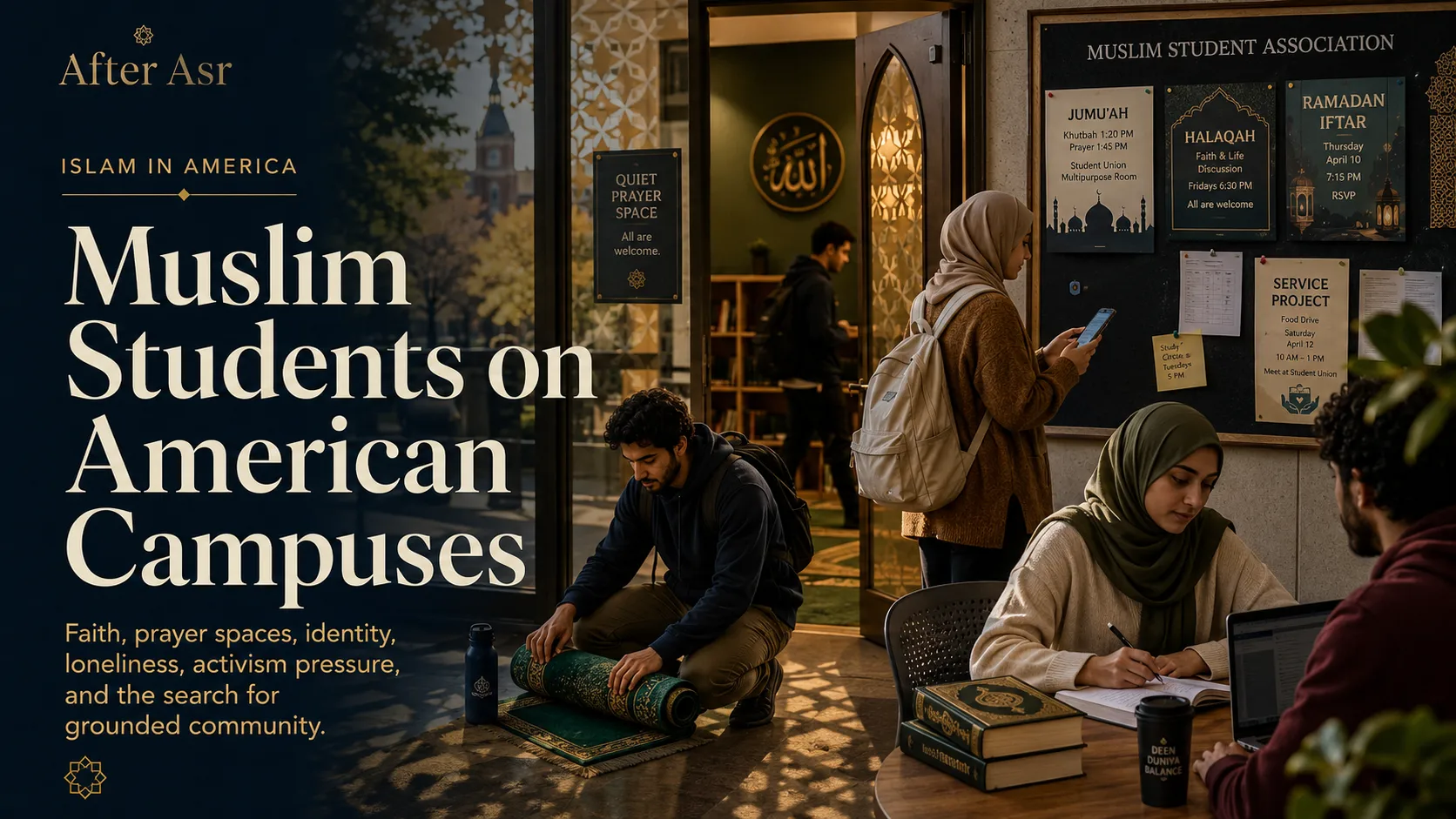
Faith, prayer spaces, identity, loneliness, activism pressure, and the search for grounded community.
A Muslim student’s day on an American campus can contain several worlds before lunch.
There is the lecture hall, where Islam may appear as a unit in world history, a case study in politics, a question in gender studies, a security concern, or not at all. There is the dining hall, where halal options may be limited, mislabeled, or absent. There is the quiet search for a place to pray between classes, sometimes a designated prayer room, sometimes an empty classroom, sometimes a stairwell, sometimes the corner of a library study room. There is the group chat where someone asks whether Jumu’ah will be in the chapel basement or the student center this week. There is the Muslim Student Association table, with flyers for iftar, a halaqah, a charity drive, and a meeting about something urgent happening in the world.
There are also the invisible parts.
The student who fasts through exams. The student who removes themselves from a social scene without knowing how to explain it. The student whose parents think college is only about grades, while the student is quietly struggling with belief. The student who becomes the only Muslim in a seminar discussion and is suddenly asked to explain a civilization. The student who is drawn into activism before they have learned how to protect their own salah. The student who appears confident in hijab but feels deeply alone. The student who grew up Muslim but is now asking questions they never had space to ask. The convert who has no Muslim family and finds the MSA before they know how to pray properly.
Campus is often described as a place of freedom, discovery, and formation. For Muslim students, it can be all of that, but also a place of pressure. It is where inherited Islam may become chosen Islam, or where inherited Islam may quietly fade. It is where public identity can become stronger while private worship becomes weaker. It is where community can be found, but also where loneliness can become sharper. It is where young Muslims learn whether Islam is large enough to guide not only family life, but intellectual life, political life, friendship, desire, ambition, and adulthood.
The American campus does not simply educate Muslim students. It forms them.
The question is whether Muslim communities are helping them be formed by Islam while they are there.
The prayer room as spiritual geography
On many campuses, the prayer room is modest.
It may be in a student union, a chapel basement, a shared interfaith space, a small office, an unused classroom, a corner of a diversity center, or a room whose carpet has seen years of hurried sujood. It may have prayer rugs, a bookshelf, a shoe rack, a qiblah marker, a donation box, a whiteboard with Jumu’ah times, and a faint mixture of coffee, winter coats, and incense someone once used and probably should not have.
To outsiders, it may look like a small accommodation.
To Muslim students, it can be a lifeline.
A prayer space on campus says that salah belongs in the middle of the day, not only at home or the masjid. It says that worship is not postponed until after productivity. It gives students a place to step out of the speed of campus life and remember Allah. It allows a student to move from calculus, biology, literature, engineering, sociology, nursing, law, or political science into sujood, then back again. It creates a sacred interruption inside a system built around deadlines, performance, and self-direction.
The prayer room also becomes a social space, sometimes beautifully and sometimes awkwardly. Students meet there, ask questions, nap between classes, leave flyers, cry quietly, argue about moon sighting, look for iftar rides, and find the people who may become their closest friends. Converts learn where to stand. Freshmen learn that they are not alone. Seniors remember who they were when they first entered.
But prayer rooms are not guaranteed. Many students still struggle for space. Some pray in stairwells, empty classrooms, parking lots, libraries, and corners. Some feel embarrassed. Some are interrupted. Some worry about safety. Some do not know where to go, so they simply miss prayers. Others do not miss them, but feel the daily friction of having to carve out sacred time in a place that does not naturally make room for it.
This is why campus prayer spaces matter. They are not symbolic diversity amenities. They are part of religious life. A university that can provide rooms for meetings, clubs, wellness programming, and administrative offices can also make dignified space for worship. Muslim students should not have to treat salah as a logistical inconvenience hidden from campus view.
At the same time, the existence of a prayer room does not guarantee prayer. The room is an invitation. The student still has to answer.
The Muslim Student Association as home and pressure
For many Muslim students, the MSA is their first real experience of Muslim community outside family.
It can be a place of friendship, study, iftar, Jumu’ah, service, activism, laughter, marriage rumors, awkward icebreakers, late-night planning, spiritual reminders, and group chats that never stop. It may be where students learn to organize events, invite speakers, negotiate with administrators, run fundraisers, manage conflict, and care for one another during crises. It may be the place where a young Muslim first realizes that Islam can be lived publicly with peers.
At its best, the MSA gives students belonging at a vulnerable time. It helps freshmen find prayer spaces. It helps converts find teachers. It helps students fast Ramadan away from home. It creates halal social life in an environment where much of campus social life revolves around drinking, dating, partying, and casual intimacy. It gives Muslim students a place to be known without constant explanation.
But the MSA can also carry pressures.
A small group of students may be expected to provide religious programming, social life, activism, da’wah, interfaith representation, Ramadan logistics, crisis response, and emotional support, all while studying full-time. The same few students may plan every event. Leadership can become cliquish. Ethnic groups may cluster. Women may carry much of the behind-the-scenes labor. Converts may be welcomed publicly but not consistently supported. Practicing students may dominate the space in ways that intimidate others. Less practicing students may feel judged before they are invited. Political urgency may crowd out spiritual formation.
The MSA is not a masjid, though it often functions like one. It is not a family, though it can feel like one. It is not a scholarly institution, though students may ask it to answer serious religious questions. It is a student organization carrying more weight than most student organizations were designed to carry.
This does not diminish its importance. It means it needs support. Local mosques, chaplains, alumni, scholars, parents, and community leaders should not treat MSAs as youth enthusiasm that will somehow sustain itself. Muslim students need mentorship, reliable teachers, conflict guidance, funding, and pastoral care. They need adults who understand campus life without trying to control it from afar.
An MSA can be a doorway to lifelong Muslim belonging. It can also become a place where young Muslims burn out. The difference often depends on whether it is rooted in worship, knowledge, adab, and shared responsibility.
The loneliness beneath visibility
A campus can be crowded and still make a student lonely.
Muslim students may be surrounded by thousands of people, yet feel that few understand the life they are trying to live. They may have classmates, roommates, lab partners, teammates, and professors, but no one who notices when they stop praying, stop attending Jumu’ah, stop eating halal, or stop coming to halaqah. They may be visible as Muslims in public, yet privately isolated.
Loneliness takes many forms.
The freshman who moved away from a large Muslim family and now breaks fast alone in a dorm room. The graduate student who is older than the undergraduates at MSA events but too young to feel settled in the local mosque. The hijabi student who is recognized by everyone as “the Muslim girl,” but has few close friends. The Muslim man trying to avoid campus party culture but unsure where to build brotherhood. The convert whose family does not understand Islam and whose Muslim peers are kind but busy. The international student who misses home and feels that American Muslim spaces do not fully understand them. The Black Muslim student who feels erased in immigrant-dominated Muslim student spaces. The Muslim student from a rural background who is seeing large Muslim community for the first time and feels both relief and disorientation.
Campus loneliness is often hidden because students are expected to be social. They post photos from iftars, attend events, smile in group pictures, and appear connected. But belonging is not the same as attendance. A student can attend every event and still feel unknown.
Muslim communities must take this seriously. Loneliness can weaken faith. Not because a lonely person is insincere, but because human beings need companionship. Islam is lived individually before Allah, but it is also sustained through jama’ah, through people who remind, correct, include, and care.
The solution is not merely more events. It is deeper community. Smaller circles. Mentorship. Regular check-ins. Welcoming culture that notices who is at the edge. Programs for converts, graduate students, commuters, international students, and those who are not already socially fluent. Spaces where students can speak honestly without being reduced to their struggles.
A student should not have to be visibly falling apart before someone asks if they are okay.
Faith under intellectual pressure
The American university often presents itself as a place of open inquiry. At its best, it can be. A good education can sharpen the mind, expose students to history, science, literature, law, medicine, philosophy, and human complexity. Muslims should not fear learning. The Islamic tradition honors knowledge and disciplined thought.
But campus intellectual life also carries assumptions.
Some classes treat religion as a human construction, useful for sociological study but not true in any ultimate sense. Some professors speak of faith as a stage humanity outgrows. Some peer cultures assume moral autonomy as a given. Some academic frameworks analyze Islam only through power, gender, empire, race, security, or identity, without any reverence for revelation. Some students are exposed to critiques of religion before they have ever studied Islam seriously.
This can be destabilizing.
A Muslim student may know how to recite Qur’an but not how to answer philosophical skepticism. They may know that prayer is obligatory but not why revelation is trustworthy. They may know that Islam has moral teachings but not how to think when those teachings are publicly framed as harm. They may know family Islam, cultural Islam, identity Islam, or political Islam, but not enough theology, seerah, usul, spirituality, or intellectual history to remain steady under pressure.
The answer is not anti-intellectualism. Muslim students do not need to be told that every professor is dangerous or every class is corrupt. Such warnings often fail because students can see that some non-Muslim teachers are thoughtful, ethical, and sincere. The better answer is stronger Islamic grounding.
Muslim students need aqeedah taught clearly. They need to know why Muslims believe in Allah, revelation, prophethood, the Qur’an, the unseen, moral accountability, and the akhirah. They need to learn how Islamic knowledge works, who has authority, how to ask questions, and how to distinguish between genuine inquiry and ideological pressure. They need teachers who are not afraid of difficult questions.
A faith that has never been explained beyond childhood may feel fragile in a seminar room. A faith rooted in knowledge can encounter questions without panic.
Identity without worship
Campus can strengthen Muslim identity while weakening Muslim practice.
This is one of its subtler dangers.
A student may become publicly Muslim through activism, representation, cultural events, social media, identity-based programming, and solidarity work. They may speak about Islamophobia, Palestine, Ramadan, diversity, hijab, representation, or Muslim belonging. They may defend Muslims in class discussions. They may organize events. They may be known as a Muslim leader.
Yet privately, salah may be slipping. Qur’an may be absent. Fasting may be inconsistent. The heart may be far from Allah.
This is not hypocrisy in every case. Sometimes students are carrying more than they know how to carry. Sometimes public Muslim identity becomes available before private religious formation. Sometimes activism feels urgent, while worship feels quiet. Sometimes community rewards visible identity more than hidden devotion. Sometimes young Muslims inherit political consciousness but not spiritual discipline.
Still, the danger is real.
Islam cannot survive as identity alone. A Muslim student may find pride in belonging to a marginalized community, but pride is not sujood. They may find meaning in representing Muslims, but representation is not dhikr. They may feel anger at injustice, but anger is not taqwa. They may defend the ummah publicly, but the soul still needs prayer.
Campus Muslim life must resist the reduction of Islam to identity. Muslim students should certainly address Islamophobia, public misunderstanding, and injustice. But all of that must be nourished by worship. The prayer room should not be less central than the panel. The halaqah should not be less important than the fundraiser. The Qur’an should not be less present than the statement. The student’s private relationship with Allah should not be sacrificed for public Muslimness.
A Muslim identity that does not bow will eventually become exhausted.
Activism pressure and the Muslim student
Muslim students are often expected to be politically awake.
Sometimes this comes from the world around them. Campus politics can turn Muslim identity into a set of expected positions, slogans, coalitions, and public responses. Sometimes the pressure comes from within Muslim spaces, where students feel that silence on certain issues is betrayal. Sometimes it comes from genuine moral urgency: war, occupation, racism, state violence, Islamophobia, surveillance, poverty, and suffering demand response.
Many Muslim students enter activism with sincerity. They want justice. They want to stand with the oppressed. They want the campus to stop ignoring Muslim pain. They want to challenge dehumanizing narratives. They want to live their faith publicly.
This can be honorable.
But activism can also consume the soul if it is not governed by Islam.
Students can become addicted to outrage. They can measure faith by public speech. They can neglect prayer while organizing for justice. They can become harsh, suspicious, and unable to rest. They can be drawn into coalitions where Islamic moral boundaries are treated as embarrassing. They can feel pressured to affirm every cause in the language of the dominant activist culture, even when that language conflicts with Islamic belief. They can become afraid to disappoint peers more than they fear displeasing Allah.
The answer is not apathy. Islam does not teach indifference to injustice. But it does teach that justice work must be rooted in worship, truth, adab, and moral clarity. A Muslim activist should pray. Verify information. Avoid slander. Protect the tongue. Refuse dehumanization. Maintain Islamic boundaries. Serve real people, not only causes. Take counsel from scholars and elders. Rest before burnout becomes bitterness. Remember that Allah is not served by disobedience, even in the name of justice.
Muslim students need mentors who can say both: stand for what is right, and do not let activism become your religion.
The pressure to represent
Muslim students are often made into representatives before they are ready.
A professor asks them to speak for Islam. A classmate asks about geopolitics. A campus newspaper wants a quote after a crisis. An interfaith panel needs a Muslim student. A diversity office asks them to explain Ramadan. A student government meeting expects the MSA president to speak for all Muslims. The Muslim student may be nineteen, sleep-deprived, still learning basic fiqh, and suddenly treated as a public voice.
This can create both confidence and burden.
Some students grow through representation. They learn to speak clearly, organize, advocate, and explain. Others become exhausted. They feel that every mistake reflects on Islam. They feel watched. They become careful in ways that are wise, then careful in ways that are spiritually draining. They may begin to simplify Islam to make it easier for campus audiences. They may avoid saying what they actually believe because the room prefers softer language.
Muslim students need permission to say, “I can speak from my experience, but I cannot speak for all Muslims.” They need permission to say, “That question requires a scholar.” They need permission to say, “I do not know.” They need permission not to educate everyone all the time.
Campuses also need to learn that Muslim students are not free consultants for institutional ignorance. If a university wants religious literacy, it should invest in chaplaincy, faculty training, curriculum, and community partnerships. It should not place the whole burden on the nearest Muslim student.
Representation can be service. It should not become extraction.
Halal life in the dining hall
Food may seem like a practical issue, but for Muslim students it can become a daily reminder of whether their needs are seen.
Some campuses offer halal dining options. Some offer vegetarian alternatives and call that enough. Some label food clearly. Others do not. Some students have meal plans they can barely use. Some survive on fries, cereal, salads, tuna packets, microwave rice, or meals cooked in dorm kitchens. During Ramadan, some campuses provide suhoor and iftar accommodations. Others require Muslim students to improvise around dining hall hours designed for everyone else.
Halal food is not merely cultural preference. It is part of worship. A student trying to eat halal is trying to live with obedience in the body. The dining hall becomes a place where Islamic commitment meets institutional planning.
When halal options are available, students feel a kind of relief. They can eat without constant calculation. They can invite friends. They can participate in campus life without compromising. When options are absent, students may feel neglected, especially if the university celebrates diversity in language but not in logistics.
Muslim student advocacy around halal food can teach important lessons. It teaches students to organize respectfully, gather data, communicate needs, and work with administrators. It also teaches universities that inclusion is not only about symbolic recognition. It is about whether students can live their obligations.
Still, halal food should not become the only measure of Muslim life. A campus may have halal chicken and still lack prayer space, spiritual support, religious literacy, or community. The goal is a campus environment where Muslim students can worship, eat, learn, and belong without constant friction.
Ramadan away from home
Ramadan on campus is often unforgettable.
For some students, it is the first Ramadan away from family. There is no parent waking them for suhoor. No familiar kitchen. No siblings at the table. No local mosque routine from childhood. The student must decide whether to wake, what to eat, where to break fast, whether to attend taraweeh, how to study while hungry, how to manage exams, and how to explain fasting to roommates.
This can be lonely. It can also be spiritually powerful.
The MSA iftar becomes family for a month. Students cook together, eat on paper plates, pray Maghrib in classrooms, listen to reminders, study after taraweeh, and build friendships that feel more sincere because they are formed through worship. A convert may experience their first Ramadan through campus community. An international student may bring a dish from home and find that others recognize the ache of missing family. A student who has been distant from Islam may return because Ramadan makes the heart softer.
But Ramadan on campus can also expose gaps. Who is invited? Are converts checked on? Are commuter students included? Are women involved in planning and leadership? Are Black Muslims and non-dominant ethnic groups fully part of the community? Are international students treated as guests or members? Are iftars spiritually meaningful or mainly social? Is taraweeh accessible? Are students taught about fasting beyond logistics?
Ramadan can become the month when campus Muslim life is most alive. It can also become the month when lonely students feel most alone if they fall outside the main social circle.
A campus Ramadan should not only feed bodies. It should build belonging around Allah.
Gender, boundaries, and campus social life
College is often a place where young adults negotiate gender in new ways.
Classes, labs, dorms, clubs, study groups, activism, internships, and social events place men and women together constantly. Many Muslim students are living away from parental supervision for the first time. Some are trying to maintain Islamic boundaries with sincerity. Some are unsure what those boundaries mean in practice. Some feel embarrassed by restrictions. Some feel judged by other Muslims. Some are lonely and want companionship. Some enter relationships secretly. Some are seeking marriage but lack healthy pathways. Some become cynical after seeing hypocrisy or double standards.
Muslim campus communities need to speak about this honestly.
Simply saying “do not date” is not enough, though moral boundaries must be clear. Students need to understand why Islam regulates intimacy, why desire is powerful, why privacy matters, why emotional dependency can become dangerous, and why marriage is not merely a romantic achievement but a serious covenant. They also need halal social spaces, mentorship, marriage education, and adults who can discuss these matters without panic.
Gender boundaries in MSAs can become sources of conflict. Some students want stricter separation. Others want more casual interaction. Some concerns are rooted in Islamic seriousness. Others are shaped by culture, discomfort, or uneven enforcement. The goal should not be hostility between brothers and sisters, nor careless mixing. The goal is adab, dignity, cooperation in good work, and protection from fitnah.
Muslim students should learn how to work together respectfully without pretending attraction does not exist. They should learn how to maintain boundaries without treating the opposite gender as an enemy. They should learn that modesty is not only clothing, but speech, gaze, intention, online conduct, and emotional restraint.
Campus life tests these lessons daily. Communities that refuse to teach them leave students to improvise.
The convert on campus
College can be a place where people encounter Islam for the first time.
A student takes a class on religion. A roommate fasts Ramadan. A Muslim friend prays with quiet consistency. A campus event introduces the Qur’an. A difficult season opens the heart. A student searching for meaning finds lectures online, visits the MSA, and eventually says shahadah.
Conversion on campus can be beautiful, but also precarious.
A new Muslim may be surrounded by peers who are themselves still learning. The MSA may celebrate the shahadah, but not have a structured convert care program. The local mosque may be far away. The student’s family may be confused or upset. The convert may need to learn prayer while also managing coursework, social changes, roommate dynamics, and identity shifts. They may enter Muslim spaces where cultural assumptions are overwhelming.
The campus convert needs a careful support system. Basic education. Prayer mentorship. A reliable teacher. Social inclusion beyond public celebration. Guidance on family relationships. Ramadan support. Eid plans. Emotional patience. Protection from students who give too much advice too quickly. Connection to older Muslims and local community beyond campus.
Converts also remind Muslim students of something essential: Islam is not merely inherited. It is guidance. When a peer enters Islam, born Muslims may be moved, but they should also be humbled. The convert is not an inspirational event for the MSA calendar. They are a person beginning a life with Allah.
A campus community that receives converts well becomes better for everyone because it learns to explain Islam from the foundations.
Black Muslim students and campus belonging
Black Muslim students often navigate several layers of belonging and exclusion.
In broader campus life, they may face anti-Black racism, tokenization, or the exhaustion of being asked to speak for race. In Muslim spaces, they may face erasure, especially if the MSA is dominated by immigrant or South Asian, Arab, or other ethnic cultures. They may hear Muslim students speak about Islamophobia with passion while remaining quiet about anti-Blackness. They may see Black Muslim history mentioned occasionally, but not integrated into religious education. They may be welcomed socially but not centered in leadership or scholarship.
This is a serious problem.
A campus Muslim community that does not honor Black Muslim presence is not telling the truth about Islam in America. Black Muslims are not a diversity addition to the MSA. They are part of the foundation of American Islam. Their history, scholarship, leadership, and experience should shape how Muslim students understand themselves on American campuses.
This means more than inviting a speaker during Black History Month. It means studying enslaved African Muslims, Black Muslim movements, Malcolm X and beyond Malcolm X, Black Sunni scholarship, prison Islam, Black Muslim women’s labor, and contemporary Black Muslim thought. It means addressing anti-Blackness in marriage conversations, social circles, leadership, jokes, and assumptions. It means ensuring Black Muslim students are not asked to educate everyone alone.
It also means recognizing that Black Muslim students are full human beings, not only representatives of struggle. They are worshippers, students, friends, artists, athletes, scholars, organizers, introverts, converts, born Muslims, questioners, and believers trying to live Islam in a demanding environment.
Belonging must be real, not visual.
International students and American Muslim spaces
International Muslim students often arrive on American campuses carrying another set of challenges.
They may come from Muslim-majority societies where Ramadan, Eid, halal food, family expectations, and public Muslim identity felt more natural. Or they may come from countries where Islam was present but politically complicated. They may be experiencing American individualism, campus social culture, academic pressure, loneliness, racism, immigration anxiety, and distance from family all at once.
Some find comfort in the MSA. Others feel surprised by American Muslim diversity and debates. Some may be more practicing than their peers. Some may be less practicing and feel judged. Some may bring cultural assumptions about gender, race, class, or religious authority that are challenged in American Muslim spaces. Some may see Black, Latino, white, convert, and immigrant Muslims together for the first time and need to relearn what the ummah can look like.
International students also give American Muslim communities a gift. They remind local students that the ummah is broader than American categories. They carry languages, memories, recitation styles, scholarly traditions, foods, and family stories that can enrich campus life. But they should not be reduced to cultural flavor. They need support, friendship, and practical care.
A healthy MSA makes room for international students without letting one cultural group dominate. It builds community across difference. It recognizes that “Muslim student” is not one experience.
Commuter students and those at the margins
Not every Muslim student lives in the dorm, attends every event, or has time for campus community.
Commuter students may drive from home, work part-time, care for siblings, support family businesses, or attend classes between other obligations. Graduate students may be isolated in labs, clinics, or professional programs. Older students may feel out of place in undergraduate-centered MSAs. Married students may have family responsibilities. Students with disabilities may find events inaccessible. Students who are poor may not be able to afford retreats, dinners, or conferences. Students who are socially anxious may want community but fear entering it.
Campus Muslim life often centers those who are already available.
This creates a gap. The most visible students are not always the most in need. A student who never comes to events may not be careless. They may be exhausted. A student who leaves immediately after Jumu’ah may have work. A student who seems distant may not know anyone. A student who cannot attend late-night programming may rely on public transit or family rules.
MSAs and campus Muslim leaders should think beyond the socially fluent core. Offer varied times. Create small study circles. Make events financially accessible. Check on commuters. Include graduate students. Provide remote options when useful. Ask who is missing. Build community that does not require constant attendance to matter.
A grounded community notices the edges.
Muslim chaplaincy and pastoral care
One of the most important developments in American campus life has been the growth of Muslim chaplaincy.
A good Muslim chaplain can change the religious life of a campus. They are not simply event speakers. They provide pastoral care, religious guidance, crisis support, convert education, grief counseling, spiritual mentorship, and institutional advocacy. They can help students navigate doubt, family pressure, mental health struggles, relationships, prayer, activism burnout, and ethical questions. They can also help universities understand Muslim needs without making students carry everything.
Where Muslim chaplains exist, students often have a more grounded resource. Where they do not, MSAs may rely on local imams, volunteer mentors, online scholars, or older students. These can help, but campus life has specific pressures. A chaplain who understands both Islam and the university environment can bridge worlds with care.
Muslim communities should advocate for chaplaincy. Universities that serve Muslim students should recognize that religious support is part of student wellbeing. Donors should fund chaplaincy as seriously as they fund buildings and events. Local mosques should partner with campus ministries and student groups. Alumni should support structures they wish they had.
Students need more than programming. They need people trained to care for souls.
The campus as a test of adulthood
College often marks the first time a young Muslim must practice Islam without being managed by family.
No one wakes them for Fajr. No one checks whether they prayed Dhuhr. No one forces them to attend Jumu’ah. No one knows if they are eating halal, dating, drinking, watching what they should not, or losing faith slowly. For some, this freedom reveals deep roots. For others, it reveals that their practice was held mostly by external structure.
This can be frightening, but it can also be necessary.
At some point, inherited Islam must become personally owned. A student must decide that salah matters because Allah matters, not because parents ask. They must decide that boundaries matter because obedience matters, not only because family reputation matters. They must decide that the Qur’an is guidance, not just childhood sound. They must learn repentance not as shame, but as return.
Campus can expose weakness. Exposure is not the end. It can become the beginning of sincerity.
Families and communities should prepare students before they leave. Not only with warnings, but with skills. How to find a prayer space. How to make wudu on campus. How to request religious accommodations. How to choose friends. How to handle loneliness. How to seek knowledge. How to respond to doubts. How to avoid haram relationships. How to repent after mistakes. How to stay connected to a masjid. How to ask for help.
A young Muslim who has only been controlled may collapse when control disappears. A young Muslim who has been formed may still struggle, but they will know the way back.
The danger of campus becoming the whole world
The campus environment can feel total.
Its debates, social codes, academic pressures, activist language, friendships, and status hierarchies can seem like the whole world. Students may begin to interpret Islam primarily through campus categories. What does Islam say about identity? What does Islam say about justice? What does Islam say about inclusion? What does Islam say about gender? These are important questions, but campus culture often frames them in ways that are not neutral.
A Muslim student must learn that the university is not the final judge of truth.
It is a place of learning, but also a place with its own ideologies, incentives, blind spots, and moral assumptions. Some of its critiques may help Muslims see real problems. Some may distort. Some may expose injustice. Some may redefine the human being in ways Islam cannot accept. Some may invite intellectual humility. Some may cultivate arrogance.
The student needs enough Islamic grounding to benefit from education without becoming absorbed by the institution’s worldview.
This does not mean suspicion toward all academic life. Muslims should be excellent students. They should read carefully, think deeply, ask strong questions, and contribute to knowledge. But they should not enter the university as empty vessels waiting to be defined. They enter as servants of Allah.
A Muslim can respect a professor without making the professor a spiritual authority. A Muslim can learn theory without making theory revelation. A Muslim can critique Muslim communities using useful tools without placing those tools above Qur’an and Sunnah. A Muslim can succeed academically without letting the university decide what kind of person they must become.
Education is a means. Allah is the end.
Grounded community
What Muslim students need most is grounded community.
Not only social events. Not only activism. Not only identity affirmation. Not only lectures. Not only halal food. Not only a prayer room. All of these matter, but they must be held together by something deeper.
Grounded community begins with salah. It protects Jumu’ah. It makes prayer visible and normal. It teaches students to return to Allah before returning to the group chat.
It includes knowledge. Regular classes. Reliable teachers. Spaces for questions. Foundations of belief. Seerah. Qur’an. Fiqh of worship. Adab. Contemporary issues addressed through Islamic principles.
It includes companionship. Friends who remind without humiliating. Mentors who listen. Alumni who return. Chaplains who care. Older students who notice freshmen. Sisters and brothers who build healthy circles. Converts who are supported after shahadah. Black Muslim students whose histories and experiences are centered, not sidelined.
It includes service. Feeding people. Helping refugees. Visiting local communities. Supporting prisoners. Caring for the poor. Serving beyond campus so faith does not become self-focused.
It includes mercy. Students will make mistakes. Some will drift. Some will return. Some will ask difficult questions. Some will struggle with prayer, desire, doubt, anxiety, depression, family pressure, or loneliness. A grounded community does not excuse sin, but it does not close the door of return.
It includes boundaries. Not everything is acceptable because campus culture accepts it. Not every coalition is wise. Not every social norm can be absorbed. Not every activist demand aligns with Islam. Not every event should be organized for popularity. The community must know what it stands on.
Grounded community helps Muslim students become adults who can carry Islam beyond college.
After graduation
Campus life ends quickly.
The student who once ran MSA events becomes a professional with a long commute. The one who attended halaqah weekly moves to a city where they know no one. The convert loses the campus community that held their first Ramadan. The activist enters a workplace where justice looks less like a rally and more like ethical decisions under pressure. The student who prayed in the campus room now has to find a masjid near an apartment. The group chat quiets. The familiar prayer space belongs to someone else.
If campus Islam was only social, graduation can feel like spiritual collapse.
This is why Muslim student life must prepare students for the long road. The goal is not only to survive college. It is to form Muslims who can pray after graduation, seek knowledge after graduation, build families after graduation, serve communities after graduation, and remain connected to Allah when the MSA is no longer nearby.
Local mosques should build bridges with graduating students. Alumni networks should offer mentorship. Communities should help young adults transition into masjid life without treating them as perpetual youth. Marriage, work, debt, relocation, loneliness, and spiritual routine all need guidance.
The campus is a season. Islam is a life.
What the campus reveals
Muslim students on American campuses reveal the future of the community in concentrated form.
They reveal whether children were taught foundations or only identity. Whether mosques prepared them for questions. Whether parents built trust or only control. Whether Islamic education can speak to modern intellectual life. Whether Muslim spaces can hold diversity. Whether activism can remain rooted in worship. Whether converts will be cared for. Whether Black Muslim history will be honored. Whether women’s leadership will be respected. Whether young Muslims can disagree with adab. Whether prayer can remain central in a life of ambition.
The campus does not create every problem. It reveals what was already fragile and what was already strong.
A student who arrives with love of Allah, habits of prayer, humility before knowledge, and trustworthy community may still struggle. But they have roots. A student who arrives with only fear, family pressure, cultural identity, or public pride may find those roots tested.
This is not a reason for despair. It is a call to responsibility.
Muslim students are not problems to be managed. They are believers in formation. They are future parents, teachers, scholars, doctors, engineers, artists, imams, writers, organizers, neighbors, and community builders. Some are already carrying burdens too heavy for their age. Some are quietly more sincere than anyone knows. Some are one good friend, one teacher, one prayer, one Ramadan, one honest conversation away from returning to Allah with strength.
They deserve more than our anxiety.
They deserve our investment.
The student between classes
Imagine a Muslim student walking across campus between classes.
Backpack heavy. Phone buzzing. Assignment due. Prayer time narrowing. Dining hall uncertain. News from the world painful. Family expectations waiting. Friends inviting them somewhere they should not go. A professor’s comment still sitting in the mind. The MSA group chat arguing about an event. The heart carrying questions no one sees.
Then the student finds the prayer room.
They take off their shoes. Make wudu. Stand alone or with two others. Say Allahu Akbar. For a few minutes, the campus becomes small. The schedule, the debates, the loneliness, the pressure to represent, the fear of falling behind, the confusion of the age, all of it is placed beneath the greater reality.
Allah is greater.
That moment is the center.
Everything else, the MSA, the activism, the intellectual work, the friendships, the accommodations, the advocacy, the leadership, the struggle to belong, must be built around that center. If Muslim students keep that center, campus can become a place of growth. If they lose it, even success can become hollow.
American campuses will continue to shape Muslim students. The task before families, mosques, scholars, chaplains, and students themselves is to ensure that Islam shapes them more deeply.
Not as a slogan.
As prayer between classes.
As Qur’an in the backpack.
As friendship rooted in Allah.
As courage in the seminar room.
As restraint at the party.
As mercy in activism.
As humility in knowledge.
As belonging that survives graduation.
As a heart that learns, in the middle of campus life, to keep returning to the One who sees every student walking quietly toward Him.