
What universities promise and what they deliver.
The modern university makes a powerful promise.
Come here, it says, and you will become educated.
Come here, and doors will open.
Come here, and you will discover who you are.
Come here, and you will find opportunity, community, knowledge, career preparation, independence, and a better future.
For many students, this promise is not empty.
A university can change a life. It can introduce a student to books, laboratories, mentors, languages, histories, methods, and questions they would never have encountered otherwise. It can help a young person leave a narrow environment and enter a larger intellectual world. It can provide professional training, research opportunities, friendships, networks, credentials, and the confidence to pursue work that once seemed impossible.
Some students meet teachers who awaken them.
Some discover a field that gives direction to their gifts.
Some find community after years of isolation.
Some become doctors, engineers, teachers, scholars, artists, scientists, lawyers, therapists, entrepreneurs, public servants, or skilled professionals because a university gave them structure and access.
This is real.
But it is not the whole story.
The modern university also makes promises it does not always keep. It sells belonging while many students feel lonely. It sells education while many students experience credentialing. It sells opportunity while attaching that opportunity to debt. It sells personal discovery while often leaving students morally unanchored. It sells intellectual freedom while sometimes rewarding conformity in fashionable forms. It sells adulthood while extending adolescence. It sells prestige while quietly sorting students by class, confidence, language, and family background.
So we must speak about higher education with balance.
The university is not useless.
The university is not sacred.
The university is not the only path to seriousness.
The university is not merely a scam.
The university is an institution filled with promise, contradiction, and risk.
A wise family, student, or community should neither worship it nor dismiss it.
They should ask what the university actually offers, what it costs, what kind of person it forms, and whether its promises match the needs of the student standing before it.
The university as gateway
In American life, higher education often functions as a gateway.
It is not only a place of learning. It is a sorting mechanism.
Certain careers require degrees. Many professions require specialized training, licensing, internships, or graduate study. A university credential can affect income, mobility, social respect, professional networks, and family stability.
For families who have known poverty, discrimination, instability, or limited opportunity, this matters deeply. A college acceptance letter may feel like more than admission. It may feel like protection. It may feel like the child has escaped a narrow future. It may feel like the family’s sacrifices have begun to bear fruit.
This is especially true for immigrant families, first-generation college students, working-class families, and communities trying to secure a stronger place in American society.
A degree can open doors.
But the fact that a degree opens doors does not mean every degree opens the same doors. It does not mean every university experience is worth the cost. It does not mean every student should attend immediately after high school. It does not mean every major carries the same financial risk. It does not mean college is the only honorable path.
The university is a gateway, but not all gates lead where students think they lead.
A student should know what they are entering.
The promise of education
At its best, a university is one of civilization’s great institutions.
It preserves knowledge. It supports research. It trains professionals. It gathers scholars and students around difficult questions. It gives people time and structure to study what cannot be learned casually.
A serious university education can teach students how to read carefully, write clearly, examine evidence, think historically, understand scientific methods, analyze arguments, encounter beauty, question assumptions, and communicate with discipline.
It can help a student become intellectually less provincial.
The student may learn that the world is older, larger, more complex, and more morally serious than they imagined. They may discover that their first opinions were too simple. They may become more patient with evidence, more careful with language, and more aware of human complexity.
This is a genuine good.
Muslim communities should not become anti-intellectual. Islam has never required believers to fear knowledge. The Muslim tradition has produced scholars, scientists, jurists, physicians, poets, historians, philosophers, teachers, linguists, mathematicians, and institutions of learning. Serious study is not foreign to Islam.
But the university does not automatically produce wisdom.
It can provide access to knowledge without teaching students what knowledge is for. It can sharpen the mind while leaving the soul neglected. It can train critique without forming humility. It can expose students to complexity without giving them moral grounding. It can teach students to question inherited beliefs without helping them distinguish truth from fashion.
The university may educate. It may also merely credential.
The difference matters.
Credentialing versus formation
Many students attend university not primarily to be educated, but to be credentialed.
This is understandable. A degree is often required. Families are practical. Students need jobs. Tuition is expensive. People want a return on investment.
But when credentialing becomes the main purpose, education changes.
Students ask, “Will this be on the exam?”
They choose classes based on ease or résumé value.
They treat reading as an obstacle.
They pursue grades more than understanding.
They collect internships, honors, leadership roles, and certificates as proof of marketability.
They learn how to appear impressive.
The university itself often participates in this shift.
It advertises outcomes, rankings, career placement, alumni salaries, networking, innovation, and student experience. It may still speak about truth, knowledge, citizenship, and human development, but the language of the marketplace becomes louder.
The student becomes a customer.
The degree becomes a product.
The campus becomes a lifestyle brand.
The university becomes a gatekeeper of economic mobility.
When this happens, the deeper purpose of higher education becomes harder to see.
A student may graduate with a degree but without intellectual courage.
A student may earn honors but never ask what kind of life is worth living.
A student may master professional skills but lack moral judgment.
A student may become employable but not wise.
This does not mean career preparation is bad. A university should help students enter useful work. But career preparation alone is too small a vision for education.
A human being is more than a future employee.
The cost of aspiration
Higher education is often sold as investment.
Borrow now, succeed later.
Sacrifice now, rise later.
Pay the price now, and the future will repay you.
Sometimes that is true.
But sometimes the price is heavier than the promise.
A student may borrow thousands of dollars for a degree without clear employment prospects. A family may take on financial stress to send a child to a school chosen for prestige rather than fit. A young adult may spend years studying without understanding the debt that is accumulating. A first-generation student may sign documents without anyone explaining the long-term burden.
The emotional language of aspiration can hide the financial reality.
Families say, “Education is priceless.”
But universities still send bills.
A degree may be valuable, but it is not infinitely valuable at any cost. Students must learn to think clearly about debt, tuition, housing, major choice, transfer options, community college pathways, scholarships, work-study, and realistic career outcomes.
This is not cynicism. It is responsibility.
Debt can shape adulthood. It can delay marriage, home ownership, family planning, entrepreneurship, charitable giving, career flexibility, and mental peace. It can pressure graduates to choose higher-paying work they dislike because their financial obligations are unforgiving.
For Muslim families, the question of debt carries additional moral and religious concerns. Many families worry about interest-based loans, financial necessity, and the tension between educational access and Islamic principles. These concerns deserve serious guidance, not casual dismissal.
A university may promise a future. Families must ask what kind of burden is being placed on that future.
Prestige and the university imagination
Prestige has a powerful grip on higher education.
Students dream of famous universities. Parents celebrate admission to selective schools. Communities praise degrees from recognizable names. Employers may favor certain institutions. Social media turns acceptance letters into public ceremonies.
Prestige is not meaningless. Some universities provide exceptional faculty, networks, resources, laboratories, libraries, alumni connections, and opportunities. Selective institutions may open doors.
But prestige is not the same as education.
A student can attend a famous university and drift.
A student can attend a modest university and grow deeply.
A student can attend community college and receive excellent teaching.
A student can attend an elite school and become arrogant, anxious, or spiritually lost.
A student can attend a lesser-known school and become disciplined, wise, and useful.
The prestige trap teaches students to ask, “How will this name look?”
A better question is, “What will this place help me become?”
Fit matters. Cost matters. Mentorship matters. Major matters. Environment matters. Faith support matters. Distance from family matters. Student maturity matters. Mental health matters. Career pathway matters.
A prestigious school may not be the best school for a particular student.
A humble path may be wiser.
Families must resist the idea that the most impressive option is automatically the most beneficial one.
The university as a moral environment
Universities often present themselves as places of open inquiry, diversity, and personal growth.
They are also moral environments.
They teach values through policies, peer culture, residential life, academic norms, social expectations, entertainment, activism, dating culture, alcohol culture, career competition, and the assumptions of faculty and students.
No university is neutral.
Students learn what is admirable.
They learn what is embarrassing.
They learn which beliefs are treated as intelligent.
They learn which moral positions are considered backward.
They learn what kinds of speech are rewarded.
They learn what kind of ambition is normal.
They learn how people treat the body, desire, money, power, and truth.
For Muslim students, this can be formative in complex ways.
Some become stronger. They learn to explain Islam, build Muslim friendships, pray in difficult settings, fast while studying, and carry faith with maturity.
Others become confused or distant. They may enter university with inherited religious habits but little grounding. They may feel embarrassed by Islamic teachings that conflict with campus norms. They may encounter professors or peers who challenge faith in ways they are not prepared to answer. They may slowly trade religious practice for social ease.
The danger is not exposure itself. Muslims cannot live forever in protected spaces. Students must learn to encounter difference.
The danger is exposure without roots.
A young person who has never thought deeply about faith may struggle when university asks them to rethink everything. A student whose Islam was built only on family pressure may not know how to carry it when family is absent. A student who was never allowed to ask questions may be vulnerable to the first environment that welcomes questioning.
Universities do not simply educate the mind.
They often test the soul.
Independence and loneliness
University promises independence.
For many students, this is exciting. They choose classes, manage time, meet new people, live away from home, explore interests, and begin adult life.
Independence can be good. Young adults need responsibility. They need to learn how to manage money, time, food, sleep, friendships, study, worship, and decision-making without constant supervision.
But independence can also become loneliness.
A student may be surrounded by thousands of people and still feel unseen. They may struggle with homesickness, anxiety, depression, isolation, imposter syndrome, or spiritual disconnection. They may feel pressure to appear confident while privately falling apart.
The modern university is often socially crowded but emotionally thin.
Students attend events but lack intimacy. They have group chats but lack trust. They build networks but lack friendship. They share rooms but lack belonging. They perform identity but lack rootedness.
For Muslim students, the presence of a strong Muslim Student Association, local masjid, chaplaincy, or supportive friend group can make a major difference. But not every campus has these supports. Even where they exist, students must be willing to seek them.
Families should discuss this before college.
Where will you pray?
Who will you call when lonely?
Is there a Muslim community nearby?
How will you handle Friday prayer?
What will you do in Ramadan?
Who will know if you are struggling?
How will you structure your time?
What boundaries will protect your faith and health?
Independence without preparation can become drift.
The classroom and the professor
At the heart of the university should be teaching and learning.
A good professor can change how a student sees the world. A serious professor can model intellectual discipline, curiosity, humility before evidence, and love of a subject. A teacher who knows how to ask difficult questions can awaken students from lazy thinking.
But university teaching is uneven.
Some professors are brilliant scholars but weak teachers. Some care deeply about students; others barely learn their names. Some use the classroom for ideological performance. Some are overworked, under-supported, or more rewarded for research than teaching. Some classes are large, impersonal, and structured around exams rather than conversation.
Students should not assume that enrolling in a university automatically means receiving mentorship.
They may need to seek it.
Go to office hours.
Ask thoughtful questions.
Find professors who care.
Look for research opportunities.
Build relationships with advisors.
Seek feedback on writing.
Do not disappear into the back of the lecture hall.
The university rewards students who know how to use it.
This creates inequality. Students from educated families may arrive already knowing how to navigate faculty, internships, advising, and institutional resources. First-generation students may not know what they are allowed to ask for.
Universities promise opportunity, but students often need guidance to access it.
General education and the fragmented mind
Most universities require students to take courses outside their major. These are often called general education requirements.
In theory, this is good. A student should not become narrow. An engineer should study history or ethics. A business student should learn writing. A biology major should encounter philosophy. A future teacher should understand society. A citizen should know more than one field.
But general education often becomes fragmented.
Students take a little of this, a little of that, often without a coherent vision of what kind of person the curriculum is forming. Courses become boxes to check. Students may not understand why they are studying literature, science, statistics, religion, politics, or art.
A university education should help students connect knowledge.
What does biology teach us about life?
What does history teach us about power and memory?
What does literature teach us about the human condition?
What does economics teach us about tradeoffs and incentives?
What does philosophy teach us about truth and meaning?
What does religious studies teach us about human longing and revelation?
What does technology teach us about power and responsibility?
Without integration, students graduate with fragments.
They may know many things but not know how those things belong together.
Muslim students especially need integration. They need to understand how their fields relate to tawheed, ethics, service, humility, and accountability. They need to see knowledge not as disconnected departments but as part of a moral universe.
A university may not provide that integration.
Families, mentors, Muslim scholars, chaplains, and students themselves may need to do that work.
The career promise
Universities often promise career readiness.
Some deliver this better than others.
A strong program may provide internships, clinical placements, labs, portfolios, advising, alumni networks, career fairs, employer partnerships, and clear pathways into work. A weak program may offer vague encouragement and leave students to figure out the rest.
Students should ask hard questions before choosing a major or institution.
What jobs do graduates actually get?
What further degrees are required?
What is the debt-to-income reality?
Are internships built into the program?
Is licensure required?
Are there local opportunities?
Can this degree stand alone?
What skills will I graduate with?
Who will help me find work?
What happens if I change my mind?
It is not unspiritual to ask these questions.
It is responsible.
A student should not spend years and large sums of money without understanding the likely path ahead.
But career readiness should not become the only measure of education. A university that becomes only job training loses something important. A student who chooses a field only for income may also lose something.
The better question is not, “What job will make me look successful?”
It is, “What work can I do with competence, integrity, sustainability, and service?”
First-generation students
First-generation college students often carry a special burden.
They may be the first in their family to navigate admissions, financial aid, majors, advising, office hours, internships, academic language, campus politics, and graduate school possibilities.
They may feel pride and pressure at the same time.
Their families may celebrate them but not understand what they are experiencing. They may feel guilty for leaving home. They may feel responsible for family expectations. They may struggle with imposter syndrome around students who seem to know the hidden rules.
The university may say, “You belong here,” while the student privately wonders if they really do.
First-generation students need more than admission. They need guidance.
They need advisors who explain systems plainly. They need mentors who decode academic expectations. They need financial clarity. They need community. They need to know that confusion is not stupidity. They need to know how to ask for help.
Muslim communities can play a role here.
A masjid or community organization can build college mentorship networks. Older students can guide younger ones. Professionals can explain pathways. Families can learn what college requires. Students can be supported spiritually and practically before crisis.
Access to university is not enough.
Students need help navigating it.
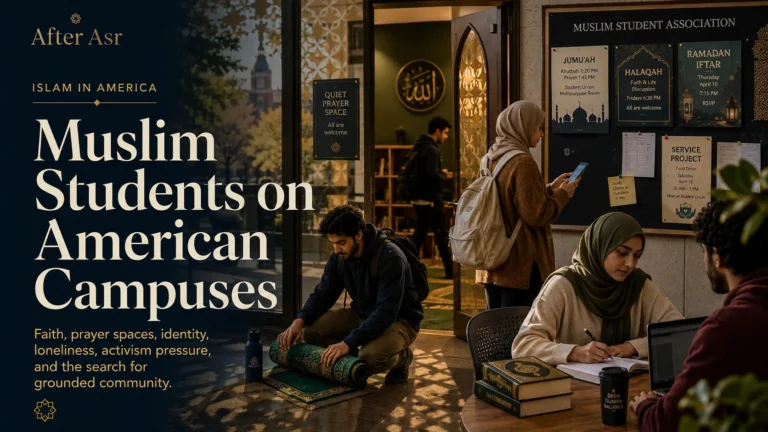
Muslim students and campus life
For Muslim students, campus life can be both opportunity and test.
A strong Muslim Student Association can provide prayer space, Jumu’ah coordination, Ramadan iftars, study groups, friendships, lectures, service projects, and a sense of belonging. It can help students feel that Islam has a visible place on campus.
But Muslim campus life can also bring challenges.
Student groups may be divided by ethnicity, ideology, gender dynamics, personality conflicts, or levels of practice. Some students may feel judged for not knowing enough. Others may feel pressured into activism without spiritual grounding. Converts may feel isolated. International students may feel separate from American-born Muslims. Practicing students may feel lonely in their majors or dorms.
The Muslim student also has to navigate broader campus culture: parties, alcohol, dating, loneliness, academic pressure, identity debates, political activism, and religious misunderstanding.
A student’s faith may grow stronger if they enter with roots and find good companionship.
It may weaken if they enter with little grounding and no support.
Families should not assume that a child who prayed at home will automatically maintain practice on campus. Nor should they assume university will destroy faith. Outcomes vary.
Preparation matters.
A student should know how to find prayer spaces, halal food, Muslim community, local masjids, trustworthy scholars, and emotionally healthy friends. They should know how to manage time around salah. They should know what boundaries they will keep before they are tested.
Campus life should be entered consciously.
The university and identity
Universities often tell students to discover themselves.
This can be valuable. Young adults need to reflect on gifts, interests, beliefs, and responsibilities.
But the modern language of identity can become unstable. Students may be encouraged to define themselves through labels, affiliations, causes, traumas, desires, politics, aesthetics, or social belonging. They may feel pressure to constantly narrate who they are.
For a Muslim student, self-discovery should not mean self-invention without limits.
The human being is not a blank canvas. The self is not created from nothing. The believer receives identity before Allah: servant, moral agent, member of family, neighbor, part of the ummah, accountable soul.
This does not erase personality, culture, or personal story. It grounds them.
A university can help students examine themselves. But it can also tempt them to confuse self-expression with truth.
Not every desire is identity.
Not every wound is destiny.
Not every label gives wisdom.
Not every community gives belonging.
Not every form of authenticity is actually freedom.
Students need grounding strong enough to engage campus identity conversations without being swallowed by them.
They need to know that Islam does not ask them to become faceless. It asks them to become truthful.
Research, science, and humility
Universities are also centers of research.
This is one of their great contributions. Research can advance medicine, engineering, environmental understanding, technology, social knowledge, historical insight, and human welfare. Students who participate in research may learn patience, method, evidence, precision, and humility before complexity.
But research culture also has temptations.
Ambition can distort truth. Funding can shape priorities. Publication pressure can encourage exaggeration. Prestige can reward novelty over wisdom. Technical skill can outrun ethical reflection.
Students in research fields need moral grounding.
Can this knowledge be misused?
Who benefits from this research?
Who may be harmed?
What assumptions shape the question?
What limits does this method have?
Does technical possibility mean moral permission?
How should humility govern expertise?
A university may teach methods. It may not teach moral wisdom deeply enough.
Muslim students in science and research should not feel they must choose between faith and inquiry. But they should also not imagine that scientific skill alone answers the question of how knowledge should be used.
Knowledge is an amanah.
The laboratory is not outside accountability.
Activism and moral seriousness
University campuses often attract activism.
Students encounter injustice, politics, war, poverty, racism, environmental concerns, labor issues, gender debates, religious discrimination, and questions of public morality. Many become politically aware for the first time.
This can be good. A university should not produce selfish graduates indifferent to suffering.
But activism can also become performative. It can reward outrage more than service, slogans more than study, moral certainty more than moral discipline. Students may be pressured to speak before they understand. They may attach identity to public positions while neglecting private character.
For Muslim students, justice matters. Speaking against oppression matters. Defending the vulnerable matters. But Islamic moral seriousness requires more than public alignment.
It requires truthfulness.
It requires humility.
It requires avoiding slander.
It requires patience.
It requires knowledge.
It requires sincerity.
It requires concern for the oppressed beyond social approval.
It requires consistency when a cause is no longer fashionable.
Universities can awaken moral concern. They can also train students into shallow performance.
Students should care about the world. But they should not confuse being seen caring with actually serving.
Community college and alternative paths
A serious conversation about higher education must include community colleges, trade schools, apprenticeships, military pathways, certifications, online degrees, work-based learning, and delayed enrollment.
Not every student needs to begin at a four-year university.
Community college can be a wise path. It may reduce cost, allow students to mature, provide transfer opportunities, offer technical programs, and keep students closer to family or community.
Trade and technical programs can lead to dignified, skilled, well-paid work. Apprenticeships can provide mentorship and practical formation. Certifications can help students enter fields without unnecessary debt.
The prestige culture around universities often hides these options.
A student who becomes an electrician, dental hygienist, aircraft mechanic, web developer, nurse, welder, paralegal, HVAC technician, radiology tech, or small business owner may be making a serious and honorable choice.
Communities should stop treating college as the only respectable path.
The question should be: what path helps this student become competent, responsible, faithful, and able to contribute?
For some, that path is university.
For others, it is not.
For many, it may be a combination.
What families should ask before college
Before sending a student to university, families should ask more than, “Where did you get accepted?”
They should ask:
Why are you going?
What do you hope to study?
What kind of work might this lead to?
What will it cost?
How will we pay?
What debt is involved?
What support exists on campus?
Is there a Muslim community?
How far will you be from home?
Are you ready for the independence?
What are your prayer plans?
What boundaries matter?
Who will mentor you?
What happens if you change majors?
What happens if you struggle?
Is there a more affordable path?
Is this school chosen for fit or prestige?
These questions are not meant to discourage.
They are meant to bring clarity.
College should be entered with intention, not momentum.
Too many students go because “that is what you do after high school.” Too many families celebrate acceptance without discussing the actual plan. Too many young adults discover the cost after the debt is already real.
Intention matters.
What universities actually deliver
So what do universities deliver?
They deliver access to knowledge, but not always wisdom.
They deliver credentials, but not always competence.
They deliver networks, but not always friendship.
They deliver independence, but not always maturity.
They deliver exposure, but not always grounding.
They deliver opportunity, but not equally.
They deliver prestige, but not always purpose.
They deliver career pathways, but not always at a wise cost.
They deliver intellectual challenge, but not always moral formation.
This does not make them worthless.
It makes them limited.
A university can be a powerful institution when used wisely. But it cannot carry the whole burden of forming a human being. It cannot replace family, faith, community, mentors, worship, work, service, or self-discipline.
A student should not enter university expecting it to give meaning to life.
Meaning must be deeper than enrollment.
A Muslim posture toward higher education
A Muslim approach to higher education should be neither fearful nor worshipful.
It should value knowledge but question prestige.
It should pursue excellence but resist arrogance.
It should seek credentials when needed but not confuse them with wisdom.
It should prepare students for careers but also for accountability before Allah.
It should engage ideas without surrendering faith.
It should build confidence without contempt.
It should ask financial questions honestly.
It should support students spiritually, socially, and intellectually.
Muslim families should not send children into universities unprepared and then act surprised when they are reshaped by the environment.
Nor should they teach children to fear every difficult idea.
The better path is rooted engagement.
Prepare students before they go. Support them while they are there. Help them integrate what they learn. Teach them to seek knowledge with humility. Remind them that their worth is not the university name, the GPA, the internship, or the salary.
Their education is an amanah.
The university in its proper place
The modern university promises much.
Some of what it promises, it can deliver.
It can deliver training, opportunity, intellectual challenge, professional pathways, research, networks, and moments of deep awakening.
But it cannot deliver everything.
It cannot guarantee wisdom.
It cannot guarantee belonging.
It cannot guarantee purpose.
It cannot guarantee moral clarity.
It cannot guarantee financial security.
It cannot guarantee spiritual strength.
It cannot guarantee that a student will become a better human being.
Those things require more than admission.
They require intention, family support, wise mentorship, good companionship, spiritual grounding, disciplined study, financial clarity, and the mercy of Allah.
A university should be respected when it serves knowledge and formation.
It should be questioned when it sells prestige, debt, and identity without wisdom.
It should be used as a tool, not worshiped as a savior.
The student walking across campus is not merely a consumer of credits. Not merely a future employee. Not merely a résumé under construction.
The student is a soul in formation.
If higher education remembers that, it can become noble.
If families remember that, they can choose more wisely.
And if students remember that, they may pass through the modern university without losing themselves inside its promises.