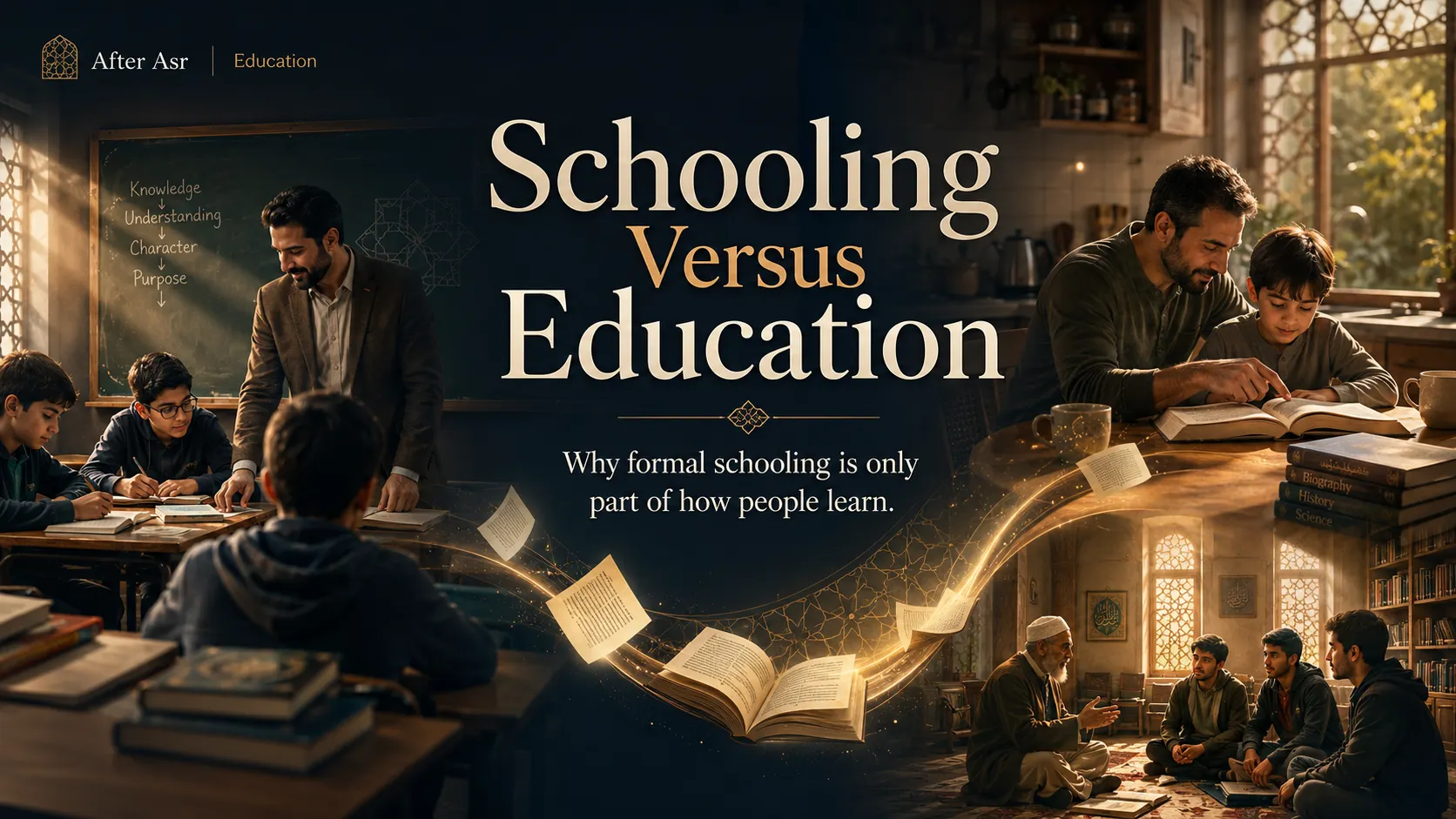
Why formal schooling is only part of how people learn.
Many people use the words schooling and education as if they mean the same thing.
They do not.
Schooling is the formal structure. It is the building, the schedule, the grade level, the classroom, the lesson plan, the textbook, the test, the report card, the transcript, the graduation requirement.
Education is larger.
Education is the formation of the whole person. It includes what a child learns in school, but also what a child learns at home, in the masjid, at work, in friendship, in hardship, through books, through service, through failure, through prayer, through conversation, through watching adults, and through the ordinary routines of life.
Schooling can be part of education. At its best, it is a powerful and necessary part.
But schooling is not the whole of education.
A person can spend many years in school and still be poorly educated in judgment, character, responsibility, faith, emotional maturity, and practical wisdom. Another person may have limited formal schooling yet possess deep understanding, discipline, skill, humility, and insight.
This does not mean school is unimportant. It means school must be placed in its proper place.
School is one institution among many that help form a human being. It is not the only one. It is not always the strongest one. And it should never be treated as a replacement for family, community, worship, mentorship, work, reading, and lived experience.
When we confuse schooling with education, we begin to believe that a child is learning well simply because the child is enrolled, attending, passing, and moving to the next grade.
But the deeper question is not only, “Is this child being schooled?”
The deeper question is, “Is this child being educated?”
Schooling is organized learning
Schooling has real value.
A good school gives structure to learning. It gathers students, teachers, materials, time, subjects, and expectations into an organized pattern. It introduces children to reading, writing, mathematics, science, history, language, art, physical activity, technology, and social life beyond the family.
Schooling can expose children to knowledge they may not encounter at home. It can help identify learning struggles. It can provide trained teachers. It can offer libraries, laboratories, music rooms, sports fields, clubs, counselors, and friendships.
For many families, schooling is also a practical necessity. Parents work. Children need routine. Society needs a way to prepare young people for literacy, citizenship, employment, and public life.
So this is not an argument against school.
A serious society needs serious schools.
But school becomes dangerous when we ask it to become everything.
A school can teach a child how to solve an equation, but it may not teach the child why honesty matters when no one is watching.
A school can assign a history essay, but it may not teach the child how to honor elders or preserve family memory.
A school can prepare a child for college, but it may not prepare the child to handle grief, marriage, debt, loneliness, arrogance, envy, or spiritual confusion.
A school can teach biology, but it may not teach reverence for life.
A school can teach communication skills, but it may not teach when silence is wise.
A school can teach a student to analyze a text, but it may not teach the student how to receive correction without resentment.
Schooling can organize learning. But education must form the learner.
Education begins before school
A child’s education begins long before the first day of kindergarten.
It begins in the voice of the parent.
It begins in the rhythm of the home.
It begins in the way adults respond to crying, curiosity, mistakes, questions, and disobedience.
It begins in the stories children hear, the words spoken around them, the habits repeated in front of them, and the emotional atmosphere they absorb.
Before a child learns the alphabet, the child is learning whether the world feels safe.
Before a child learns arithmetic, the child is learning whether adults are trustworthy.
Before a child writes essays, the child is learning what kinds of speech are normal.
Before a child studies religion formally, the child is learning what faith looks like in daily life.
This early education may not appear on a report card, but it is powerful.
A child who grows up around books may learn that reading belongs to ordinary life.
A child who hears adults apologize may learn that dignity does not require pretending to be perfect.
A child who sees prayer treated with seriousness may learn that worship is not a decorative identity.
A child who watches adults mock others may learn cruelty before anyone teaches it directly.
A child who sees constant phone use may learn that attention is disposable.
A child who is never allowed to ask questions may learn that obedience means silence.
This is education.
Not all of it is intentional. That is precisely why it matters.
The home is always teaching.
The question is whether it is teaching what we hope.
Children learn by imitation
One of the most basic truths about education is also one of the easiest to forget: children learn by watching.
They watch what adults do with anger.
They watch what adults do with money.
They watch how adults speak about absent people.
They watch whether adults keep promises.
They watch how adults treat service workers.
They watch how adults respond to inconvenience.
They watch whether religious language is matched by religious conduct.
They watch whether learning is loved or merely demanded.
Many adults try to lecture children into virtues they themselves do not practice.
They tell children to read while never reading.
They tell children to be patient while constantly snapping.
They tell children to be honest while making excuses.
They tell children to respect others while speaking with contempt.
They tell children to pray while treating prayer as a burden.
They tell children to value school while speaking as if learning is only useful for money.
Children notice the gap.
This does not mean adults must be perfect. Perfection is not possible. But adults must understand that example is part of education.
A teacher’s patience educates.
A parent’s discipline educates.
An elder’s gentleness educates.
A coach’s fairness educates.
An imam’s humility educates.
A business owner’s honesty educates.
A sibling’s responsibility educates.
We are always teaching more than we say.
The hidden curriculum of life
Schools have official curricula. These include subjects, standards, textbooks, assignments, and assessments.
But every environment also has a hidden curriculum.
The hidden curriculum is what people learn indirectly from the culture around them.
In school, students may learn that speed matters more than depth.
They may learn that quiet students are overlooked.
They may learn that popularity protects bad behavior.
They may learn that grades are more important than understanding.
They may learn that asking for help is embarrassing.
They may learn that adults are too busy to notice pain.
But the hidden curriculum also exists outside school.
At home, a child may learn that boys are not allowed to express sadness.
In a community, a child may learn that wealth earns more respect than character.
Online, a child may learn that attention is the highest form of value.
In friendship groups, a child may learn that cruelty creates status.
In religious spaces, a child may learn either mercy and reverence or judgment and shame.
Formal schooling is only one curriculum among many.
This is why parents should not only ask, “What is my child learning in class?”
They should also ask:
What is my child learning from our home?
What is my child learning from their friends?
What is my child learning from the internet?
What is my child learning from our community?
What is my child learning from the way adults handle disagreement?
What is my child learning about Allah from the way Muslims behave?
A child’s education is the sum of many teachers, not all of them official.
Education happens through work
One of the great losses of modern education is the separation of learning from useful work.
Many children spend years doing assignments that are meant to prepare them for life, while having very few chances to participate meaningfully in actual life.
They complete worksheets, projects, essays, and digital tasks. Some of these are helpful. But children also need to learn through contribution.
They need to cook, clean, repair, organize, care, build, plant, serve, manage time, handle money, help younger children, assist elders, solve practical problems, and take responsibility for real tasks.
Work educates because work reveals reality.
A student who helps cook learns measurement, timing, patience, cleanliness, and service.
A student who helps repair something learns attention, cause and effect, tools, humility, and persistence.
A student who helps with family budgeting learns limits, tradeoffs, gratitude, and planning.
A student who volunteers learns that other people’s needs are not imaginary.
A student who works a part-time job may learn punctuality, customer service, endurance, and respect for labor.
This kind of learning cannot be fully replaced by classroom discussion.
A society that treats all manual work as inferior will produce students who may be credentialed but helpless. They may know theories but not how to care for a home, feed guests, change a tire, manage conflict, or serve without applause.
Education should not make people useless outside professional settings.
A well-educated person should know how to think and how to act.
Education happens through worship
For Muslims, worship is also a form of education.
Prayer educates the body, the tongue, the attention, and the soul.
Fasting educates desire, patience, hunger, gratitude, and self-command.
Zakat educates the believer about wealth, obligation, and the rights of others.
Hajj educates through movement, sacrifice, equality, memory, and surrender.
Qur’an recitation educates the ear, the heart, the intellect, and the moral imagination.
A child who learns to pray is not only learning motions and words. The child is learning that life has a center beyond personal preference.
A teenager who fasts is not only learning hunger. The teenager is learning that desire does not have to rule.
A family that gives charity is not only donating money. It is teaching that wealth carries responsibility.
A community that gathers for Jumu’ah is not only attending a weekly sermon. It is teaching that believers are not meant to be isolated spiritual consumers.
This kind of education is not always recognized by formal systems. It may not appear in a transcript. It may not raise a test score. It may not impress a university.
But it forms the human being.
Religious education is not limited to Islamic studies class. It is also the shaping of time, appetite, manners, memory, speech, priorities, and belonging.
A child may attend the best school in the city and still be spiritually uneducated if no one teaches them how to live before Allah.
Education happens through conversation
A great deal of education happens through conversation.
Not lectures. Not announcements. Not instructions shouted from another room.
Conversation.
The kind where adults listen before correcting.
The kind where children are allowed to ask real questions.
The kind where disagreement does not immediately become disrespect.
The kind where stories are told.
The kind where a parent explains why a decision was made.
The kind where a teacher asks, “What do you think?” and waits for a real answer.
The kind where an elder remembers how things used to be.
The kind where a child learns that thought can be spoken aloud without fear.
Many families underestimate this.
They may spend money on tutoring but rarely sit with the child in thoughtful conversation. They may worry about curriculum but not about whether the child can express confusion. They may demand religious commitment but panic when the child asks difficult questions.
Conversation is one of the bridges between schooling and education.
School may introduce a topic. Conversation helps a child interpret it.
A child learns about history at school, then asks a parent about justice.
A child learns about biology, then asks about creation.
A child hears something confusing from friends, then asks an older sibling.
A child reads a novel, then asks why people betray each other.
A child sees suffering, then asks why Allah allows pain.
If adults are unavailable for these conversations, children will still seek answers. They may seek them from friends, influencers, entertainment, algorithms, or strangers.
A family that wants to educate must become a place where meaningful questions can breathe.
Education happens through failure
School often treats failure as a mark against the student.
A failed test lowers the grade.
A missed assignment triggers penalty.
A wrong answer may embarrass the child.
A poor performance may create anxiety.
Some accountability is necessary. But education must help students understand failure wisely.
Failure can educate if it is handled with honesty, patience, and correction.
A child who fails and learns to try again is being educated in resilience.
A teenager who makes a mistake and takes responsibility is being educated in character.
A student who struggles with a subject and seeks help is being educated in humility.
A young adult who chooses the wrong path and returns to what is right is being educated in repentance and maturity.
A life without failure is not possible. An education that cannot make sense of failure is incomplete.
Prestige-driven schooling often teaches children to fear mistakes because mistakes threaten the image of success. But real learning requires risk. A student must be able to say, “I do not understand.” A child must be able to attempt something difficult without believing that temporary weakness defines them.
Families and schools should not celebrate failure as if it is good by itself. Failure can hurt. It can carry consequences. It can reveal laziness, poor preparation, or bad choices.
But failure can also become a teacher.
The question is whether adults know how to guide children through it.
Education happens through place
Where a child learns matters.
A classroom teaches through its walls, sounds, order, and atmosphere.
A home teaches through its routines, clutter, peace, conflict, and hospitality.
A masjid teaches through its architecture, cleanliness, welcome, and adab.
A library teaches through silence, shelves, and the visible honor of books.
A workplace teaches through hierarchy, responsibility, and skill.
A neighborhood teaches through safety, neglect, beauty, or disorder.
Place forms expectation.
A child who grows up with access to safe parks, books, attentive adults, and organized activities receives a different informal education than a child surrounded by chaos, danger, and constant stress.
This is why education cannot be separated from community development. If we care about children, we must care about the spaces that form them.
A beautiful school building does not guarantee deep learning. But neglected spaces send messages. They tell children what adults believe they are worth.
Muslim communities should think carefully about this. What do our masjids teach children before anyone opens a book? Do they teach welcome, cleanliness, beauty, order, reverence, and belonging? Or do they teach that children are tolerated only when quiet?
What do our homes teach?
What do our classrooms teach?
What do our community centers teach?
What do our online spaces teach?
Every place has a curriculum.
Credentials are not the same as wisdom
Modern society relies heavily on credentials.
Degrees, certificates, licenses, transcripts, and test scores all serve a purpose. They help institutions identify training, competence, and eligibility. In fields like medicine, engineering, teaching, law, and aviation, formal training matters deeply.
But credentials are not the same as wisdom.
A person can be highly credentialed and still lack judgment.
A person can hold degrees and still be arrogant.
A person can be professionally successful and still be morally immature.
A person can speak impressively and still be spiritually empty.
A person can know many things and still not know how to live.
This is not an attack on higher education. Serious study deserves respect. Scholars, researchers, teachers, doctors, engineers, and trained professionals contribute enormously to society.
But we should not confuse certification with formation.
A diploma can show that someone completed a program. It cannot fully show whether they are honest, compassionate, patient, brave, humble, or wise.
An education worthy of the name must care about more than credentialing.
The world does not only need people who can pass exams. It needs people who can be trusted with power, wealth, knowledge, technology, authority, and influence.
A credential may open a door. Character determines what a person does once inside.
The danger of outsourcing education
Modern families are busy. Parents work long hours. Schools are complex. Technology is overwhelming. Many adults feel underprepared. It is tempting to outsource education to institutions and experts.
Let the school teach academics.
Let the masjid teach religion.
Let the coach teach discipline.
Let the therapist handle emotions.
Let the internet answer questions.
Let the college prepare the future.
Let the child figure things out eventually.
But no institution can replace the responsibility of the family and community.
This does not mean parents must do everything alone. They cannot. A wise family uses schools, teachers, tutors, scholars, counselors, coaches, relatives, and mentors. Seeking help is not failure.
The problem is not partnership. The problem is abandonment.
When adults outsource education completely, children receive fragments. One institution teaches achievement. Another teaches rituals. Another teaches entertainment. Another teaches identity. Another teaches consumer habits. Another teaches social status. But no one helps the child put it all together.
The child becomes surrounded by influence but lacking guidance.
Education requires integration. It requires adults who help children understand how knowledge, faith, work, family, friendship, technology, money, and purpose belong together.
A child should not have to assemble a worldview alone from school assignments, TikTok videos, peer pressure, and occasional advice.
School can support education when it knows its limits
The best schools do not pretend to replace families.
They partner with them.
They understand that students arrive with histories, homes, languages, fears, gifts, responsibilities, and spiritual lives. They recognize that learning is not only cognitive, but also emotional, social, moral, and practical.
A good school teaches subjects seriously while remembering that the student is not merely a test-taking mind.
It respects parents without surrendering professional responsibility.
It respects teachers without treating them as machines.
It respects children without making them the rulers of the room.
It respects knowledge without turning it into vanity.
It respects achievement without worshiping prestige.
Such a school understands that schooling is a servant of education.
It is not the master.
This distinction matters because a school that forgets its limits may become arrogant. It may treat parents as obstacles, faith as inconvenience, culture as backwardness, and children as data points.
But families can also forget limits. Parents may expect school to fix every problem, produce every virtue, explain every moral question, provide every opportunity, and compensate for every weakness at home.
A healthy educational life requires shared responsibility.
Schools should teach well.
Families should form deeply.
Communities should support wisely.
Students should gradually take ownership of their own learning.
The educated person
If schooling is not the same as education, then what does an educated person look like?
Not merely someone with degrees.
An educated person can read with understanding.
An educated person can listen without immediately reacting.
An educated person can ask better questions.
An educated person can tell the difference between information and wisdom.
An educated person can work with discipline.
An educated person can receive correction.
An educated person can respect evidence without losing moral clarity.
An educated person can appreciate beauty.
An educated person can serve without needing applause.
An educated person can live with purpose beyond status.
From an Islamic perspective, education should also help a person recognize their dependence on Allah, their obligations to others, the limits of their knowledge, and the seriousness of their choices.
The educated person does not merely know how the world works. The educated person also asks what the world is for, who they are within it, and how they are accountable for what they know.
This is why schooling alone is not enough.
A school may teach a child how to read. Education must help the child ask what is worth reading.
A school may teach a child how to argue. Education must help the child ask when argument becomes arrogance.
A school may teach a child how to earn. Education must help the child ask what wealth is for.
A school may teach a child how to win. Education must help the child ask what must never be sacrificed for victory.
Bringing schooling back into education
The answer is not to abandon schooling. The answer is to restore it to its proper purpose.
Parents should care about schools. They should care about curriculum, teachers, safety, reading levels, math skills, graduation requirements, special education, technology, and college or career preparation.
But they should not stop there.
They should also ask:
Is my child becoming truthful?
Is my child becoming patient?
Is my child learning how to think?
Is my child learning how to serve?
Is my child learning how to handle boredom?
Is my child learning how to use technology wisely?
Is my child learning how to disagree with adab?
Is my child learning that faith belongs to all of life?
Is my child learning that work has dignity?
Is my child learning that knowledge is an amanah?
These questions do not replace academic concerns. They complete them.
A child who cannot read well needs help. A child who cannot do basic math needs help. A child who lacks scientific understanding needs help. A child who cannot write clearly needs help.
But a child who can do all these things while becoming selfish, arrogant, careless, faithless, or cruel is also in danger.
Education must hold both concerns together.
Competence and character.
Knowledge and wisdom.
Achievement and humility.
Schooling and formation.
The larger classroom
The world is a classroom, but not every lesson is good.
This is why children need guidance. Life will educate them either way. The only question is what kind of education they will receive.
The street educates.
The screen educates.
The marketplace educates.
The family educates.
The masjid educates.
The school educates.
Friendship educates.
Pain educates.
Success educates.
Failure educates.
Silence educates.
Beauty educates.
A wise community does not leave this to chance.
It builds schools, but also homes of conversation.
It honors teachers, but also mentors.
It values books, but also service.
It teaches religion, but also embodies it.
It prepares children for work, but also for worship.
It helps students succeed, but also helps them become worthy of success.
Formal schooling is one important chapter in a much larger book.
If we remember that, we can stop asking school to be everything and start rebuilding the many places where real education happens.
A child needs classrooms, but not only classrooms.
A child needs teachers, but not only certified teachers.
A child needs knowledge, but not only information.
A child needs achievement, but not only recognition.
A child needs education in the fullest sense: mind, body, character, faith, skill, memory, responsibility, and purpose.
Schooling can help with that.
But education is the greater task.
And it belongs to all of us.