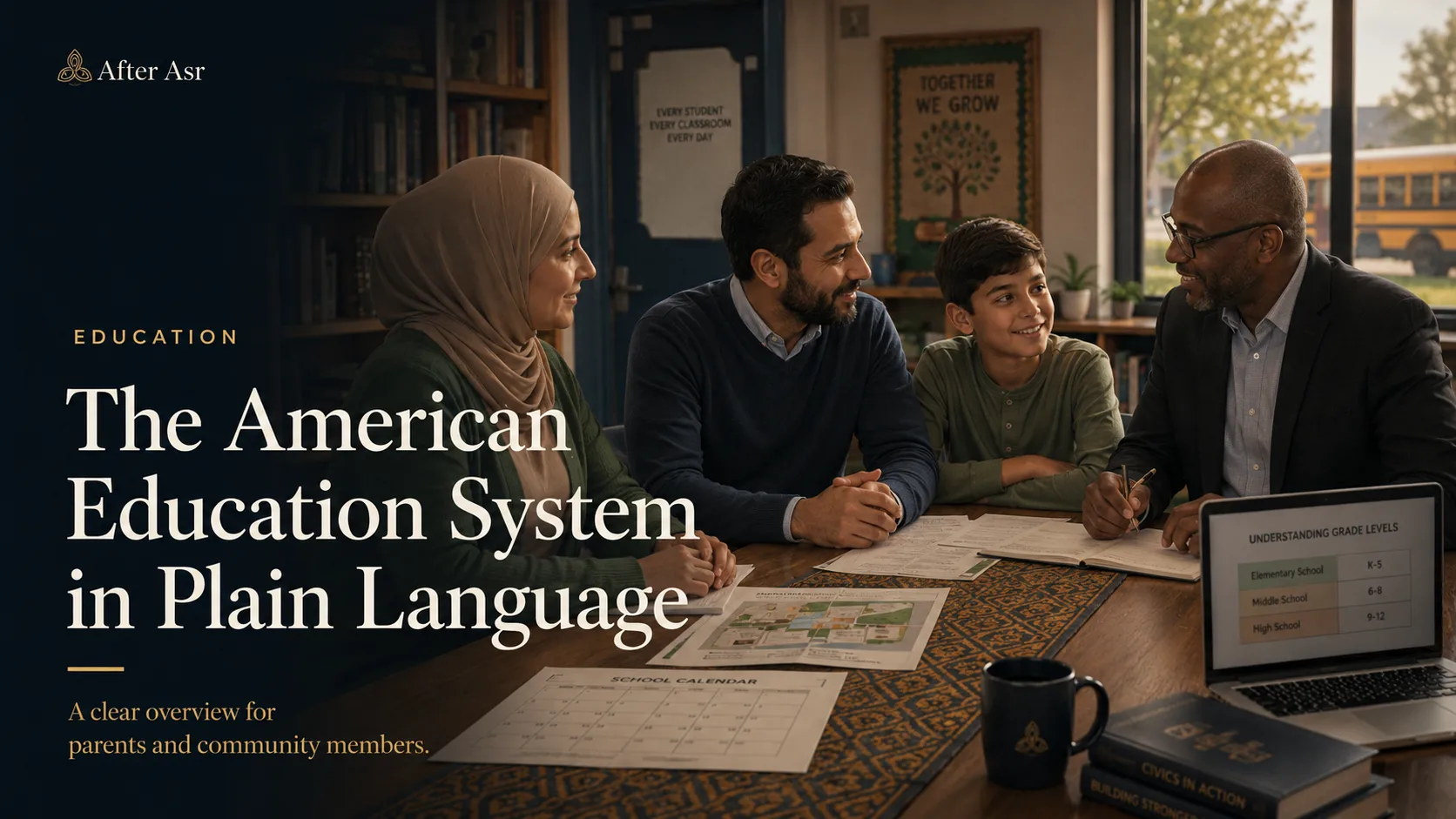
A clear overview for parents and community members.
The American education system can feel confusing even to people who grew up inside it.
For parents who are new to the country, new to a state, new to a school district, or simply trying to understand what is happening in their child’s life, the system can feel like a maze of grade levels, acronyms, policies, tests, forms, meetings, school boards, counselors, credits, transcripts, and programs.
For Muslim families, there can be another layer of concern. Parents may wonder what their children are being taught, how to request religious accommodations, how to communicate with teachers, whether public school is enough, whether Islamic school is realistic, whether homeschooling is possible, and how to protect faith and character while still giving children access to strong academics.
The first step is not panic.
The first step is understanding the basic structure.
The American education system is large, uneven, local, and often difficult to summarize. But it can be explained in plain language. Once families understand the main pieces, they are better able to ask good questions, advocate for their children, and make wise decisions.
This article is not a legal guide, and it cannot explain every rule in every state. But it can give parents and community members a clear map of how the system generally works.
There is no single American school system
One of the first things to understand is that the United States does not have one single national school system that works the same way everywhere.
There is a federal government. There are state governments. There are local school districts. There are school boards. There are public schools, charter schools, magnet schools, private schools, Islamic schools, Catholic schools, independent schools, online schools, and homeschool arrangements.
This can be frustrating, but it is also important.
In many countries, education is more centralized. A national ministry may have strong control over curriculum, exams, teacher rules, and school structure. In the United States, the federal government influences education, but most major decisions are made at the state and local levels.
That means a child’s experience can change significantly depending on where the family lives.
Two families may both say, “My child goes to public school,” but one child may attend a well-funded suburban school with many advanced classes, while another child may attend an under-resourced school struggling with teacher shortages, aging buildings, and limited support services.
This is one reason parents should not only ask, “How are American schools?”
They should ask:
What is my state’s education system like?
What is my school district like?
What is this specific school like?
Who is the principal?
What support does the school offer?
What are the expectations for parents?
What rights and responsibilities do families have?
In America, education is local enough that the details matter.
The basic grade structure
The American school path is usually divided into several stages.
Children may begin with preschool or pre-kindergarten, often called pre-K. This is usually for younger children before formal kindergarten. Some programs are public, some private, and some connected to religious or community organizations.
Then comes kindergarten, which is often the first formal year of school.
After that, students move through numbered grades.
Elementary school usually includes kindergarten through 5th grade, though some schools may end at 4th or 6th grade.
Middle school usually includes grades 6 through 8. In some places, it may be called junior high.
High school usually includes grades 9 through 12.
High school grades also have traditional names:
9th grade is freshman year.
10th grade is sophomore year.
11th grade is junior year.
12th grade is senior year.
After high school, students may go to a community college, four-year college, university, trade school, technical program, apprenticeship, military service, work, or another path.
This structure may sound simple, but parents should remember that each stage has a different culture.
Elementary school is usually more guided. Students often have one main teacher and spend much of the day with the same group.
Middle school is often a difficult transition. Students change classes, deal with puberty, social pressure, identity questions, and more independence.
High school is more serious academically and socially. Grades begin to matter more for graduation, college admissions, scholarships, and future planning.
Parents should not treat all school years the same. Each stage requires a different kind of attention.
Public schools
Public schools are government-funded schools that are generally free for students who live in the district or attendance zone.
Most American children attend public school.
Public schools are usually funded through a combination of local, state, and federal money. Local property taxes often play a major role, which is one reason wealthier neighborhoods may have better-resourced schools than poorer neighborhoods.
Public schools must follow many state and federal rules. They must serve a wide range of students, including students with disabilities, English language learners, low-income students, gifted students, and children from many religious, cultural, and family backgrounds.
For Muslim families, public schools may offer opportunity and challenge at the same time.
A public school may provide strong academics, sports, clubs, technology, advanced classes, free meals, special education support, counseling, and social diversity.
But families may also face concerns about peer influence, bullying, modesty, prayer, lunch options, holidays, sex education, classroom materials, identity pressure, or the feeling that their child is always explaining Islam to others.
The question is not simply, “Are public schools good or bad?”
The better question is, “What is this particular public school teaching, rewarding, allowing, ignoring, and expecting?”
Parents should visit the school when possible. They should learn the names of teachers and administrators. They should attend parent meetings. They should read school communications. They should ask about curriculum, discipline, safety, counseling, religious accommodations, and academic support.
A public school may be a blessing for one child and a struggle for another. Families need clear eyes, not slogans.
School districts and school boards
Most public schools are organized into school districts.
A school district is a local education authority that manages a group of public schools in a city, county, or region. The district may make decisions about school calendars, staffing, transportation, budgets, programs, and local policies.
Many districts are governed by a school board. School board members are often elected by the public. They may vote on budgets, policies, leadership, curriculum issues, superintendent hiring, and other major decisions.
This matters because many parents complain about “the school system” without realizing that some decisions are made close to home.
If a school policy concerns parents, the answer may not be only to speak with the teacher. Sometimes the principal matters. Sometimes the district office matters. Sometimes the school board matters. Sometimes the state education department matters.
Parents and community members should know who makes which decisions.
A teacher may not control the curriculum.
A principal may not control state testing.
A district may not control federal requirements.
A school board may not decide every classroom practice.
Understanding the structure helps families advocate more wisely.
Private schools
Private schools are not run by the public school district. Families usually pay tuition, though scholarships or financial aid may be available.
Private schools may be religious or nonreligious. They may have a specific educational philosophy, smaller classes, stricter admissions, different discipline systems, or a particular academic focus.
Private schools can offer families more alignment with values, more flexibility, or a more focused environment. But they also vary widely in quality.
A private school is not automatically better because it charges tuition. Families should ask hard questions.
Is the school accredited or recognized by a credible body?
Who teaches there?
What are the class sizes?
What curriculum is used?
How does the school handle discipline?
What support exists for struggling students?
What happens if a child has a disability or learning difference?
What is the school’s religious or moral environment?
What are the hidden costs beyond tuition?
Some private schools are excellent. Some are weak. Some are warm but academically thin. Some are academically strong but emotionally harsh. Some promise values but fail to build healthy culture.
Parents should not be dazzled by uniforms, brochures, or polite language. They should look carefully at the actual daily life of the school.
Islamic schools
Islamic schools in the United States are a form of private religious school. They are usually created by Muslim communities to provide academic education in an Islamic environment.
At their best, Islamic schools can give students something very valuable: a place where their faith is normal.
They may hear the adhan, pray during the school day, study Qur’an, learn Arabic, discuss Islamic manners, see Muslim teachers, eat halal food, observe Ramadan and Eid, and build friendships with other Muslim students.
For many families, this matters deeply.
But Islamic schools also face real challenges.
Some have limited funding. Some struggle to pay teachers competitive salaries. Some have small facilities. Some lack advanced classes, special education services, counseling, sports, arts, or extracurricular opportunities. Some are still developing strong administrative systems. Some depend heavily on volunteers or underpaid staff.
This does not mean Islamic schools are a bad option. It means families should approach them with love and seriousness.
An Islamic school should not be judged only by whether it is Muslim. It should be judged by whether it is trustworthy, organized, academically serious, spiritually healthy, emotionally safe, and honest about its strengths and limitations.
A school does not become excellent by adding Islamic language to weak structure.
But a sincere, well-led Islamic school can become one of the most important institutions in a Muslim community.
Charter and magnet schools
Some public school options are not traditional neighborhood schools.
Charter schools are publicly funded but usually operate with more independence than regular public schools. They may have a particular mission, teaching model, or focus. They do not charge tuition, but admission may be limited. If more students apply than available seats, some use a lottery.
Magnet schools are public schools with a special focus, such as science, technology, arts, international studies, language immersion, or advanced academics. Students may apply from outside the normal neighborhood zone.
These schools can provide strong opportunities. But again, families should look carefully.
A charter school may be innovative, or it may be poorly managed.
A magnet school may be academically rich, or it may create pressure that does not fit every child.
A special program may sound impressive, but the daily culture still matters.
Parents should ask about transportation, admissions, expectations, homework load, discipline, teacher stability, and student support.
Homeschooling
Homeschooling means the child’s education is directed primarily by the family instead of a traditional school.
Homeschooling rules vary by state. Some states require more reporting, testing, recordkeeping, or association membership than others. Families must learn their local requirements carefully.
Homeschooling can be a serious and beautiful option when done responsibly. It can allow for religious formation, flexible pacing, family closeness, travel, deep reading, practical skills, and protection from harmful school environments.
But homeschooling is not simply keeping a child at home.
It requires planning, discipline, curriculum choices, social opportunities, recordkeeping, patience, and honesty about what the parent can and cannot teach well.
Some families thrive with homeschooling. Others underestimate the responsibility. Some children benefit from the flexibility. Others need more structure, peer interaction, or specialized support than the family can provide alone.
The best homeschooling families usually do not isolate themselves. They build networks, co-ops, tutoring arrangements, extracurricular activities, library routines, community service, and religious learning circles.
Homeschooling is not an escape from education. It is taking direct responsibility for it.
Curriculum
Curriculum means what students are expected to learn.
This includes subjects such as reading, writing, mathematics, science, history, social studies, art, music, physical education, technology, and sometimes foreign language.
In public schools, curriculum is often shaped by state standards, district choices, textbooks, testing requirements, and teacher planning. In private schools, curriculum may be chosen more independently.
Parents often hear the word curriculum only when controversy arises. But curriculum is broader than a single book or lesson. It includes the sequence of learning, the materials used, the questions asked, the skills practiced, and the worldview implied by what is included or excluded.
A parent does not need to become an expert in every subject. But parents should know what their children are studying.
They should ask:
What books are being read?
What math level is my child in?
How is writing taught?
How is history presented?
What science topics are covered?
How are sensitive subjects handled?
How much homework is expected?
What support exists if my child falls behind?
The goal is not to become suspicious of everything. The goal is to be awake.
Testing and grades
American schools use many forms of testing.
There are classroom quizzes and exams. There are state standardized tests. There are college entrance exams. There may be reading assessments, math benchmarks, end-of-course exams, placement tests, and diagnostic evaluations.
Grades are usually given as letters, numbers, percentages, or standards-based ratings.
Testing can be useful. It can show what students understand, where they need help, and whether schools are meeting basic expectations.
But testing can also become excessive. It can narrow learning, stress students, pressure teachers, and make families believe that a child’s worth can be measured by a score.
Parents should take grades seriously, but not worship them.
A low grade may mean the child needs help. It may also mean the child is disorganized, bored, anxious, confused, distracted, unsupported, or dealing with something outside school.
A high grade may mean the child is learning well. It may also mean the work is too easy, the child is good at compliance, or the grading system rewards performance more than depth.
Grades are information. They are not identity.
A wise parent asks not only, “What grade did you get?”
A wise parent asks, “What did you learn? What confused you? What are you proud of? What do you need to practice? Did you do your work honestly? Did this subject help you see the world more clearly?”
Special education
Special education refers to services and supports for students with disabilities or learning needs that affect school performance.
This may include students with autism, ADHD, dyslexia, speech or language difficulties, emotional disabilities, physical disabilities, intellectual disabilities, hearing or vision impairments, or other needs.
In public schools, eligible students may receive an IEP, which means Individualized Education Program. An IEP is a formal plan for students who qualify for special education services.
Some students may receive a 504 Plan, which provides accommodations for a disability but may not include the same level of specialized instruction as an IEP.
Plainly stated: if a child has a disability or learning difference that affects school, the family should not simply hope the child catches up alone.
Parents can ask the school for an evaluation. They can request meetings. They can ask what support is available. They can bring questions in writing. They can keep copies of documents.
For Muslim communities, this is especially important. Some families feel shame around disability or learning struggles. Some delay seeking help because they fear labels. Some think the child is lazy, disobedient, or not trying hard enough.
But learning difficulties are not moral failures.
A child who struggles to read may need intervention, not scolding.
A child who cannot sit still may need structure and support, not humiliation.
A child with autism may need understanding, not constant correction for being different.
A child with anxiety may need help, not lectures about toughness.
Seeking support is not a rejection of qadr. It is part of taking the means seriously.
English language learners
Many students in American schools are learning English while also trying to learn academic subjects.
These students may be called English Language Learners, ELL students, or multilingual learners.
A child may be intelligent, thoughtful, and academically capable while still struggling to express ideas in English. Parents and teachers should not confuse language development with lack of ability.
Families should ask what language support is available. Schools may provide English instruction, translation assistance, bilingual communication, or other services depending on the district.
Community members can also help by supporting reading, conversation, tutoring, and family navigation.
For immigrant Muslim families, language can become a barrier between parents and schools. Parents may feel embarrassed, ignored, or powerless. Schools may misunderstand family expectations. Children may end up translating adult conversations they are too young to handle.
A healthy community should help families bridge this gap.
Language should not prevent parents from understanding their child’s education.
Counselors, principals, and support staff
Schools are not made only of teachers.
A school may include a principal, assistant principals, counselors, social workers, nurses, librarians, special education coordinators, coaches, office staff, bus drivers, cafeteria workers, and security staff.
Parents should know who does what.
The teacher handles classroom learning and daily academic concerns.
The principal leads the school and handles larger school issues.
The school counselor may help with schedules, emotional support, college planning, conflict, or student concerns.
The nurse may handle medication, health plans, injuries, or medical needs during school.
The special education team handles evaluations, IEPs, accommodations, and support services.
The front office staff often know practical information about attendance, forms, schedules, and communication.
A respectful relationship with school staff can make a major difference. Parents do not need to be aggressive to advocate. They need to be clear, consistent, documented, and present.
Attendance matters
Attendance is one of the simplest but most important parts of school success.
Students who miss school often fall behind, even if they are bright. Absences affect reading, math, friendships, routines, and teacher understanding.
At the same time, families may need flexibility for illness, emergencies, religious holidays, travel, or family responsibilities.
Parents should learn the school’s attendance policy. They should know how to report absences, how many absences trigger concern, and whether religious holidays can be excused.
For Muslim families, this matters around Eid, Ramadan fatigue, Jumu’ah concerns, and sometimes travel for family or religious reasons.
A child should not be punished unfairly for legitimate religious observance. But parents should communicate clearly and early. Written communication is often better than casual verbal requests.
Religious accommodations
Muslim students in public schools may need accommodations related to prayer, fasting, Eid, halal food, modest clothing, religious dress, or avoiding certain activities.
Many schools are willing to help when parents communicate respectfully and specifically.
For example, a student may need a quiet place to pray Dhuhr during the school day. A fasting student may need an alternative space during lunch in Ramadan. A family may request an excused absence for Eid. A student may wear hijab, kufi, or modest clothing. A parent may ask about curriculum content or participation in certain activities.
The key is to communicate early, clearly, and calmly.
Instead of saying only, “My child is Muslim,” parents should explain the actual need.
“My child will be fasting during Ramadan and may need to sit quietly during lunch.”
“My child needs a clean and private place to pray for a few minutes during the school day.”
“Our family observes Eid, and my child will be absent on this date.”
“My child does not eat pork or non-halal meat. Please help us understand the lunch options.”
Most problems become harder when families wait until conflict appears.
A good school should not treat ordinary Muslim practice as strange or disruptive. But parents also need to help schools understand what is being requested.
School culture matters
A school is not only its curriculum.
A school has a culture.
Culture means the lived atmosphere of the place. It includes how students speak to each other, how teachers manage classrooms, how bullying is handled, how discipline works, how parents are treated, how differences are respected, and what kind of behavior earns status among students.
A school may look strong on paper but feel unhealthy in daily life.
Parents should pay attention to signs.
Does my child feel safe?
Does my child feel known?
Are teachers responsive?
Is bullying taken seriously?
Are students cruel to those who are different?
Is academic success respected?
Are modesty and faith mocked?
Are adults present and attentive?
Does the school communicate clearly with families?
Children do not only learn from lessons. They learn from the atmosphere.
A school culture can build confidence or quietly damage it.
High school credits and graduation
High school is different because students usually need specific credits to graduate.
A credit is earned by passing a required course. Requirements vary by state and district, but students commonly need credits in English, math, science, social studies, physical education, and electives.
Students may also have opportunities for honors classes, Advanced Placement courses, dual enrollment college classes, career and technical education, internships, or vocational programs.
Parents should not wait until 12th grade to understand graduation requirements.
By 9th grade, families should know:
What courses are required for graduation?
Is the student on track?
What happens if a class is failed?
Are there advanced or career-focused options?
What tests are required?
What GPA is needed for certain opportunities?
What does the student want after high school?
A student can be smart but still lose opportunities because nobody helped them plan.
Families should meet counselors early and keep records.
After high school
American society often talks as if college is the only serious path after high school. This is not true.
Students may choose a four-year university, community college, trade school, technical certification, apprenticeship, military service, entrepreneurship, work, religious study, or a combination.
Each path has benefits and risks.
A four-year university can offer deep study, credentials, networks, and professional opportunities. It can also be expensive and socially challenging.
Community college can be more affordable and flexible. It can lead to transfer, technical training, or associate degrees.
Trade schools and apprenticeships can lead to skilled work with strong earning potential and less debt.
Military service can provide structure, benefits, and training, though it also carries serious moral, physical, and personal considerations.
Work can build maturity and responsibility, but young people may need guidance to avoid becoming stuck without growth.
Families should not ask only, “What sounds impressive?”
They should ask, “What path fits this student’s abilities, responsibilities, faith, finances, temperament, and long-term goals?”
A wise education does not force every child into the same mold.
Parents have a role
Some parents think school is the teacher’s responsibility.
Some teachers think learning problems are the family’s fault.
Both views are too simple.
Education works best when parents and schools understand that they share responsibility, even if their roles are different.
Parents do not need to do the teacher’s job. But they should know whether homework is being completed, whether the child can read well, whether grades are slipping, whether the child is lonely, whether the child is sleeping enough, and whether school is shaping the child’s character in healthy or unhealthy ways.
Parents should read school emails. They should attend conferences when possible. They should ask questions. They should keep documents. They should talk with their children about school in more than one-word conversations.
Instead of only asking, “How was school?” parents can ask:
What was something interesting you learned today?
Who did you sit with at lunch?
Was anyone treated unfairly?
What was difficult today?
Did you feel respected?
Did you help anyone?
What are you working on this week?
Is there anything your teacher wants me to know?
Children often reveal more when parents ask better questions.
Community members also have a role
Education is not only a private family matter.
Mosques, libraries, nonprofits, businesses, elders, college students, professionals, and neighbors all shape the educational life of a community.
A mosque can offer tutoring, youth circles, reading programs, mentorship, college preparation, parent workshops, Arabic classes, Qur’an learning, career talks, and support for converts and immigrant families navigating schools.
A business owner can host apprenticeships or career days.
A retired teacher can help children read.
A college student can mentor high school students.
An imam can help families think about faith, character, and school challenges.
A community that complains about children but does not teach them has misunderstood its responsibility.
Children need more than schools. They need a community that takes learning seriously.
The system is imperfect, but families are not powerless
The American education system has real problems.
Funding is unequal. Teachers are often overworked. Students are pressured. Families are confused. Politics enters classrooms. Technology distracts. Special education can be difficult to navigate. College can be expensive. Some schools are unsafe. Some children are overlooked.
But families are not powerless.
Parents can learn the system.
They can ask questions.
They can document concerns.
They can build relationships with teachers.
They can attend school board meetings.
They can request evaluations.
They can seek tutoring.
They can organize community support.
They can protect religious practice.
They can choose different school options when available.
They can teach at home what the school neglects.
Understanding the system does not solve every problem. But confusion makes every problem harder.
A parent who understands the basic map can move with more confidence.
A plain-language summary
The American education system is not one simple machine.
It is a layered structure made of federal influence, state rules, local districts, school boards, individual schools, teachers, families, and communities.
Public schools are free and widely used, but they vary greatly.
Private and Islamic schools may offer value alignment, but they require careful evaluation.
Homeschooling can be serious and beautiful, but it demands responsibility.
Grades and tests matter, but they do not define a child.
Special education and language support exist, but families often need to advocate.
Teachers matter, but schools cannot raise children alone.
Parents matter, but they should not have to navigate everything alone.
Community matters because education is bigger than school.
The goal is not for every parent to become an education expert. The goal is for parents and community members to become informed enough to participate wisely.
A child’s education should not feel like a locked room where only professionals hold the key.
Families have a right to understand.
Children have a right to be supported.
Teachers deserve partners, not only critics.
Communities have a responsibility to help.
The American education system may be complicated, but the central question remains simple:
Are we helping children learn what they need in order to become capable, truthful, faithful, responsible, and whole?
That question belongs not only to schools.
It belongs to all of us.