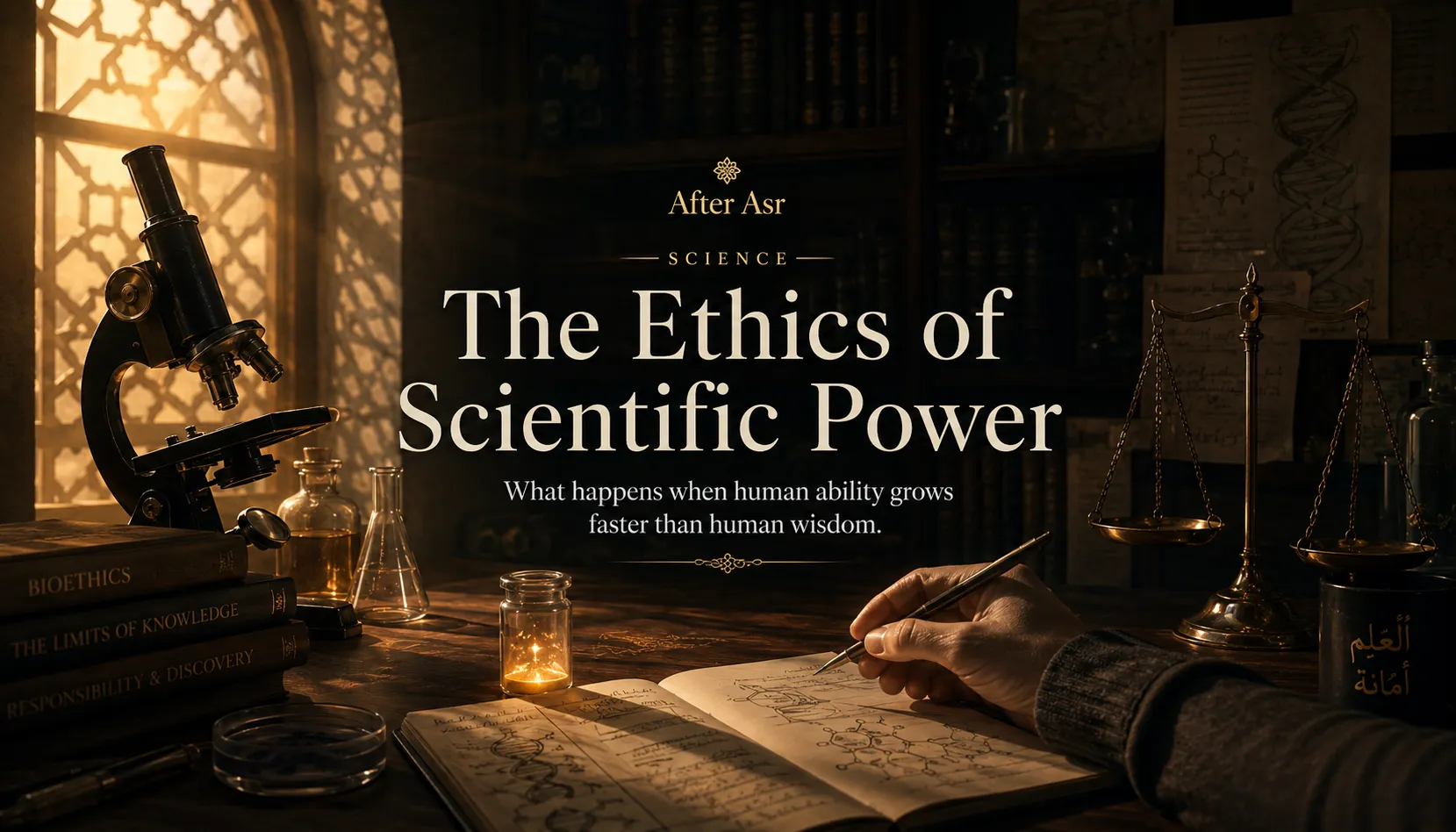
What happens when human ability grows faster than human wisdom
Human beings are very good at learning how to do things.
We learn how to split atoms, edit genes, build machines that imitate language, produce chemicals that alter bodies and landscapes, see inside the brain, track populations, manipulate attention, preserve life, end life, and move information across the world in an instant. We learn how to intervene in systems that previous generations could barely understand. We learn how to predict, amplify, automate, engineer, and control.
But learning how to do something is not the same as becoming worthy of doing it.
This is one of the central moral problems of scientific power. Human ability can grow faster than human wisdom. A society may gain the capacity to act before it has developed the character to act rightly. It may possess tools of extraordinary precision while remaining childish in its desires. It may become technically brilliant and morally confused.
Science expands what is possible. Ethics asks what should be permitted. Faith asks what we are accountable for.
When these questions are separated, power becomes dangerous.
The problem is not science itself. Scientific inquiry can heal, protect, clarify, and serve. The problem begins when knowledge becomes detached from humility, when ability becomes detached from restraint, and when the human being begins to imagine that possibility itself is permission.
A tool does not become moral simply because it works.
A discovery does not become wise simply because it is impressive.
A technique does not become just simply because it is efficient.
Scientific power must be governed by moral seriousness, or it will eventually serve whatever desire is strongest.
Power arrives before reflection
One of the reasons scientific power is dangerous is that it often arrives before society has reflected deeply on its consequences.
A new technology appears. It is exciting, profitable, useful, and difficult to resist. Institutions adopt it. Companies market it. Governments regulate it slowly, if at all. Ordinary people rearrange their lives around it before they understand what it is doing to them. By the time serious ethical questions become mainstream, the tool may already be woven into work, school, medicine, war, communication, and family life.
This pattern has repeated many times.
Chemicals were released before their long term environmental effects were understood. Industrial systems were built before their consequences for air, water, labor, and climate were fully acknowledged. Digital platforms spread before societies understood how they would reshape attention, loneliness, politics, childhood, and public trust. Medical technologies developed before communities agreed on the moral boundaries of reproduction, end of life care, genetic selection, or human enhancement.
Scientific power often moves with speed. Wisdom usually moves more slowly.
This mismatch creates danger.
Speed rewards adoption. Wisdom requires pause.
Speed asks, “How soon can we use this?” Wisdom asks, “What kind of life will this create?”
Speed looks for market advantage. Wisdom looks for moral consequence.
Speed celebrates novelty. Wisdom asks what should remain untouched.
A society that treats hesitation as backwardness will eventually mistake recklessness for progress.
The question beneath every innovation
Every powerful technology carries a hidden question: What vision of the human being does this assume?
A medical system may assume the human being is a patient to be healed, a customer to be billed, a body to be managed, or a problem to be optimized. A social media platform may assume the human being is a soul to be respected, or an attention source to be harvested. An educational technology may assume the student is a mind to be formed, or a performance metric to be improved. A genetic technology may assume children are gifts to be received, or projects to be designed.
These assumptions matter.
Tools do not enter the world empty. They carry values in their design, use, funding, and distribution. They encourage certain habits. They make some actions easier and others harder. They reward some behaviors and discourage others.
This is why the ethical question must come early.
Not only: Can this be done?
Not only: Does this work?
Not only: Is it profitable?
Not only: Is it efficient?
But also: What does this do to dignity? What does it do to responsibility? Who gains power? Who becomes vulnerable? What kinds of people will this technology encourage us to become?
Scientific power becomes dangerous when these questions are treated as obstacles instead of necessities.
Ability is not permission
Modern people often assume that if something can be done, someone will eventually do it. This may be true as a prediction, but it is not a moral argument.
Human beings can do many things they should not do.
We can deceive. We can exploit. We can surveil. We can manipulate. We can build weapons of enormous destruction. We can design systems that profit from addiction. We can alter bodies for reasons rooted in vanity or discrimination. We can collect intimate data from people who do not fully understand what they have surrendered.
The fact that we can do these things does not make them right.
Science can reveal possibility. Ethics must judge permission.
This judgment requires a moral framework strong enough to resist fascination. That is difficult because power is seductive. A new ability can make people feel as if they are standing at the edge of history. Investors see opportunity. Governments see advantage. Researchers see discovery. Consumers see convenience. The vulnerable may see hope.
Hope is powerful, especially in medicine. A person facing infertility, disability, illness, aging, grief, or death may understandably want any tool that promises relief. We should be compassionate toward that longing. But compassion does not require surrendering all boundaries.
Not every desire should become a market.
Not every suffering should be answered with any available intervention.
Not every hope should be sold before its consequences are understood.
Sometimes love requires restraint.
The vulnerable carry the risk
Scientific power rarely falls evenly.
The wealthy often receive the benefits first. The poor often carry the risks first. This has been true in environmental exposure, medical experimentation, industrial labor, dangerous housing, data extraction, and unequal healthcare access.
When a new technology is introduced, we should always ask: Who will be tested on? Who will be watched? Who will be displaced? Who will breathe the pollution? Who will be told the risk is acceptable? Who will lack the power to refuse?
Power often hides its costs in the lives of people with fewer choices.
A factory may bring jobs while also bringing toxic exposure. A medical trial may offer access while also creating ethical vulnerability. A surveillance tool may be justified by safety while being used most aggressively against marginalized communities. An algorithm may promise efficiency while quietly denying services to people who cannot appeal its decision.
Scientific power becomes morally corrupt when the burdens are placed on those least able to resist.
This is why ethics cannot be an afterthought. It must protect people before harm becomes normalized. It must ask whether consent is real, whether benefits are fairly shared, whether risks are honestly communicated, and whether those affected have a voice in decisions made about them.
A society’s treatment of the vulnerable reveals whether its knowledge has become wisdom or merely control.
Research is never only technical
Research often presents itself in clean language: methods, samples, outcomes, controls, variables, significance. This language is important. It helps discipline inquiry. But research is never only technical because research involves human choices.
What gets studied?
Who funds it?
Who benefits from the findings?
Who is included in the sample?
Who is excluded?
What risks are considered acceptable?
How is consent obtained?
How are results communicated?
What happens after the study ends?
These questions are ethical, not merely procedural.
A study can be well designed statistically and still morally troubling. A result can be useful and still produced through exploitation. A discovery can advance knowledge while damaging trust if the people involved were treated as objects rather than persons.
Science has learned this painfully. Histories of unethical experimentation, racialized medical abuse, forced sterilization, environmental sacrifice zones, and hidden corporate research remind us that intelligence does not prevent cruelty. Sometimes intelligence makes cruelty more efficient.
This does not mean research should be rejected. It means research must be accountable.
The pursuit of knowledge does not excuse the violation of dignity.
Medicine and the power over life
Medicine is one of the places where scientific power becomes most intimate.
A physician may recommend treatment that affects fertility, consciousness, pain, lifespan, mental health, disability, or death. A hospital may decide how aggressively to treat. Researchers may develop technologies that alter reproduction or predict disease risk. Scientists may create tools that edit genetic material, grow organs, or intervene before birth.
These abilities can be merciful. They can relieve pain, save children, restore function, and offer hope where previous generations had little.
But they also raise serious questions.
What is healing, and what is enhancement?
What is treatment, and what is redesign?
What should be accepted as part of human limitation?
When does preventing suffering become rejecting certain kinds of people?
Who decides which lives are worth living?
How should we care for the dying without treating death as either failure or convenience?
Medicine can become dangerous when it starts to see vulnerability only as a defect to eliminate.
A disabled person is not a medical error. An elderly person is not a failed body. A child is not a consumer product. A dying patient is not useless because cure is no longer possible. The unborn, the chronically ill, the mentally distressed, and the dependent all carry dignity that science did not create and cannot revoke.
Scientific power over life must be governed by a deep reverence for life.
Faith has much to say here. It reminds us that the body is a trust, that life is sacred, that suffering people are not disposable, and that mercy must not be confused with convenience. It also reminds us that human beings are not owners of life in the ultimate sense. We are stewards, caregivers, and accountable servants.
The danger of enhancement without wisdom
Scientific power does not only seek to heal. It increasingly seeks to enhance.
Human beings want to be stronger, smarter, younger, more attractive, more productive, more emotionally controlled, and less limited. Some forms of enhancement may seem harmless. Others may be medically appropriate, especially when they restore lost function. But as enhancement becomes more powerful, the ethical questions become more serious.
What happens if only the wealthy can enhance their children?
What happens if workplaces expect workers to modify themselves to remain competitive?
What happens if ordinary human variation becomes treated as deficiency?
What happens if aging, sadness, slowness, dependence, or imperfection become intolerable?
What happens if we design people to fit unjust systems instead of reforming the systems?
The pursuit of enhancement can hide contempt for creatureliness.
Human beings are limited. We get tired. We forget. We depend on others. We age. We grieve. We cannot optimize our way out of mortality. Some of these limits are painful and deserve compassionate treatment. But not every limit is an enemy. Some limits teach humility, patience, empathy, and dependence upon God.
A society obsessed with enhancement may become less merciful toward those who remain visibly human.
It may call itself advanced while becoming cruel.
Artificial intelligence and surrendered judgment
Artificial intelligence is one of the clearest contemporary examples of scientific power outpacing wisdom.
AI systems can process enormous amounts of information, generate language and images, detect patterns, assist in diagnosis, automate decisions, monitor behavior, and simulate forms of interaction that feel strangely human. These tools can be useful. They can support accessibility, research, education, administration, creativity, and medical analysis.
But AI also tempts human beings to surrender judgment.
A model can produce an answer, but it does not bear moral responsibility. A system can recommend a decision, but it does not know the person affected. An algorithm can rank, sort, deny, approve, predict, and flag, but it cannot answer before God for injustice.
Human beings remain accountable for automated harm.
This is especially important when AI is used in policing, hiring, education, medicine, finance, immigration, warfare, or social services. A wrong decision can change a person’s life. If the decision is hidden behind technical complexity, the harmed person may not even know how to appeal.
Scientific power becomes dangerous when it makes responsibility harder to locate.
People begin to say, “The system decided.” But systems are built, trained, deployed, funded, and protected by human beings. There is no moral escape into machinery.
AI should assist human judgment, not replace conscience.
Knowledge in the service of war
Scientific power has always had a relationship with war.
Physics, chemistry, engineering, aviation, computing, medicine, and materials science have all been shaped by military needs. Some discoveries developed for war later served civilian life. Some civilian technologies later became instruments of war.
This history is morally complicated.
Defending the innocent may require force in certain circumstances. But the scale of modern scientific power makes warfare more distant, more precise, more destructive, and sometimes easier to justify. Drones, autonomous weapons, surveillance systems, cyber tools, chemical weapons, biological research, and nuclear arms all raise grave ethical questions.
The more distant the act of violence becomes, the easier it may be for the conscience to sleep.
A button is pressed. A screen is watched. A target is calculated. A report is generated. But bodies still bleed. Families still grieve. Cities still break. Children still carry trauma.
Science can make weapons more precise. It cannot make unjust violence moral.
The ethics of scientific power must include the refusal to treat technical sophistication as moral purification. A clean interface can hide a dirty act. A precise weapon can still be used for oppression. A legal framework can still fail before divine justice.
Human beings are accountable for what they build to harm one another.
Environmental power and delayed consequences
Environmental harm is another area where scientific power exceeds wisdom.
Human beings learned to extract, burn, manufacture, transport, fertilize, preserve, and produce at massive scales. These abilities supported growth, comfort, food systems, medicine, housing, and transportation. But they also produced pollution, habitat destruction, climate disruption, waste, chemical exposure, and unequal burdens on vulnerable communities.
The problem was not only ignorance. Sometimes people did not know the consequences. But often, once evidence appeared, denial continued because change was expensive.
Scientific power can create harms that unfold slowly. This makes moral response difficult. People may enjoy benefits immediately while costs appear decades later, far away, or in the bodies of the poor.
Delayed consequences test the soul.
Will we care about people we will never meet?
Will we protect children not yet born?
Will we restrain our consumption when the harm is not immediately visible?
Will we believe evidence before disaster becomes undeniable?
Environmental science reveals connection. Ethics demands responsibility. Faith reminds us that the earth is not ours to abuse simply because it is temporarily under our use.
The market is not a moral guide
Scientific power is often shaped by markets.
Research requires funding. Technologies require investment. Products require customers. Companies pursue profit. This is not automatically wrong. Markets can help distribute useful tools, support innovation, and reward work.
But the market is not a moral guide.
A technology may be profitable because it exploits weakness. A drug may be priced beyond the reach of those who need it. A platform may make money from addiction, outrage, or insecurity. A chemical may remain in use because regulation is costly. A medical intervention may be marketed before its long term consequences are clear.
Profit answers the question, “What can be sold?”
It does not answer the question, “What should be protected?”
When scientific power is governed mainly by profit, human dignity becomes vulnerable. The patient becomes a customer. The user becomes data. The child becomes a target market. The worker becomes replaceable. The body becomes a site for monetization.
Ethics must be strong enough to say no even when profit says yes.
Faith must be strong enough to remind us that rizq is not an excuse for exploitation, and success in the market is not proof of righteousness.
Regulation and its limits
Because scientific power can harm, societies create regulations, review boards, safety standards, professional ethics, and laws. These are necessary.
But regulation has limits.
Law often moves slowly. Companies may move faster. Scientific fields may develop before lawmakers understand them. Regulations may be weakened by lobbying, corruption, ideology, or lack of enforcement. International technologies may cross borders more easily than rules do.
And even when law exists, legality is not the same as morality.
Something can be legal and still exploitative. Something can be permitted and still unwise. Something can meet a technical standard and still damage trust. Law is necessary, but it cannot replace conscience.
The best protection against misuse of scientific power is not one safeguard alone. It is a moral ecosystem: ethical training, public accountability, transparent research, wise regulation, community voice, spiritual humility, and a culture that honors restraint.
We need laws, but we also need people who would fear doing wrong even if no one could punish them.
The need for moral imagination
Ethics requires imagination.
Not fantasy, but the ability to picture consequences before they fully arrive. The ability to imagine the patient, the worker, the child, the future generation, the poor neighborhood, the person misclassified by a system, the family affected by a medical decision, the land damaged by extraction, the soul shaped by a tool.
Scientific power becomes dangerous when imagination narrows.
Researchers may focus only on discovery. Engineers may focus only on function. Investors may focus only on scale. Consumers may focus only on convenience. Governments may focus only on control. Everyone sees their part, but no one sees the whole.
Moral imagination asks us to widen the frame.
What happens after launch?
What happens after profit?
What happens after publication?
What happens to the person who cannot opt out?
What happens to the community that was never consulted?
What happens when this tool becomes normal?
The question of normality is especially important. Many harms begin as exceptions and become habits. Once a society becomes accustomed to surveillance, addiction, inequality, genetic selection, environmental sacrifice, or automated judgment, it may stop feeling shocked.
Ethics must speak before numbness becomes culture.
Humility before the unknown
Scientific power often operates under uncertainty.
A new intervention may appear beneficial, but long term consequences may be unclear. A technology may work in controlled settings but behave differently at scale. A chemical may seem safe until accumulation reveals harm. A system may function well for some groups but fail others. A medical breakthrough may carry risks that only time can expose.
This does not mean we should never act under uncertainty. Human life requires action with incomplete knowledge. But uncertainty should produce humility.
Humility asks for monitoring, transparency, reversibility where possible, caution around vulnerable populations, honest communication, and willingness to stop when harm appears.
Arrogance says, “We are sure enough.”
Humility says, “What if we are missing something?”
Arrogance says, “The benefits justify the risk.”
Humility asks, “Who carries the risk?”
Arrogance says, “Innovation must not be slowed.”
Humility asks, “What is the cost of speed?”
A society that cannot slow down for ethical reflection has already chosen power over wisdom.
Faith as a restraint on power
Faith does not oppose knowledge. It restrains arrogance.
It tells the human being that ability is a test, not a crown. It tells us that the world is created, not owned by us absolutely. It tells us that the body is a trust, the weak have rights, the unseen matters, and every act is accountable before God.
This matters because scientific power can intoxicate.
The more we can do, the more we may forget that we are servants. The more we can control, the more we may resent dependence. The more we can measure, the more we may dismiss what cannot be measured. The more we can modify, the more we may lose reverence for what should be received.
Faith restores limits.
Not the limits of ignorance, but the limits of adab. The limits that protect dignity. The limits that say no to exploitation. The limits that remind us that some doors should not be opened carelessly, some powers should not be used selfishly, and some questions must be asked with fear of God in the heart.
A scientist can be brilliant and humble. A physician can be skilled and reverent. An engineer can be innovative and restrained. A society can pursue knowledge without worshiping power.
But this requires formation. Wisdom does not appear automatically because a laboratory is advanced.
Public responsibility
The ethics of scientific power is not only for experts.
Ordinary people participate in the moral life of technology and science through what we buy, accept, fund, share, vote for, normalize, and demand. We participate when we use platforms that exploit attention. We participate when we ignore environmental costs. We participate when we treat medical miracles as consumer entitlements. We participate when we spread untested claims. We participate when we allow companies and governments to decide ethical questions without public accountability.
A scientifically powerful society needs scientifically literate citizens, but also morally serious citizens.
We do not all need to become specialists. But we do need to ask better public questions.
What safeguards exist?
Who audits the system?
Who profits?
Who can appeal harm?
Who was excluded from testing?
Who bears environmental cost?
What rights are protected?
What kind of future does this create?
These questions are not anti-progress. They are how progress becomes humane.
Wisdom must catch up
Human ability is not slowing down.
Scientific discovery will continue. Technologies will become more powerful. Medicine will reach deeper into the body. Artificial intelligence will become more embedded in daily life. Environmental pressures will require difficult choices. Data will become easier to collect and harder to escape. The line between healing and enhancement will become more contested.
The question is whether wisdom will grow with power.
If wisdom does not catch up, scientific progress may produce societies that are efficient but cruel, informed but shallow, healthy but unequal, connected but lonely, powerful but spiritually empty.
But this is not inevitable.
Human beings can choose restraint. Institutions can build safeguards. Scientists can speak honestly. Communities can demand justice. Believers can bring moral clarity without rejecting beneficial knowledge. Educators can teach students that science is not only about discovery, but about responsibility.
The future will be shaped not only by what we are able to do, but by what we are willing to refuse.
Power under accountability
Scientific power is a trust.
It can heal the sick, feed the hungry, protect the vulnerable, clean water, reduce suffering, and reveal the beauty of creation. It can also exploit bodies, damage the earth, manipulate minds, automate injustice, intensify war, and deepen inequality.
The difference is not knowledge alone. The difference is the moral condition of the people who hold knowledge.
A tool in the hand of arrogance becomes a weapon.
A tool in the hand of mercy can become service.
A discovery in the service of greed can become corruption.
A discovery in the service of justice can become relief.
Science tells us what may be possible. Wisdom asks what is worthy. Faith reminds us that every possibility will one day be judged.
The ethics of scientific power begins with a simple confession: we are capable of more than we are always wise enough to handle.
That confession should not make us anti-science. It should make us humble. It should make us careful with the body, careful with the earth, careful with the weak, careful with the future, careful with the hidden assumptions inside our tools, and careful with the intoxication of control.
Human ability is growing.
The question is whether our humility, mercy, restraint, and accountability will grow with it.
If they do not, our brilliance may become a danger to us.
If they do, scientific power can become what it should have been all along: knowledge placed in the service of life, dignity, justice, and gratitude before the One who gave human beings the capacity to know.