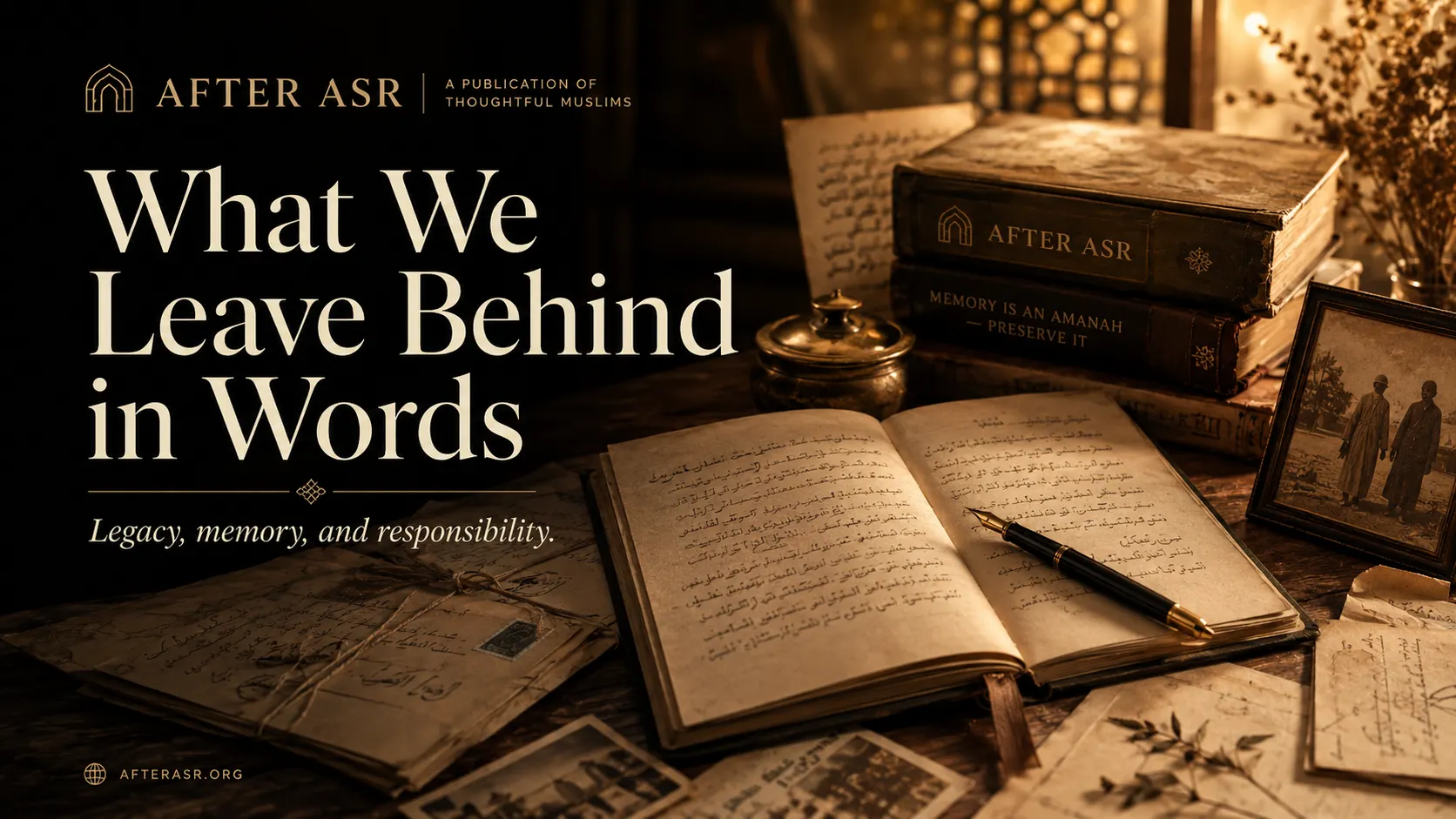
Legacy, memory, and responsibility.
Most of us will not leave behind monuments.
No statue. No archive named in our honor. No building with our initials carved above the entrance. No official biography waiting to be revised by scholars. Most lives pass through the world more quietly than that.
And yet nearly everyone leaves language behind.
A letter saved in a drawer. A birthday card someone cannot throw away. A message reread after a death. Notes in the margin of a book. A journal hidden under old papers. An email that captures tenderness more clearly than the sender realized. A prayer written during a frightened night. A story told often enough that children inherit its phrases even after forgetting who first spoke them. A novel, an essay, a poem, a public statement, a family history, a sentence offered at the right moment and remembered long after its speaker has gone.
Words outlive us unevenly. Some disappear instantly. Others remain because someone loved them, needed them, catalogued them, or found them later and understood that they held more than ink.
This is one reason documentary heritage matters. UNESCO’s Memory of the World programme is built on the conviction that written and recorded materials preserve human memory and must be protected against war, decay, neglect, and collective amnesia. In April 2025, UNESCO added 74 new documentary collections to its international register, bringing the total to 570. Such collections range from scientific records to women’s archives, from political documents to cultural materials, each preserved because words and records are among the ways civilizations remain knowable to those who come after.
But legacy in words is not only institutional. It is intimate before it is archival. Long before a manuscript enters a library, it matters because one person chose to keep it. A letter between siblings. A diary written by someone no historian expected to study. A bundle of recipes with remarks in the margins. A text thread saved after loss. These materials may seem small beside state papers or famous manuscripts, yet archives consistently treat letters, diaries, journals, correspondence, and personal papers as vital primary sources because they reveal lives from within, often preserving details absent from official records.
What we leave behind in words is therefore never merely literary. It is ethical.
Words can preserve love. They can preserve harm. They can clarify a life or distort it. They can bear witness, pass down prejudice, transmit courage, create confusion, heal a fracture, or freeze one person inside another person’s unfair account. They can survive their moment and enter futures we cannot control.
To write is to send something beyond the present. Even when we do not intend legacy, language may become one.
The responsibility begins there.
Legacy Is Not the Same as Fame
Modern culture often confuses legacy with recognition.
A legacy is imagined as public impact, name recognition, influence measurable at scale. Writers speak of leaving a mark. Leaders curate institutions. Artists hope their works endure. Public figures think about how history will judge them. These ambitions are not always vain. A life of real service may rightly hope to remain useful beyond death.
But most legacies are not famous. They are relational.
A grandmother’s written dua may matter more to her descendants than a celebrated book by an author they never read. A father’s letter of apology may reshape how his adult child remembers an entire relationship. A teacher’s handwritten note in the margin of a student’s work may survive in memory long after the paper is gone. A family memoir printed in twenty copies may alter the way three generations understand where they came from.
Legacy is not only about how many people remember. It is about what is handed forward.
The word itself once referred to a gift transmitted by will, and its broader cultural meaning still carries that older sense: a legacy is something received from those before us, whether material, moral, or intellectual.
Words become legacy when they remain available to shape someone else after we are no longer present to explain them. That can happen in a published book. It can happen in a note left on a kitchen table.
Fame magnifies reach. It does not determine worth.
The Future Reads Differently Than the Present
When we write, we often imagine immediate readers.
The person receiving the message. The audience of an article. The friend opening the card. The public responding to a post. We shape language toward the now because the now is what we can see.
But words that endure will be read by people living under conditions we cannot predict.
A diary written during an ordinary year may become precious because the world it recorded later vanished. A letter once considered private may help future historians understand migration, work, family structure, war, religious life, or domestic expectations in a particular era. A manuscript draft may reveal how a writer struggled toward a final form, allowing later readers to see that what appears inevitable in a finished work was once uncertain and revised. The Library of Congress and other archives maintain vast collections of personal papers precisely because correspondence, diaries, manuscripts, and notebooks preserve the developmental and lived textures that final public records often leave out.
This should make us humble.
A sentence we think insignificant may later be revealing. A sentence we think brilliant may not matter at all. Words escape the author’s control once they enter time. They may be read more generously than intended, more harshly than deserved, or in contexts impossible to anticipate.
The future is not obliged to read us as we hoped.
That is true for famous writers. It is true for ordinary people too. A private note discovered years later may help descendants understand a family tension differently. It may also wound them if it records contempt never confessed aloud. A digital post made casually may become one of the only surviving statements attached to a person’s name. A public essay may outlive the controversy that produced it and be judged by larger standards than the author imagined.
What we write belongs partly to the moment. It also begins moving beyond it.
The Personal Record Becomes Public Memory
One of the enduring surprises of archives is how often personal writing becomes historically indispensable.
Letters, diaries, and journals reveal what formal histories cannot. They tell us how people experienced events while they were still uncertain. They preserve daily life rather than hindsight. They show what someone noticed before later generations decided what “mattered.” They record ordinary time: illness, prices, weather, family quarrels, grief, hope, boredom, habits of speech. Researchers and archivists rely on such documents because they offer first-person accounts that complicate institutional narratives and illuminate lived experience.
A person writing a diary may not intend to preserve an era. They may be trying to endure a week. Yet the diary can become a window into a world.
This has implications for how we value seemingly modest writing. A person who records family stories, local customs, memories of a changing neighborhood, or the moral atmosphere of a community is not “just” writing for themselves. They may be preserving what no institution will otherwise think to save.
Not every notebook belongs in an archive. Not every private thought should be rescued for posterity. Privacy matters, and the dead should not be treated as though death cancels their right to dignity. But the broader point remains: ordinary words can acquire extraordinary significance when they become one of the few surviving traces of a life or world.
We do not always know which words will become records.
That uncertainty is part of their power.
To Write Is to Choose What Deserves Continuance
Every act of writing performs selection.
The world is larger than any page. To write one scene is to leave out others. To name one person is to let another remain unnamed. To record one family story is to decide, consciously or not, that this story should travel. Even a diary selects from the day. No account is total.
This is why writing carries responsibility. It does not merely reflect life. It shapes the fragment of life that may remain.
A memoirist decides whether to expose a relative’s failure. A journalist chooses whose quote receives prominence. A novelist based on community memory decides what emotional truth to foreground. A parent writing family history decides whether to pass down grievance, gratitude, or both. A community newsletter chooses which milestones count as communal memory. A writer preserving a language through fiction decides which words remain untranslated, which customs are explained, which rhythms of speech are allowed to stay visible.
Selection can be generous. It can also be unjust.
We may preserve what flatters us and omit what implicates us. We may memorialize achievements while burying apologies owed. We may record suffering in ways that magnify our role as witness rather than the dignity of those affected. We may leave descendants a family mythology more than a family memory.
The ethical question is not whether writing can ever be complete. It cannot. The question is whether our selections are guided by honesty.
What do we want to remain?
What are we tempted to erase?
Whose version of events have we centered because it is ours?
What would a more truthful account require?
These questions matter whether one is composing a book, writing an obituary, preserving a community archive, or drafting a letter a child may someday read.
Words Can Outlive Our Intentions
A remark made lightly can become heavy in memory.
Anyone who has lost someone knows this. After death, ordinary words change status. A voicemail once ignored becomes precious. A grocery list in familiar handwriting becomes unbearable. A teasing message acquires tenderness. A short apology may come to matter more than years of better-spoken conversations. Death reorganizes language.
The same is true, though less visibly, across history. Words detached from their original moment are reread under new conditions. A political speech may seem noble to one generation and evasive to another. A novel admired in its time may later be challenged for its exclusions. A private diary may reveal truths the author did not realize they were recording. A manuscript draft may show hesitation where the finished work displays confidence.
Legacy in words is therefore unstable. We cannot fully determine how our language will be understood after us. But we can influence what it offers. Precision, humility, and honesty travel better than performance. A sentence that admits uncertainty may age more honorably than one inflated by the need to sound absolute. A letter that refuses cruelty may remain healing. An account that distinguishes memory from fact may become more trustworthy with time.
Words outlive intention, but not all words age equally well.
The Responsibility of Not Writing Only for the Moment
Much contemporary language is produced for immediacy.
It is reactive, platform-shaped, optimized for attention, sharpened for quick circulation. There is a place for immediate speech. Crises require response. Public life needs timely argument. Social media has helped people witness events, organize communities, and challenge narratives that institutions preferred to control.
But writing entirely for the moment can become careless with the future.
A sentence formed only to win today’s applause may become embarrassing tomorrow. A public accusation made without enough evidence may continue harming someone long after the crowd has moved on. A clever insult may survive longer than the grievance that inspired it. An oversimplified post may be the version others later quote because it circulated widely, not because it was fair.
Writing with legacy in mind does not mean writing stiffly or solemnly. It means remembering that language can remain searchable, shareable, reproducible, and recoverable. Digital abundance has not made preservation automatic, but it has made many forms of public expression more durable and more easily detached from context than previous generations experienced. UNESCO and archival institutions now explicitly treat digital documentary heritage as something requiring preservation because online materials, like paper records, can shape future memory.
A responsible writer asks not only, “Does this work now?” but also, “Would I stand by this when the immediate heat has passed?”
The question does not eliminate risk. It deepens care.
Legacy Is Also What We Refuse to Leave
What we leave behind in words includes what we decide not to transmit.
A family may choose not to pass down a humiliating nickname. A writer may remove an unnecessary detail that exposes someone without clarifying the truth. An elder may tell a difficult history without teaching the next generation to inherit hatred. A community historian may document pain without embalming resentment as identity.
Silence is not always erasure. Sometimes it is mercy. Sometimes it is privacy. Sometimes it is the refusal to make another person’s worst moment their permanent public record.
The ethics of legacy therefore includes restraint.
Not every true thing must be written. Not every private confession should become literature. Not every wound should be handed forward in raw form. The fact that a story could survive does not mean it should. Responsibility lies in discerning whether words will preserve truth, perpetuate harm, or do both in a way that demands special caution.
This is especially important in memoir, testimony, family history, and writing about communities under pressure. The desire to “tell the truth” can become a justification for exposing others beyond what justice or care requires. Honesty without responsibility may wound the very people memory claims to honor.
What we leave behind matters.
What we spare others from inheriting matters too.
Writing as an Act of Moral Bequest
There are inheritances more important than property.
A person may leave descendants a clear account of where they came from. They may leave language for gratitude, repentance, or faith. They may leave a family memory corrected of falsehood. They may leave evidence that, in one difficult time, someone tried to see clearly and speak responsibly.
This is not grandiosity. It is stewardship.
A letter written to children for a future birthday. A memoir recorded for family rather than publication. A community oral history project. A poem written in a language grandchildren are still learning. A short essay about a neighborhood before redevelopment erases its character. These acts may never enter a national archive, but they bequeath more than information. They pass forward a way of attending.
The archive of humanity is built partly from famous works and partly from ordinary people deciding that something should not disappear.
Databases such as Letters and Diaries Online and the manuscript holdings of major libraries demonstrate the historical value of private writings from both prominent and ordinary lives. They remind us that personal documents often become collective memory once time has revealed what they preserve.
To write with care is to offer the future more than data. It is to offer a trace of consciousness.
The Writer Does Not Control Legacy, but Shapes It
No writer can command remembrance.
Some great books vanish for centuries and return. Some celebrated authors fade. Some humble documents become indispensable. Some sentences intended as permanent truths become curiosities. Some private words unexpectedly outlive public works.
Legacy is not fully ours to manage.
Yet this does not make responsibility meaningless. Farmers cannot control every season, but they still decide what to plant. Writers cannot govern posterity, but they can govern integrity in the present. They can choose not to flatter themselves in every account. They can avoid leaving behind unnecessary cruelty. They can preserve voices besides their own. They can write carefully enough that future readers encounter something more substantial than ego.
A legacy in words is not guaranteed by ambition. It is dignified by truthfulness.
The Dead Continue Speaking, but Not Always Clearly
When words survive their authors, the dead become partially audible.
We read their diaries, letters, essays, testimonies, books, and drafts. We infer hopes, contradictions, blind spots, and care. The newly unsealed archives of figures such as Victorian writer Amy Levy continue to reshape how later generations understand both the writer and the world around her, offering letters, manuscripts, photographs, and diaries that complicate the public memory of a life once read too narrowly.
Yet posthumous words are not total access. They do not give us the whole person. A diary may reveal and conceal. A public essay may reflect conviction, performance, or both. Letters vary according to recipient. Archives are partial. Silence remains.
This should restrain the arrogance of later judgment. We should learn from what remains without pretending it is everything. We should read the dead with gratitude and caution. Their words are evidence, not omniscience.
The same will be true of us.
If any of our language survives, it will not contain our whole lives. It will contain fragments. Let those fragments be worthy.
A Muslim Sensibility Toward What Remains
For Muslim readers, legacy in words sits within a larger moral horizon.
Islam teaches that speech is accountable. Words are not weightless. The Qur’an states that no utterance is spoken except that a watcher is ready to record it, a verse that has long shaped Muslim consciousness about the seriousness of speech. (quran.com)
That teaching concerns divine accountability, not literary reputation. Yet it casts light on the ethical significance of what we say and write. Words matter even before they become legacy. They matter because they arise from intention, affect others, and enter a moral record beyond human applause.
There is also a quieter, deeply moving Islamic dimension to legacy: beneficial knowledge. The well-known prophetic teaching that a person’s deeds cease at death except for ongoing charity, beneficial knowledge, and a righteous child who prays for them has encouraged generations of Muslims to think about what remains useful after one is gone. Writing is not automatically beneficial knowledge. Much writing is not. But truthful teaching, careful preservation, sound reflection, and language that helps others understand what is good may participate in that larger aspiration.
A Muslim writer, teacher, parent, or community member might therefore ask: what will my words continue doing when I am absent? Will they mislead? Humiliate? Clarify? Comfort? Preserve? Encourage reverence? Hand forward confusion? Make someone more honest? Give a child language for gratitude? Help a community remember itself with greater truth?
Legacy is not only a literary concern. It is a spiritual one.
The Small Words That Remain
Not every enduring word announces itself as important.
Sometimes legacy is a phrase one family repeats because someone beloved always said it. Sometimes it is a line in the margin of a book: Do not rush this chapter. Sometimes it is a recipe with corrections. Sometimes it is an old email ending, I am proud of you. Sometimes it is a community newsletter saved by accident that later becomes one of the few records of a mosque’s earliest years. Sometimes it is a poem written by a teenager that no one reads until long afterward, when it reveals a tenderness their family did not know how to see at the time.
These words matter because human beings do not live only in public history. They live in trace. In gesture. In phrase. In fragments that remain charged because someone once meant them.
We should not become so obsessed with leaving a legacy that we begin manufacturing ourselves for future admiration. That is another vanity. But neither should we treat language casually because most of it will disappear. The words that survive may not be the ones we predict. Better, then, to write and speak in ways we would not be ashamed to have remain.
What We Leave Behind
In the end, what we leave behind in words is not merely content.
We leave habits of attention.
We leave moral atmospheres.
We leave examples of how to describe others.
We leave records of what we considered worth noticing.
We leave evidence of whether we exaggerated, concealed, apologized, blessed, mocked, clarified, or preserved.
We leave, sometimes, a trail by which those after us may find a fuller account of who we were and what mattered around us.
The most responsible legacy is not a polished self-portrait. It is a truthful offering.
Let later readers discover that we tried to name things carefully. That we did not treat language as disposable. That we understood memory to be a trust. That when something precious seemed likely to vanish, we made room for it in words.
We cannot ensure permanence.
We can leave something worthy of being kept.