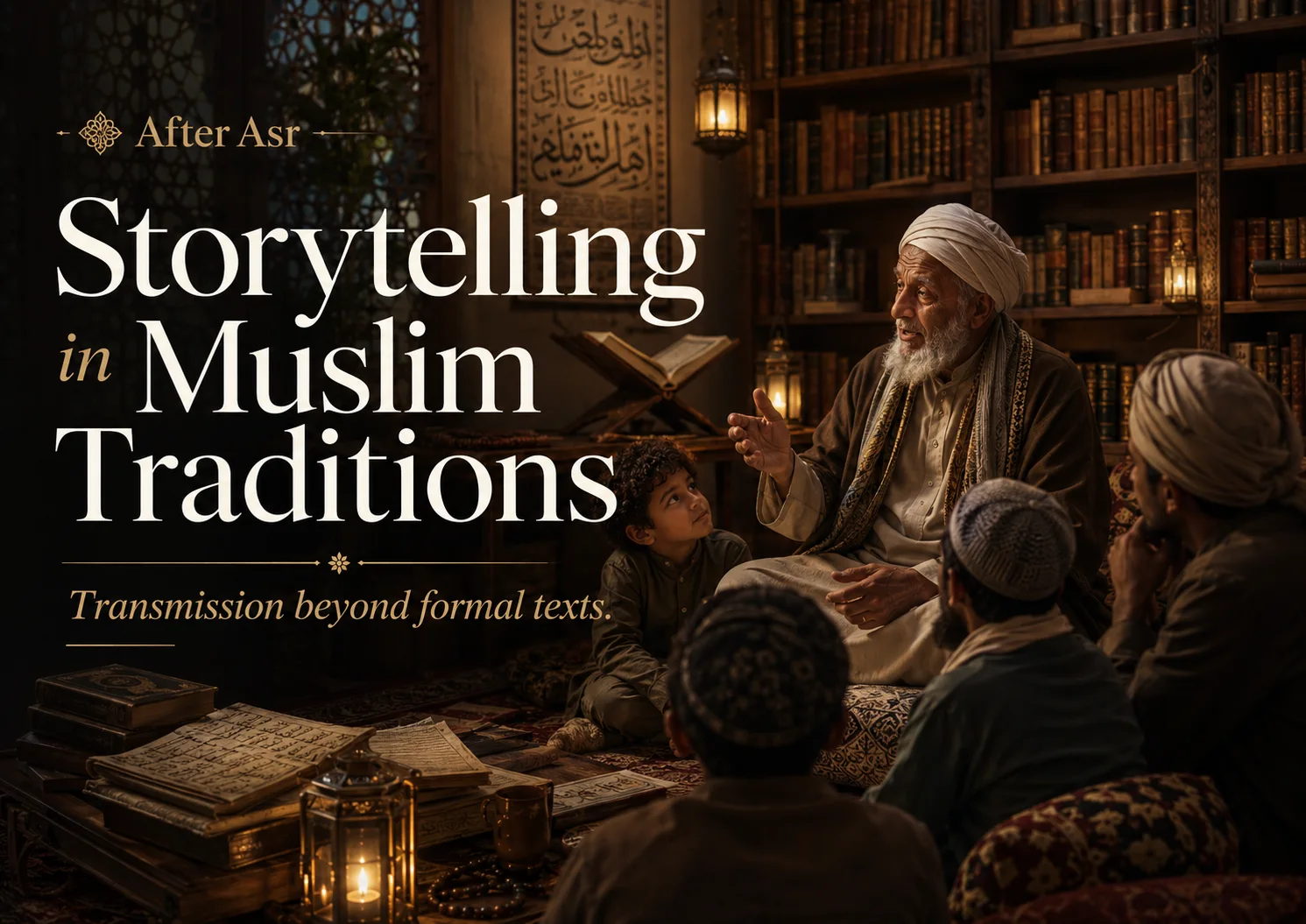
Transmission beyond formal texts.
Not everything a community knows is kept in books.
Some knowledge is carried in a voice. Some is folded into a family story repeated after dinner until the children can recite the punchline before the elder reaches it. Some is preserved in the cadence of a khutbah, the memory of a teacher’s example, a proverb that arrives at exactly the right moment, a wedding song, a travel account, a poem recited by heart, a story told about a scholar, a saint, a neighbor, a ruler, a fool, or a stranger whose brief appearance becomes a lesson.
Muslim civilizations have produced vast formal texts: Qur’anic commentaries, hadith collections, legal manuals, theological treatises, chronicles, biographies, dictionaries, poetry anthologies, philosophical works, travel narratives, and adab compilations. These texts matter profoundly. They preserve precision, discipline inquiry, transmit knowledge, and allow later generations to check memory against record.
But Muslim life has never been transmitted only through formal texts.
It has also moved through storytelling.
This does not mean every story told in Muslim communities carries religious authority. Many do not. Some are exaggerated, local, humorous, folkloric, legendary, contested, or plainly invented. Storytelling is not scholarship by another name. It should not be confused with hadith authentication, legal reasoning, or Qur’anic interpretation. A community that forgets this distinction risks mistaking charm for proof.
Yet a community that dismisses storytelling entirely misunderstands how human beings actually inherit meaning.
Formal knowledge may tell us what a virtue is. Storytelling shows us how it appears in a kitchen, a marketplace, a court, a desert road, a mosque courtyard, a child’s embarrassment, a traveler’s fear, an old woman’s generosity, or a ruler’s arrogance. It gives moral life a human body. It translates principles into scenes that can be remembered.
In Muslim traditions, storytelling has carried memory, etiquette, warning, humor, longing, devotion, and cultural identity across distances that no syllabus alone could cover. It has helped communities remember not only what they believe, but what those beliefs feel like when lived.
The Qur’an and the Seriousness of Story
Any Muslim reflection on storytelling must begin carefully.
The Qur’an is not folklore, myth, legend, or literature in the ordinary sense. For Muslims, it is revelation. Its stories are not entertainment offered for cultural color. They are guidance, warning, mercy, and moral instruction. Surah Yusuf closes by saying that in the stories of earlier peoples there is “a lesson for people of reason,” and that the message is not a fabricated tale but guidance and mercy for believers.
That verse establishes an important principle: narrative can be a vehicle of serious truth.
The Qur’an teaches through command and prohibition, but also through story. It gives scenes of pride, patience, betrayal, repentance, arrogance, family conflict, political power, prophetic endurance, and divine mercy. It does not treat human beings as abstract moral machines. It addresses them through memory, image, dialogue, reversal, fear, hope, and recognition.
This matters because some modern readers are tempted to divide truth from story too sharply. They imagine that serious knowledge must be propositional, while stories merely decorate. The Qur’an itself resists such simplification. It does not reduce guidance to narrative, but it also does not treat narrative as secondary ornament.
A story can make a truth unforgettable.
The account of Yusuf عليه السلام does not merely inform the reader that jealousy harms families, that patience matters, or that God’s wisdom may unfold beyond visible circumstances. It makes the reader live through betrayal, separation, temptation, imprisonment, recognition, and forgiveness. The lesson emerges through time. That is part of its force.
Muslim storytelling beyond the Qur’an must never claim the Qur’an’s authority. But it often draws from this wider recognition: human beings learn deeply through stories because stories join meaning to memory.
Islam Was Heard Before It Was Shelved
Muslim tradition is inseparable from orality.
The Qur’an itself means recitation, and Qur’anic recitation remains central to Muslim devotional life. Frederick Mathewson Denny’s study of Qur’an recitation describes oral performance as being at the center of Islamic individual and communal piety, noting its presence in daily prayer, Ramadan nights, mosque gatherings, schools, weddings, funerals, and many other occasions.
This is crucial. Islam was not first encountered by most Muslims as a silent printed page. It was heard. Recited. Memorized. Repeated. Corrected by teachers. Carried in the chest. Experienced through sound before analysis and often alongside it.
The science of tajwid, the care of recitation, the practice of memorization, and the communal experience of listening all shaped Muslim consciousness. A child may not understand every Arabic word they hear in tarawih, yet the sound becomes part of the architecture of faith. A convert may first be moved by recitation before studying grammar or tafsir. An elder may carry portions of Qur’an through memory long after eyesight weakens.
This oral environment shaped other forms of transmission too. Stories of prophets, companions, scholars, righteous people, rulers, poets, travelers, and ordinary believers circulated in sermons, lessons, family gatherings, poetry sessions, and public assemblies. The written and the spoken were not enemies. They fed one another.
A formal book preserved material. A teacher animated it. A storyteller localized it. A family remembered it. A community passed it on.
Adab and the Link Between Literature and Conduct
The Arabic term adab reveals something important about Muslim literary culture.
Today, adab is often translated as literature. Historically, however, its earlier meaning was connected to conduct, custom, courtesy, refinement, and good breeding. Britannica notes that adab evolved from an original sense of “norm of conduct” into a literary genre marked by broad humanitarian concerns, especially during the Abbasid period and through the medieval Islamic world.
This matters because it shows that literature and moral formation were not always sharply separated.
Adab works often gathered poetry, anecdotes, wise sayings, history, biography, humor, counsel, and refined expression. They were not merely collections of beautiful language. They formed taste, manners, judgment, and social intelligence. In premodern Arabic heritage, “literature” included what modern categories might divide into biography, history, ethics, witty anecdote, and cultivated prose. Britannica specifically notes that premodern Arabic literature was not restricted to belles lettres alone, but also included biography and history within the wider phenomenon of adab.
This is storytelling beyond formal texts in a sophisticated sense. Anecdotes were not always treated as casual amusements. A brief story could reveal generosity, foolishness, arrogance, eloquence, hypocrisy, patience, or political wisdom. A story about a miser could teach more memorably than an abstract lecture on greed. A tale of escape after hardship could steady a person living through difficulty. A witty exchange could train the ear in language and the mind in proportion.
Adab reminds us that Muslim storytelling has often been both pleasurable and formative. It did not always announce itself as moral instruction. It refined through delight.
The Majlis as a School of Memory
Storytelling requires a setting.
In Muslim societies, the majlis, the gathering, has often served as more than social space. It is where knowledge is heard, news is exchanged, poetry is recited, disputes are softened, elders speak, guests are honored, and collective memory is kept alive. The particular forms differ across regions, languages, classes, and centuries, but the underlying pattern is recognizable: people gather, and meaning circulates through speech.
In such spaces, storytelling does work no formal text can do alone.
A scholar may tell a story to clarify a legal or ethical principle. A parent may recount how their own parent endured hardship. A traveler may describe a distant land and expand the listeners’ sense of the ummah. An imam may tell a carefully chosen story in a khutbah, making an abstract warning suddenly visible. A host may repeat an old anecdote about hospitality at the exact moment a guest feels awkward. A grandmother may explain Ramadan not through doctrine, but through remembered hunger, lanterns, neighbors, and the smell of food before Maghrib.
These moments may never be footnoted. Yet they transmit a worldview.
They teach what is admired. They teach what is shameful. They teach how communities remember themselves. They reveal the emotional texture of obligations that might otherwise appear dry: honoring parents, feeding guests, guarding speech, resisting arrogance, showing patience, forgiving without becoming foolish.
The majlis keeps knowledge social. It reminds us that meaning is not only stored. It is performed, embodied, corrected, and received in relationship.
Stories of Scholars and Saints
Many Muslim communities carry stories about scholars, righteous people, and saints.
Some are historically documented. Others are devotional anecdotes whose exact factual status may be uncertain. Some belong to Sufi teaching traditions. Others circulate informally in families or local communities. They may describe a scholar’s humility, a saint’s generosity, a student’s discipline, a ruler’s arrogance corrected by a pious voice, or a poor person whose sincerity exposes the emptiness of prestige.
These stories must be handled carefully. Not every beloved anecdote should be treated as verified history. Muslim intellectual tradition has long developed methods for evaluating reports, especially in hadith and legal contexts. That seriousness should not be abandoned simply because a story is moving.
But it is also worth asking why such stories endure.
They endure because people need virtue in narrative form. A community may affirm humility, but a story of a great scholar carrying someone’s shoes lodges differently in memory. A sermon may condemn arrogance, but an anecdote about a ruler humiliated by a poor believer can travel for generations. A teacher may speak about sincerity, but a story of hidden charity gives sincerity a shape.
The best of these stories do not replace scholarship. They humanize aspiration. They show that knowledge without character is incomplete, and that holiness is not always visible in the ways prestige expects.
The danger comes when stories become tools of manipulation, personality cults, or anti-intellectual shortcuts. A community that loves righteous anecdotes should also love verification, proportion, and humility about what it does not know.
Poetry as Communal Transmission
Poetry has held a special place in many Muslim cultures.
Arabic poetry predates Islam and remained central to Arab literary identity. Persian, Turkish, Urdu, Malay, Swahili, Bosnian, Hausa, Bengali, and many other Muslim literary worlds developed their own poetic forms, devotional vocabularies, and public traditions. Poetry carried praise, satire, grief, longing, theology, courtly culture, spiritual yearning, love, politics, and communal memory.
Some poetry was written and studied. Much was also recited, sung, memorized, and passed through performance.
In this sense, poetry acted as compressed storytelling. A qasida could preserve tribal memory, praise the Prophet ﷺ, lament loss, or teach spiritual longing through images that communities carried by heart. A couplet could become a proverb. A devotional poem could travel beyond literacy, entering ceremonies, gatherings, homes, and mosques. A verse learned in youth might return in old age with new meaning.
This oral-poetic dimension matters because it resists a narrow definition of transmission as formal instruction. A community may learn reverence not only through a textbook, but through the repeated beauty of praise. It may learn grief through elegy. It may learn the instability of worldly status through satirical or ascetic verse.
Poetry does not always teach by explaining. It teaches by becoming memorable.
Travel, Hajj, and the Stories of Elsewhere
The Muslim world has long been shaped by travel.
Pilgrimage, trade, scholarship, migration, diplomacy, and exile all produced stories of elsewhere. Britannica notes that the obligation of hajj helped inspire travel narrative in Arabic literature, a genre for which Arabs became especially known.
Travel stories widened Muslim imagination. They allowed listeners and readers to imagine other cities, schools, mosques, marketplaces, rulers, landscapes, customs, and scholarly circles. They connected local communities to a larger world. They made the ummah more than a concept. It became a series of roads, ports, inns, mosques, teachers, languages, and faces.
A traveler returning from hajj did not bring back only legal information about the rites. They brought memory: the crowd, the exhaustion, the awe, the generosity of strangers, the strangeness of hearing so many languages joined by worship. Such stories could shape a community’s sense of belonging to something vast.
Travel narratives also carried comparison. They allowed Muslims to see their own customs in relation to others. They preserved details of cities and practices that later changed. They became archives of movement, curiosity, and encounter.
Storytelling here did not only transmit information. It transmitted scale.
Family Stories as Islamic Inheritance
Not all Muslim storytelling is grand.
Some of the most formative stories are family stories.
A mother tells her child how their grandfather learned to pray after years of neglect. An uncle recounts the first Eid after migration. A grandmother remembers hiding Qur’an pages during political repression. A father tells the story of a neighbor who fed his family when money ran out. A convert tells their children about the first time they heard the adhan and felt addressed by something they did not yet understand.
These stories may never enter a formal archive. Yet they shape religious identity in intimate ways.
They connect Islam to the family’s own history. They teach children that faith is not merely a set of external duties, but something carried through choices, mistakes, risks, sacrifices, and returns. They give moral vocabulary to ordinary life. “Your grandmother never let a guest leave hungry” may teach hospitality more deeply than a rule stated without memory.
Family stories also carry pain. They may preserve displacement, racism, poverty, divorce, war, conversion, estrangement, or spiritual struggle. Told carefully, they help later generations understand what they inherited. Told carelessly, they can become burdens, resentments, or myths that trap a family inside a single version of itself.
The ethics of family storytelling therefore matter. Children deserve inheritance, but not manipulation. They deserve roots, but not bitterness disguised as history. They deserve to know sacrifice, but not be made to repay every wound.
Humor as Moral Memory
Muslim storytelling has never been only solemn.
Humor has long served as a vehicle of social intelligence. Jokes about misers, fools, pompous officials, literal-minded students, boastful poets, or overly dramatic relatives do more than entertain. They reveal communal standards. They teach what is ridiculous, what is excessive, what is hypocritical, what deserves gentle correction.
Adab literature frequently includes anecdote, wit, and comic reversal. Britannica notes the importance of anecdotal narrative within Arabic literary compilations and identifies figures such as al-Jahiz, known for works on subjects including animals and misers, within this broader literary culture.
Humor can be cruel, and Muslim ethics of speech place limits on mockery, slander, and humiliation. But humor can also protect communities from self-importance. It can puncture arrogance without requiring a lecture. It can correct gently where direct confrontation would harden the listener.
A story about a pompous man exposed by a child may travel because people recognize both the pompous man and themselves. A joke about someone misunderstanding a proverb may teach linguistic care. A comic tale of someone trying to appear pious while failing basic decency can warn a community against performance.
Sometimes laughter carries the lesson farther than severity could.
Storytelling and the Transmission of Adab
Muslim traditions often care not only about what is known, but about how a person carries knowledge.
Adab, in the sense of manners, comportment, and cultivated refinement, is difficult to teach through rules alone. A list can say: honor your teacher, do not interrupt, speak truthfully, serve guests, avoid arrogance, lower your voice, keep trust, show mercy. These commands matter. But adab becomes livable when people see it enacted.
Stories do that.
A teacher tells of a student who waited years before asking a question because the time was not right. An elder tells of someone who apologized publicly after correcting a person harshly. A preacher recounts a moment when a poor person’s dignity was preserved by subtle generosity. These stories teach not only the action, but the texture of the action: timing, tone, restraint, intention.
This is why storytelling has moral force. It teaches proportion.
Rules can tell a person to be generous. Stories can teach that generosity should not humiliate. Rules can teach truthfulness. Stories can show that truth spoken with arrogance can become another wound. Rules can teach patience. Stories can reveal the difference between patience and passivity.
Formal instruction gives structure. Story gives social and emotional intelligence.
The Danger of Unverified Stories
A serious article on Muslim storytelling must acknowledge a major danger: stories can mislead.
A moving anecdote may be historically false. A popular story about the Prophet ﷺ, a companion, or a scholar may circulate without reliable basis. A fabricated story may become beloved because it confirms what listeners want to believe. A preacher may choose emotional impact over accuracy. A community may prefer legends that flatter its identity.
This is not a small matter.
Islamic tradition places great importance on truthfulness in transmission, especially concerning the Prophet ﷺ and religious claims. While not every family story or moral fable requires the same evidentiary standard as hadith, Muslims should be careful not to present unverified stories as authoritative proof.
There is room for parable, folklore, and moral anecdote when properly framed. A person may say, “There is a story told…” or “This tale illustrates…” without claiming historical certainty. The problem arises when emotional usefulness is treated as sufficient evidence.
A beautiful story can still be false.
A useful lesson can still be attached to a report that should not be attributed.
A community can love a tale and still need to correct how it uses it.
Respect for storytelling requires respect for truth. Otherwise transmission becomes sentimental corruption.
Women as Keepers of Story
Many formal histories have centered rulers, scholars, battles, institutions, and public men. Yet much communal memory has been carried by women in homes, courtyards, kitchens, weddings, funerals, children’s bedrooms, and family gatherings.
This is not to romanticize domestic labor or confine women to private memory. Muslim women have also been scholars, poets, transmitters of hadith, patrons, teachers, writers, and public figures. But it is important to recognize that informal storytelling has often preserved forms of knowledge that formal histories neglected.
Women remembered births, marriages, migrations, recipes, kinship lines, conflicts, reconciliations, illnesses, generosity, betrayals, and the emotional histories of families. They transmitted duas, lullabies, etiquette, warnings, proverbs, and accounts of how faith was practiced under ordinary pressure.
A community that records only formal male-centered history may miss the stories through which Islam was made daily, practical, and emotionally intelligible to generations.
The grandmother telling a child why they should not waste bread is not merely managing behavior. She may be preserving memories of hunger, gratitude, and divine provision. The aunt explaining how Eid was celebrated before migration is not merely reminiscing. She is keeping a cultural form alive. The mother recounting her first Ramadan after marriage may be transmitting resilience, humor, and adaptation.
Informal does not mean insignificant.
Storytelling Across Languages
Muslim storytelling has never belonged to one language alone.
Arabic holds a unique place because of the Qur’an and the centrality of Arabic in Islamic learning. But Muslim narrative traditions have flourished in Persian, Turkish, Urdu, Bengali, Malay, Indonesian, Hausa, Swahili, Bosnian, Kurdish, Somali, English, French, and many other languages. Each language carries its own metaphors, humor, rhythms, and emotional registers.
This multilingual reality complicates any simplistic account of “Islamic storytelling.” There is no single style. A Malay hikayat, a Persian masnavi, an Urdu dastan, an Arabic maqamah, a West African praise poem, and a Bosnian family memory may all participate in Muslim cultural worlds without sounding alike.
Translation helps these stories travel, but not without change. A proverb may lose its bite. A joke may require explanation. A phrase of religious tenderness may sound too formal in English. Yet the effort matters because translation allows Muslim communities to encounter one another beyond national and linguistic borders.
Stories become bridges within the ummah as well as beyond it.
Modern Media and Old Functions
Today, Muslim storytelling moves through podcasts, documentaries, children’s books, spoken word, social media threads, YouTube lectures, memoirs, novels, short films, newsletters, and community archives. The forms have changed. The functions remain familiar.
A podcast episode may do what an old majlis did: gather listeners around memory, advice, humor, and moral reflection. A children’s picture book may transmit prophetic stories in age-appropriate form. A documentary may preserve community testimony. A Ramadan short video may retell an ethical lesson once shared in a khutbah. A social media post may carry a family memory across continents in minutes.
The speed and reach of modern media bring opportunity and danger.
Good stories can travel farther than ever. So can weak, false, manipulative, or sensational ones. The old ethics of storytelling are therefore more important, not less. Is the story true? If not historically verified, is it clearly framed as illustrative? Does it honor the people described? Does it deepen faith, wisdom, compassion, and responsibility, or merely provoke emotion? Does it preserve dignity?
Technology changes the vessel. It does not remove the moral weight of transmission.
What Storytelling Carries That Formal Texts Cannot
Formal texts are necessary. They preserve knowledge with structure. They allow arguments to be examined. They discipline memory. They protect communities from drift.
But storytelling carries other things.
It carries tone.
It carries warmth.
It carries timing.
It carries the human face of a principle.
It carries local memory.
It carries humor.
It carries the atmosphere of a community.
It carries the difference between knowing a virtue and wanting to live it.
A legal text may define rights and duties. A story may show why they matter. A theological text may clarify belief. A story may reveal how belief steadies a person in fear. A history may record a migration. A family story may preserve what migration cost. A biography may document a scholar’s work. An anecdote may reveal their humility.
The serious Muslim reader should not place story against scholarship. The healthier relationship is partnership. Scholarship tests, clarifies, and preserves. Story animates, carries, and embeds. One without the other can become dry or careless.
The Trust of Transmission
Every community is always telling itself stories.
Some stories are true. Some are false. Some are useful but incomplete. Some heal. Some harden resentment. Some preserve dignity. Some flatter. Some invite repentance. Some excuse harm. Some make the next generation larger in spirit. Some make it afraid.
Muslim storytelling deserves attention because it is one of the ways faith and culture become livable across time. It is how children learn that Islam is not only something written in books, but something people endured for, laughed within, struggled with, and carried into kitchens, ships, deserts, schools, prisons, marketplaces, and homes.
But the trust is serious.
We should tell stories beautifully, but not falsely. Tenderly, but not sentimentally. Proudly, but not arrogantly. Critically, but not with contempt for those who came before us. We should preserve what deserves preservation and correct what has been distorted. We should let stories open the heart without allowing them to replace disciplined knowledge.
Transmission beyond formal texts is not lesser transmission.
It is the human road by which much of what we know becomes unforgettable.